Unlocking the business value of sustainability

The Sustainability Fusion framework for evaluating your ROI

Most leaders agree that sustainability is important, but communicating those benefits in financial terms can create a disconnect. It’s in this translation gap that credible projects often stall. To help navigate this challenge, in collaboration with the Aspen Institute Business & Society Program and its network of sustainability and finance leaders, Deloitte created a valuation framework that can help bridge this divide. Read on to learn how it can help you quantify the business case for sustainability in financial terms so you can drive meaningful sustainable value.

Key takeaways

  • A "translation gap" often exists between sustainability and finance teams. This can cause credible investments to be undervalued when each team uses different language and metrics to define success.
  • Anchoring valuation of sustainability investments in tax-adjusted cash flow (TACF) provides a decision-useful metric that connects directly to enterprise value and existing financial processes.
  • Deloitte’s Sustainability Fusion framework organizes valuation into three distinct layers: identifying the Value Category, defining the Value Levers (both quantifiable and directional), and measuring specific Value Dimensions.
  • The framework provides organizations with a clear, financially grounded way to document and explain how sustainability investments generate and protect value across both costs and revenues.

Why is a value framework needed?

Our guide to building a better business case for sustainability.

Determine the business case for sustainability

Many existing sustainability and reporting frameworks have introduced a distinct language and analytical paradigm that differs from the frameworks commonly used by finance and investment teams. This separation can create friction.

Sustainability leaders cite challenges such as a difficulty expressing value in financial terms, inconsistent evaluation of diverse sustainability projects, and pressure from CFOs for clearer cash-flow narratives.

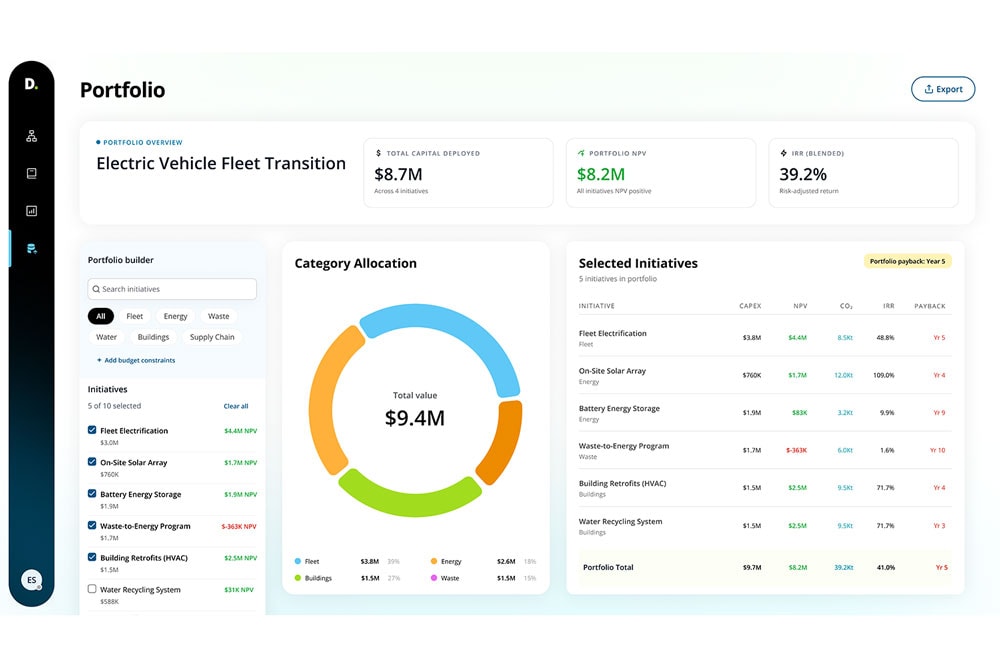
Finance leaders, meanwhile, look for approaches that allow ‘apples-to-apples’ comparison across projects, anchor on the core drivers—cost, revenue, and risk—and avoid speculative or inflated metrics.

Building value on cash flow

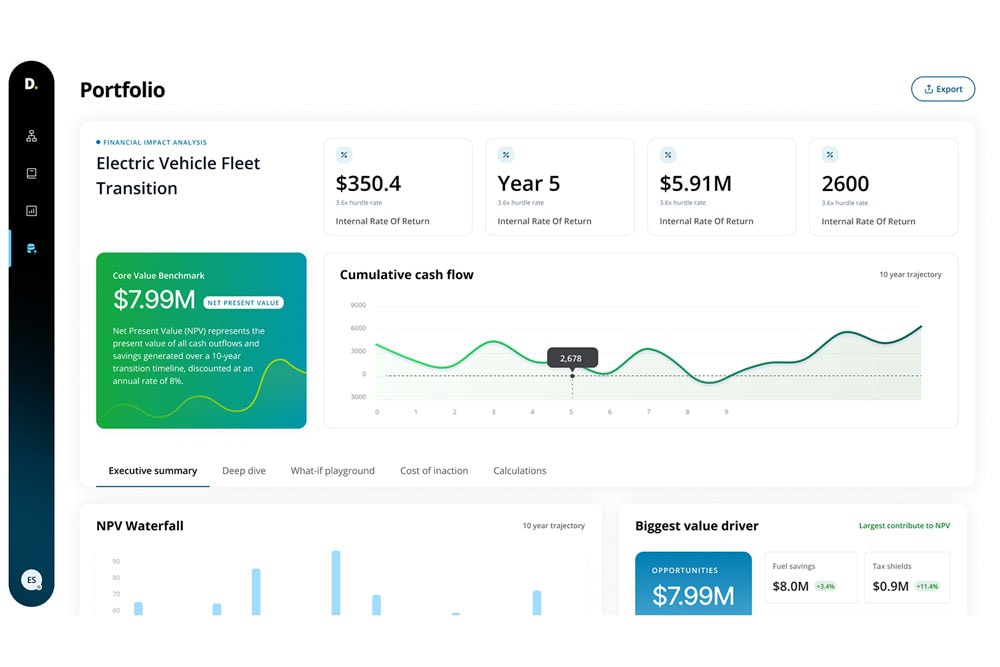
We chose tax-adjusted cash flow (TACF) as a credible and decision-useful metric for expressing business value. Cash flow is foundational because it connects directly to enterprise value, uses financial data organizations already track, and integrates with existing finance and capital-allocation processes.

Incorporating tax effects can improve decision quality because sustainability projects often involve capital investments, depreciation, tax credits, and incentives that materially affect economics. 

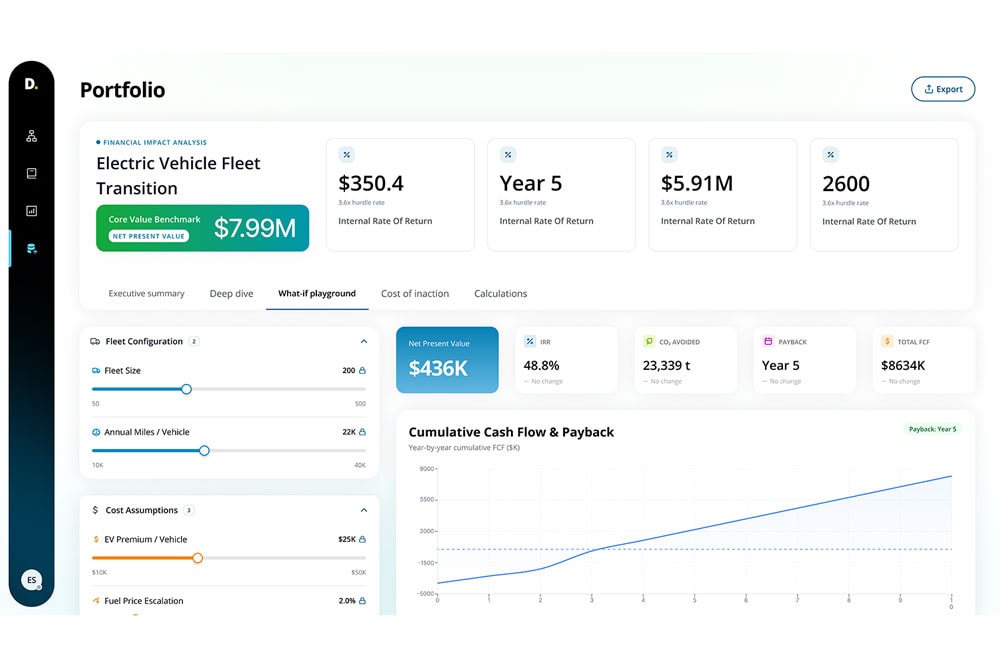
In cases where value components are difficult to express as precise cash flow amounts, the Sustainability Fusion framework treats such impacts as directional levers—explicitly acknowledging the scale of influence on cash flows without estimating a dollar value. 

A three-layer approach to sustainability performance measurement

Fusion evaluates sustainability investments through three layers, each increasing in specificity and precision.

Sustainability investments impact one of two financial drivers—cost or revenue—and focus on one of two outcomes—return or risk. Combining these perspectives yields four Value Categories: cost reduced, cost avoided, revenue generated, and revenue protected. Each sustainability investment has a dominant Value Category, and they support storytelling by clearly identifying what is truly driving an investment decision.

Value Levers indicate the way in which a Value Category (layer 1) is achieved. They are the individual drivers that form the explanatory bridge between the investment and its financial outcomes, and are often the most valuable part of the framework for cross-functional alignment.

Layer 3 translates each Value Lever into a measurable business impact by defining how much value is created and over what timeframe. Fusion navigates this by supporting two approaches for measuring Value Levers: a quantifiable approach when input parameters can be reliably estimated, and a directional approach when the direction of value is clear, but the actual value is not.

Too often, sustainability investment decisions stall due to unclear business logic. Sustainability Fusion can bring consistency and credibility to those decisions by anchoring them in tax-adjusted cash flow—demonstrating how investments can create return and mitigate risk. Most importantly, it can help you power and release the business value inherent in sustainability.

Learn even more about how to build a stronger business case for sustainability in our full report.

Did you find this useful?

Thanks for your feedback