
North American CFOs cite AI cost-governance gaps in third-quarter 2026 survey
Most respondents to Deloitte’s latest CFO Signals Survey say their organizations would need several business days or longer to pause AI use if costs exceeded approved limits
As organizations scale artificial intelligence across the enterprise, finance leaders are being asked to approve increasingly significant investments while managing costs that can be volatile, difficult to forecast, and challenging to control. New findings indicate that many organizations could benefit from greater real-time visibility, advanced AI-specific controls, and rapid-response capabilities to manage spending effectively once these technologies go live. For chief financial officers, the challenge is no longer simply deciding what to fund; it is building the cost governance and discipline important to scaling AI responsibly.
These insights come from Deloitte’s third-quarter 2026 CFO Signals Survey, which polls 200 CFOs from North American organizations with annual revenues of at least US$1 billion each quarter. The survey findings align with the Deloitte Finance Trends 2027 research, which found that many finance leaders are taking on expanded responsibilities for AI trust, capital allocation, and cost management. With leaders in the Trends report anticipating greater cost and complexity through 2027, finance organizations may need to increase the sophistication of their approaches to AI cost governance.
AI cost volatility can undermine CFO coordination
Nearly 80% of respondents to the CFO Signals Survey indicate that finance has a formal role in their organizations’ AI-related decisions, with 38% defining or administering the evaluation framework and 41% serving as required approvers. That compares with 20% who provide just cost, budget, or accounting guidance but do not shape the decision. For many, these are relatively new responsibilities. The Finance Trends research found that more than two-thirds of leaders who oversee AI trust, capital allocation, or cost management took on an owner or approver role within the past three years.
The criticality of AI cost governance and controls is clear. For decades, organizations operated in a seat-based software world built around purchasing licenses, deploying tools, and measuring adoption. Higher usage typically signaled success because costs remained relatively predictable regardless of how often employees used the technology.
Now, however, commercial AI providers are more commonly charging per token rather than per user seat or at flat rates, and AI bills can spike quickly due to large context windows or long conversation loops. As a result, finance organizations often find themselves under pressure to justify the business value of token use. Given the potential for variable billing and rapidly increasing costs, a strong case can be made for greater investment discipline with “tokenomics”—the financial practice of measuring, pricing, and optimizing the consumption of tokens.
Many organizations are managing AI costs reactively
Survey results indicate that many organizations tend to evaluate AI spending reactively instead of proactively. When the cost of using AI technologies and services are reviewed, a little over half of survey respondents (53%) say their organizations’ primary practice is to review AI usage costs retrospectively through vendor bills, periodic reports, dashboards, or manual analysis. Fewer respondents (47%) monitor AI usage costs in or close to real time and actively manage deviations using alerts, dashboards, spending anomaly reviews, or budget forecasts.
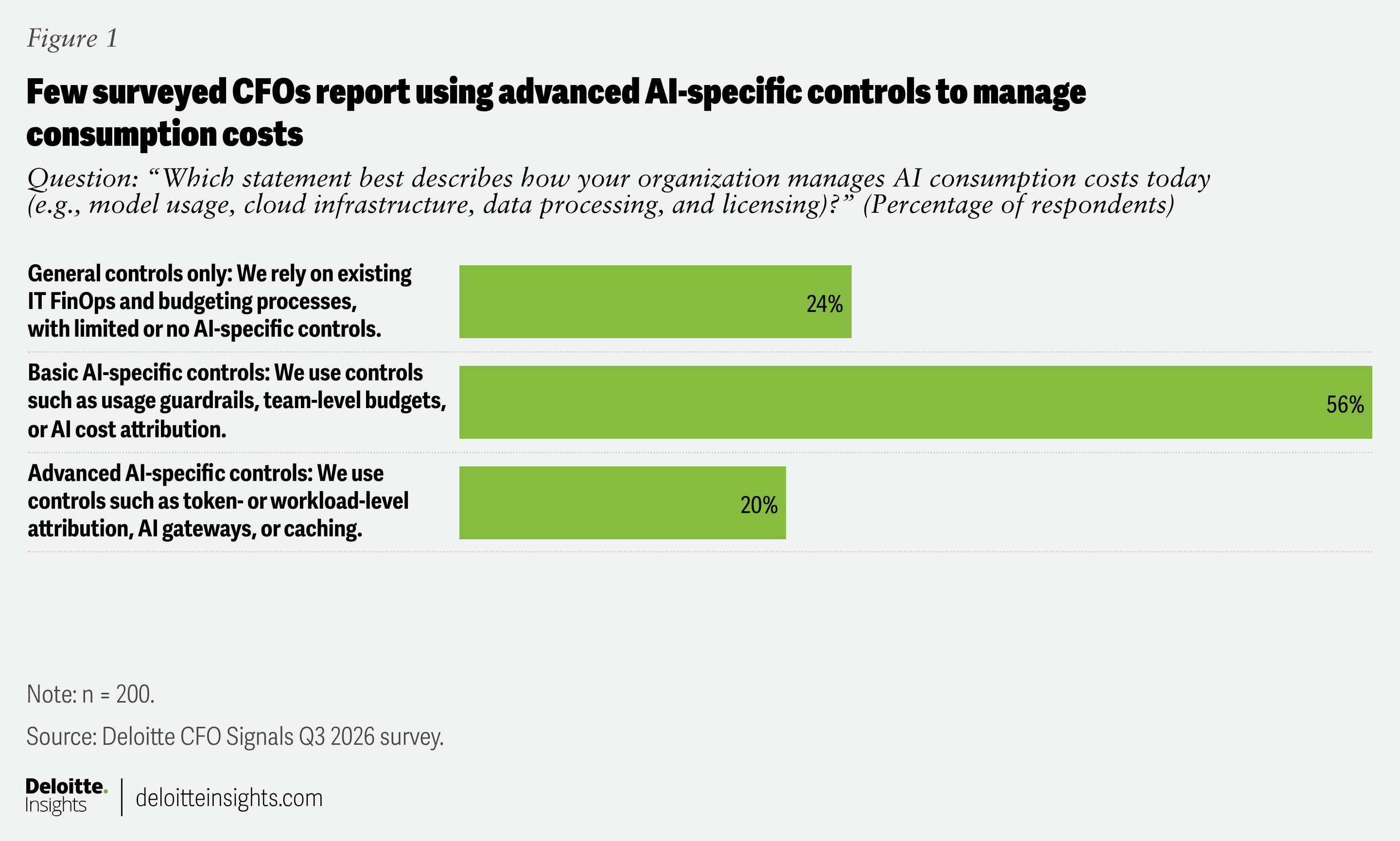
When asked to indicate how their organizations manage AI consumption costs, including model usage, cloud infrastructure, data processing, and licensing, most surveyed CFOs (80%) report that their organizations’ use less advanced controls: More than half (56%) use only basic AI-specific controls, such as usage guardrails, team-level budgets, or AI cost attribution, while 24% rely only on general controls, such as existing IT financial operations and budgeting processes. In contrast, only 20% use advanced AI-specific controls, such as token- or workload-level attribution, AI gateways, or caching (figure 1).
Slow responses can increase exposure to AI cost overruns
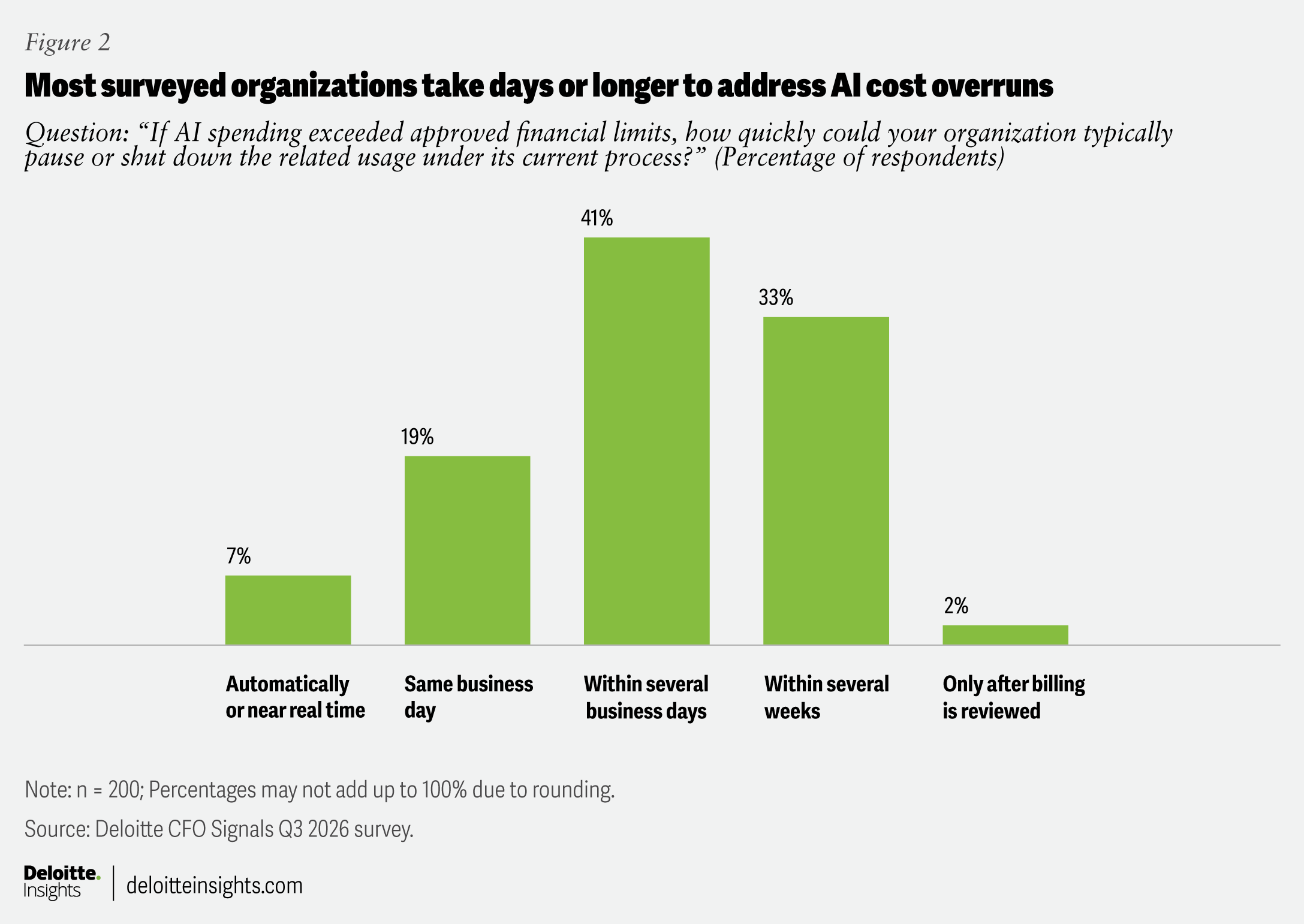
When AI cost-control measures fail, organizations are limited by how quickly they can address the overruns. Nearly three-quarters of respondents (74%) indicate that their organization typically pauses or shuts down the related usage within several business days to several weeks (figure 2). Meanwhile, just 19% of respondents address the issue on the same business day, and only 7% respond automatically or in near real time.
AI cost concerns span governance and vendor complexity
Among the factors limiting organizations’ ability to monitor and oversee AI-related spending, respondents most frequently cite a lack of AI cost governance, processes, or policies (40%). This is followed by limited timely insight into token usage and unit costs (38%) and limited standards for models, prompts, data retrieval, workflow design, or usage standards (36%).
Interestingly, another 27% of respondents identify contracts as a sticking point, stating that pricing, commitments, or data egress terms limit flexibility. Some AI vendors are actively introducing restrictions, gating mechanisms, and tollgating fees, which are charges imposed for accessing data that enterprises previously considered their own. CFOs, therefore, may want to consider how to leverage their relationships with external partners to negotiate more favorable contract terms.
Practices like token metering, where vendors track and bill based on the volume or frequency of data usage, are also becoming standard. For instance, a company using a cloud-based customer relationship management system may now incur additional fees when exporting customer data for analytics, directly impacting its AI strategies, budgeting, and architectural decisions.
Since many organizations are early in their tokenomics journeys, it’s important for finance leaders to keep asking hard questions. Some to consider: Is token awareness part of our AI onboarding? Has my organization set guardrails around experimentation? As new pricing models take hold, what is our vendor cost exposure? How much of the value do we get from AI in productivity metrics versus revenue enablement?
Continue the conversation
Meet the industry leaders
by
Ed Hardy
Timothy Murphy
Many thanks to Jagjeet Gill, Diana Kearns-Manolatos, Craig Schneider, and Brandon Parrott-Shefffer for guidance in shaping this survey and article. Also, much appreciation to Abhinav Annapureddy, Justine Barry, and Jessica Martins for their indispensable contributions in producing the report.
Editorial (including production and copyediting): Karen Edelman, Anu Augustine, and Aparna Prusty
Design: Molly Piersol and Harry Wedel
Cover image by: Harry Wedel
Knowledge services: Viswa Teja Vanapalli