
Medtech’s agentic AI moment: Turning ambition into enterprise advantage
Medtech leaders may pull ahead by rearchitecting workflows, governance, and data around agentic AI
Medtech’s artificial intelligence ambition appears to be moving beyond productivity. The Deloitte Center for Health Solutions’ 2026 survey of 100 medtech executives shows a wide gap between how organizations use AI today and how far they want it to go in generating value (see methodology).
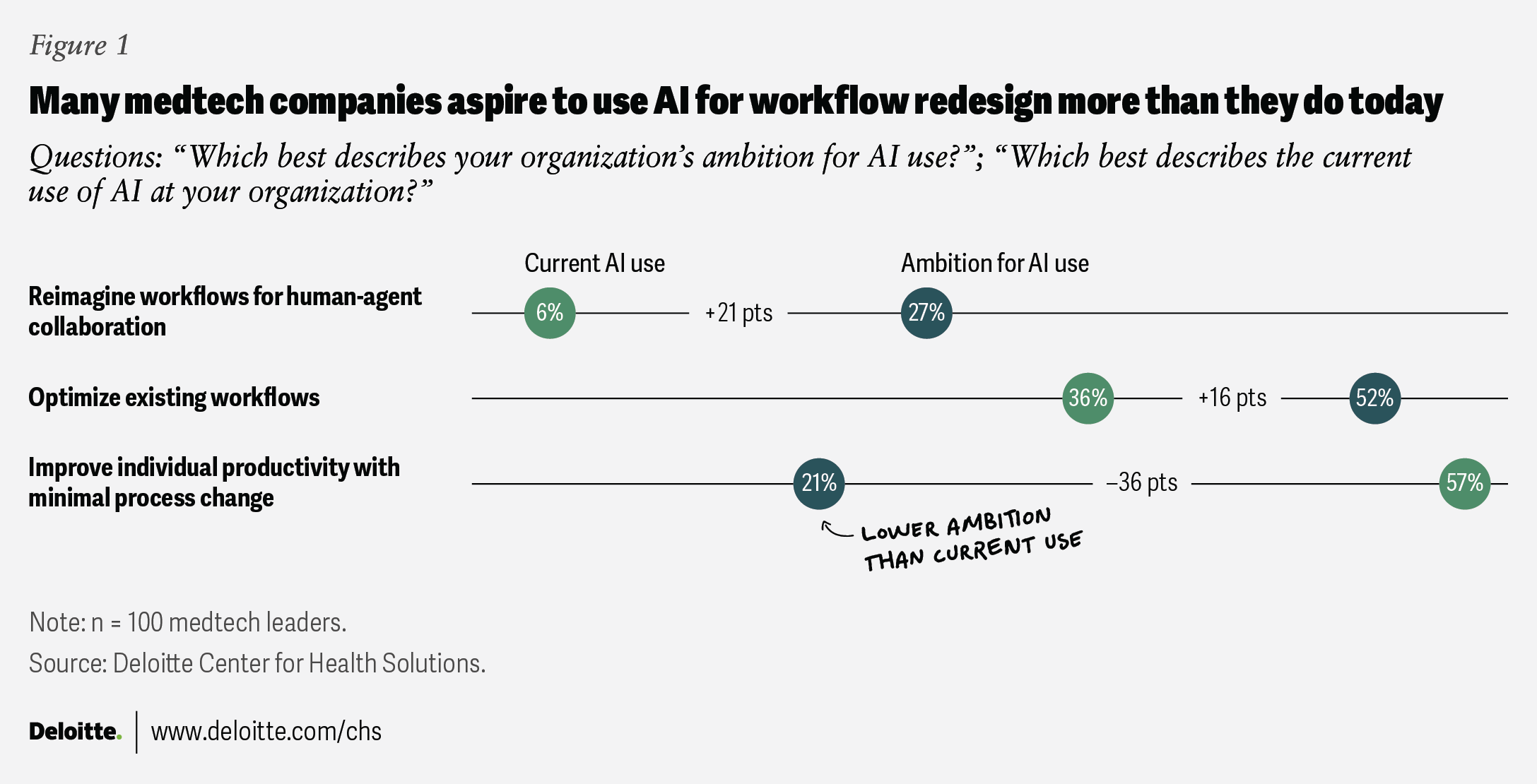
AI ambition seems to be moving toward reinvention, while execution remains anchored in productivity. That tension runs through the survey findings. For many organizations, AI use remains concentrated on individual productivity gains rather than broader process redesign. In the survey, 57% of executives say AI is still mainly used to enhance individual productivity with minimal process change, while only 21% say that this reflects their organization’s ambition.
Overall, the survey findings indicate that the bigger goal is transformation. Most executives say they want AI to do more than improve existing tasks—they want it to help optimize workflows across the business, and some aim to fundamentally redesign how people and AI agents work together. But far fewer say their organizations have reached that point today. While more than half of the executives we surveyed say their ambition is to optimize workflows, only 36% say they’re there now. Another 27% say they want to reimagine workflows around human-agent collaboration, and just 6% say they’re operating at that level today (figure 1).
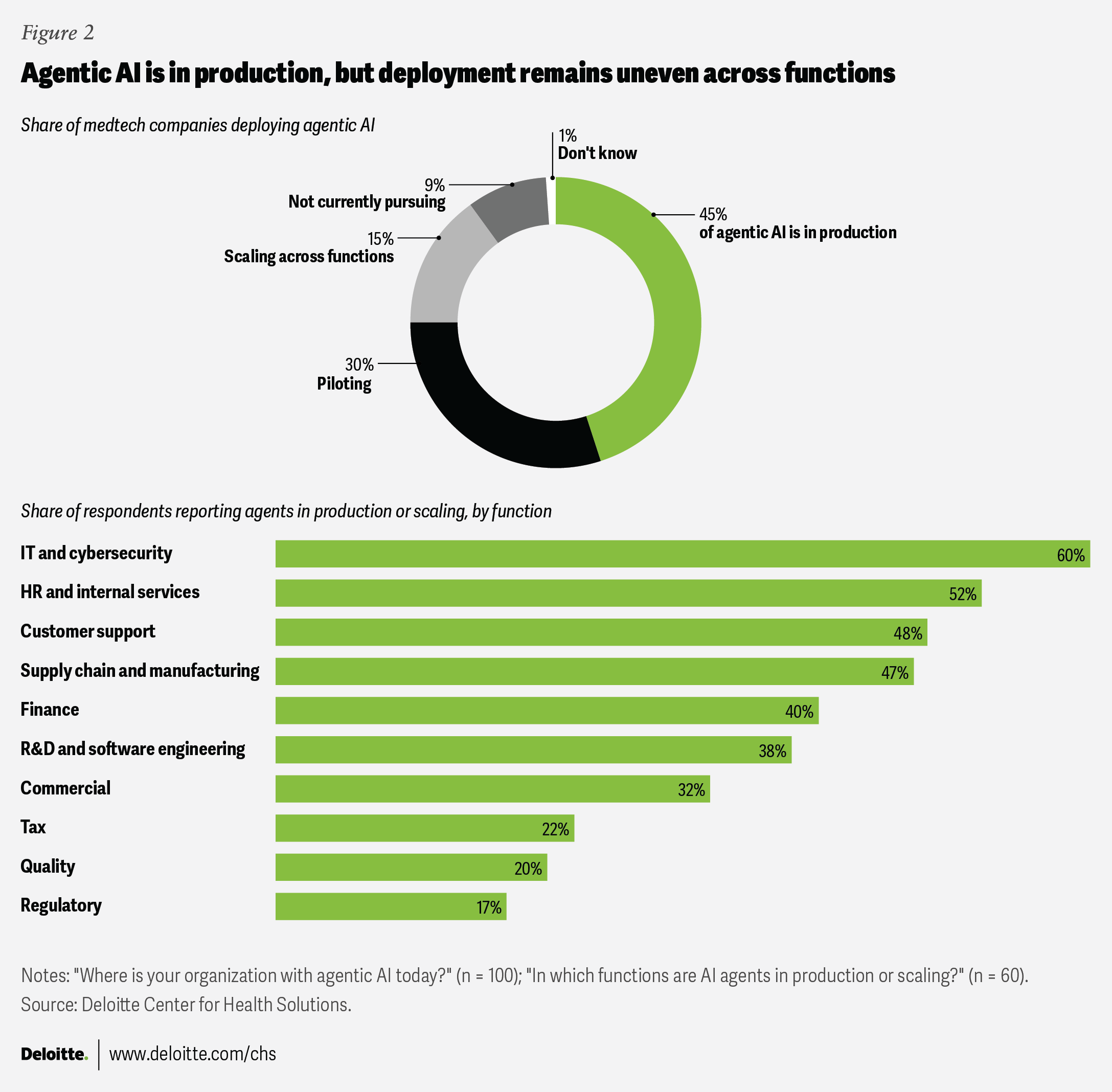
That same ambition-execution gap shows up in agentic-AI deployment. It hasn’t yet translated into broad workflow transformation for most medtech organizations. Although 45% of surveyed executives say agentic AI is already in production (figure 2), 90% say that fewer than 15% of workflows have been materially transformed by AI agents. Some medtech organizations report they are moving beyond experimentation with agentic AI, but the larger opportunity could lie in creating balanced workflows to incorporate AI.
Figure 2 shows that the use of AI agents is spreading across the enterprise, although unevenly—and perhaps not yet where transformation could have the greatest impact. Deployment is strongest in information technology and cybersecurity, human resources and internal services, customer support, and supply chain and manufacturing.
Workflows in other functions, where deployment remains lower, can shape growth, risk, and speed to market—suggesting that some of the greatest opportunities for enterprise transformation may still lie ahead.
For medtech organizations, respondents report a shift in focus regarding AI. The emphasis is moving from where AI can be used to how efficiently the operating model can be redesigned around what AI makes possible. However, deploying more AI agents may not be enough. The real advantage can start when agents are embedded in how work is designed, governed, and executed, and the building blocks are in place to scale agentic AI across the enterprise.
From AI building blocks to agentic AI operating discipline
A 2024 Deloitte study of AI readiness in medtech, informed by a survey of 85 industry leaders, identified six building blocks to consider when scaling AI: strategic blueprint, operating structures, value realization, technology and scaling capabilities, new ways of working, and responsible AI (figure 3).1 Those foundations still matter.2
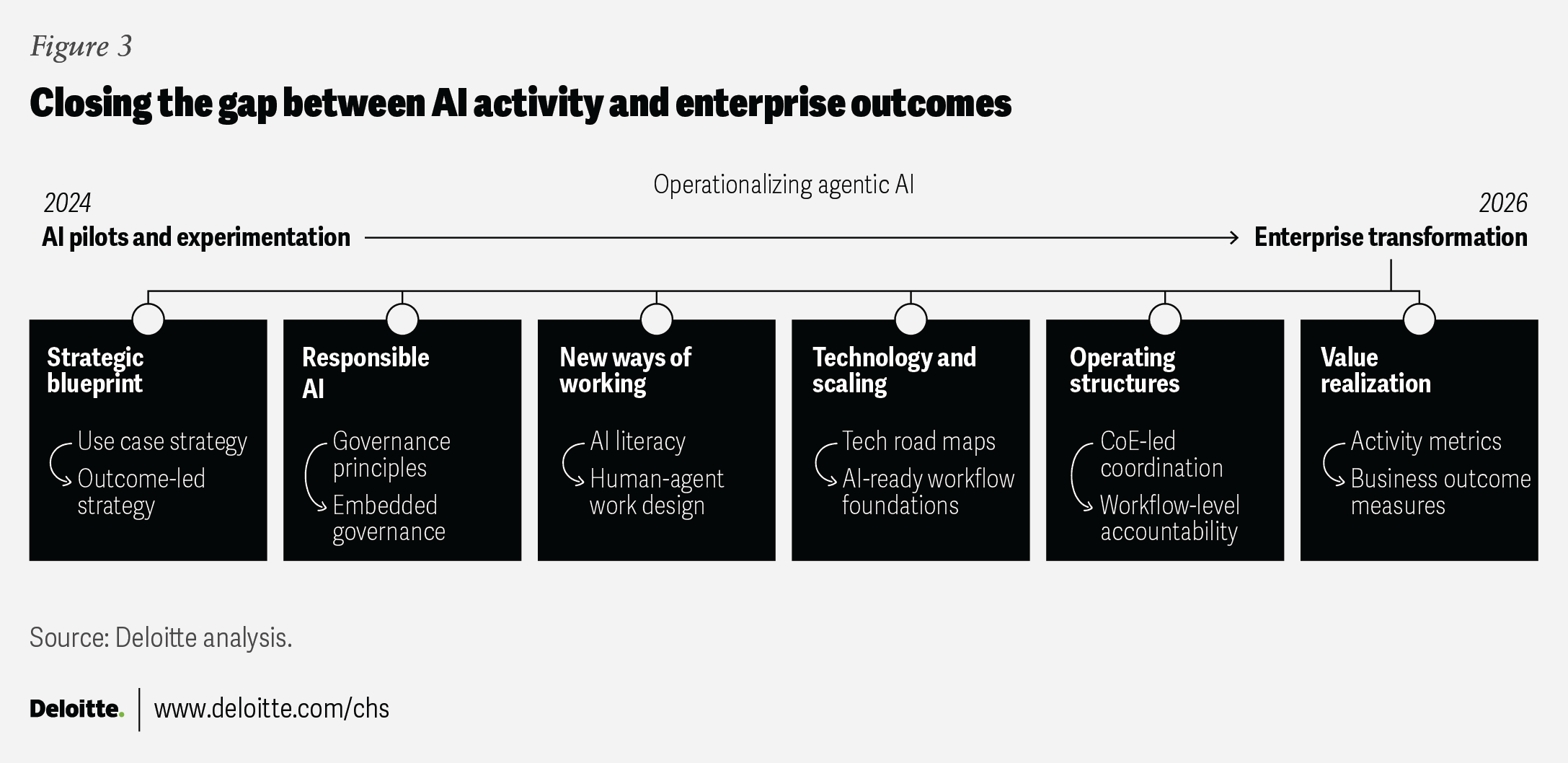
However, in 2024, leaders may have asked whether each building block was in place. Today, the question is likely whether those foundations are ready for AI agents to operate at speed, across more workflows, and with more complexity.
Let’s look at how the six building blocks are evolving in the age of agentic AI.
Craft a strategic blueprint
The question likely used to be: Is there an AI strategy? Our survey data suggests that, for many medtech organizations, that’s no longer the main issue. What hasn’t been settled is whether the strategy is built around outcomes worth redesigning work for, or whether it remains a use-case prioritization exercise.
In medtech, the outcomes that clear that bar could include faster product development cycles, fewer quality delays, better field service responsiveness, lower administrative burden, or stronger supply reliability. The strategy should define these priorities with enough specificity to support decisions about how work is organized and executed.
Build operating structures
In 2024, having a center of excellence was aspirational.3 Today, it’s the floor. A center of excellence that sets standards and coordinates investment has real value, but agentic AI doesn’t follow organizational boundaries. If accountability sits several layers above the workflow where agents operate, it’s unlikely to function as accountability in practice. It could become documentation.
What most organizations may still need to do is pin down accountability at the workflow level. That means knowing, before an agent goes live, who owns the outcome if something goes wrong, who signs off on changes, and who makes the call when a situation falls outside what the agent was designed to handle. Those answers cut across business, technology, quality, regulatory, legal, privacy, and risk teams. Until those lines are drawn inside the functions where agents actually operate, governance is likely to remain a policy document rather than a working system, potentially widening the gap between organizational intent and operational reality.
Focus on value realization
Tracking pilot counts, user numbers, and prompts runs made sense when the goal was building momentum with AI. But these can become less useful when agents may start to influence complaint investigations, procurement decisions, and quality workflows.
The shift most organizations may still need to make is from measuring AI activity to measuring business outcomes. Instead of consistently tracking metrics such as shorter product development cycles, fewer regulatory delays, lower cost per resolved quality event, or faster supplier qualification, organizations often vary measurement approaches by use case. More than one-third of the medtech executives we surveyed say AI value is measured differently across use cases or not consistently at all, and nearly half apply a common approach only to priority programs.
In a regulated industry such as medtech, that isn’t just a measurement gap. What can’t be measured can’t be governed or improved. Medtech organizations looking to build durable advantage should treat measurement as a governance discipline, defining outcome metrics before deployment rather than after. In a regulated environment, the ability to demonstrate value and the ability to demonstrate control can be equally important.
Create scaling and technology capabilities
Agentic AI raises the bar for medtech data infrastructure. Agents need to move across systems, interpret context, trigger actions, and do so with the lineage and controls required in a regulated enterprise.
Nearly half of the executives we surveyed say their data is searchable and reused in only one or two priority areas, with inconsistent lineage documentation. Another 29% say data reuse happens case by case. Only 22% describe their data environment as broadly searchable, routinely reused, and consistently documented. Tool fragmentation compounds the challenge as 61% of executives report that shared tools exist but are used differently across functions. That means agents operating in one part of the business may be working with different data standards, taxonomies, and levels of completeness than agents operating in another.
This matters beyond efficiency. An agent’s trustworthiness depends heavily on the quality of the data it acts on, along with the controls around how it uses that data. In medtech, an agent operating with incomplete or inconsistent context could create quality and compliance risks—particularly in functions like regulatory affairs, post-market surveillance, and supply chain, where data integrity requirements are explicit, and the consequences of acting on flawed inputs can be serious.
The strategic consideration is to know precisely where the data foundation is sound enough to support agent operations today, where infrastructure modernization should come first, and where AI can accelerate the remediation. That sequencing discipline of knowing where to run, where to build, and where to wait could separate organizations that scale responsibly from those that scale fast and remediate expensively.
Build new ways of working
What most organizations haven’t yet confronted is redesigning how people and agents divide work, share accountability, and hand off decisions. That involves new operating logic, not just training.
An important test is whether role-level expectations have actually been rewritten around the workflows agents now support. Only 11% of the surveyed executives say AI enablement is integrated into onboarding or upskilling with clear accountability and tracking, even as 28% report role-based training for priority teams. That gap tends to matter most in quality, regulatory, and clinical affairs, where misplaced trust in an agent can be a compliance issue, not just an operational one.
Medtech organizations building the next generation of operating models for agentic AI should take a harder look at whether they’re redesigning the work itself or simply adding AI to roles built for a pre-agent world. And that could determine whether AI creates operational and compliance challenges—or delivers the intended benefits.
There can also be a longer-term capability risk in medtech. If AI automates routine tasks that once helped employees build skills in quality, regulatory, clinical affairs, and post-market surveillance, organizations may create a “broken skills ladder,” where employees are expected to exercise advanced professional judgment without the experience that typically develops it.4
Promote responsible AI use
Some medtech organizations already have responsible AI policies in place.5 Scaling agentic AI involves governance embedded in day-to-day operations, including validated audit trails, change control for agent updates, post-deployment monitoring, privacy protections aligned with applicable requirements, cybersecurity controls aligned with relevant standards and regulatory expectations, and clear human accountability at consequential decision points.
Consider this: Of the 45% of medtech executives we surveyed who report agentic AI in production, only 7% describe AI as fully embedded and audit-ready within those workflows. One in three surveyed leaders report that AI outputs are used informally, without updated standard operating procedures or validation steps.
This isn’t just an IT governance issue. When an agent influences a complaint investigation, corrective and preventive action workflow, labeling decision, or supplier qualification, it may be operating within a regulated process with real quality, validation, and oversight implications. Although they differ, US Food and Drug Administration and European Union requirements for certain AI-enabled medical products and high-risk use cases underscore the importance of transparency, oversight, responsible AI, and post-market monitoring.6 Undocumented or unvalidated decision logic could create inspection risk when it affects regulated records or decisions.
The organizations building governance infrastructure aren’t moving slowly. They’re building the foundation from which regulated AI can scale without creating the kind of audit exposure that stops deployment in its tracks.7
What could distinguish leaders from followers
The medtech organizations that pull ahead will likely be distinguished by how many workflows, decisions, and accountability structures they’re willing to redesign, and by how rigorously they govern that redesign from the start. In a regulated, margin-sensitive industry, that difference likely won’t stay abstract for long. It could surface in audit findings and inspection outcomes. It could show up in cost structure and time-to-market. It may also influence whether quality and regulatory talent chooses to stay or leave.
The ambition gap this survey reveals is a strategic window, and it may not stay open indefinitely. Regulators are accelerating their frameworks.8 Organizations are evaluating and acting on workflow redesign and upskilling. The organizations moving now to embed governance into daily operations, clarify accountability at the workflow level, and build the data infrastructure that agents require to operate traceably are likely to help define the operating standard. The rest may spend the next several years catching up.
Continue the conversation
Meet the industry leader
Sheryl Jacobson
by
Aditya Kudumala
Ram Paravasthu
Mukund Lal
Sheryl Jacobson
Dr. Jay Bhatt
Wendell Miranda
The authors would like to express their sincere gratitude to Apoorva Singh for leading the survey data analysis and for her significant contributions to the storyboarding, writing, and editing of this paper. Her expertise and dedication were instrumental in shaping this publication.
The authors would also like to thank Dimple Jobanputra, Sheetal Chandrashekar, Adam Israel, Rebecca Knutsen, Christina Giambrone, Debra Pielack (Asay), Julie Landmesser, Shyamili M, Natasha Elsner, Anjalee Khemlani, Jesse Daniel Anthony, Radhika Pandey, and many others who contributed their insights and expertise to this thought leadership paper.
This study would not have been possible without the participants who graciously agreed to take part in the survey. The authors wish to thank them for their generous time and perspectives.
Editorial (including production and copyediting): Rebecca Knutsen, Shyamili M, Anu Augustine, and Cintia Cheong
Design: Natalie Pfaff
Cover image by: Pooja Lnu
Knowledge services: Vanapalli Viswa Teja
Visit the Deloitte Center for Health Solutions
Access more insights for the hospital, health system and provider, pharmaceutical manufacturer, health plan and payer, medtech, and health tech organization sectors.