
Rethinking customer engagement in diagnostics: Are manufacturers prepared?
Diagnostics manufacturers should consider new customer engagement models. While providers remain the core customers today, consumer expectations are reshaping the industry.
Diagnostics manufacturers are facing disruption from two directions at once. Consumers now have more ways to access diagnostic testing and interpret results through virtual health, self-ordered testing, digital tools, wearables, and artificial intelligence-enabled platforms.1 At the same time, health care providers—including commercial laboratories and radiology companies—are under pressure to deliver faster, simpler, and more personalized diagnostic experiences or risk losing market share to consumer-focused entrants.2
Together, these shifts reflect Deloitte’s Future of Health vision: a more data-driven, consumer-centered, and personalized health ecosystem. However, that future isn’t replacing today’s market overnight. Health care providers still account for the core share of diagnostics manufacturers’ revenue.3 The strategic question is whether manufacturers can help providers compete in a more consumer-driven diagnostics market.
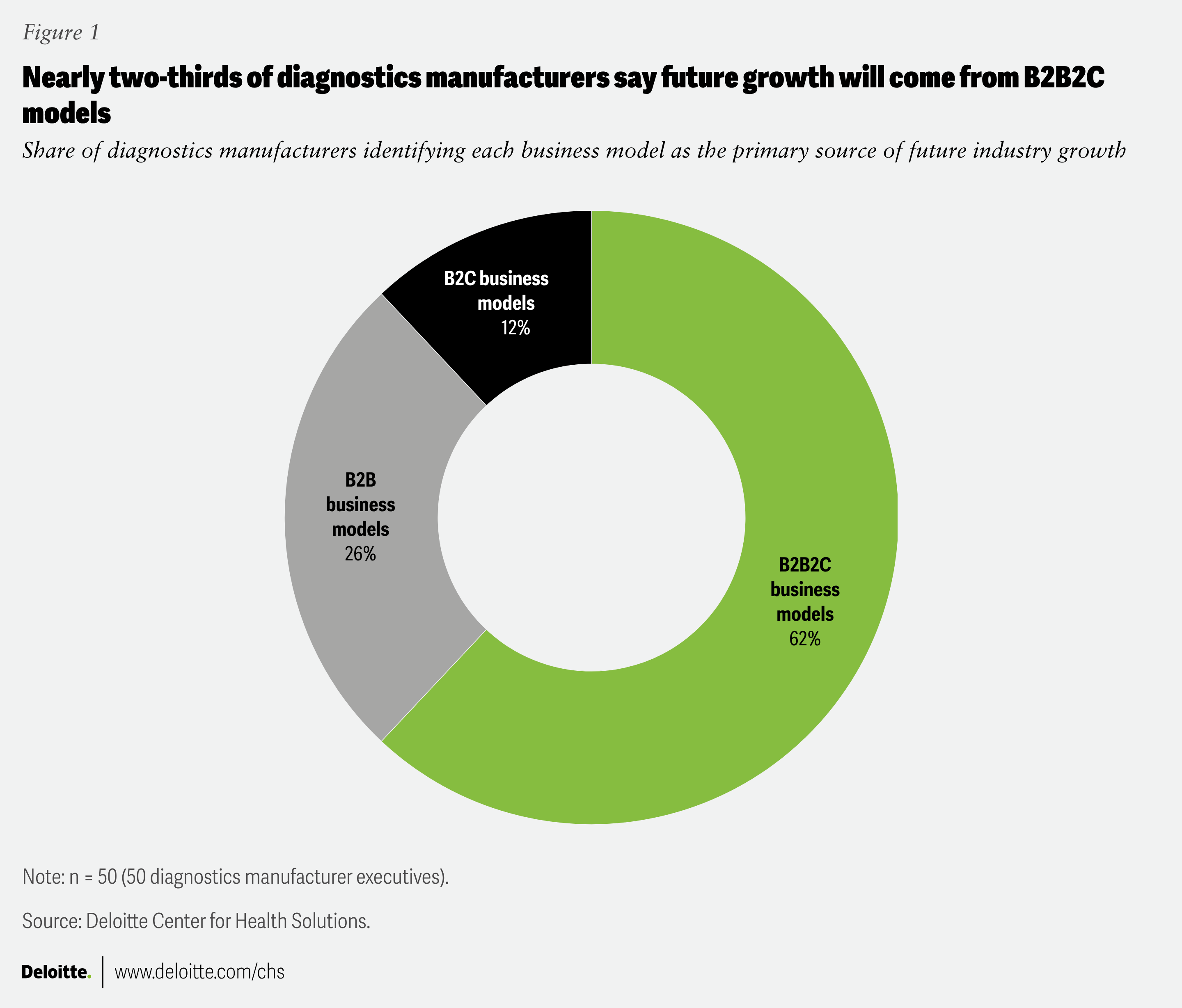
To assess how prepared the industry is for this shift, the Deloitte Center for Health Solutions surveyed 50 diagnostics manufacturer executives and 50 health care provider executives, and conducted 20 in-depth interviews with industry leaders (see methodology). Nearly two-thirds of diagnostics manufacturer respondents (62%) said future growth will depend on a business-to-business-to-consumer model (figure 1), suggesting manufacturers should operate differently. Yet the research also shows gaps in how manufacturers engage providers, support workflows, and help providers meet the needs of increasingly empowered consumers.
The strategic question is whether manufacturers can help providers compete in a more consumer-driven diagnostics market.
To keep pace, diagnostics manufacturers should redesign customer engagement around the full diagnostic journey—from test selection and ordering to interpretation, follow-up, and ongoing consumer engagement. That means engaging a broader set of provider stakeholders, strengthening workflow and data integration through platform-based models, and building AI capabilities that support a more connected customer experience.
The current disconnects: Diagnostics manufacturers appear to be misaligned with provider needs
Before diagnostics manufacturers can compete in a more consumer-driven market, they may need to reexamine how providers—still their core customers—select, order, and use diagnostics in practice. Our research suggests many manufacturers aren’t fully in tune with what providers need or how they prefer to engage.
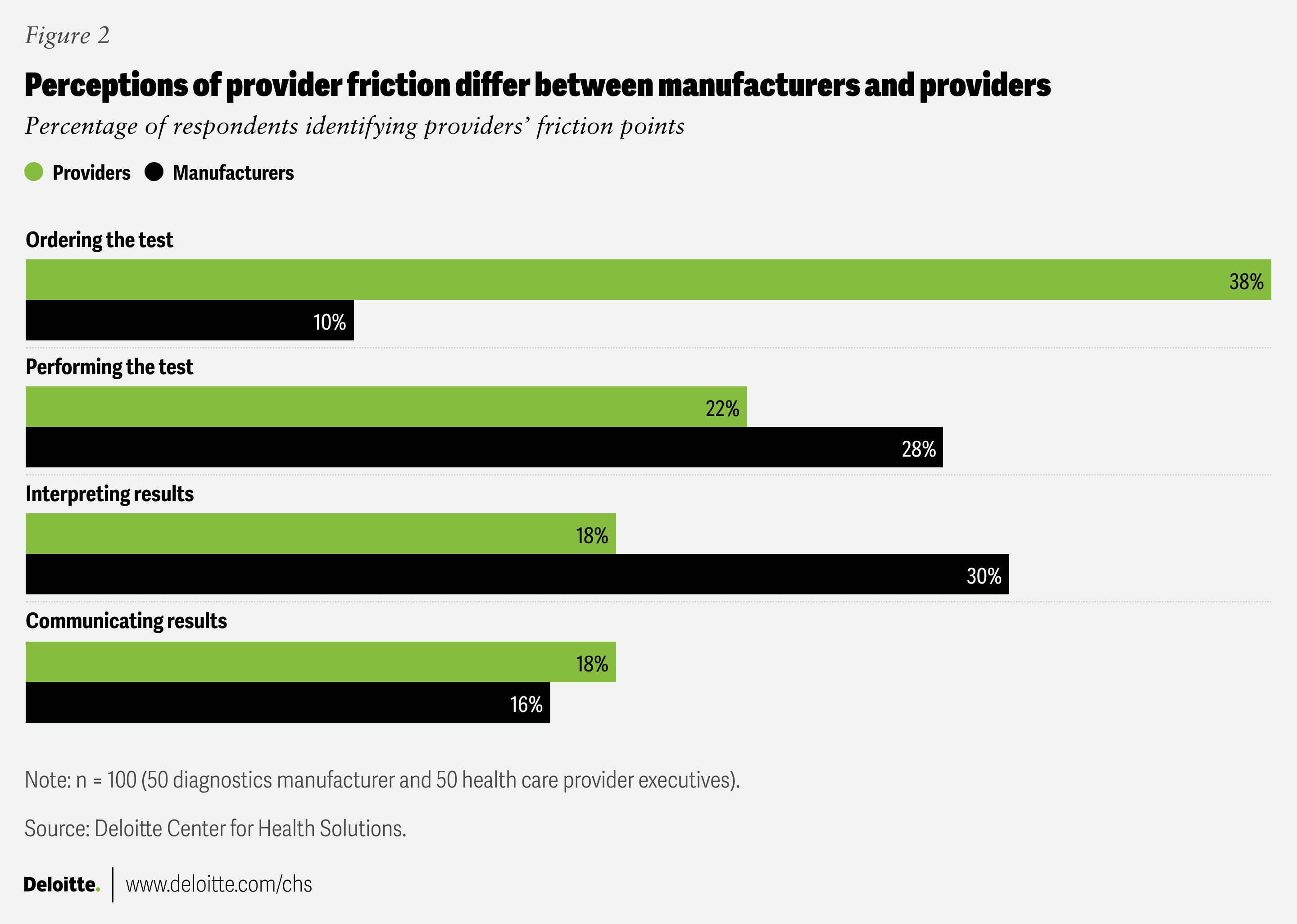
The first disconnect is the problem providers need solved. In our study, providers identified test ordering as the biggest friction point (figure 2). Manufacturers, by contrast, were more likely to point to result interpretation, an area that is directly tied to their products, as the greater challenge. To address test ordering, some manufacturers may consider expanding their offering beyond products and into software and services.
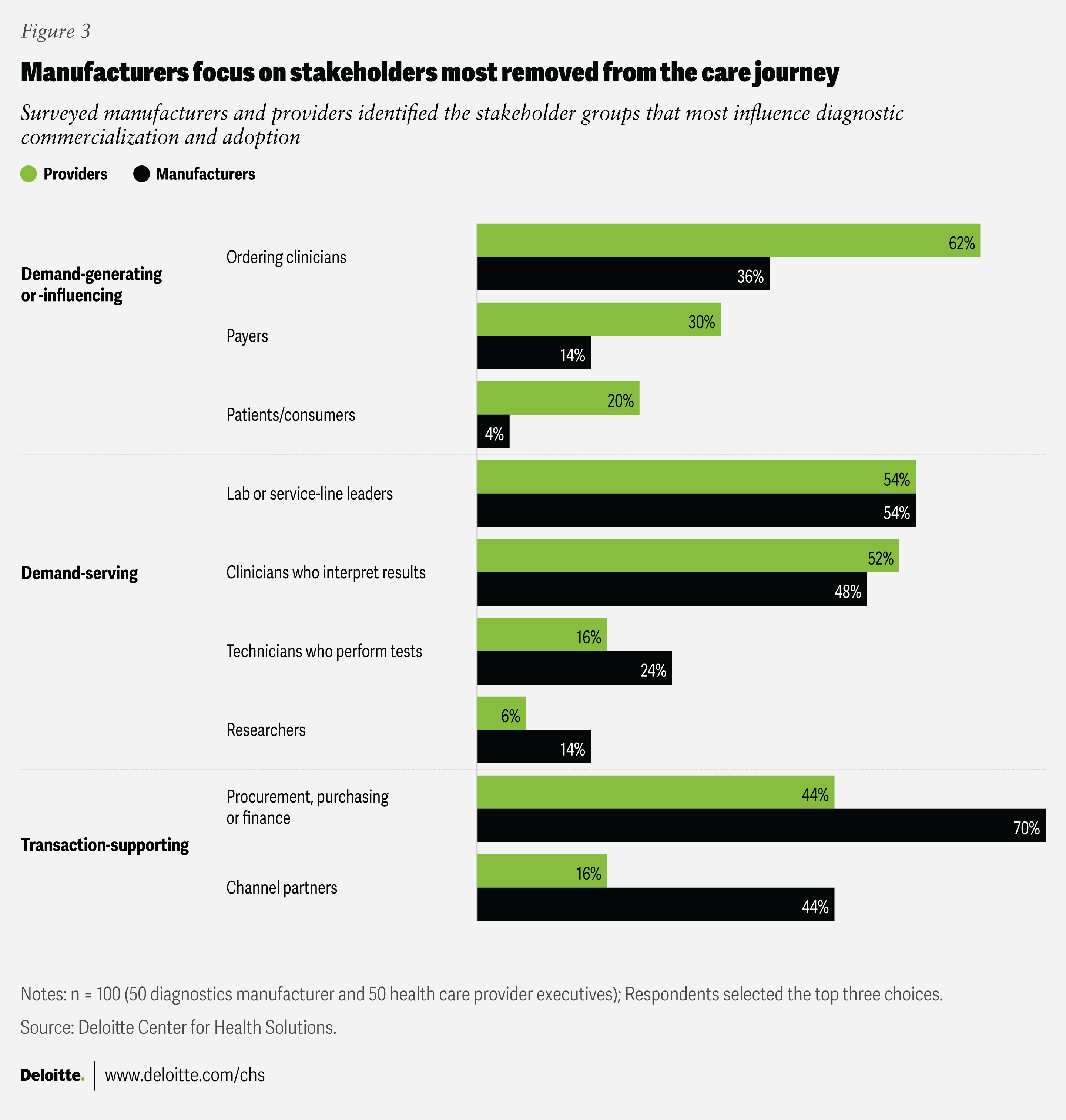
The second disconnect is with whom manufacturers engage (figure 3). Surveyed manufacturers said their key contacts are hospital procurement offices and channel partners, or the formal buyers who sign contracts. Providers, however, said the people who most influence what gets ordered, when, and for whom are ordering clinicians, lab directors, and service-line leaders. The risk is that manufacturers may be building relationships with those who approve purchases while underinvesting in the stakeholders who shape adoption, utilization, clinical value, and future needs.
The third disconnect is how providers want to engage. Providers prioritized peer-to-peer exchange and education, including conferences, clinical forums, and conversations with colleagues who have hands-on product experience. Several provider interviewees also said they wanted better websites where they could research products on their own, without going through a sales call. Manufacturers, by contrast, emphasized field sales and application scientists. While provider interviewees saw value in application scientists, especially for complex products, several described field sales outreach as too frequent and not always valuable.
Together, these disconnects suggest that many manufacturers still organize customer engagement around account coverage and purchasing, while providers are looking for workflow support, clinical education, service responsiveness, and digital self-service. That may require manufacturers to engage less like product vendors and more like partners helping providers solve operational and clinical challenges. Based on our interviews, this may look like risk-sharing, genuine responsiveness to service issues, and collaborating on solving thorny issues like reducing length of stay.
Closing these provider engagement gaps is an immediate priority. It’s also the foundation for the next challenge: helping providers meet the expectations of consumers, who are gaining more influence over what tests are ordered, how they want to see results presented, and where follow-up takes place.4
The next generation of B2B2C
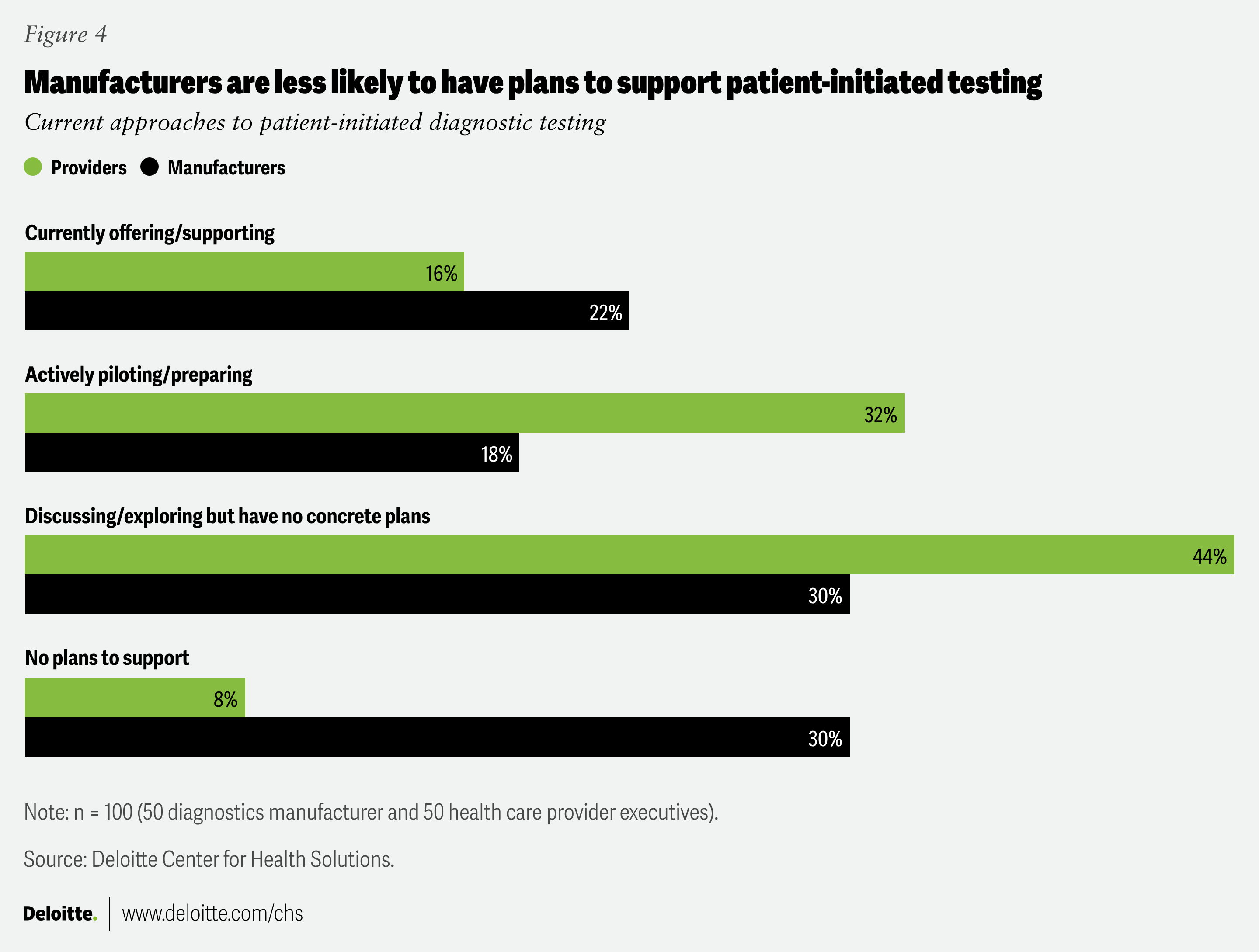
The pressure to rethink engagement is likely to grow. In our survey, 76% of provider respondents said consumer- and patient-initiated demand5 will significantly change the diagnostics market in the next three years. Ninety-two percent of providers said they are already offering or exploring patient-initiated testing, compared with 70% of diagnostics manufacturers (figure 4). This suggests providers may be facing more pressure than manufacturers to respond to changing consumer behavior.
As more testing moves into the home, retail settings, and digital platforms, providers are becoming part of a more distributed care model.6 Consumers increasingly expect convenient access, transparent and predictable experiences, personalized interactions, and results they can understand and act on.7 A recent survey of 1,000 US-based patients by a diagnostics manufacturer found that 93% of respondents expect their doctor to order a lab test upon request, while 27% pursue testing without a doctor’s recommendation.8 That means a meaningful share of consumers already appear to be making decisions around diagnostic testing outside the traditional health care system. Nontraditional players such as digital health startups, direct-to-consumer testing companies, and wearable technology makers (for example, LetsGetChecked, Everlywell, Oura, and Ultrahuman) are responding with streamlined access, intuitive interfaces, and clearer, more actionable outputs.9
For diagnostics manufacturers, that is the B2B2C opportunity: helping provider customers deliver the kind of diagnostic experience consumers increasingly expect.
But consumerization doesn’t necessarily mean providers will be replaced. According to our interviews, many consumer-facing entrants are collaborating with health care organizations, employers, health plans, and testing service providers, and securing coverage through health savings accounts or flexible spending accounts.10 Two government initiatives—the Centers for Medicare and Medicaid Services Innovation Center’s Advancing Chronic Care with Effective, Scalable Solutions Model and the Food and Drug Administration’s Technology-Enabled Meaningful Patient Outcomes for Digital Health Devices Pilot—may also drive collaboration between providers and new and existing diagnostic companies. Consumers also continue to look to clinicians for interpretation and follow-up. In Deloitte’s 2025 US Health Care Consumer Survey, 62% of respondents who track their health data said they share it with a health care provider. In the survey commissioned by a diagnostics manufacturer, 94% of respondents said they’re more likely to follow a doctor’s recommendation when it’s supported by test results.11
For diagnostics manufacturers, that is the B2B2C opportunity: helping provider customers deliver the kind of diagnostic experience consumers increasingly expect.
Can diagnostics manufacturers help providers meet consumer expectations?
Across our research, one theme came through consistently: Many consumers increasingly want “more data, more context, and more personalization” in how they manage their health. This is where diagnostics can begin to move from a fragmented testing experience to a more connected, personalized, and actionable one.
Data and workflow integration come first
Supporting providers and consumers at scale will likely involve more than incremental improvements in engagement. It may depend on better data and workflow integration across the diagnostic journey to connect how diagnostics are ordered, processed, and acted upon within provider systems, and how results are delivered, understood, and used by consumers.
Providers pointed to different data integration priorities at different stages of the diagnostic journey: revenue cycle and prior authorization systems at the front end, electronic health record (EHR) integration within clinical workflows, and patient engagement tools after testing. But these systems often remain disconnected. In our survey, 74% of providers said their systems aren’t yet integrated across the end-to-end diagnostic journey.
Some interviewees noted that the transition from Health Level Seven to Fast Healthcare Interoperability Resources standards could help reduce some of this friction.
Consumer-generated data will likely become increasingly important over the next three to five years, especially as wearables and ambient sensors are likely to expand beyond watches and rings into clothing, footwear, and the home. These technologies could help providers screen, monitor, stratify risk, support adherence, and manage chronic conditions more effectively.12
Diagnostics manufacturers that build interoperability with these growing sources of health data now may be better positioned to contribute to and benefit from platforms that provide a longitudinal, continuous view of patient health extending far beyond the clinical encounter. Those that do not embed within these emerging platforms risk being relegated to interchangeable test providers, with limited visibility into patient journeys and reduced influence over diagnostic decisions.
Deploy AI where friction is highest
As AI capabilities become more widely available, diagnostics manufacturers that effectively embed AI within connected data, workflows, and care delivery models and enable integrated diagnostics platforms will likely have an advantage. In this emerging model, value is no longer created by isolated tools, but by the ability to connect data, workflows, and insights across the end-to-end diagnostic journey.
Some provider respondents identified operational efficiency and embedding diagnostics into clinical workflows as the AI-enabled capabilities with the greatest near-term impact. Sixty-six percent of respondents believe that personalized workflow integration will be very important in the next three to five years. In practice, that means focusing on high-impact use cases where friction is greatest: embedding test-ordering support into EHR workflows, automating prior authorization, improving patient-friendly result interpretation, and guiding next-best actions for follow-up care, potentially through software and service offerings.
In this emerging model, value is no longer created by isolated tools, but by the ability to connect data, workflows, and insights across the end-to-end diagnostic journey.
Over time, these capabilities begin to form the foundation of a broader platform model where AI is not deployed as a standalone tool, but embedded across interconnected workflows, continuously learning from longitudinal data and influencing decisions across the care continuum.
Emerging examples illustrate how these capabilities are being applied and point toward an emerging platform-based model for diagnostics. Collaborations between diagnostics companies and EHR providers13 are improving ordering and results workflows. Some integrated solutions embed AI into lab and pathology operations.14 Consumer-facing companies are delivering app-based results with more actionable insights. While these examples may appear discrete, they represent early building blocks of a more connected ecosystem where workflow integration, data aggregation, and consumer engagement increasingly operate as part of a unified platform rather than as separate capabilities.
Personalization becomes a differentiator
As the consumer-directed diagnostics market moves beyond well-being into screening, prevention, and diagnosis, personalization will likely become even more important. This can include individual test recommendations, preparation guidance, clearer result explanations, follow-up nudges, provider routing, and longitudinal context.
Manufacturers and providers in our survey both recognized the importance of personalized test recommendations, though manufacturers (94%) placed even greater emphasis on them than providers did (82%). As one interviewee noted, “A lot of people don’t get the tests they should,” in part because of the limited time they have with their doctor. This customization is likely to become more important to consumers as innovation in diagnostics continues to grow.
Nearly all survey respondents also agreed that personalized consumer communication matters. But one interviewee put the challenge plainly, “Everyone in health care has to learn to talk to patients better.”
Consumer-facing startups and wearable technology companies offer a glimpse of what better personalization can look like. According to our interviews, they have built interfaces people want to use: Results are displayed visually, contextualized over time, and translated into clear next steps. Is this value in range or out of range? Better or worse than last week? What does it mean? Users likely check these interfaces when they wake up, throughout the day, and before bed. The experience tends to move beyond simply delivering data to helping people understand the data and what to do next. A few of the wearable tech executives we interviewed noted that consumers continue using their products even when they could get the same services at a lower cost through the traditional health care system, demonstrating the value that consumers see in them.
According to some of the leaders we interviewed, when done well, this kind of personalization can reinforce, rather than replace, the role of providers by directing consumers back into care when appropriate through either partnerships or vertical integration.
That’s an opportunity for diagnostics manufacturers: to go beyond efforts to improve testing by helping providers deliver a diagnostics experience that is more connected, understandable, and actionable. Manufacturers that do this well may help providers build a level of consumer trust that’s difficult for competitors to replicate.
Our research suggests that manufacturers should focus transformation efforts in three areas:
- Redesigning the service model: Manufacturers have an opportunity to go beyond the instrument and expand into software and services. Coupled with AI, manufacturers can redesign provider workflows to make test ordering simpler, more integrated, and easier to navigate. That could include smart ordering, automated prior authorization integration, better fit within EHR workflows, greater specimen logistics visibility, next-best-action routing, and fewer manual handoffs. Additionally, manufacturers should build the data, workflow, platform integration, and governance infrastructure needed for a more AI-driven, consumer-focused future. As these capabilities scale, they begin to reshape how diagnostics manufacturers create and capture value, shifting from one-time test transactions toward models that reward longitudinal insight, workflow integration, and influence over clinical and consumer decision-making. In many cases, that will involve new partnerships across the ecosystem, including with nontraditional players.
- Elevating consumer experience: Manufacturers should aim to improve the diagnostics experience—and perhaps even reimagine it around convenience, clarity, and personalization. Investment in integrated diagnostics platforms that include a focus on interoperability, AI, software, and services may be underlying requirements for this reimagination. Manufacturers that integrate data from wearable devices and personalize the journey—from onboarding and preparation through results explanation, interpretation, and follow-up—may be better positioned to build trust with both providers and consumers. In established relationships, the priority may be to strengthen existing trust. In newer markets, trust will likely need to be earned deliberately and protected carefully. Partnerships may also help manufacturers extend credibility and improve the consumer experience.
- Reshaping sales operations: Diagnostics manufacturers should reassess how they identify and engage stakeholders across the diagnostic journey, including ordering clinicians, lab directors, and service-line leaders. The goal should be to understand who makes decisions, who shapes demand, and who enables fulfillment, and then build the engagement model accordingly. Depending on the strategy, procurement may not be the right starting point. This shift could reshape field application scientist coverage, medical affairs support, training, peer education, and digital self-service. AI may also help improve the efficiency and effectiveness of these activities.
Rewiring engagement for better diagnostic journeys
To help thrive in this evolving market, diagnostics manufacturers should consider developing breakthrough products and becoming orchestrators of the entire diagnostic journey. That means helping to simplify provider workflows, making interpretation clearer and more actionable, embedding into consumer-facing touchpoints, and personalizing the path from testing to follow-up.
This shift will involve rethinking long-standing customer engagement models. Manufacturers should consider building stronger bridges to clinicians beyond procurement offices, engaging consumers more meaningfully (without bypassing providers), and investing in the platforms and partnerships that turn fragmented diagnostic moments into seamless, connected experiences.
Trust may also need to be redefined. With providers, the priority should be to consider deepening existing relationships. With consumers, trust may need to be earned more intentionally through transparency and reliability, often without the benefit of an established relationship.
Manufacturers can rewire their engagement strategies by aligning with provider needs, embracing personalization, and integrating across the care continuum. And those that act now may be better positioned to shape and adapt in the next era of diagnostics.
Methodology
In February 2026, the Deloitte Center for Health Solutions conducted parallel surveys to examine the current state and future direction of customer engagement in diagnostics, surveying 50 diagnostics manufacturers and 50 hospital and lab providers. To supplement the survey findings, the research included 20 in-depth interviews with leaders from diagnostics manufacturers, providers, wearable technology companies, and venture capital firms.
“Diagnostics manufacturers” refers to companies that develop and produce diagnostic tests and platforms. “Providers” refers to members of the broader care delivery ecosystem, including hospital systems, hospital labs, independent and commercial laboratories, imaging centers, and health care professionals who order, process, and interpret diagnostic tests.
Our definition of diagnostics includes:
- In vitro diagnostics: Tests performed on samples taken from the human body, such as routine blood tests to detect diseases, conditions, or infections in a laboratory setting.
- Imaging and other in vivo diagnostics: Techniques and procedures that create visual representations of the interior of the body for clinical analysis and medical intervention, such as X-rays and MRIs.
- Digital tech and wearables: Devices worn on the body that monitor and analyze physiological data to provide insights into an individual’s health and fitness, such as fitness watches.
Continue the conversation
Meet the industry leaders
Sheryl Jacobson
Dr. Jay Bhatt
by
Rob Jacoby
Puneet Sharma
Carly Cook
Rob Bucciarelli
Christine Chang
Dimple Jobanputra
We would like to thank Natasha Elsner, who served as an advisor on this project, helping with ideation, survey design, storyline development, writing, and reviewing the paper.
We would also like to thank Leslie Korenda and Madhushree Wagh for their assistance with insight analysis.
The authors would like to thank Anjalee Khemlani, Lauren Demele, Nooshin Bowman, Badeia Jawhari, Talia Haller, Vipul Bhatt, Varun Madan, Apurva Pangam, Julie Ellis, Ryder Riess, Brad Maruca, Laura DeSimio, Jeff Ford, and Namrita Negi for their insights, expertise, and input on the research.
Thanks to Rebecca Knutsen and Andy Bayiates for their contributions to the editing and structuring of the paper. Special thanks to Christina Giambrone for her marketing support. Additionally, we would like to thank Jessica Overman, Riley Cole, Shyamili M, Julie Landmesser, and Debra Pielack (Asay), and many others who contributed to this project.
This study would not have been possible without the participants who graciously agreed to take part in the survey and interviews. The authors wish to thank them for being generous with their time and insights.
Editorial (including production and copyediting): Rebecca Knutsen, Shyamili M, Andy Bayiates, and Anu Augustine
Design: Rahul Bodiga, Harry Wedel, Meena Sonar, and Natalie Pfaff
Cover image by: Rahul Bodiga
Knowledge services: Vanapalli Viswa Teja
Visit the Deloitte Center for Health Solutions
Access more insights for the hospital, health system and provider, pharmaceutical manufacturer, health plan and payer, medtech, and health tech organization sectors.