
AI is changing work. It might also be limiting how expertise is built
As AI takes on more entry-level tasks, organizations risk losing the pathways that turn novices into experts. Here’s how the public sector can help rebuild them.
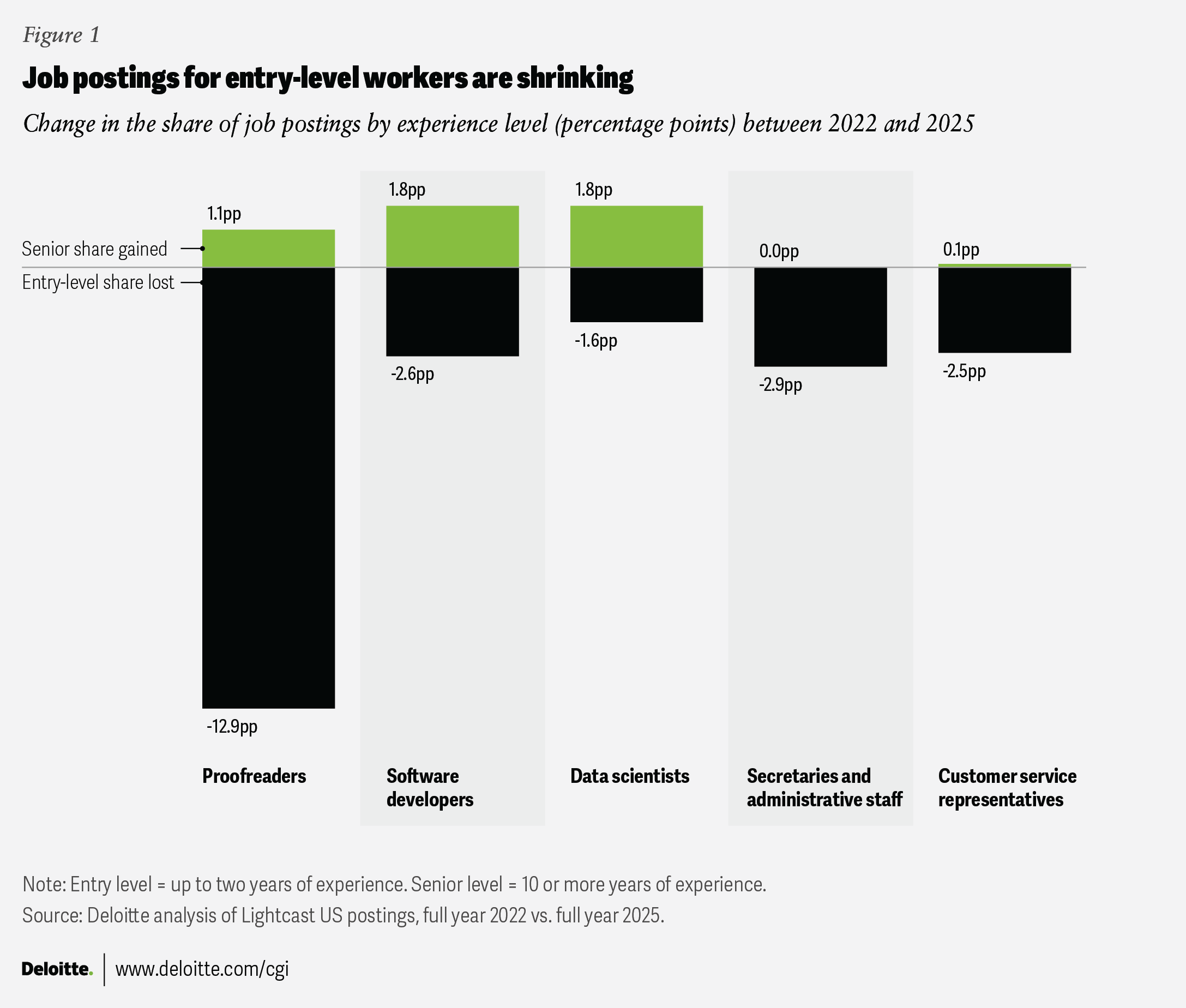
Organizations are rapidly accelerating their use of artificial intelligence. Deloitte research shows that worker access to AI rose by 50% in 2025,1 and firms are hiring fewer entry-level workers as a result.2 For example, a Deloitte analysis of US job postings from 2022 to 2025 found firms hiring fewer entry-level data scientists, software developers, and other occupations, even while senior-level hiring remained strong (figure 1).
As AI takes on more of the foundational entry-level work that once enabled learning in fields like these, it is creating what we call a “broken skills ladder”: a gap between the expertise an organization needs and the pathways available to build it. The long-term impact is not just a shortage of workers, but a shortage of workers who have had the chance to build proficiency over time and become experts in their fields.
The broken skills ladder
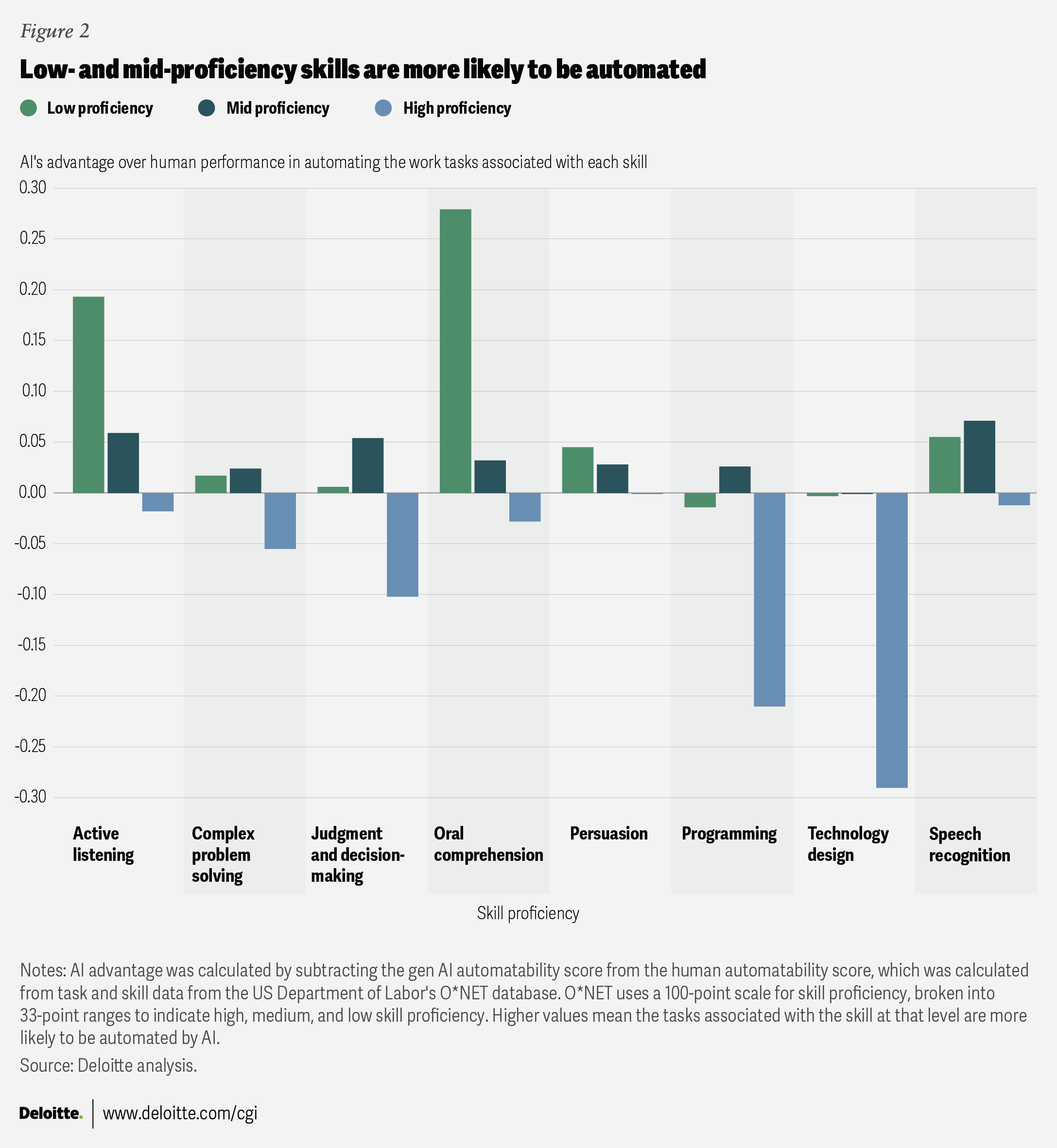
As AI changes how work is done, it’s also impacting how workers apply and learn skills. To further explore what this might mean for how expertise is built over time, Deloitte analyzed the automatability of 19,000 work tasks and mapped those tasks to skills using Department of Labor O*NET data. The goal was to understand not only what skills are changing but also how AI is altering the pathways through which those skills are developed. The analysis suggests that what we call broken-ladder skills might pose the greatest long-term risk.
AI is automating the tasks that have traditionally enabled workers to build low- or mid-level proficiency (figure 2). Yet at higher levels of proficiency, human expertise remains essential. The work that once taught people how to do a job is disappearing, even as the need for expertise persists. New workers are increasingly expected to operate at higher levels, but without the opportunity to learn by doing. In other words, the ladder is broken for certain skills.
This dynamic may help explain why many organizations are already seeing signs of an experience gap. Deloitte research finds that 72% of workers and 73% of executives believe organizations should be doing more to create opportunities for employees to gain experience.3 At the same time, employers report that many new hires lack the real-world experience needed to perform effectively, even as expectations continue to rise.4
Vibe coding—an approach to software development where users create software by describing desired outcomes in plain English to AI tools rather than writing code—is one of the most visible examples of this phenomenon. Generative AI can now automate many of the foundational programming tasks that once helped coders build proficiency, such as writing basic code, troubleshooting syntax, or creating simple applications. But organizations still need workers who can design and build complex systems, manage identity and security, and integrate across platforms. Those higher-order capabilities depend on experience that’s becoming harder to acquire.
And it’s not just programming. Many of the skills organizations increasingly value, such as complex problem-solving, critical thinking, judgment, and decision-making, are also affected by broken skills ladders. Development of these skills depends on challenging repetition, feedback, and exposure to real-world scenarios.
Over time, this scenario is likely to create a talent imbalance. As experienced workers exit the workforce, organizations will need to replace them with new talent capable of operating at a high level. But if the pathways to building that expertise have eroded, developing that talent might become slower, more difficult, and more uncertain.
Challenges and solutions for the public sector
Talent and workforce development challenges are not new to employers, but the public sector has a unique role not only in developing its own talent, but in supporting the broader workforce. AI’s impact on how expertise is built introduces challenges that likely can’t be solved through traditional hiring or training strategies alone. Addressing them will require collaboration across higher education, workforce development agencies, and employers, as public sector leaders rethink how expertise is developed across the broader workforce ecosystem in light of three key challenges.
1. Expertise can’t be fast-tracked
There is no shortcut to proficiency. Workers can’t jump from novice to expert without developing a foundational understanding along the way. Dr. Holly Taylor, co-director of the Center for Applied Brain and Cognitive Sciences at Tufts University, notes that without grasping core concepts, tools like AI can lead to incorrect conclusions rather than better outcomes.5 AI could actually exacerbate the cognitive offload and lead to worse performance.6 A similar challenge has emerged with technologies like GPS, where a study at Tufts found that the use of navigation devices actually impaired people’s memory of where they had been compared with those navigating without GPS.7
Potential solutions:
What does it mean for public sector organizations when training can no longer rely solely on exposure to live work? Leaders will likely need to invest in alternative ways to build experience. Both employers and educational institutions can use methods such as individual or group simulations, scenario-based learning, and structured practice environments to help learners gain expertise. These approaches, long used in fields like aviation and medicine to build proficiency in critical but hard-to-practice skills, can recreate repetition and feedback loops when real-world opportunities are limited. Far from just overcoming a barrier, these approaches could be a boon to both learners and employers: Research shows that simulation-based training can provide 56% better skill proficiency than more traditional methods.8
2. Signals about what skills matter are becoming less clear
Historically, labor market demand has helped guide workforce development. Job postings signaled which skills were needed, allowing workforce training providers, community colleges, and higher education institutions to align their training and curriculum with market needs.
But AI is disrupting these demand signals. Many employers are still figuring out how AI is changing the work they do every day. As a result, job descriptions might lag behind reality, leaving training providers guessing at what skills to prioritize. For example, according to Gallup, only 12% of US employees believe that AI has transformed how work gets done within their organization,9 suggesting that many changes remain implicit rather than formally defined.
Potential solutions:
If workforce systems can no longer rely on static signals, public sector organizations may need to play a more active role in capturing how work is evolving in real time. AI itself can support this work by surfacing where human judgment is applied within AI-enabled workflows, making otherwise invisible skills more visible and teachable.
Take benefits eligibility as an example. When using AI, experienced workers evaluate more than what the tool produces. They also assess what it leaves out: key data, context, or assumptions that aren’t immediately visible. That kind of evaluation is difficult to capture in a job description, yet it’s central to effective performance. If AI could capture the moments when experts intervene to evaluate output, educational leaders could design learning experiences that help build this kind of judgment directly across a range of tools and contexts.
3. Tacit knowledge can be difficult to transfer
Using AI tools effectively often requires deep domain expertise. For example, a skilled writer can use AI to improve clarity rather than just generating more words. Similarly, using AI in accounting requires an understanding of underlying financial principles to interpret outputs and identify errors or gaps.
The challenge is that expertise that comes with experience is often built over a decade of work in most fields.10 But much of that expertise is tacit—knowledge workers rely on that isn’t fully articulated. Experienced workers may struggle to explain how they make decisions or what defines a strong outcome. Even when processes are documented, critical elements of execution often are not. For example, engineers are unable to recreate the F1 rocket engine from the Saturn V program that began in the late 1960s—not because blueprints are missing, but because much of the assembly was done by hand and key assembly techniques were never formally recorded.11
Without access to tacit knowledge, new workers face significant barriers to acquiring the skills they need to be successful.
Potential solutions:
Organizations have often addressed this through proximity and shared experience. Apprenticeships, mentorship, and on-the-job learning have allowed tacit knowledge to transfer through observation and repetition. Put people in close proximity often enough, and ways of working are more likely to naturally transmit from one person to another.
As AI reshapes how work is performed, these informal pathways to expertise become even more important. State workforce development agencies could reinforce them by creating guilds, apprenticeship programs, centers of excellence, and other mechanisms to bring together workers practicing similar skills. These mechanisms can help workers get up to speed more quickly and keep their skills sharp longer.12
A system-level response
Each of these challenges points to the same conclusion: Repairing the broken skills ladder is a system-level challenge for the public sector. Addressing it will likely require coordination among employers, higher education institutions, and workforce development agencies.
Public sector leaders are well-positioned to convene these stakeholders and help redesign how expertise is built in an AI-enabled workforce. That may mean investing in new pathways for developing it, ensuring that as work evolves, organizations don’t lose the ability to develop the expertise they depend on.
Continue the conversation
Meet the industry leaders
Christine Elliott
Joe Mariani
By
Christine Elliott
Megan Cluver
Joe Mariani
Sushumna Agarwal
Thirumalai Kannan
The authors would like to thank Aparna Prusty, Corrie Commisso, and the entire Deloitte Insights team.
Editorial (including production and copyediting): Corrie Commisso, Aparna Prusty, Cintia Cheong, and Anu Augustine
Design: Sonya Vasilieff, Natalie Pfaff, and Alexis Werbeck
Cover image by: Alexis Werbeck
Knowledge services: Agni Wagh
Visit the Deloitte Center for Government Insights
Access more insights for the defense, security and justice, government health care, state and local government, transportation and infrastructure, human services, and higher education sectors.