
Strategic intellectual property management may maximize government’s return on investment
As AI reshapes federal government contracting, agencies should consider how to manage intellectual property to sustain, modify, use, and reuse technology over time
Across the US federal government, agencies spend years and hundreds of millions of dollars building and operating technology platforms. At the end of a technology or software development contract, an agency may want to add new features or move a system to a new vendor, only to discover that it doesn’t have the rights it needs to do so. The original vendor may not have been required to deliver the source code. Therefore, modernizing the platform could mean rebuilding it from scratch, at high cost, for a capability the agency believed it had already paid for.
When the government does not have the intellectual property (IP) rights it needs, it can lose the flexibility to modify, reuse, or recompete the work needed to sustain or upgrade a system it paid to build. A 2026 Government Accountability Office (GAO) review of federal artificial intelligence acquisitions shows how those challenges can play out in practice. For example, Federal Emergency Management Agency officials told GAO that they couldn’t share model outputs with federal and state disaster-recovery partners because the necessary data rights hadn’t been obtained when the contract was awarded.1 GAO noted that officials considered the ability to share that data with partners important to supporting disaster recovery as AI plays a larger role in future acquisitions.
So, what is the government actually buying when it signs a technology contract, and what rights does it have once that contract ends?
Technology acquisitions once centered more heavily on physical assets such as equipment and hardware. Today, software, data, algorithms, and other intangible assets account for a growing share of what agencies acquire. That shift has made managing the government’s IP rights quite complex.
One of the challenges is that no single set of IP rights works for every acquisition. In some cases, the government may need broader rights to sustain an asset over the long term; in others, less restrictive requirements may help attract new companies that do not want to give up the rights to their solutions. What is being acquired, from whom, how it will be used, and how those needs may change over time can all shape the rights the government needs. And with artificial intelligence accelerating the pace at which these factors can change, even within a single acquisition, managing the right combination of IP rights can become more complex. If the government is going to get the value it needs from its IP, it should consider an enhanced IP management system.
Managing IP rights requires a careful balance
How these challenges play out can vary considerably by acquisition. The following scenarios show what can happen when agencies struggle to secure the right IP rights at the right time.
When the government acquires too little
A major defense program can reach the sustainment phase only to find that it lacks the technical data or rights needed to repair and maintain a system. The GAO has documented this challenge across Army and Marine Corps ground vehicles. In a 2025 review of 18 vehicle fleets, the GAO found that a lack of current technical data or drawings, including challenges involving proprietary data rights, affected every fleet it reviewed.3 Without the technical data and associated rights they need, government maintainers can face constraints in repairing and sustaining equipment, potentially affecting cost and readiness.
When the government demands too much
The inverse problem can be equally consequential. When agencies seek unlimited IP license rights, or even IP ownership, innovative companies, particularly startups and commercial technology firms, may choose not to participate. This can narrow the vendor pool and limit the government’s access to emerging technologies and capabilities.4 The correct answer is almost never “acquire all IP rights.” More often, it is to acquire the data and data rights needed to compete for future product support while leaving the underlying IP with the innovator. Making that distinction requires IP proficiency, nuance, and precision that manual processes can struggle to deliver consistently.
When AI changes the equation
These IP challenges predated AI, but artificial intelligence adds a new layer of complexity. When agencies deploy AI tools, new questions can arise at every stage: Who owns the training data used to develop a model? Who owns the model itself? Who owns the output it generates? What rights apply to prompt engineering? As IP litigation continues to test the boundaries of fair use for AI training data5 and questions persist around AI-assisted inventorship, agencies should have an IP posture that allows them to continuously monitor legal exposure while preserving operational flexibility over time.
Whether the government acquires too little, seeks too much, or encounters new questions as technology changes, the underlying challenge is similar: IP decisions vary by program, life-cycle stage, and technology type. Managing those decisions with the necessary precision and nuance consistently and at scale is difficult with many existing approaches.
Why existing approaches no longer scale
For decades, federal IP management has relied on manual reviews of contract language, static documentation in program offices, and spreadsheet-based tracking of deliverables and rights. As acquisitions become more complex, these approaches are becoming harder to manage at scale.
The volume and complexity of IP-bearing acquisitions have grown substantially due to digital modernization. Software-intensive systems, data-centric contracts, cloud services, and AI deployments each generate different rights questions. A single major program may involve dozens of subcontractors, each with distinct IP restrictions that can evolve over a multi-decade life cycle. The rights established at award can also be affected by contract modifications, follow-on contracts, and technology refreshes, creating layers of information that can be difficult to track manually in real time (figure 1).
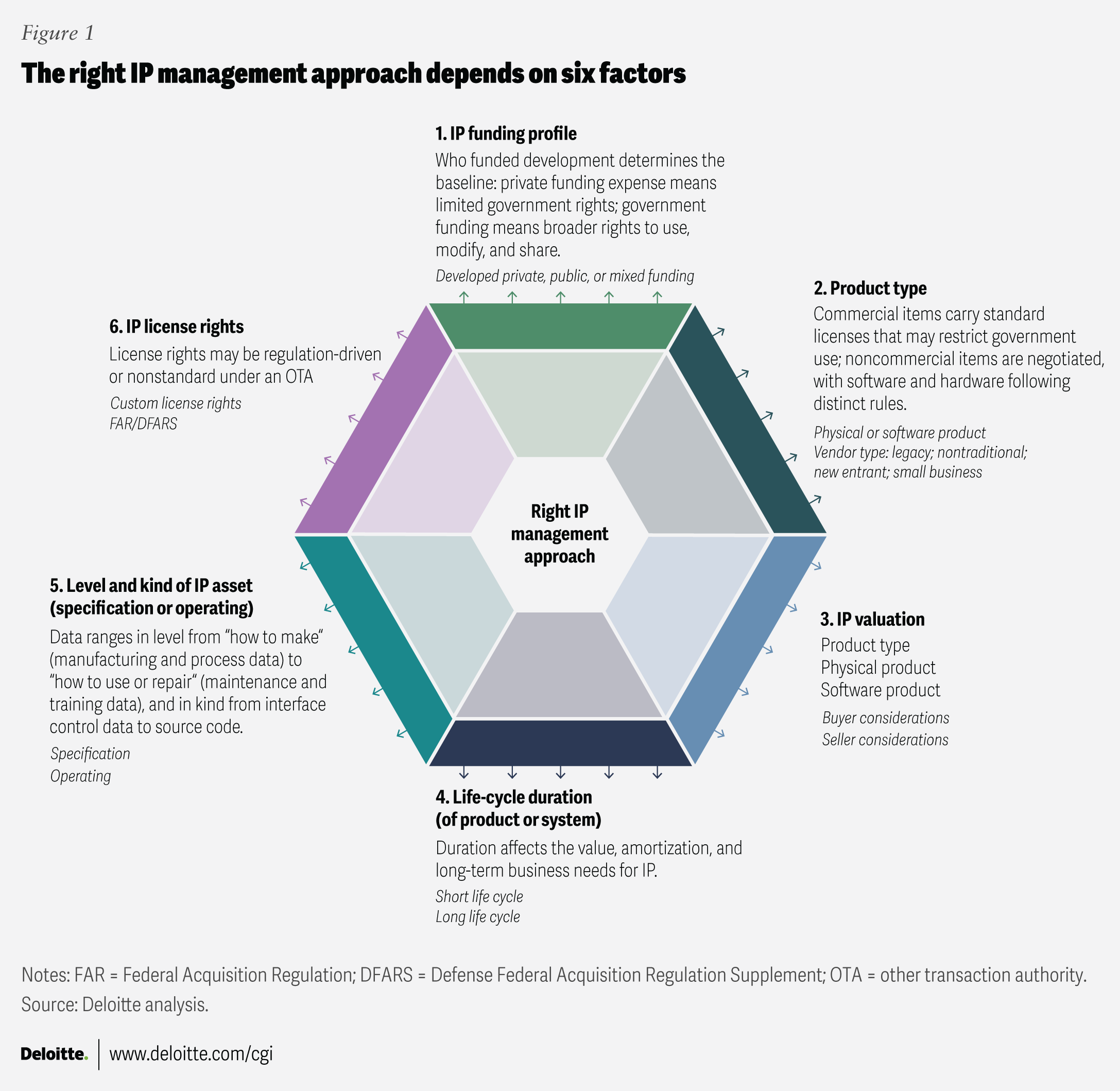
When these decisions are not managed consistently and over time, organizations can accumulate what we call “IP debt”: a gap between the IP rights the government holds on paper and the rights it can actually exercise in practice. That gap can widen with every contract that closes without a clear deliverable checklist, every modification that changes the technology without revisiting the IP strategy, and every program transition that reveals, too late, that a new vendor cannot access the documentation the previous one created.
A 2026 Government Accountability Office review of AI acquisitions across the departments of Homeland Security and Defense, the General Services Administration, and the Department of Veterans Affairs found that IP and data rights were among the most persistent challenges agencies faced.6 At the National Geospatial-Intelligence Agency’s Maven program, officials struggled to determine before contract award what level of IP and data rights would support future competition.7 Even after a two-day summit involving legal, program, and contracting personnel, officials identified a need for additional training on IP-rights clauses for AI contracts.
The path forward
Effective IP strategies should not depend on IP rights clauses in a static legal document alone. IP is a form of operational capital that can help the government sustain mission systems, modernize them, create opportunities for vendor competition, and reuse what it has already funded. Managing that capital effectively requires attention to IP rights and assets throughout the life cycle of an acquisition.
Enhanced IP management can help address this challenge. As used here, it means systems that continuously inventory IP assets, track rights provenance, monitor whether required deliverables have been received, and flag potential risks in near real time. Rather than relying primarily on manual contract reviews or spreadsheet-based tracking, these systems can bring relevant IP information into a common data and workflow infrastructure. Human decision-makers still make the calls, but with greater visibility into the information they may need.
There is no single vendor or product that solves this challenge. Agencies can build these capabilities through in-house tools, integrator-built systems, or a combination of approaches. What matters is the underlying capability, not the specific system used to deliver it. At a minimum, an effective approach should be able to:
- Establish clear metadata tags: IP assets should be discoverable across programs. Clear metadata can indicate how an asset may be shared, by whom, and for what purposes, while also providing traceability to the contract that required its delivery and the associated IP license rights.
- Trace IP deliverables: Agencies should be able to verify IP rights and required deliverables before contracts close, rather than discovering gaps years later during a compliance review. This can include tracing what was required under the contract to what was actually delivered, along with the corresponding IP license rights and data markings.
- Conduct IP clearance checks early: Before an AI platform uses training data, agencies should be able to trace the data’s provenance and identify any restrictions on its use. An IP use assessment can help flag potential restrictions before the data is ingested.
- Build an IP repository: When a vendor relationship ends, the government can use the IP rights it possesses to support future competition. To enable this, the government can build an internal market research application that scans its IP assets and alerts acquisition teams to which assets may legally be uploaded to a bidder’s library.
That future may depend on treating IP management as a continuous operational function rather than solely as a contract administration task. It may require moving from static documentation and manual review toward embedded IP experience and workflow automation, with AI helping to process large volumes of complex, changing information and flagging relevant information for human decision-makers.
The question is no longer whether government needs better IP management, but what an effective approach looks like and how agencies can build it.
by
Alan Holden
John Lisciandro
Steven Cady
Jarrett Rumoro
Kevin Almerini
We’d like to thank Samantha Thomas for her contributions to this work.
Editorial (including production and copyediting): Kavita Majumdar, Rithu Thomas, Shyamili M, and Anu Augustine
Design: Alexis Werbeck, Natalie Pfaff, and Rahul Bodiga
Cover image by: Rahul Bodiga
Knowledge services: Viswa Teja Vanapalli
Visit the Deloitte Center for Government Insights
Access more insights for the defense, security and justice, government health care, state and local government, transportation and infrastructure, human services, and higher education sectors.