
Infinite innovation: Building self-improving systems in government
From episodic innovation to continuous learning, governments should build self-improving systems powered by AI, data, and simulation
For decades, government innovation has followed a familiar rhythm. Agencies identify problems through stakeholder interviews, surveys, or periodic program reviews. Teams convene workshops or scout commercial technologies to generate ideas. Promising concepts are piloted and, if successful, implemented more broadly.
This approach has produced meaningful improvements across public services. But it is episodic, with innovation occurring in bursts—often tied to leadership initiatives, budget cycles, or external crises—rather than as a continuous capability embedded in daily operations.
But what if the innovation process itself were transformed to take advantage of new technologies?
Imagine a public service that detects where users struggle, generates potential improvements, tests those ideas in simulated environments, and deploys the most promising solutions—while learning from real-world performance. We call this model “infinite innovation”: an ongoing, cyclical, self-improving capability enabled by emerging technologies.
Infinite innovation parallels the evolution of cognitive government capabilities. While cognitive government improves how governments act and make decisions, infinite innovation improves how those systems learn, adapt, and evolve over time.
Although this vision may sound futuristic, many of its building blocks already exist. Governments already use behavioral analytics to understand how citizens interact with digital services. Affective computing and eye tracking are used to assess user responses. Generative artificial intelligence can rapidly surface potential solutions. Simulation tools—such as synthetic users and digital twins—allow ideas to be tested before deployment. Together, these technologies enable public systems to learn and improve continuously.
Imagining the future: Innovation transformed
Imagine a veteran logging into a federal benefits portal to upload medical documentation for a disability claim. Like thousands of applicants before him, he pauses at the document upload step. The system quietly registers the hesitation, along with a growing pattern of abandoned submissions and help-center calls related to file uploads.
Behind the scenes, these signals are translated into a clear need: simplifying document submission for web and mobile users. Generative AI begins generating potential solutions, from automatic file compression and mobile photo capture to clearer document guidance.
Rather than relying on overburdened staff to evaluate, implement, and deploy each option, solutions are tested in a simulated environment. Synthetic users representing different applicant profiles—mobile-only users, older veterans, and first-time applicants—interact with the redesigned workflow across different solution combinations to identify potential problems and optimize return on investment.
Once the most effective solutions and the associated user interface and user experience design are identified, the changes move through the agency’s deployment pipeline. AI agents specialized in code generation compress the development timeline from weeks to days—or even hours. Within a week, the improved upload features are live, and the system begins monitoring whether completion rates improve (figure 1).
The next improvement cycle has already begun.
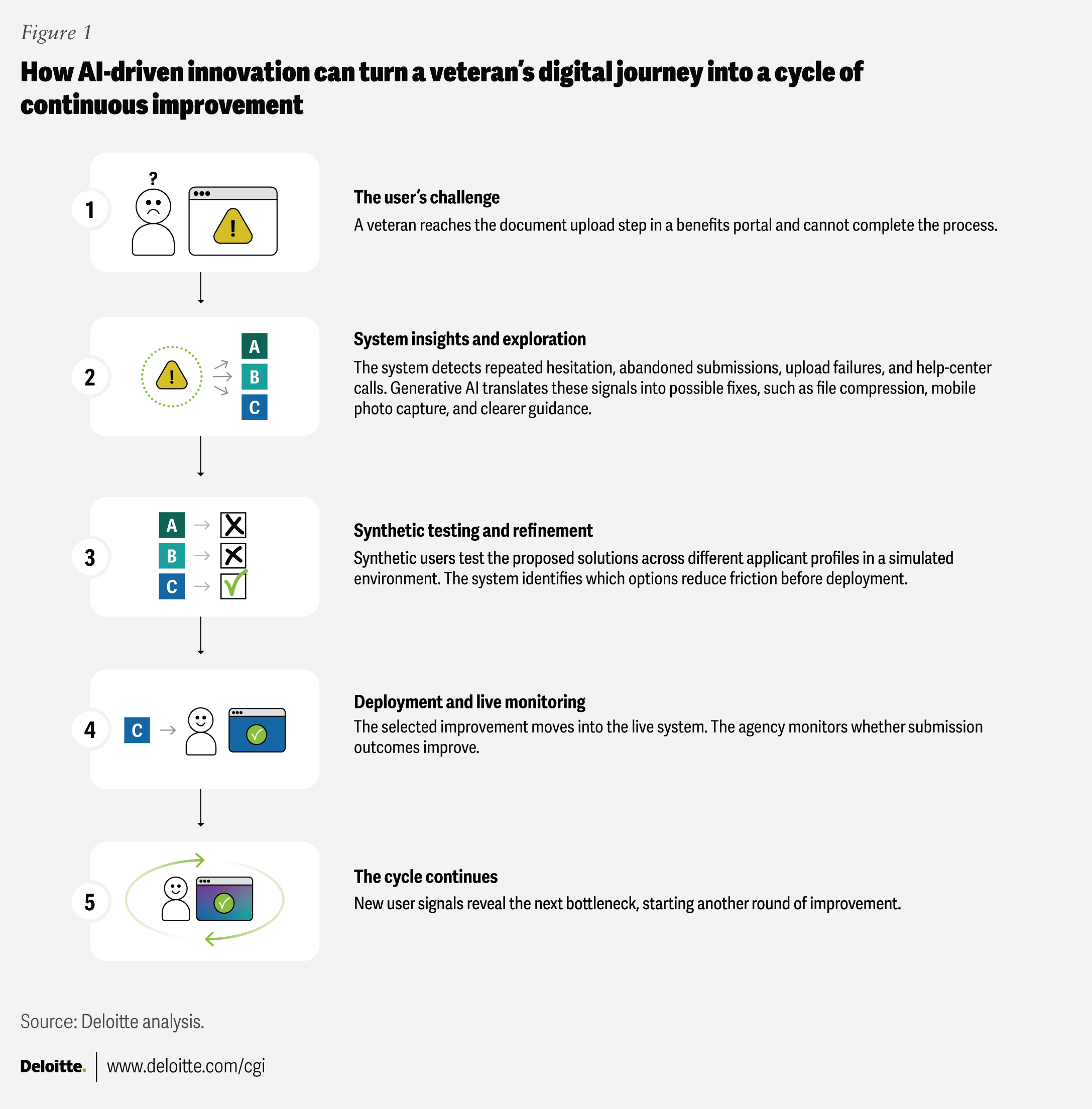
From signals to solutions: The infinite innovation system in practice
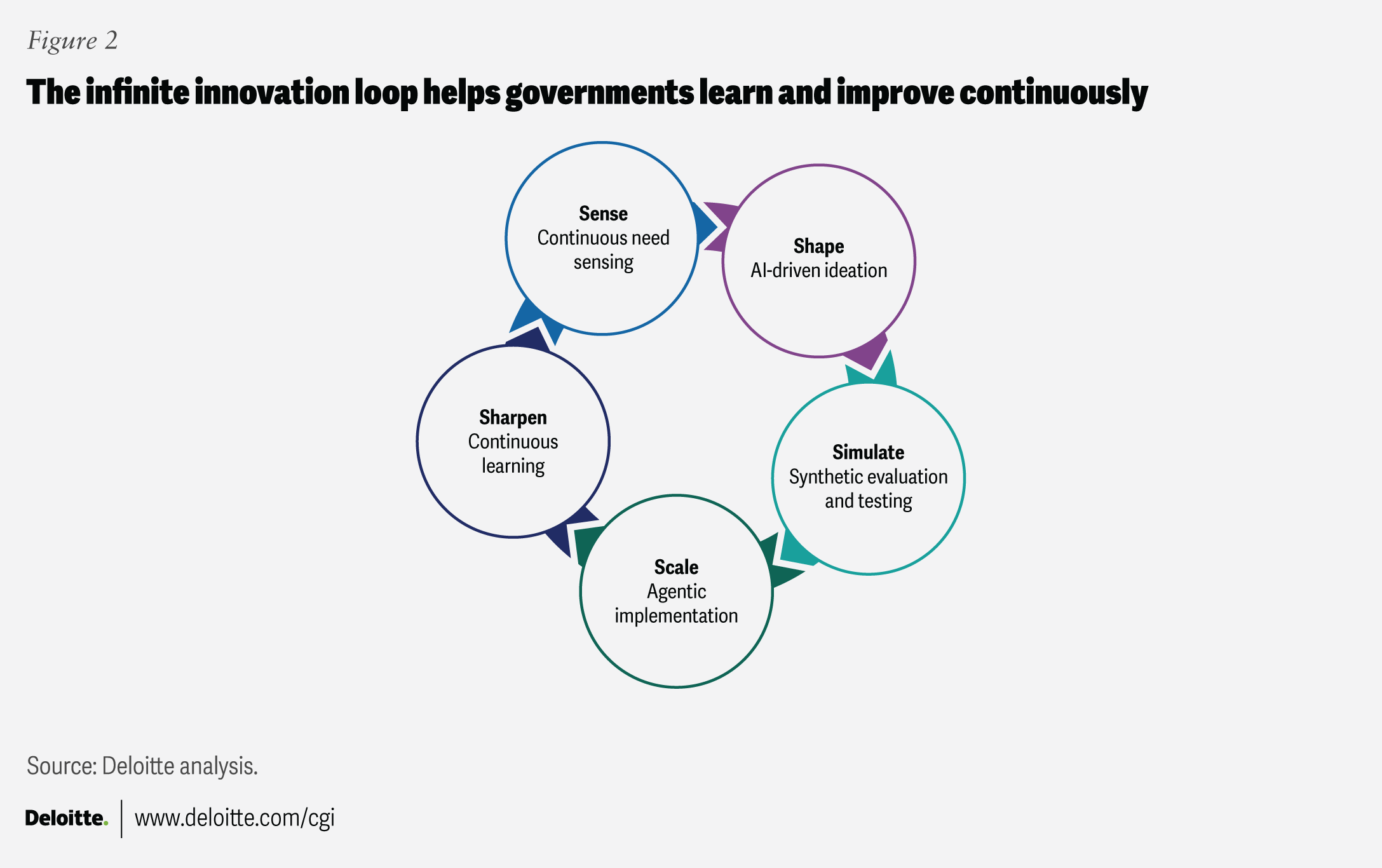
The example above illustrates a different model of innovation that operates continuously rather than episodically. Behind the scenes, improvements follow a repeatable cycle: detecting friction in real-world systems, generating potential solutions, testing those ideas in controlled environments, deploying the most promising changes, and learning from real-world results.
Together, these stages form what we call the “infinite innovation system” (figure 2).
At its core, an infinite innovation system can function as a learning system for public services. Just as modern digital platforms continuously analyze user behavior, test improvements, and refine their products, governments can increasingly design services that learn from their own performance.
Each interaction generates signals about what works and what does not. Those signals can then be translated into improvements that are tested and deployed. Over time, the system becomes better at identifying problems and implementing solutions—turning innovation into an ongoing capability.
The engines behind the infinite innovation loop
At the core of the system is the infinite innovation loop, powered by several emerging capabilities. Individually, many of these tools already exist in government and the private sector. What is new is the ability to combine them into a system that allows innovation to operate as an ongoing capability.
Each stage of the loop is powered by a different capability.
- Sense: Continuous need sensing
- Shape: AI-driven ideation
- Simulate: Synthetic evaluation and testing
- Scale: Agentic implementation
- Sharpen: Continuous learning
Together, these capabilities power the innovation loop, enabling organizations to continuously sense, explore, test, and deploy improvements.
How governments can put these capabilities to work
Sense: Continuous need sensing
As government services become increasingly digital, they generate continuous streams of interaction data—signals that reveal where users struggle, where processes stall, and where systems diverge from their intended outcomes.
Governments can analyze these signals to detect patterns of friction in near real time. Behavioral analytics, operational telemetry, and sentiment signals from call centers can reveal problems long before they appear in formal complaints or program evaluations. When analyzed using machine learning tools, these signals can be translated into structured requirements for improvement, turning interaction data into a continuous source of insight for innovation systems.
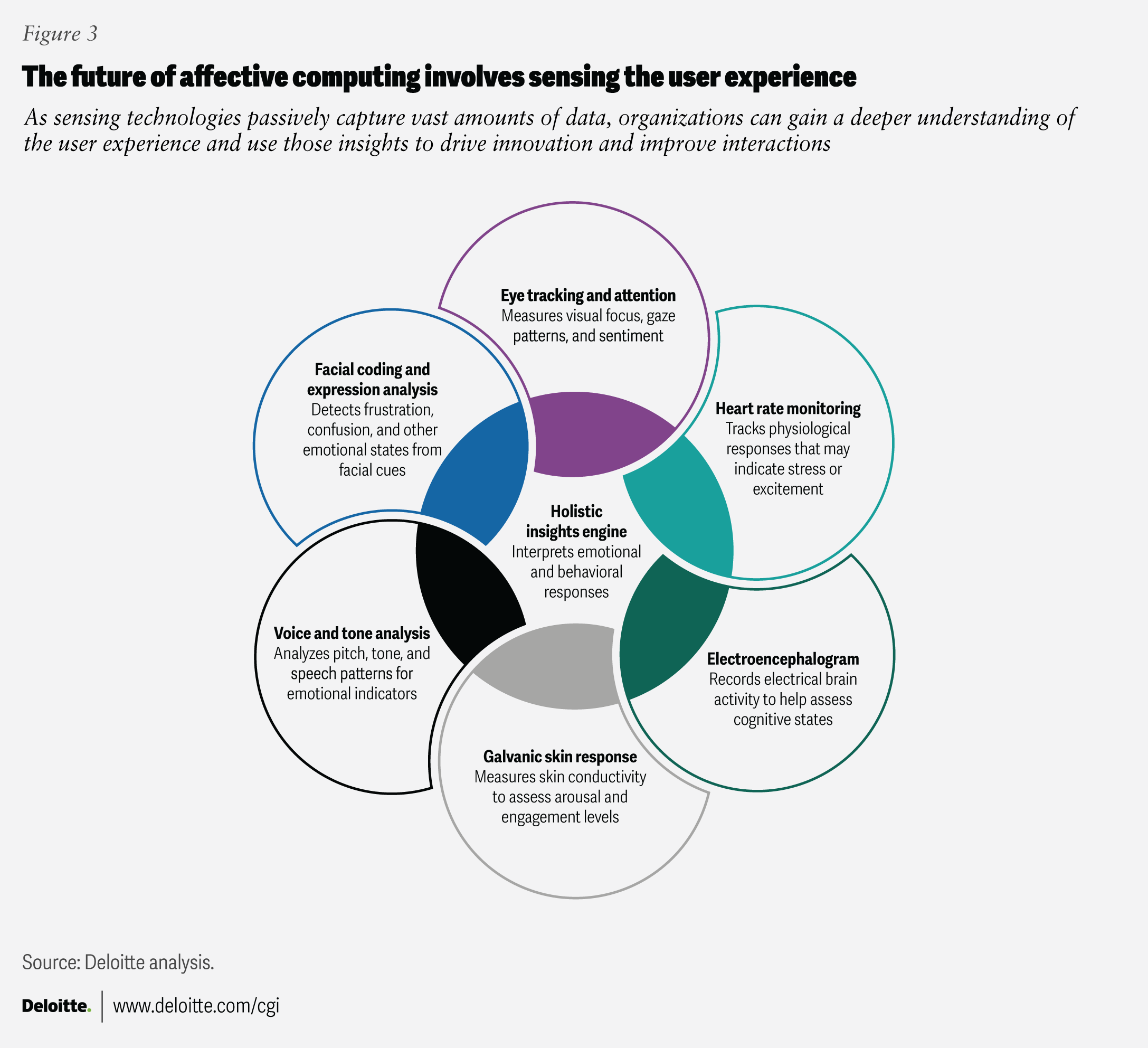
As sensing technologies advance, the range of signals available to organizations is expanding. Affective computing—technologies that interpret emotional and behavioral responses—can analyze voice tone, facial expressions, and other indicators to detect frustration or confusion. Increasingly, these tools can allow systems to capture and interpret rich signals about the user experience, with the right safeguards in place (figure 3).
Consider the previously mentioned example of a veteran accessing a benefits application portal. Service analytics reveal that many users repeatedly pause or abandon the process during the document upload step. At the same time, contact center transcripts show a spike in calls related to file upload failures. By combining these behavioral signals, the system identifies a pattern of user friction and flags the document submission process as a priority for improvement.
Shape: AI-driven ideation
Once needs are identified, innovation can turn to generating possible solutions. Workshops, brainstorming sessions, crowdsourcing campaigns, and technology scouting have long been the primary tools for generating ideas. While valuable, these approaches are constrained by time, cognitive bandwidth, and the diversity of perspectives available.
Generative AI changes the scale of this exploration. Rather than producing a handful of ideas, AI systems can generate and evaluate thousands of potential approaches based on defined requirements, institutional knowledge, and historical data. These systems can produce workflow redesigns, service delivery improvements, and technical architectures, exploring large solution spaces to identify promising options that teams can refine and evaluate.
For more on the implications of AI in design work, see “Designing for the public sector with generative AI.”
Simulate: Synthetic evaluation and testing
As the volume of potential solutions increases, organizations need new ways to evaluate ideas quickly and safely before deploying them in real-world systems. Traditionally, governments have tested new policies or service designs through pilot programs, usability testing, or limited trials with real users. These approaches remain essential, but they can be time-consuming, expensive, and difficult to scale.
Synthetic users and digital twins provide a complementary way to accelerate experimentation. Synthetic users can interact with prototype services or policies to explore how different groups might experience a change. Synthetic users should be calibrated using behavioral and affective signals captured during need sensing. Patterns such as hesitation, repeated backtracking, escalation to agents, sentiment shifts, and drop-off points can be used as training targets and validation checks. This helps ensure that simulations reflect how real users experience friction and respond to changes.
Together, these tools allow innovation systems to stress-test ideas, identify edge cases, and narrow the field of potential solutions before moving to real-world testing.
Scale: Agentic implementation
Even when promising ideas emerge, translating them into deployed solutions has historically been one of the slowest stages of innovation. Requirements must be translated into technical specifications, systems must be built or modified, and testing must ensure that changes meet security, accessibility, and operational standards. These steps are necessary, but they often create bottlenecks that slow the pace of innovation from concept to reality.
Advances in AI-assisted software development can accelerate this process. AI code generation tools can produce application components, testing scripts, and infrastructure configurations based on defined requirements. When integrated into modern development, security, and operations pipelines, these systems can help teams translate validated concepts into deployable software more quickly while maintaining human oversight at critical decision points.
As these capabilities mature, they may allow innovation systems to move from idea to implementation much faster, enabling continuous deployment and learning.
Sharpen: Continuous learning
Another defining capability of the infinite innovation system is the ability to learn from experience. Every experiment generates information about what works, what doesn’t, and how systems behave under different conditions. Over time, these insights can be incorporated into the data, models, and decision-making processes that power the innovation system.
The result is institutional memory. Rather than rediscovering the same lessons repeatedly, agencies can build systems that accumulate knowledge about which interventions are most effective in their specific operating environments. Over time, organizations that build these capabilities will not simply improve individual services—they will learn faster across the enterprise.
Designing and launching infinite innovation systems
Building infinite innovation systems requires more than new technologies. It also requires a clear operating model that connects sensing, ideation, testing, and implementation into a continuous cycle while maintaining appropriate safeguards.
Rather than transforming entire organizations at once, agencies can begin by building a prototype innovation loop around a high-impact problem and scaling from there.
1. Start with a high-impact service journey
Select a single service or operational process where improvements could deliver meaningful benefits. High-volume, complex, or high-friction journeys—such as benefits applications or permitting processes—provide ideal starting points. Focusing on one journey creates a manageable experimentation environment while generating measurable outcomes.
2. Build the insight-to-action pipeline
Continuous innovation depends on translating signals into action. Agencies should integrate service analytics, operational data, and user feedback into a pipeline that converts real-world signals into structured requirements and hypotheses for improvement. The goal is to move beyond dashboards toward mechanisms that translate insights directly into hypotheses, creating a pipeline from experience data to potential solutions.
3. Generate and test solutions at scale
Generative tools allow teams to explore a wide range of solutions. These may include service redesigns, workflow changes, policy adjustments, or technology enhancements. Simulation environments, synthetic users, and controlled pilots enable rapid testing before deployment. Together, these capabilities allow organizations to identify and refine the most promising options quickly.
4. Establish governance and human oversight
Continuous experimentation requires strong guardrails, such as transparent audit trails, explainability requirements, privacy-by-design data practices, and ongoing monitoring for bias or model drift.5 Human judgment remains essential for decisions involving policy interpretation, equity, security, and public trust. Effective systems focus human oversight on these critical decision points while allowing routine iteration to proceed quickly.
5. Design for continuous learning
Each cycle of experimentation generates insights that can improve future decisions. Over time, organizations can build institutional memory—systems that accumulate knowledge about what works and continuously refine performance. This shifts the role of leadership to designing the structures that enable organizations to sense, learn, and adapt over time.
Building governments that learn faster
For decades, innovation in government has largely been episodic, driven by task forces, pilot programs, or reform initiatives aimed at solving specific problems at a particular time. While these efforts have produced important improvements, they often struggle to keep pace with environments that are increasingly dynamic, complex, and data-rich.
Emerging technologies now make it possible to imagine a different model: public systems that continuously detect problems, generate solutions, test ideas, and deploy improvements through an ongoing cycle of learning.
In this model, innovation becomes less about isolated initiatives and more about systems designed to learn from their own performance.
The governments that succeed in the years ahead may not simply innovate more. They will learn faster, more continuously, and at a greater speed and scale. Governments that don’t build these capabilities risk falling behind systems that learn and adapt in real time, creating widening gaps in service quality, responsiveness, and public trust.
by
Alan Holden
William D. Eggers
Meghan Sullivan
Courtney Brett
Kevin Almerini
The authors express their gratitude to Mahesh Kelkar, Tori Carter, and Nicole Savia Luis for their invaluable operational and research support in the development of the draft.
Editorial (including production and copyediting): Kavita Majumdar, Aparna Prusty, Pubali Dey, and Anu Augustine
Design: Sanaa Saifi, Jaime Austin, Natalie Pfaff, Meena Sonar, and Harry Wedel
Cover image by: Sanaa Saifi, Jaime Austin; Adobe Stock
Knowledge services: Rishitha Bichapogu
Visit the Deloitte Center for Government Insights
Access more insights for the defense, security and justice, government health care, state and local government, transportation and infrastructure, human services, and higher education sectors.