
Health care innovation hubs: A catalyst for technology adoption across federal health
Can applying human-centered design principles in an innovation incubator be the key to a technological revolution?
Many successful technological breakthroughs are less about helping people and companies do new things and more about enabling them to do familiar things better, faster, and more securely. Often, the key is eliminating friction in an onerous process. Remember how many steps it took—not so long ago—to deposit a check into a bank account and the subsequent time it took for the money to become available. Mobile banking dramatically streamlined these processes. According to Forbes, as of 2022, 78% of Americans surveyed prefer digital over traditional banking, providing financial institutions the opportunity to boost customer satisfaction and loyalty.1
The health care space has long struggled with similar challenges related to efficiency, speed, and security, with hopes that technology will solve many of the problems. Clinicians are looking for new technologies to help make their work easier.2 It’s also likely that clinicians will expect emerging tech to meet their patients’ needs while patients seek a health care experience free from complications or disruptions.3 And all stakeholders—clinicians, patients, and administrators—need new technology to be reliable and secure.
Just as banking apps shifted the playing field for fintech, artificial intelligence–based technologies could revolutionize health care delivery. Predicting patient outcomes through machine learning, virtual health assistants, remote patient-monitoring tools, wearables, and other technological advancements can help clinicians deliver better health care services.4 But the revolution—one that the industry could have to help boost efficiency, effectiveness, and coverage—hinges on clinicians and their patients being able to adopt such technologies.
Federal health leaders can play a role in this transformation through federally sponsored innovation hubs focused not just on fast-tracking innovation but also on accelerating adoption. These hubs can serve as a platform for testing and advancing health care technologies that can transform both clinician and patient experiences. Using a human-centered design approach, federal health leaders can revolutionize innovation hubs, going beyond tech development and deployment to create a system that learns from care providers and designs for their tasks and environments.
With a focus on the real-world needs and challenges faced by clinicians (doctors, nurses, allied health professionals, pharmacists, and other health care providers), innovation hubs can create solutions that meet clinicians where they are and ultimately address the needs of their patients, too, helping to promote greater adoption and catalyze the tech revolution.
Innovation hubs have a history of accelerating innovation and are well-suited to a federal health environment
As early as 1998, Michael E. Porter, a professor emeritus at Harvard Business School, defined business clusters as the “geographic concentrations of a critical mass of interconnected companies and institutions in a particular field” in a Harvard Business Review article.5 This definition has now been broadened in the field to recognize not only the physical closeness of organizations but also the dynamic interactions and evolutionary processes that contribute to the collective growth and innovation of a cluster.6 For decades, Silicon Valley has been touted as a gold standard for innovation hubs, allowing participants to innovate in fail-safe environments.7 By fostering collaboration among academia, industry, and government, it has been able to create synergies that can accelerate the development and commercialization of new technologies. Noteworthy achievements include the commercializing routers that formed the backbone of the internet and the establishment of the modern semiconductor industry.8
Innovation hubs are incubators designed to catalyze the development and adoption of cutting-edge health care technologies.9 Key features of innovation hubs include:
- Focused expertise: Involves skilled professionals and people possessing deep domain-specific knowledge
- Collaborative environment: Fosters partnerships and networks between academia, industry, government, and nonprofits to share knowledge and codevelop solutions.
- Advanced infrastructure: Equipped with state-of-the-art technology and tools necessary for research, development, and testing.
- Regulatory and compliance support: Provides capabilities to conduct clinical trials and other necessary testing while also understanding how to comply with health care regulations and standards.
In health care, innovation hubs can help accelerate technology adoption by providing a controlled environment to test and refine new technologies before they are rolled out on a larger scale.
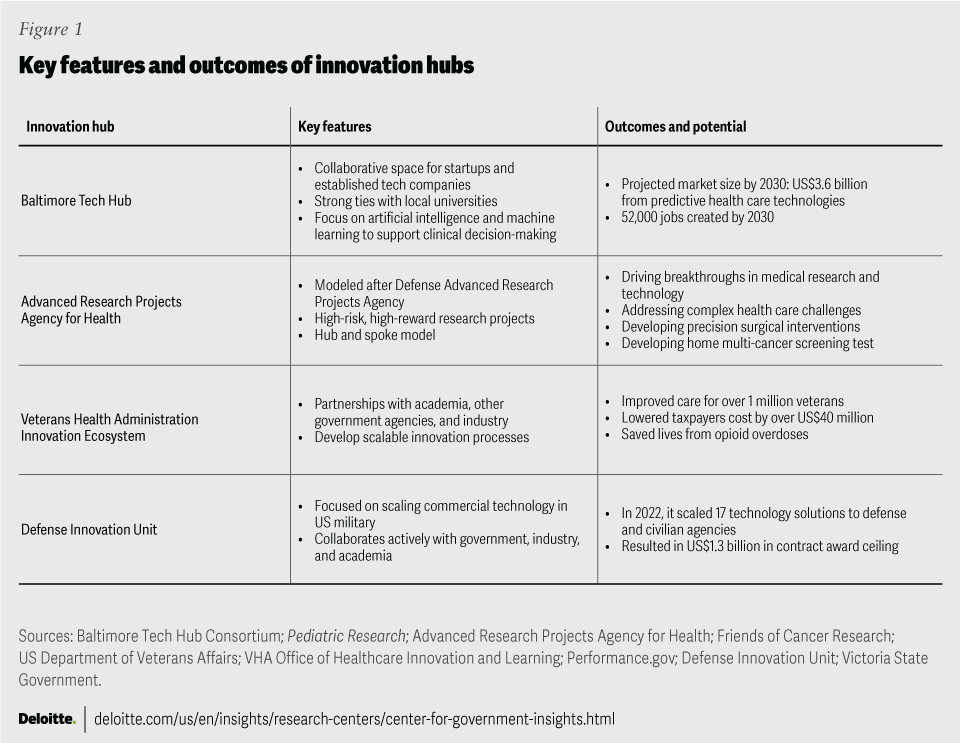
Agencies like the Veterans Health Administration (VHA) and the Department of Health and Human Services (HHS) are already frontrunners in prioritizing cutting-edge technology solutions to improve patient care through efforts like the VHA Innovation Ecosystem (figure 1). Building on such initiatives, innovation hubs can be used to test and scale technologies across the network of Veterans Affairs hospitals, Military Health System facilities, and HHS services, saving time and resources.
For example, the Baltimore Tech Hub in Maryland is developing predictive health care technologies (figure 1).10 The hub has built its own equitable technology model called “Equitech” to develop tech supporting clinical decision-making, bioethics, personalized medicine, new biologics, and therapeutics.11 Along with this, the hub also seeks to benefit the region by opening up new career pathways for veterans and opportunities for youth from disadvantaged backgrounds and low-income families.12
The innovation hub approach can help produce significant advancements in scientific development (figure 1). But, their impact can be furthered by incorporating human-centered design principles by directly involving clinicians in the design, testing, and scaling of innovations (see “The human-centered design imperative for the technology revolution”).
The new tech revolution will have to overcome adoption hesitancy
Transforming a sector with technology requires not just capital, time, and talent—all of which are often in short supply in health care today—but also clinician willingness to embrace new technology.19 Providers today may be hesitant to take on new, unproven technology that could divert critical resources and time away from immediate patient care.20
Clinicians have often found that technology adoption can increase the burden rather than alleviate it.21 This was particularly evident following the 2009 America Recovery and Reinvestment Act, which led to the near-universal adoption of electronic health records (EHR) across the nation’s health care system. Despite this widespread implementation, some clinicians were disappointed with the unexpected consequences of the changes (see “Lessons from the past: When change is too hard, by design”).22
They expected measurable gains in safety, quality of care, and patient outcomes while saving time on paperwork.23 But, clinicians reported losing face time with patients and spending around six hours daily on administrative tasks like documentation, order entry, billing and coding, system security, and inbox management, both during and after clinical hours.24 It’s understandable, then, that many clinicians approach new technology with caution.
Efforts to usher in the smart technology revolution should consider the context in which clinicians operate today and what they want new tech to do for them. Meeting clinicians where they are should be a precursor to transforming the health sector’s use of technology.
From evolution to revolution: How human-centered innovation hubs can promote faster adoption of emerging technologies
Federal health leaders may be well positioned to help drive the next technology revolution—and to massively boost the scale. To help usher in a new era of transformative technology, federal health leaders can support clinicians with the resources they need to be successful, working to make changes as frictionless as possible. Federally sponsored innovation hubs using human-centered design thinking can test and promote innovations that facilitate both clinician and patient experience.
To help foster this environment of innovation and collaboration, federal health leaders can consider promoting a human-centered design approach before incentivizing emerging technologies that can meet clinicians where they are.
Considerations when promoting a human-centered design approach to federal health innovation hubs
Create an innovation hub for testing and adapting new technologies, using regional learning collaboratives to spur innovations focused on what matters to clinicians and patients regionally. An innovation hub can play a pivotal role by coordinating usability testing of new technologies and testing and promoting interoperability and equitable integration into the health care system. The focus should be on integrating emerging tech in a way that is evidence-based, unbiased, and minimally disruptive to the patient-provider relationship.
Similar innovation hubs already exist throughout the government to solve public policy problems. An example of this is the Advanced Research Projects Agency for Health model, which embodies a culture of measured risk-taking and rapid innovation. This dedicated funding infrastructure allows researchers to boldly pursue groundbreaking projects, nurturing disruptive ideas from incubation to scale. The program fosters a dynamic environment where experimentation is encouraged, helping to strengthen the potential for developing novel technologies that transcend traditional disease-specific treatments.36
Similarly, the VHA’s Office of Healthcare Innovation and Learning strengthens VHA health care by driving creative solutions and practices, building innovation competencies, integrating simulation with emerging health care technologies, and using clinical training to promote high reliability within the organization.37 VHA Office of Healthcare Innovation and Learning has used a simulation health care training program called Simulation Learning, Evaluation, Assessment, and Research Network to test new technologies such as AI ambient dictation within simulated health care operations.38 It also tests the integration of anesthesia equipment with the VHA’s new EHR in a simulated operating room and adapts clinical workflows utilizing new technology.39 Partnerships with vendors and clinical leaders in this process have incorporated clinician perspectives while promoting adoption, patient safety, staff experience, and patient experience.
A hub can also act as a sandbox for regulations. While regulations targeting technology are part of the American health care system, incorporating new tech into the medical workflow can create tensions between the rules as written and rules as they operate. The innovation hub could monitor the implementation of both new technologies and the rules concerning them, aiming to resolve tensions as they arise. The hub could continually adapt to address broader trends in the industry. New technology development in the past decade has shifted toward consolidation within health systems and more coordination of care across public and private stakeholders. For example, the CDC Technology R&D Team promotes the testing and adoption of innovative solutions to public health challenges through various programs and incentives.40
For innovation hubs to meet the mission of spurring novel technology adoption, they should operate under a framework that emphasizes rapid prototyping, iterative testing, and user feedback integration. This approach can allow for the quick identification of potential improvements and the agile adaptation of technologies to better meet the needs of clinicians and patients. Additionally, strong partnerships with regulatory bodies and alignment with health care policies can be crucial to navigate the complex landscape of health care technology approval and implementation, helping facilitate the seamless integration of new innovations into existing systems and practices.
Anchor design, development, and deployment in a human-centered design approach. For a tech revolution to work, we need to revolutionize innovation hubs using human-centered design principles to focus on not just science but also what clinicians are looking for from technology. Broad adoption is vital, and it’s important for leaders to keep in mind the whole range of users. By making clinician-friendly systems, health care organizations can facilitate quicker and more universal adoption of new technologies.
A human-centered design approach focused on making technology more intuitive, iterative, and responsive to care provider needs can help health care organizations achieve universal and rapid adoption of new technologies. Clinicians may resist adopting new systems that degrade existing levels of comfort, security, safety, and quality or that require them to take on new responsibilities that don’t align with provider roles.
Clinicians may be more likely to use technology that meets their needs: strengthening human connection and improving care outcomes, quality of care, patient experience, and clinical value.46 They’re looking for systems that make patient data safe, secure, reliable, high-quality, and shareable.47 Clinicians we spoke to prefer a robust accountability framework that not only clarifies governance but also can result in continuous improvement of AI systems, particularly if an AI-aided diagnosis misses a significant risk factor.48 Care providers may also look to augment AI as a reliable support tool for clinicians, focusing on iterative advancements rather than merely assigning blame.49
The federal Office of the National Coordinator for Health Information Technology pushed for the development and adoption of health information technology systems designed with a patient-centered approach. The office was instrumental in promoting the use of EHRs that prioritize patient access and control over their health data, resulting in the nearly ubiquitous use of patient portals today.50 Leaders could apply this same effort toward clinician-centered design.
By making human-centered design a core tenet of innovation hubs, the development of new technology can result in not only technical robustness but also user-friendliness and customization to meet end users’ needs. Moving away from the concept of getting it right the first time, the focus can be more on human-centered design approaches such as heuristic evaluations, usability testing, simulation, and prototyping.51 For instance, a clinical decision support system might be redesigned to simplify its utility based on feedback from clinicians who found the original system too rigid or nonintuitive.52 This redesign could focus on integrating more flexible, context-sensitive guidelines and alerts that directly support the clinical workflow, thereby increasing adherence to leading practices and improving patient outcomes. By actively seeking and incorporating real-world feedback, leaders within these hubs can make health care technology more effective, resulting in better patient outcomes and improved clinician workflows.
Work to mitigate risk by centering empathy in design research. Empathy is at the core of human-centered design, which involves understanding the needs, challenges, and contexts of end users. In health care innovation hubs, this might involve detailed observations, interviews, and shadowing of clinicians to gather insights into their daily experiences and pain points. Identifying potential issues early in the design process can allow for adjustments before costly development errors might occur. This approach can also build a stronger connection between the product and its users, potentially increasing user satisfaction and loyalty.
The Blue Button initiative adopted by the Veterans Affairs (VA) is a prime example of how federal health programs can effectively use empathetic design to help address specific user needs. The VA conducted consultations with veterans, gathering insights into their experiences, frustrations, and needs regarding health record accessibility. Based on these insights, the VA developed the Blue Button patient portal technology, accommodating veterans’ varying levels of tech-savviness and physical abilities and improving overall health management and outcomes.53 One study found that 73% of Blue Button users surveyed noted understanding their own health history as the primary advantage since it consolidates information in one location.54 Additionally, 21% of those users shared their VA health data with non-VA providers, and 87% of external providers found the information to be helpful.55
Evaluate new tech return on investment and identify policy and reimbursement facilitators for widespread adoption. As part of the innovation hub, federal health leaders can encourage objective, transparent, and standards-based evaluation of new technologies. The National Institutes of Health Information Technology Acquisition and Assessment Center uses cost-savings and cost-avoidance metrics to measure the return on investment of new technology procurements.56 Where feasible, pilot testing can assess the return on investment before full-scale deployment through nationwide incentive programs. These smaller, controlled environments provide insights into potential challenges and user acceptance, allowing for necessary adjustments before wider implementation.
Likewise, federal health agencies can lead parallel analysis of required policy and reimbursement changes that need to occur to enable adoption. Adopting flexible contracting methods like Other Transaction Authorities can improve this process by encouraging rather than restricting innovative thinking within the industry. This can result in contractual models that are compatible with the agile development and deployment of new technologies.
Championing health care innovation: The federal catalyst
Technological innovation has the potential to improve health care outcomes—provided clinicians and patients adopt it. That’s where the federal government can make a real difference. From developing life-saving vaccines to its commitment to value-based care, the government has been a fundamental driver of health care innovation—and it can bring the industry together. Through innovation hubs, agencies can play a significant role today, helping accelerate tech adoption by focusing on what matters to clinicians and addressing tech hesitancy head-on.
As new technologies rapidly come online, agencies should put people first as they work to foster innovation. By meeting clinicians where they are in this environment, federal health leaders can catalyze a health care technology revolution that is increasingly necessary. This proactive approach can not only help accelerate the adoption of vital technologies but can also solidify the government’s role as a pivotal player in shaping a future where health care is both cutting-edge and equitable.
By
Tim Small
Laura Baker
Alison Muckle Egizi
Ipshita Sinha
Paige Leiser
Joe VerValin
The authors would like to thank Dr. Mark Ediger for his insights and thoughtful feedback on the draft; they would also like to thank Nicole Savia Luis, David Noone, Elene Nakas, Cristian Carrillo, Elias Contrubis, and Roxie Zarate, for supporting the study. They are grateful for the insights shared by Andy Davis, David Betts, Dr. Ken Abrams, Dr. Bill Fera, Dr. Rich Stone, Anwesha Dutta, Dr. Shaun Rangappa, Christine Chang, Dr. Marc Perlman, Dr. Bharat Sutariya, Ankur Shah, Neal Batra, and Dr. Asif Dhar for the study.
Cover image by: Jim Slatton
Visit the Deloitte Center for Government Insights
Access more insights for the defense, security and justice, government health care, state and local government, transportation and infrastructure, human services, and higher education sectors.