
Rewiring regulation: From static rulebooks to adaptive, data-driven oversight
Across regions, regulators are updating rules, tools, and processes using AI, sandboxes, and data to make regulation more adaptive while maintaining public trust
A generation ago, regulators could take years to draft and finalize rules. Today, they must adapt in months.1 Advances in data, AI, and digital design are reshaping how regulation is written, implemented, and enforced—turning static rulebooks into more adaptive, evidence-driven systems.2
As technology accelerates change, agencies are modernizing regulatory processes without compromising public trust or safety. Governments are pairing policy reform with smart tools—from generative AI to regulatory sandboxes and policy simulation—to make rules clearer, more precise, and easier to comply with.3 Speed and consistency, often thought to be incompatible with public oversight, are fast becoming not only achievable but expected.4
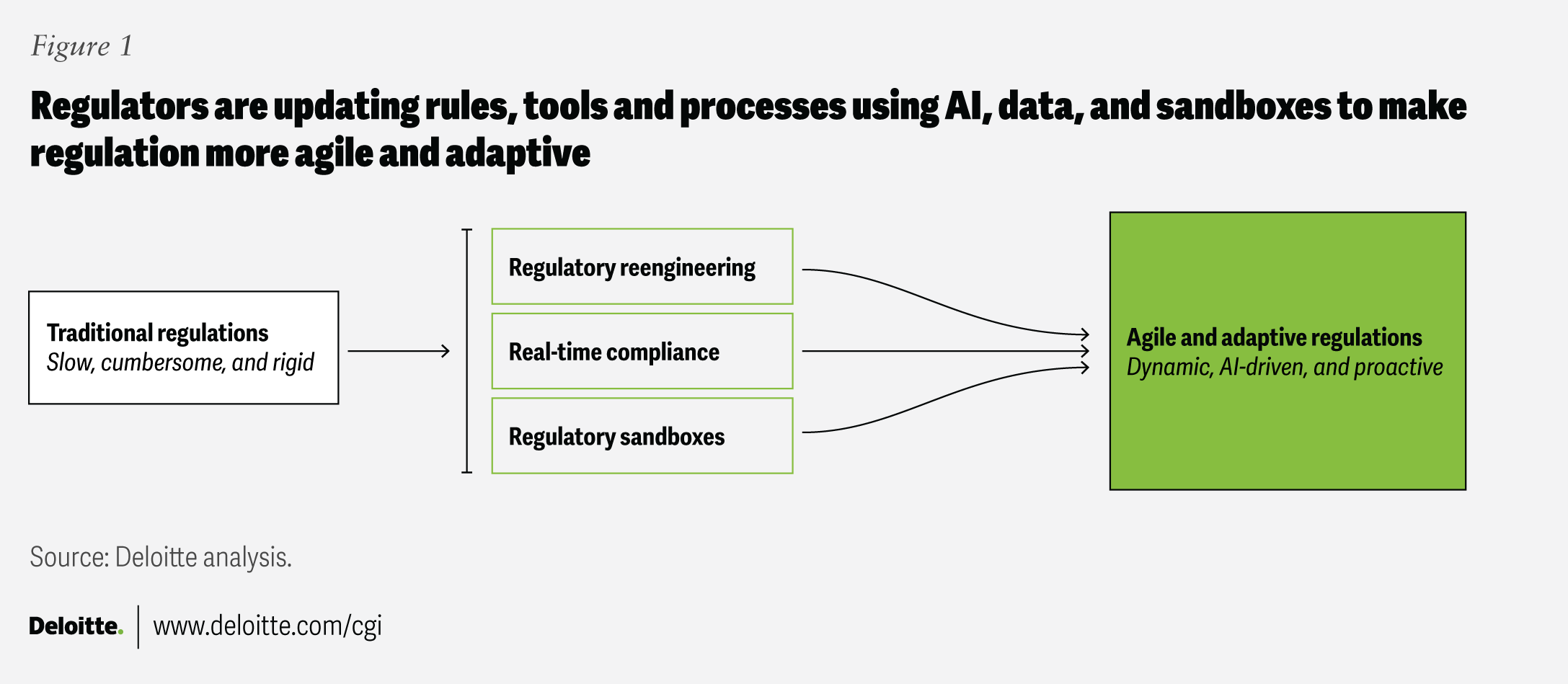
Dense and overlapping regulations are being rewritten in plain language and converted into machine-readable formats.5 One-stop portals, automated code checks, and streamlined workflows are simplifying compliance journeys.6 Policies can now be tested in controlled environments before broad rollout, with data used to refine rules over time (figure 1).
Trend in action
Regulatory reengineering: Using AI to turn complex regulations into easy-to-understand language
Regulations are often dense, cross-referenced, and amended over time, making even simple questions difficult to answer. AI is accelerating efforts to simplify how agencies write, interpret, and apply rules.
Governments are converting legislation into machine-readable formats, allowing digital systems to guide users through tailored compliance journeys that clarify what applies and what to do next.7
Australia has been a front-runner. Its Rules as Code initiative, launched as a sandbox, helps agencies translate legislation into machine-readable services.8 In New South Wales, the Community Gaming Check tool uses a short questionnaire to determine instantly whether a local gaming activity requires approval.9
By translating complexity into structured logic, regulatory reengineering can deliver faster decisions, fewer errors, and greater confidence in outcomes.10
Laws can be challenging for regulators to navigate. Legal jargon, cross-references, and scattered amendments can turn simple questions into time-consuming research exercises.
The impact varies by role:
Policy experts: Using AI to translate law into actionable guidance
AI-enabled tools help policy teams turn statutory language into practical guidance while preserving legal authority. In Minnesota, the Department of Revenue and Minnesota IT Services built an AI-driven legislative tracking system in 90 days. It analyzes 100 bills per minute and has processed more than 6,500 bills with 99% accuracy, saving over 1,000 hours of manual review each session.11
Businesses: Clarity that lowers the cost of compliance
Reengineering can consolidate fragmented rules into clearer obligations. The Netherlands’ Permit Check tool identifies which environmental regulations apply to a specific address, guiding users through relevant requirements.12
More broadly, aligning overlapping rule sets within a single business process rather than treating each approval separately can reduce delays and improve coordination across agencies.13
Citizens: Simplified access to services
Applying a customer-experience lens to regulation enables end-to-end service journeys. Pre-filled forms, semi-automatic data exchange, and embedded compliance checks help citizens and professionals get it right the first time.
Estonia has digitized all government services, allowing citizens to register life events online through integrated, safeguarded systems.14
Cleaning up the rulebook: Ensuring regulations are clear, current, and consistent
Over time, regulatory systems accumulate complexity—overlapping provisions, outdated requirements, and inconsistent guidance. AI is helping regulators surface and address that hidden friction.
Virginia’s agentic AI pilot scans statutes, regulations, and guidance to identify contradictions, redundancies, and opportunities to simplify language. When rules change, related portals, forms, and checklists can update automatically, keeping compliance requirements aligned with current law.15
The Flemish Government’s Regelrecht initiative similarly focuses on identifying unnecessary rules and simplifying processes in collaboration with citizens and businesses.16
These efforts are converging into digital regulatory twins—virtual representations of the regulatory landscape that map applicable rules over time, flag overlaps, and test proposed reforms before implementation. New South Wales’ Legislation Twin brings laws into a unified, machine-readable system to support clearer analysis and decision-making.17
By continuously cleaning and modeling the rulebook, regulators can reduce ambiguity, prevent drift, and make reform more deliberate and evidence-based.
Real-time compliance: From paper-based processes to continuous digital oversight
Governments are shifting compliance from paper-heavy, sequential processes to integrated digital journeys. The aim is not speed for its own sake, but earlier clarity, faster approvals, and targeted human oversight for complex cases.
One front door for compliance
Single portals are simplifying regulatory interactions and supporting growth. Portugal’s one-stop business registration platform increased firm creation, while similar reforms in Colombia boosted new registrations.18 Nevada’s unified licensing platform allows businesses to apply for, manage, and renew licenses in one place, reducing duplication across agencies.19
One-stop portals have emerged as a global regulatory trend, helping to simplify compliance and spur economic activity.
AI-assisted approvals and audits
Lengthy permitting processes remain a major barrier to housing and infrastructure, driving up costs and extending delivery times.20 AI tools can help to speed up permitting by interpreting complex codes and conducting automated pre-checks, flagging issues before formal review. In Austin, AI-assisted building permit reviews reduce processing time and allow staff to focus on more complex applications.21 Across the US federal government, automation could save tens of millions of staff hours annually in compliance and enforcement.22
AI can also reduce burdens by allowing businesses to submit data in formats that suit their systems, with regulators extracting and standardizing required information automatically.
Strengthening inspections with real-time evidence
Drones and earth observation technologies are strengthening inspections by providing high-resolution, real-time data that is often more accurate than traditional ground surveys. Equipped with sensors such as light detection and ranging, these approaches can capture detailed imagery of wildlife, habitats, water, coasts, bridges, and roads, enabling faster, more accurate, and cost-effective decision-making.23
Cincinnati uses AI-enabled drones to inspect bridges and roads, lowering costs, reducing risk to inspectors, and compressing analysis timelines from months to minutes.24
Drones and earth observation data are helping to transform inspections and environmental compliance by providing real-time, high-resolution data.
Across these examples, a consistent model is emerging: a single entry point, automated pre-checks, risk-based human review, and continuous system updates. When applied across the regulatory lifecycle—from authorization to supervision and enforcement—this approach preserves public protections while improving speed and consistency. To realize the full promise of real-time regulation, similar innovations should extend across the entire regulatory value chain—including supervision and enforcement.
Regulatory sandboxes: Creating a safe space for innovation and oversight
As innovation accelerates, regulators face a widening gap between technological change and rulemaking cycles.25 Regulatory sandboxes help close that gap by creating controlled environments where new products and technologies can be tested under supervision before full market deployment.26
Sandboxes enable iterative learning. Regulators gather evidence, refine safeguards, and adjust frameworks while maintaining public protections.27 What began as isolated pilots is increasingly becoming a standard feature of adaptive regulation.
AI sandboxes: Tightening the gap between innovation and regulation
Given the rapid pace of AI development, many governments are embedding experimentation directly into regulatory design. The European Union’s AI Act requires each member state to establish at least one AI sandbox.28 In the United Kingdom, the AI Growth Lab allows businesses to test AI technologies under regulatory observation, helping policymakers assess risks and opportunities in real time.29
Participatory sandboxes: Co-designing safeguards with innovators
Some regulators are shifting from prescriptive oversight to co-design. The UK Financial Conduct Authority’s AI Sprint brings together industry, academics, consumer groups, and regulators to identify risks and develop safeguards collectively. In combination with the authority’s AI Input Zone, this approach provides early visibility into emerging use cases and aligns innovation with public protections.30
Energy sandboxes: De-risking the energy transition through controlled trials
In the energy sector, sandboxes enable real-world testing of new technologies under relaxed conditions.
Singapore’s Energy Market Authority uses regulatory sandboxes to grant temporary waivers, enabling new products and services—such as virtual power plants, which digitally bundle distributed energy resources to operate as a single power generator—to be tested safely.31
Autonomous systems sandboxes: From controlled pilots to safe public deployment
As autonomous vehicles move from pilots to public roads, regulators are using sandboxes to test fast-evolving autonomous and advanced driver-assistance technologies in real-world conditions. India’s Advanced Driver Assistance Systems Test City provides a controlled environment for evaluating autonomous vehicle technologies.32
The collaborative nature of regulatory sandboxes allows businesses and regulators to work closely from testing through implementation. The Australian Institute of Marine Science’s ReefWorks inshore test range operates a sandbox that enables developers of uncrewed vessels to conduct trials without securing individual permits, reducing friction in research and development.33 Data and lessons from these trials are shared with regulators to inform legislative updates.34 ReefWorks has accelerated innovation, strengthened industry participation, and emerged as a national maritime testing hub—demonstrating how adaptive regulation can support responsible growth.35
Across domains, sandboxes provide a structured path from pilot to policy—accelerating innovation while strengthening regulatory insight and trust.
Enablers and accelerators
Governments can accelerate regulatory rewiring by investing in foundational capabilities.
- Regulatory norm engineering: Translate complex rules into structured, machine-readable formats that both humans and automated systems can interpret.
- Risk-based authorization: Use enhanced data capture and analytics to fast-track low-risk applications while maintaining oversight for higher-risk cases.36
- Policy simulation and digital twins: Test reforms in virtual environments before rollout, modeling real-world impacts and trade-offs.
- Unified regulatory platforms: Create a single digital front door that connects agency systems and simplifies compliance journeys.
- Regulatory intelligence tools: Combine AI and human insight to map, analyze, and streamline large regulatory data sets.37
- Predictive and proactive oversight: Apply analytics to identify emerging risks and intervene early rather than relying solely on retrospective enforcement.
- Agentic AI for routine tasks: Deploy autonomous agents to handle repetitive regulatory processes, generate insights, and support decision-making in complex cases.
Toward 2030: The future this trend could unlock
By 2030, regulation should function less as a static rulebook and more as a dynamic operating system—continuously updated, machine-readable, and responsive to real-world data. Regulation becomes not a brake on innovation, but an adaptive infrastructure that supports growth while safeguarding the public interest.
For businesses: Compliance by design
- Built-in compliance: Rules are embedded directly into digital systems. Applications are validated at the point of submission, reducing errors and accelerating approvals.
- Once-only proof: Regulators reuse verified data across agencies, eliminating duplicate document collection, lowering compliance costs, and speeding time to market.
For regulators: Continuous oversight
- One source of truth: Guidance is published in clear language, supported by digital tools. When rules change, forms, portals, and checklists update automatically, reducing ambiguity and lag.
- Adaptive supervision: Agencies monitor outcomes in near real time, focusing human effort on higher-risk activity and intervening proactively rather than reactively.
For citizens: Seamless, explainable services
- One front door, tailored journeys: Life events begin through a unified digital entry point that guides users through clear, personalized pathways with transparent timelines and status updates.
- Decisions that explain themselves: Approvals and denials are accompanied by clear reasoning and supporting evidence, reinforcing fairness, privacy, and public trust.
by
William D. Eggers
Matthew Gracie
Sam Walsh
Stijn Vandeweyer
Glynis Rodrigues
The authors would like to thank Nicole Savia Luis for helping in the research and development of the draft, and John O'Leary for his inputs during the initial stages of the draft. In addition, the authors would like to thank Angus Barry, head of data transformation, Department for Business and Trade, UK government, and Santiago Garces, chief information officer of the City of Boston, for their valuable input in the “My take” section.
Editorial (including production and copyediting): Kavita Majumdar, Rupesh Bhat, Aparna Prusty, Anu Augustine, Cintia Cheong, Pubali Dey, and Shyamili M
Design: Molly Piersol
Cover image by: Meena Sonar and Sonya Vasilieff
Knowledge Services: Vanapalli Viswa Teja