
Agentic interfaces: Government digital services weren't built for AI agents—but they can be
Four design principles can help US agencies make digital services ready for AI agents while preserving security, accountability, and citizen trust
For decades, many government digital services have been built around one fundamental assumption: a human is sitting at the keyboard. That assumption is embedded everywhere. Authentication systems issue credentials to individuals, not to software acting on their behalf. Form logic assumes sequential, human-paced completion. Fraud controls are calibrated to the behavioral patterns of people, not machines. These safeguards exist for good reason: they help protect citizens from fraud and other harms. But as artificial intelligence agents become more capable of navigating digital services on citizens’ behalf, they will encounter protections and processes designed for human users. Supporting these new interactions without weakening existing safeguards may require changes to the government’s digital architecture.
In a digital service designed to work with AI agents, a citizen could state an intent, and an AI agent could help determine eligibility, locate the right programs, prefill forms, and coordinate across agencies. And citizens seem open to AI-enabled government services. The Deloitte Center for Government Insights’ 2026 Digital Citizen Survey of 1,000 Americans found that 55% of respondents expect AI to improve public services, while 48% identified step-by-step guidance when applying for government services as an important need. Familiarity also appears to shape attitudes toward AI: 65% of frequent AI users feel positive about AI, compared with 38% of those who have never used it.1
To see how an AI agent might help a citizen navigate services in practice, meet Marcus: a Medicare beneficiary who has just moved across state lines, needs to finish a student loan application, and wants to schedule an appointment with his bank to discuss his financial situation. Due to his move, he has temporarily lost access to Medicare. He works more than 40 hours a week and does not have time to scroll through agency websites, track down the right forms, or figure out the correct sequence of steps to accomplish his tasks across three separate institutions. But he does have an AI agent on his phone. He explains what he needs. The agent locates the correct Medicare update form, assembles evidence of his move, schedules the bank appointment, and prepares the loan application materials for his review. Marcus approves each step. The tasks get done.
Marcus’s experience may not yet be widely available across government services. But it points to where government services may be heading and what agencies should be preparing for. The challenge is whether today’s service architecture can support that shift.
Why government’s front door was not built for this
Government’s digital front door was designed around how people find, authenticate in order to access, and complete services, not around agents acting on their behalf. That human-centered design extends beyond authentication to how services themselves are organized. Service taxonomies are often organized around agency structures rather than citizen life events. For example, a US citizen trying to start a small business may need to navigate the Small Business Administration, Internal Revenue Service, state licensing boards, and a local municipality before accomplishing a single goal.
AI agents expose the limits of this design (figure 1). An agent that encounters a CAPTCHA may not be able to proceed. An agent that reaches a portal requiring step-up authentication mid-session may need to stop and hand control back to the user. An agent navigating a service that buries its application programming interface (API) behind a cluttered web interface may be unable to use the service effectively, if at all. Together, these barriers point to a broader challenge: how government digital services can work for both people and AI agents acting on their behalf.
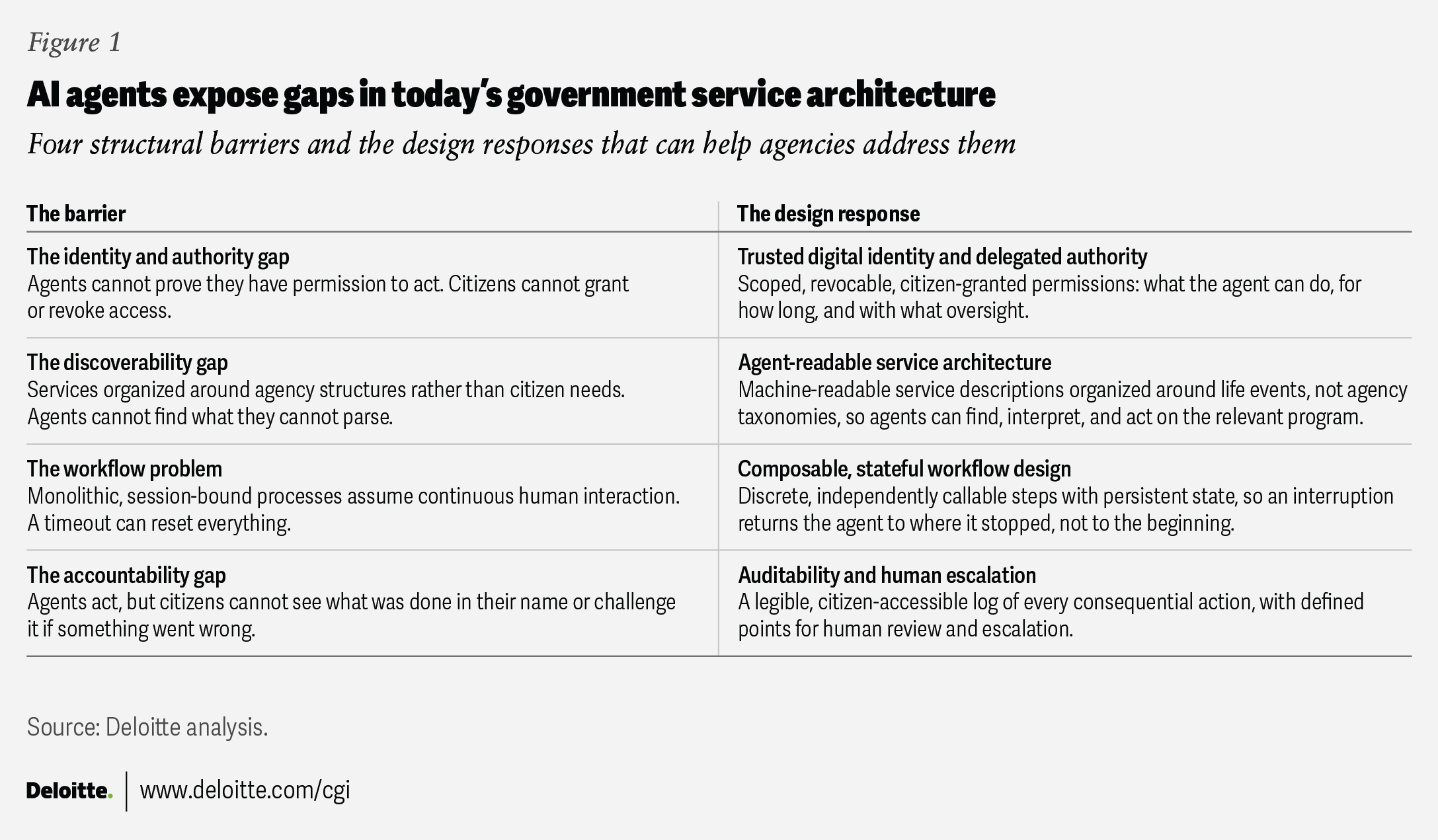
Why government services remain hard for AI agents to navigate
The identity and authority gap: Can the agent prove it has permission to act?
A veteran asks her agent to check the status of her Department of Veterans Affairs benefits. The agent reaches Login.gov and encounters an authentication challenge that it cannot complete on the veteran’s behalf. The task stalls. By 2025, Login.gov supported more than 100 million user accounts and provided authentication services across over 50 government web channels, but the platform was designed for individuals rather than agents exercising delegated authority.3
Trusted digital identity and delegated authority need to work together. Identity infrastructure can provide an agent with a verified, portable credential to present across agency boundaries without having to restart verification from scratch. Delegated authority then establishes what the agent is permitted to do on the citizen’s behalf.
The agentic era may benefit from a standardized pathway for machine authentication with explicit, revocable, citizen-granted permissions—an approach some practitioners are beginning to call “OAuth for AI.” Delegated authority gives the veteran in this scenario greater control through scoped and time-bound permissions—the digital equivalent of a limited power of attorney. She can grant her agent access to check her benefits status, view a log of the agent’s actions, and revoke access if something looks wrong.
The discoverability gap: Can the agent find the right service?
A citizen asks their AI agent to find all housing assistance programs for which they might qualify. The agent returns a generic list because there is no comprehensive government service registry that an AI system can query directly. The services may be real, funded, and relevant, but information about them is organized for people to browse rather than for machines to interpret. Federal guidance under the 21st Century Integrated Digital Experience Act requires machine-readable content where practicable, but making government services semantically rich and agent-discoverable is a different task.6
Agent-readable service architecture provides AI agents with structured, machine-readable descriptions they can use to find, interpret, and interact with government services. This requires organizing service metadata around citizen life events rather than agency taxonomies, so an agent searching for “housing assistance” finds Housing Choice Voucher Program, emergency rental subsidies, and utility relief in a single query rather than searching across three separate agency portals.
The workflow problem: Can the agent complete the transaction?
A citizen asks their agent to renew a professional license. The agent authenticates, begins the renewal workflow, then hits step seven of 23: a browser-based drag-and-drop upload, a session timeout that resets the form, and an identity confirmation requiring physical presence. The task fails, partially completed, with no way to resume because government service processes were designed as sequential, session-bound workflows for people.
Composable, stateful workflow design rebuilds service processes around how agents actually work. Composable design means breaking monolithic workflows into discrete, independently callable steps: the agent submits continuing education credits, pays the fee, and confirms identity as separate transactions, rather than one uninterruptible sequence. Stateful design means the service remembers where the agent left off between sessions, so a timeout or a mid-workflow interruption returns the agent to step seven, not step one.
The accountability gap: Can citizens see what was done in their name and challenge it if something goes wrong?
A citizen’s agent successfully submits a housing assistance application on her behalf. Two weeks later, she receives a denial letter citing missing documentation. She never saw what the agent submitted, cannot tell which document was missing, and has no way to escalate the issue without restarting from scratch. As agents take on consequential tasks like filing claims, submitting appeals, and supporting eligibility determinations, the absence of a legible record becomes more than an inconvenience.
Auditability and accountability make agent actions visible and contestable and provide a pathway for correcting them when necessary. Consequential agent actions should produce a legible, citizen-accessible record of what was submitted, when, and with what information. Agentic services should also define points for human escalation, where a person can review the agent’s actions, correct an error, or take over a case that the agent should not resolve alone. Accountability also has a security dimension: the same audit infrastructure that allows a citizen to contest an incorrect outcome can help the government detect when an agent pathway is being exploited, connecting citizen protection with system integrity.
The next digital divide
For government services, an important dimension of the agentic divide will be architectural: whether services are set up so AI agents can act on citizens’ behalf. Given a citizen’s intent, an agent could map eligibility, sequence applications, and surface options the citizen might not have found on their own—provided government services are designed around citizen needs.
Agent-accessible government services could be particularly valuable for citizens with disabilities, language barriers, or low digital literacy, who may face additional challenges navigating complex portals, program terminology, and fragmented agency processes. Intent-driven service design can reduce some of that burden by allowing citizens to start with what they need rather than having to identify the right program or agency. This means rewriting service descriptions in plain language, organizing them around life events rather than program names, and mapping citizen journeys across agency lines so that a single stated intent returns a coherent set of relevant options rather than a fragmented list of portals.
Agentic interfaces may also accelerate the shift toward more personalized public services. Once services are organized around citizen intent, agents can help identify relevant programs, assemble context across agencies, and guide individuals through more personalized, cross-agency life-event journeys.9
Four principles for agent-ready services
Addressing the barriers outlined above will require agencies to rethink how services are designed and delivered. These four principles build on the design responses in figure 1, offering a starting point for that shift. Each closes with a “first move”: a concrete action teams can take without waiting for a full transformation.
Design around citizen intent, not agency taxonomy
Start with the citizen’s problem, not the agency’s solution portfolio. A citizen who has just lost their job may not know whether they need unemployment insurance, workforce retraining, or an emergency food benefit. An intent-first service architecture begins with “I lost my job,” gathers context, and surfaces relevant options across agency lines.
First move: Rewrite service descriptions for intent, not navigation. Organize around citizen life events, not agency taxonomies. No technology investment required.
Reduce bureaucratic friction while preserving protective friction
Not all friction is bad. Identity verification, fraud prevention, and informed consent are important protections. Repetitive forms, redundant documentation, and avoidable reauthentication, however, can create bureaucratic friction for citizens.
First move: Adopt delegated identity as a citizen experience standard. Give citizens the ability to grant an AI agent scoped, revocable permission to act on their behalf. Identify information that the government already holds that systems currently ask citizens to provide again.
Build in context, escalation, and accountability
Services should carry context across sessions and include clear human handoff points for cases that require human judgment. Appeals, complex cases, sensitive determinations, and vulnerable populations may all require human involvement. Every agentic service should have an explicit answer to the question: What happens when the agent cannot or should not proceed? This means deliberately mapping handoff points, including what the agent communicates, what state is preserved, and how the workflow resumes.
First move: Map every handoff point and design it deliberately. Specify what the agent communicates, what state is preserved, and how the workflow resumes.
Shift from tracking outputs to managing outcomes
The agentic era may require agencies to rethink not only their technology but also how they manage and measure service delivery. A management system built around forms and sequential workflow steps may struggle to support fluid, intent-driven, multiagency service journeys. Moving to outcomes means defining metrics around what citizens are trying to accomplish rather than how many forms were processed and giving frontline staff tools to see whether a citizen’s underlying problem was resolved. Describing services in structured, outcome-oriented terms can help agencies connect individual transactions to the outcomes they are intended to support. Structured metadata and plain-language field labels can be added to existing portals without rebuilding them, helping make services both legible to agents and easier to measure against those outcomes.
First move: Add semantic layers to existing interfaces. Structured metadata, plain-language field labels, and model context protocol or OpenAPI schema definitions can be added to existing portals without rebuilding them, providing a practical first step toward agent-readable, outcome-trackable services.
The door is still open
Government did not build its digital front door to be inaccessible. Portals, forms, and online workflows were designed to make services more reachable than they were in the paper era. The problem is that the next wave of citizens arriving at that door may do so through an agent, and the door was not designed for them.
Redesigning government services around citizen intent is the next step in the evolution of digital service delivery. Agencies that invest in identity, interoperability, persistent context, and outcome-oriented service design will be better positioned to support both citizens and the tools they increasingly rely on.
Government interfaces in the future should aim to reduce navigational burden, better respond to citizen needs, and help people achieve outcomes across institutional boundaries. Agencies that begin designing for that future now will be better positioned to remain accessible, relevant, and effective in the age of AI-assisted interaction.
Continue the conversation
Meet the industry leader
Alan Holden
BY
Alan Holden
Rajiv Gupta
Shelly Metschan
Tori Carter
Kevin Almerini
Editorial (including production and copyediting): Kavita Majumdar, Anu Augustine, and Preetha Devan
Design: Natalie Pfaff
Cover image by: Adamya Manshiva
Knowledge services: Rohan Singh
Visit the Deloitte Center for Government Insights
Access more insights for the defense, security and justice, government health care, state and local government, transportation and infrastructure, human services, and higher education sectors.