
Customized for constituents: Agentic AI accelerates personalized public services
As agentic AI matures, government agencies are beginning to deliver personalized services to their citizens that cut across agencies, simplify journeys, and improve outcomes
Government agencies have long aimed to offer services tailored to individuals—requiring minimal effort, anticipating needs, and delivered proactively. Services such as the United Kingdom’s Tell Us Once, Texas by Texas in the United States, and Singapore’s LifeSG have advanced that vision. But truly customized services at scale have remained difficult because they run against the siloed structure of most organizations. Today, smart technology—especially agentic AI—makes individuated services at scale increasingly achievable.
Over the past decade, agencies have built digital foundations—cloud infrastructure, data exchanges, and digital identity. Layering agentic AI on top of these foundations can transform service delivery into customized platforms: systems that match individual needs to the right services, securely access data across agencies, and guide users through end-to-end journeys.
For individuals, the promise is simpler experiences—clearer eligibility, real-time status updates, and fewer touchpoints. For governments, the payoff is more targeted services delivered more efficiently, improving outcomes while reducing costs.
Signals: Customized for constituents
- According to the United Nations, 94 countries reported explicit AI references in their national e-government strategies between 2022 and 2024.1 The Organisation for Economic Co-operation and Development’s AI repository catalogs roughly 200 government AI use cases worldwide.2
- Many governments have already built the digital infrastructure required for customized service platforms. As of December 2025, at least 64 countries have adopted digital identity systems aligned with digital public infrastructure (DPI) principles. Digital payments with DPI characteristics exist in 97 countries, and more than 100 countries operate DPI-style data exchange platforms.3
- Early examples of customized services are emerging. After the 2024 Noto Peninsula earthquake, AI tools in Japan analyzed social media and environmental data to deliver verified, real-time insights.4 In 2025, Portugal’s Gov.pt portal launched a gen AI-powered assistant covering more than 2,300 services, enabling multilingual guidance, process tracking, and appointment scheduling.5
Trend in action
Now: The data foundations are already laid
Customized services depend on high-quality, connected data—often spread across multiple agencies. Anticipating needs requires systems that can securely access and combine data without centralizing it in one vulnerable repository.
Data exchanges play a pivotal role. Through application programming interfaces, agencies can access the information required to deliver requested services while preserving control and consent.
In the United States, a 2025 executive order accelerated intra- and inter-agency data-sharing, increasing demand for cross-agency integration platforms.6 Similar shifts are underway globally.7
The European Union’s Once-Only Technical System enables agencies to request verified records across borders—such as diplomas or licenses—after secure identity verification and consent.8 Data moves directly between authorities, reducing duplication and error.9 With this system, cross-border services—such as studying, working, registering a car, or claiming a pension—may be faster and less error-prone within the EU single market.10
Singapore’s APEX national data exchange and Estonia’s X-Road demonstrate how national data exchange platforms can enable secure, real-time information-sharing while maintaining agency control. These platforms ensure that data is encrypted, digitally signed, time-stamped, and logged; authentication happens at the organization and system levels.11 The X-Road data exchange has been deployed in more than 20 countries.12
New: AI and super apps are improving experiences
Building on these foundations, governments are using AI and super apps to redesign public interactions.
Ireland’s MyWelfare platform integrates cross-agency data to support benefit applications, personal updates, and automated decisions for straightforward cases. By late 2024, more than 83% of illness benefit claims and 98% of treatment benefit claims were auto-awarded—significantly accelerating processing times for citizens.13
Spain’s My Citizen Folder provides a unified interface across multiple agencies, allowing users to track applications, receive personalized notifications, and access official documents through web, chat, and mobile channels.14
AI is not simply digitizing paper processes—it enables new service designs. As Ukraine’s former minister of digital transformation has noted, the goal is not to replicate bureaucracy digitally, but to create new services that improve outcomes.15 In other words, the focus should be on improving citizen outcomes, not just on streamlining processes.
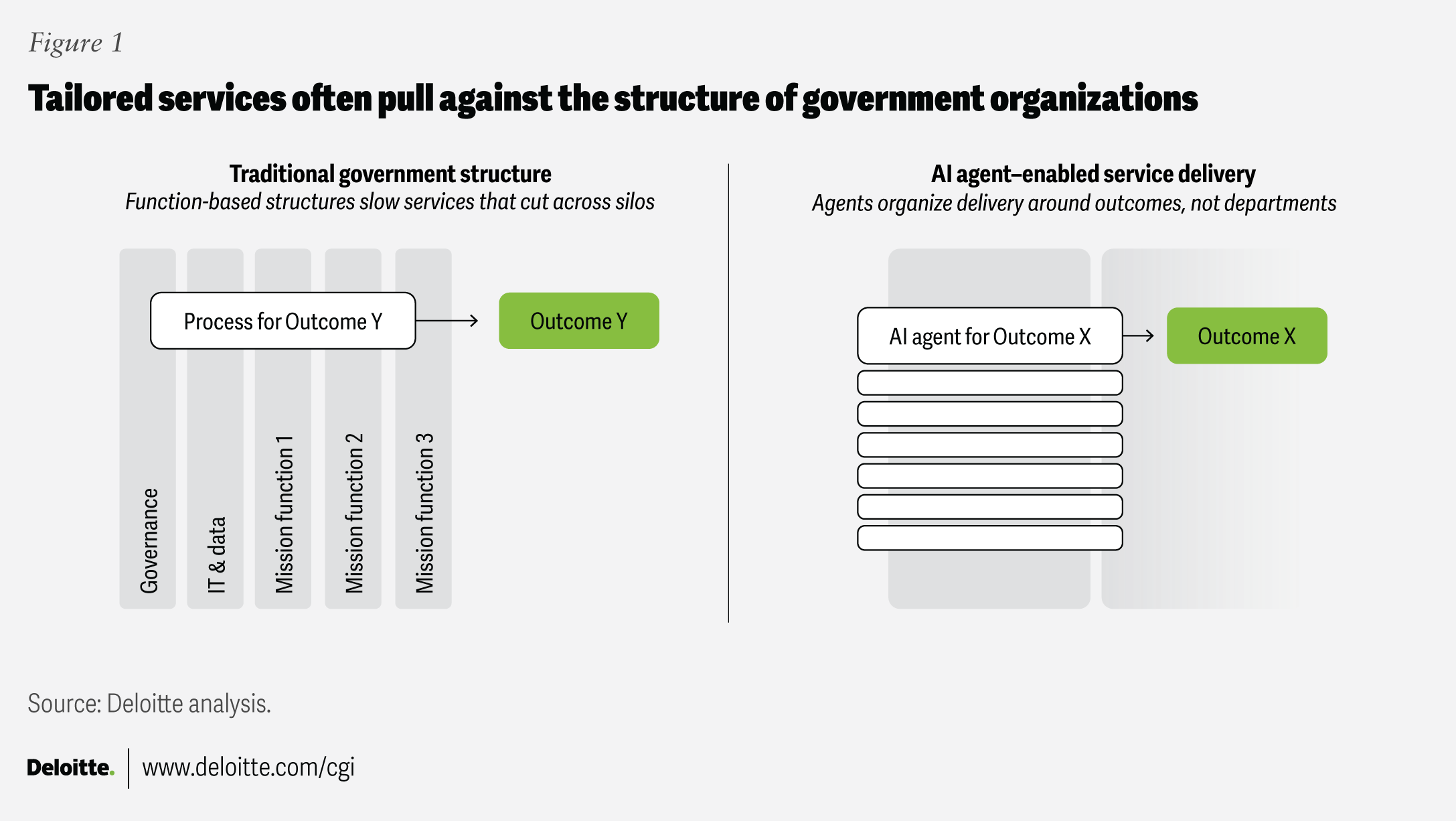
Yet, customized services still challenge traditional structures. Agencies are organized by function and domain, while individuals’ needs often cut across boundaries. Enter AI agents, built around workflows and outcomes rather than departments or functions. They don’t need to cut across silos—they operate outside them—thereby helping to overcome structural constraints (figure 1).
Next: AI agents help reorient service delivery
Many digital leaders are already exploring how AI agents can make services more customized, composable, and proactive.
Imagine incorporating a business. Instead of navigating multiple sites, an AI agent gathers required information, auto-completes forms, and submits filings through a single interaction. Similar coordination can extend to tax filings, licensing, or benefits access.
Platforms such as India’s UMANG, Ukraine’s Diia, and Ireland’s MyWelfare already provide multichannel access to services. What changes with AI agents is the ability to coordinate tasks autonomously across organizational boundaries.
Estonia’s Bürokratt illustrates this shift. It connects a network of virtual assistants across government sites, allowing users to ask questions and complete tasks through secure, supervised AI workflows.16 Built on Estonia’s digital identity and data exchange infrastructure, these agents collaborate to retrieve verified data and execute actions within defined guardrails.17
Enablers and accelerators
Despite the promise of personalized delivery, significant adoption hurdles remain. Four foundations are key:
- Leadership and governance
Senior leaders should champion modernization, reduce tech debt, and align cross-agency priorities to enable coordinated delivery. By prioritizing technology upgrades, agencies can free themselves from tech debt and create an environment where innovative solutions, including AI, can thrive. - A flexible technology stack
Customized services depend on interoperable layers: identity, payments, data exchange, orchestration APIs, and user interfaces. Each layer of this stack should be extensive enough to grow with demand but also open enough to operate across layers and agencies. - Flexible acquisition
Keeping the tech flexible also means keeping procurement flexible. Procurement approaches should accommodate software-driven services and evolving technologies while encouraging market awareness and ecosystem participation. - Operational redesign
Workflows should be redesigned to support cross-agency coordination, data protection, and rapid onboarding of new tools without vendor lock-in.
Toward 2030: The future this trend could unlock
AI agents are a tool, not the goal. The deeper shift is toward outcome-focused service delivery that connects individuals to the right services at the right time—regardless of where the services originate.
Integrated public-private delivery: Customized service platforms can extend beyond government, allowing trusted partners such as universities, hospitals, or nonprofits to deliver services through shared APIs and verified data exchanges.
Abu Dhabi’s TAMM platform offers a glimpse of this model. TAMM deploys several AI agents on a data exchange layer to map users’ life events to more than 1,000 services from over 90 public and private service providers through a unified workflow.18 Vehicle owners can renew licenses, pay traffic fines, and compare and buy motor insurance from private companies in one place. Entrepreneurs can apply for licenses specific to their industry and geography, open new business accounts, and link existing ones within one workflow.19
Agent-to-agent delivery: Agent-to-agent communication allows agents to exchange data and trigger actions without the need for manual handoffs, reducing processing time. The MIT Media Lab’s Project NANDA is developing protocols that allow agent-to-agent coordination.20 Over time, this could allow every individual to have a personal agent that could work with government agents to execute common tasks simply by asking, for example, “register my business” or “pay my tax bill.”
The result is not simply faster services, but fewer touchpoints, clearer journeys, and broader access across public and private providers.
by
Jaimie Boyd
Yousef Barkawie
Rajiv Gupta
Joe Mariani
Sushumna Agarwal
The authors would like to thank William D. Eggers and Adithi Pandit for their thoughtful feedback on the draft. The authors would also like to thank Nick Holmes, director of sustainable infrastructure and transportation, ServiceNow, for his valuable input in the “My take” section.
Editorial (including production and copyediting): Kavita Majumdar, Rupesh Bhat, Aparna Prusty, Shyamili M., Anu Augustine, Cintia Cheong, and Pubali Dey
Design: Molly Piersol
Cover image by: Meena Sonar and Sonya Vasilieff
Knowledge Services: Rishitha Bichapogu
Visit the Deloitte Center for Government Insights
Access more insights for the defense, security and justice, government health care, state and local government, transportation and infrastructure, human services, and higher education sectors.