


A modern replacement? New UK-NZ tax treaty signed
Tax Alert - July 2026
By Annamaria Maclean, Sam Mathews and Hamish Butterworth-Snell
The soon-to-be revamped double tax agreement (DTA) between New Zealand and the United Kingdom (UK-NZ DTA) is a helpful but thorny step in aligning New Zealand’s cross-border tax rules with its major trading partners. It also comes at a time when several other New Zealand DTA developments appear to be on the cards, including signed but not yet in force arrangements with Belgium, Croatia and Iceland, and negotiations involving Australia, Fiji, Germany, Hungary, the Netherlands, Portugal, Slovenia and South Korea.
The new UK-NZ DTA includes several major changes, with the main headlines being an ability to reduce dividend withholding rates to zero percent in some instances, and the introduction of new permanent establishment triggers. As such, if you have United Kingdom – New Zealand cross border activities, it would be worthwhile considering how the new DTA will apply to your structure once it is in force.
Background
New Zealand and the United Kingdom signed a new double tax agreement on 1 June 2026. Negotiations formally began in March 2020, though we understand that the new DTA has been under discussion for the last 15 years. The DTA will replace the 1983 agreement (as amended with protocols in 2003 and 2007, and by the Multilateral Convention in 2018). Given that it has been almost 20 years since its last update, the new DTA has a variety of changes relevant to United Kingdom and New Zealand groups, cross-border investors, financiers, and individuals operating across both countries.
The key changes include:
- Expanded permanent establishment rules;
- Reduced withholding tax rates for certain dividends;
- Overarching treaty anti-avoidance rules, including an anti-treaty abuse test, rather than article-specific anti-avoidance measures;
- New exemptions for certain interest payments;
- Updated royalty definition;
- Removal of the separate independent personal services article; and
- Enhanced mutual agreement procedure provisions, including arbitration in some cases.
The new DTA is not yet in force. It will enter into force once both countries have completed their domestic procedures and notified each other through diplomatic channels.
Permanent establishment rules
The permanent establishment (PE) article has been substantially updated.
Generally, where a taxpayer of a country has a PE in another country, the latter will have a right to tax income attributable to the PE. The new DTA introduces two new ways to create a PE:
- Services PE rule: where services are performed in the other country through an individual present for more than 183 days in any 12-month period and more than 50% of the gross revenue relates to these services; and
- natural resources PE rule: where an enterprise carries on activities for 183-days in any 12-month period which relates to the exploration for or exploitation of natural resources (including standing timber). Note, the existing treaty already contained a separate provision dealing with income from these types of natural resource activities, so the change is more about how the rule is structured than a wholly new taxing right.
In addition to the two new PE rules, there are several other PE-related changes including:
- The construction PE threshold is reduced from more than 12 months to more than 6 months, now also covering assembly projects and related supervisory activities;
- An aggregation rule adding together connected activities at the same site or project when testing whether a PE time threshold is met;
- An anti-fragmentation rule to prevent an enterprise or closely related enterprises from artificially splitting a cohesive business operation into separate activities;
- A broader dependent agent PE rule, including where a person plays the principal role leading to contract conclusion; and
- Limitation on the independent agent exclusion where the person acts exclusively or almost exclusively for closely related enterprises.
These changes are relevant for groups with personnel, contractors, sales teams, project activity, or natural resource operations in the other country. Existing operating models should be reviewed.
Dividends
The dividend article in the new DTA has been materially updated.
Under the existing treaty, dividends paid by a company resident in one country to a beneficial owner resident in the other country are generally subject to a 15% source-country withholding tax cap.
The new DTA keeps the 15% cap for ordinary cases but introduces lower rates in specific circumstances, including:
- 5% where the beneficial owner is a company that directly holds at least 10% of the voting power in the dividend-paying company for a 12-month period ending on the date the dividend is declared;
- 0% for certain government and sovereign investors, subject to conditions; and
- 0% for certain companies holding 80% or more of the voting power in the dividend-paying company for a 12-month period, where additional listing, ownership, equivalent-benefit or competent authority requirements are met.
Treaty access and anti-avoidance
The new DTA introduces a dedicated entitlement to benefits article, which gives the treaty a broader anti-abuse rule than the current DTA. In simple terms, treaty benefits can be denied where one of the main purposes of an arrangement is to access those benefits, or where income is routed through a low-taxed permanent establishment in a third country.
Although the current DTA included anti-avoidance measures, these measures were incorporated into specific provisions. The change to an overarching avoidance article emphasises that taxpayers should assess the commercial rationale of their cross-border arrangements in their totality rather than considering specific treaty articles. For most taxpayers, this should not be a material change.
Other changes
Additionally, some other important changes include:
- Interest: withholding tax rate remains capped at 10%, with new exemptions for certain sovereign investors, pension funds, and financial institutions, subject to conditions and approved issuer levy carve‑outs.
- Royalties: withholding tax rate remains capped at 10%, with an expanded definition (including media, broadcasting, and similar rights) and removal of the equipment leasing reference.
- Independent personal services: separate article removed, with income now dealt with under the business profits article and PE rules.
- Introduction of arbitration where disputes are unresolved after two years, subject to exclusions (including certain New Zealand anti-avoidance cases).
Some of these changes are technical in nature and are only likely to apply in very particular instances.
Treaty rate comparison
The new UK-NZ DTA withholding rates are in alignment with other current New Zealand DTAs:
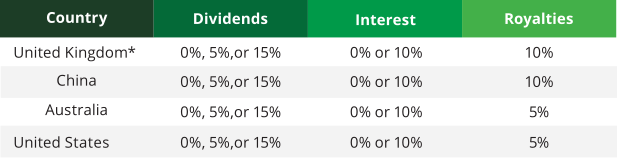
These are headline treaty rates only. The actual withholding position will depend on the character of the payment, beneficial ownership, shareholding level, holding period, whether any special exemption applies, and any domestic law requirements such as approved issuer levy for certain New Zealand-sourced interest.
Final thoughts
Delays aside, the new DTA is a long-awaited update to the United Kingdom-New Zealand tax treaty framework and in many cases the new DTA should provide improved outcomes, particularly for certain dividend payments. For taxpayers with cross-border activities in the United Kingdom and New Zealand, we would recommend revisiting tax treatments and taxable positions with a particular focus on:
- Existing and proposed cross-border financing arrangements;
- Dividend flows and relevant shareholding periods;
- Activities that could create a PE under the expanded PE rules;
- Structures involving partnerships, trusts or other fiscally transparent entities; and
- Whether treaty benefits remain supportable under the new principal purpose test.
If you have any questions about how the new DTA may affect your arrangements or broader tax positions, please contact your usual Deloitte advisor.
July 2026 – Tax Alerts
- Election tax policies, part one
- Tax simplification in practice: three years of incremental reform
- The rising tide of tax complexity
- A modern replacement? New UK-NZ tax treaty signed
- Snapshot of recent developments


