
Transforming learning and development to better equip industrial workers
Designing learning and development initiatives around time, arena, knowledge, and team can help industrial workers adapt to evolving technologies and changing job expectations
The skills required on factory floors and in other industrial work environments are changing fundamentally and rapidly. As advanced technologies like artificial intelligence transform the enterprise software that manages systems like supply chains and equipment maintenance, and enterprises increasingly automate manufacturing tasks, how can these organizations train and upskill their workforce to handle this transformation?
Traditional training programs fall short. Consider a relatively inexperienced mechanic who is assigned to replace the drive belt and electric motor on an automatic door—a critical and challenging job. The mechanic must unwrap the new belt and motor from piles of packaging, remove the old parts and motor—working in the tightly confined space around the door mechanism—set up the new system according to strict specifications, then plug in the program parameters on a custom laptop to reconnect the door system to the company’s digital diagnostics. The mechanic took a classroom lesson on door-motor and drive-belt replacement, but he doesn’t recall all the steps. He checks the engineering schematics, but they just diagram the overall system. Ordinarily, he would ask for guidance from a more experienced colleague, but she’s out sick today. He’s left with a set of bad choices: proceed with the motor replacement and risk inefficiency, errors, or worse; spend hours reading multiple maintenance documents; or wait until a senior colleague is available, leading to extended downtime for the door.
Scenarios like this are still common across today’s industrial workforce, from service technicians to blue-collar workers. Ensuring these workers have access to continuous learning and performance support has never been more urgent. Yet industrial organizations have traditionally considered their workforce as a cost center to be optimized, rather than a strategic asset to invest in and develop. Organizations also may face several structural barriers that impede the delivery of traditional learning and development programs: shift work, time constraints, limited ability to learn from experienced colleagues or subject-matter experts, challenging working conditions such as noise, heat, and dust, and lack of access to flexible learning formats.
Applying a new lens can help reconcile organizations’ needs with these real-world challenges. Leaders may be familiar with the takt principle from the lean approach to operations, which many manufacturing companies use to match production with demand.1 We propose that organizations can take inspiration from takt to improve learning and development for workers in production environments—by applying the four dimensions of time, arena, knowledge, and team. Together, they address when and where learning takes place, what it covers, and who is involved.
A TAKT approach (figure 1) can help organizations incorporate training into day-to-day operations and provide the kind of learning support industrial workers need, when, where, and how they need it, creating a consistent trajectory of learning and application.
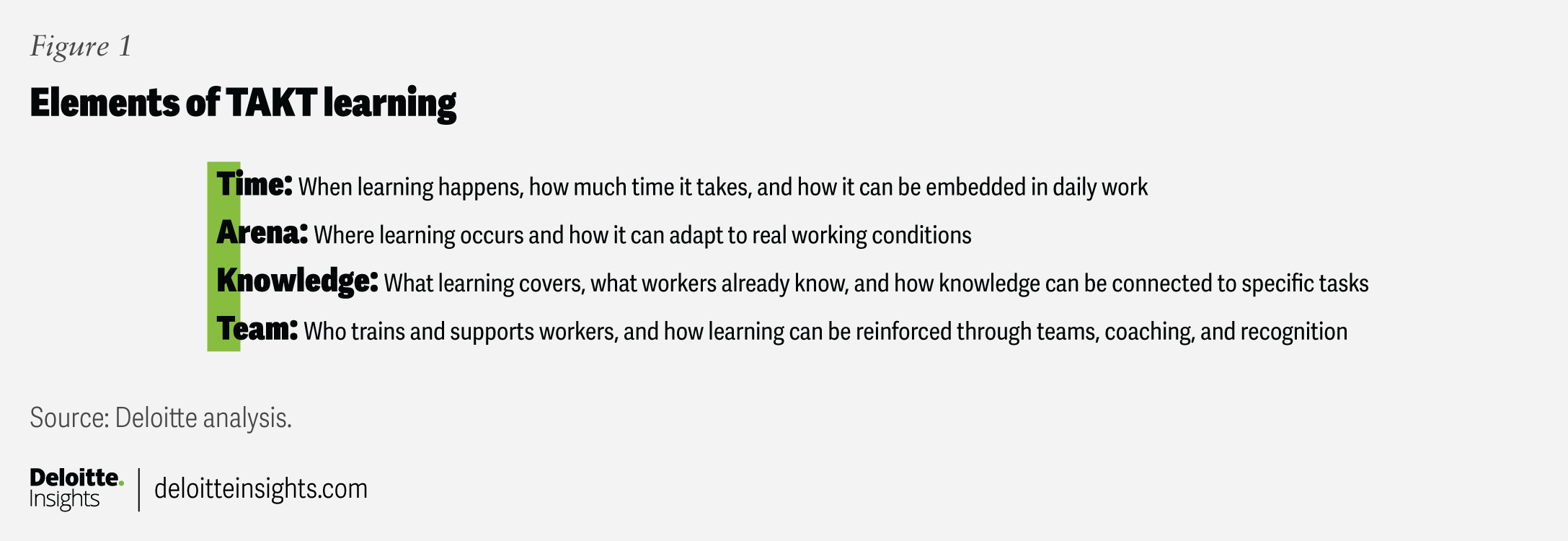
What it looks like to structure industrial learning and development around TAKT
TAKT learning offers a pragmatic framework for aligning workforce development with operational realities. It focuses on designing learning that can move at the pace of operations and improve performance, safety, and productivity outcomes.
Time: When learning happens and how much time it takes
Time is a limited resource in many industrial environments. Organizations operating under tight production schedules often deprioritize learning in favor of immediate productivity. While this mindset frames time spent learning as a cost that reduces a worker’s current production, it may be more useful to define time spent learning as an investment toward future improvements in efficiency, safety, and progress toward other organizational goals.
Consider the following practices to maximize the return on the time invested in workers’ training.
- Right-size learning time. Traditional training is often one-size-fits-all: A worker might receive a three-hour course when a 15-minute module might be more effective. Use worker time efficiently by designing learning programs that allocate time appropriate to the lesson.
- Promote learning while working. Embedding continuous skills development in daily work can improve task accuracy and reduce the lag between learning and application2—valuable in environments where errors can have safety, quality, or cost implications.
- Build flexibility into the training schedule. A worker’s windows for learning may occur unexpectedly and unpredictably. For example, delayed delivery of a part may open an hour or more of unanticipated downtime. Learning programs can be designed to capitalize on time that becomes available in such cases.
Consider a manufacturer that replaces a multi-hour classroom training with augmented guidance and microlearning integrated directly into workflows on the shop floor. Embedding brief lessons into the execution of specific tasks, rather than larger, more time-consuming lessons delivered out of context, can help technicians resolve issues faster and apply new skills immediately. Learning time reinforces productivity rather than disrupting it.
Arena: Where the learning occurs
Organizations can meet blue-collar workers where they are—literally—by providing learning in real work conditions.
It may not be easy to introduce training in industrial workplaces. These arenas may be remote oil rigs, satellite towers, or other far-flung locations. They might be dangerous, loud, and physically demanding, such as dusty or wet factory floors.
Organizations can overcome these location challenges by developing visual, scenario-based learning solutions that adapt to real working conditions rather than expecting workers to adapt to conventional learning formats. The growing ubiquity of AI and the emergence of AI knowledge agents offer new tools that organizations may be able to employ to deliver knowledge where it will be used. An extra benefit of this approach: Learning becomes embedded in operational planning, not a separate cost center competing for budget and time.
Examples include an interactive decision tree for “what to do if you detect a gas leak,” with visual cues taken from the worksite itself; animated walkthroughs of emergency evacuation procedures in a specific facility; and real-time learnings captured within 48 hours of near-miss incidents, transforming safety incidents into micro lessons.
Consider DHL’s Vision Picking program.3 The company uses smart glasses to provide real-time instructions for employees as they perform picking tasks. This approach trains workers within their shifts without removing them from operations, while improving consistency and confidence in the execution of tasks.
Likewise, rather than pulling technicians offsite, organizations can integrate learning modules directly into daily pre-shift briefings. For example, an energy company could deploy a monthly series of onsite safety modules timed to seasonal operational risks—winter weather protocols in the first quarter, summer maintenance schedules in the third.
Knowledge: What the learning covers and what workers already know
Providing modular, visual content tailored to specific contexts can increase the efficiency of knowledge delivery and speed the translation from knowledge to skills.
Industrial roles often require quick access to safety-critical procedural and technical knowledge. Training content routinely falls short, providing information that is overly broad or unconnected to real tasks. These shortcomings limit the applicability and retention of the information.4
In contrast, breaking complex curricula into short, visual modules embedded in operational systems has been proven to accelerate the acquisition of skills.5 These approaches shift the focus from knowing to doing, helping ensure knowledge is activated when and where it is required.
Consider a safety program for renewable energy field technicians who need to climb wind turbines. The traditional approach might cover theoretical discussions of a broad range of safety procedures. Alternatively, immediately prior to climbing the turbine, the worker could be required to participate in an interactive safety checklist on a tablet, guided by augmented reality and tailored to the task—saving time, leading to immediate application, and improving knowledge retention.
The confluence of rapid change and an aging workforce also heightens the need for organizations to capture, document, store, and update operational knowledge. At many organizations, older workers are the only people with the knowledge and skills to maintain older machinery. These workers are taking critical knowledge with them when they leave. A structured, stable process for transferring knowledge is essential.
Team: Who trains workers
Teaching and learning are communal endeavors. Digital tools can provide access to information, but they do not replace the social dimensions of skill development.
Social learning, coaching, and recognition help workers acquire and retain skills, potentially producing broader benefits for both employers and employees. Studies by the European Centre for Development of Vocational Training have found that workplaces with strong cultures of informal learning, including practices such as peer coaching, shared problem-solving, and continuous feedback, achieve higher levels of worker well-being and company performance.6 Recognition mechanisms further reinforce learning behaviors by signaling that both the immediate team and the larger organization value the worker’s development.
Successful workforce development initiatives consistently combine digital learning with team-based reinforcement. Embedding learning into team routines, leadership practices, and performance discussions ensures that individual skill acquisition translates into collective capability and operational impact.
The team lens can help transform tasks from a box for an individual to check to a collective responsibility. For example, a company might:
- Establish safety peer networks where workers share incident learnings and best practices
- Implement monthly 15-minute safety huddles where teams discuss real scenarios and solve problems together
- Recognize safety champions publicly and create peer-led safety audits, signaling that safety development is valued at both team and organizational levels
Effectively applying the team lens may require professionals in charge of learning and development to reframe how they think about their role. Rather than acting as organizers of top-down initiatives, they can operate as orchestrators of efforts developed in partnership with operational teams. When the organization engages in formal learning interventions, these professionals can deliver them with the business rather than to the business.
Creating the conditions for TAKT learning to succeed
Applying the four dimensions of TAKT requires organizations to address a variety of practical considerations. Time for learning must be treated as an operational investment rather than as lost production. Organizations should design learning approaches that are flexible enough to deploy during both planned and unexpected gaps in workers’ schedules. Learning must be accessible in the environments where work takes place, including for workers who may not have suitable devices, reliable connectivity, or easy access to conventional or digital learning formats.
Organizations also need reliable ways to capture, maintain, and translate operational knowledge. That mandate demands an understanding of current procedures—information that might be undocumented, outdated, or written in ways that do not support practical execution, and may be known primarily by experienced workers whose time is occupied with production and problem-solving. Finally, learning cannot depend entirely on team leaders or one-to-one instruction. A blended approach that combines accessible digital support with coaching, peer learning, and team routines can make development more scalable and sustainable.
Organizations are more likely to meet these conditions when learning professionals, operational leaders, and workers design solutions together. Starting with a focused operational challenge, testing the approach in the flow of work, and refining it through worker feedback can help organizations apply TAKT without losing sight of operational realities, contributing to better results.
Unlocking competitive advantage through strategic capability development
As the industrial workforce evolves, companies that master strategic capability development can gain a decisive edge. A TAKT approach provides a practical, strategic framework to balance operational demands with continuous learning, helping nurture workers’ skills, adaptability, and engagement.
The future belongs to organizations that view their frontline employees not just as labor but as critical human capital—investing in their growth, recognizing their contributions, and empowering them to drive innovation and productivity in an increasingly complex world.
Continue the conversation
Meet the industry leaders
by
Pieter Goudeseune
Frederiek Van Tornout
Jasper De Cnuydt
The authors would like to thank Jeroen Van Eeghem, Benoit Masset, and Matthias Peeters for their contributions to this article.
Editorial (including production and copyediting): Aditi Rao, Arpan Kr. Saha, Anu Augustine, Aparna Prusty
Design: Alexis Werbeck, Adamya Manshiva, and Molly Piersol
Cover image by: Adamya Manshiva
Knowledge services: Viswa Teja Vanapalli