
From tensions to tipping points: Choosing the human advantage
The 2026 Global Human Capital Trends survey reveals the intentional choices organizations can make to adapt continuously, move with speed, and lead with a human edge
Control or empowerment? Stability or agility? Automation or augmentation? Last year, we explored these tensions and the need to navigate the polarities at play. But in 2026, the pace of change is sharpening the edges of these questions. Organizations are no longer just trying to balance competing forces: They are standing at a tipping point.
In our 2026 Global Human Capital Trends survey, 7 in 10 business leaders say their primary competitive strategy over the next three years is to be fast and nimble—to quickly adapt to and capitalize on changing business, customer or market needs. Leaders also report that the two most important drivers of success are accelerating how people and resources are orchestrated to perform work and increasing their organization’s and workforce’s ability to adapt to change and speed.
The classic S curve of growth has long described how businesses and work evolve: gradual lift, rapid acceleration, and eventual plateau. Today, that curve is compressing. AI and workforce transformation are accelerating the climb and bringing the plateau sooner (figure 1). Organizations are pressed to leap to the next curve more quickly to remain competitive. Long cycles of planning and predictable execution may no longer hold in a world where markets, technologies, and worker and customer expectations shift in real time. Success may now depend more on sensing change, experimenting quickly, and adapting continuously.
Today, new data and workforce insights—ranging from organizational digital twins to real-time analytics—make it possible to see where an organization sits on the curve and actively steer how and when to jump to the next one.
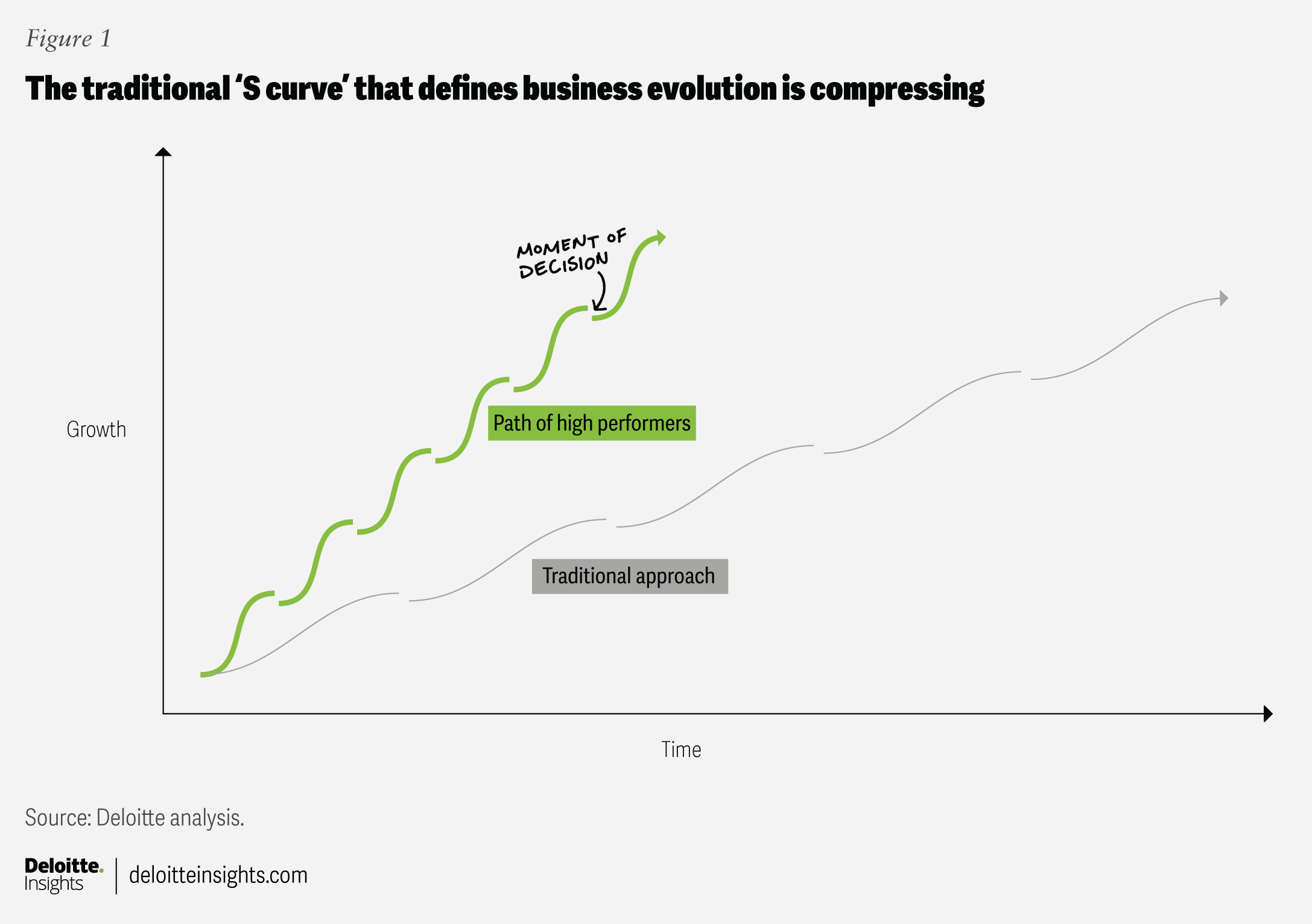
Historically, organizations jumped the curve by adding new technology, a strategy that may no longer be enough. Organizations will likely need to make the leap differently.
Competitive advantage is now primarily less driven by technology differentiation and more by cultivating the human edge. Technology—especially something as increasingly ubiquitous as AI—is replicable. People aren’t. Humans create competitive differentiation through adaptivity, creativity, and judgement amid uncertainty and change. When it comes to AI, value is unlocked through a reimagination of work that brings the best of humans and machines together in concert.
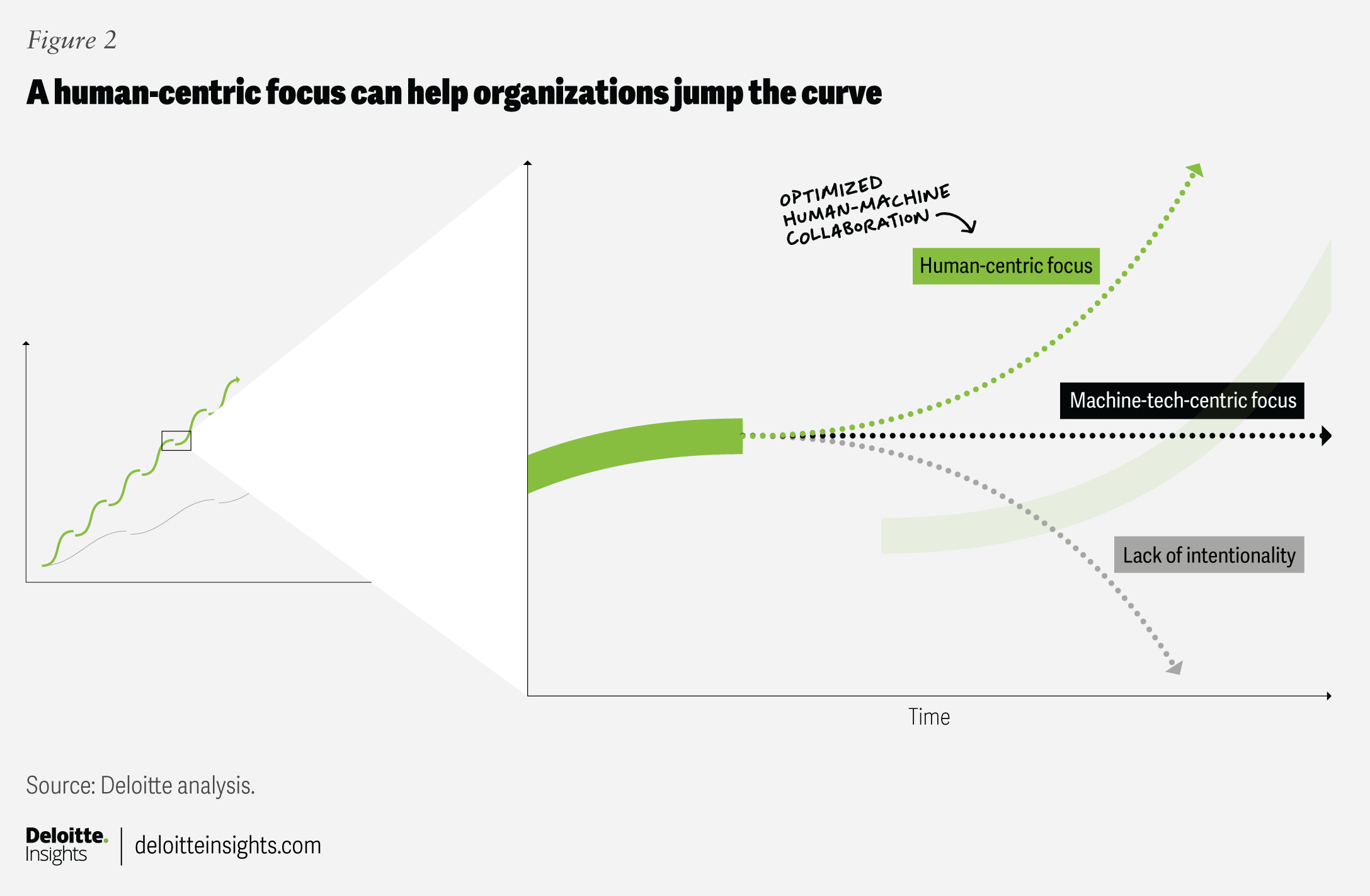
Indeed, recent Deloitte research with 100 C-suite leaders reveals that most organizations (59%) are taking a tech-focused approach when it comes to AI. But those taking a tech-focused approach are 1.6x more likely to not realize returns on AI investments that exceed expectations compared to those that take a human-centric approach.1
This human-centric focus allows organizations to confidently jump the curve rather than stay on the same curve, or worse, fall off the curve entirely (figure 2).
Three tipping points shaping the future of work
What makes this moment different is that the pressures on organizations are no longer sequential, but compounding. Technological advancement is converging with economic volatility, geopolitical tensions, societal expectations, and a rapidly shifting workforce. The boundary between planning and execution is collapsing, even as cost pressures, efficiency mandates, and questions of trust and clarity intensify. Many leaders feel overwhelmed—aware of the challenges but struggling to act decisively. Tensions once manageable over time are now tipping points, where hesitation risks missed opportunities and lasting consequences for organizations, their people, and society.
In moments of discontinuity, leaders face a choice: remain tethered to the old curve or leap boldly to the next. Winning organizations see tipping points as an opening rather than a crisis but changing that mindset isn’t easy. Letting go of familiar models, rewiring assumptions, and bringing people along require courage, discomfort, and persistence. By constantly embracing reinvention, they can turn disruption into momentum—unlocking new value, human potential, and growth on the next S-curve. The next curve isn’t on the horizon—it’s unfolding now.
In 2026, three tipping points stand out as especially important—moments where leaders will need to decide whether to cling to the old curve or leap to the next. Each tipping point represents a shift that organizations can no longer defer. They are not distant possibilities but present realities, demanding choices that will define how organizations create value, build trust, and unleash human potential in an AI-powered world. Given the speed and complexity of change, these tipping points can either sweep leaders along or become moments to act with precision and intention.
From human + machine to human x machine
The boundaries between humans and machines are blurring. Organizations will likely need to redesign work to harness human–machine synergy, moving beyond having humans and machines work side by side. This includes a rethinking of culture, decision rights, and trust in data itself. The questions are fundamental: How does culture evolve when people and intelligent agents work side by side? Who has the authority to decide when algorithms act and when humans intervene? And how can organizations protect themselves against misinformation and untrustworthy outputs in a world where AI is both a collaborator and a risk?
From cost efficiency to value creation
Relentless cost pressures, changing consumer and worker behaviors, and geopolitical shifts have pushed many organizations toward efficiency at all costs. But as that model tips, the focus should shift toward value. This means evolving functions to be fit-for-purpose, investing in innovation, and prioritizing growth through adaptability rather than simply reducing expense. At the same time, demographic shifts and disappearing workforces are making human capacity itself a scarce resource, elevating the need to invest where humans create unique and irreplaceable value. Organizations that succeed will likely not be those that automate the fastest, but those that channel efficiency into reinvestment, fueling new forms of value creation and worker performance.
From static plans to dynamic orchestration
The future is both here and unknown, making curiosity a core organizational capability. Staying relevant means continually reimagining how workers change, learn, and grow. And as strategy and execution merge, organizations will likely need to move beyond structured jobs and workers, orchestrating capacity and capabilities to meet shifting demands. This means building systems for perpetual learning, experimentation, and reinvention, where workers are not only adapting to disruption but empowered to shape it. Purpose, values, and culture should evolve from static statements into living parts of the organization, anchoring them while providing the freedom to adapt, compete, and thrive.
Exploring the tipping points in this year’s trends
Each tipping point presents an opportunity for leaders to test new possibilities and accelerate toward the next curve, while also surfacing questions that can no longer be deferred. The promise of AI is expanding rapidly, reaching further into work and the workforce than ever before; yet the gap between its potential and today’s reality remains wide. Bridging that gap will likely require organizations to intentionally evolve how work is designed, how workers stay relevant, and how leadership and culture enable adaptation.
This year’s report focuses on choices that our research shows, despite being powerful levers of value, are often overlooked. Many organizations are not yet making intentional decisions in these areas. The chapters that follow examine these questions in depth, illuminating the decisions leaders will need to navigate to thrive in an AI-powered, constantly shifting world.
- How do we maximize the value of humans and machines working together?
What choices matter most when redesigning work for humans working in concert with AI—and how do these choices shape the experience and performance of the humans in the system? As AI becomes part of everyday work, most organizations still aren’t intentionally designing how humans and machines interact, limiting returns and reinforcing outdated processes. Our research shows that those who intentionally redesign roles, workflows, and decision-making to support human–AI collaboration are more likely to exceed expectations on investment returns and deliver meaningful work. With AI access widening, intentional design—not technology alone—is becoming the real differentiator. - How do we know what is true about people and work?
How can organizations trust the data they rely on to make decisions about people and work? AI is increasingly blurring authorship and eroding confidence from both workers and organizations. Yet according to our 2026 survey, few organizations are making significant progress to address these concerns. To stay resilient, leaders will likely need to expand from focusing on cybersecurity to focusing on disinformation security and establishing stronger foundations of digital trust. - Who’s accountable when both humans and AI are making decisions?
When humans and machines interact, who’s the boss? Who decides? And how will accountability, decision rights, and leadership evolve? AI is increasingly influencing organizational decisions and authority. Treating decision-making as a strategic discipline—and intentionally designing how humans and AI share judgment and accountability—is important to maintaining trust and protecting human agency. Done well, AI can strengthen rather than override human decision making. - How is AI changing our culture?
How does culture shift when intelligent machines are part of the workforce? What are the implications for connection, trust, and the human fabric of organizations? Many organizations are overlooking AI’s impact on human-to-human behaviors, allowing misalignment, distrust, and unaddressed norms to accumulate as “cultural debt.” With workers questioning what counts as effort, ownership, fairness, and accountability—and most organizations rarely evaluating AI’s cultural effects—trust and cohesion are eroding just when they matter most. To avoid this quiet deterioration, leaders should intentionally reinforce and evolve culture so that AI strengthens, rather than undermines, shared values and performance. - How do we orchestrate capability and capacity at speed?
AI is accelerating how work happens, and advantage is shifting from allocating talent in static structures to orchestrating people, skills, data, and technology in real time. Speed now outpaces scale, yet most organizations aren’t moving fast enough. Those that continuously reconfigure capabilities around outcomes are more likely to outperform financially and create meaningful work, turning volatility into opportunity. - How do we get more value from our functions?
As cost efficiency gives way to value creation, how should core functions like human resources, finance, and IT evolve to be fit for purpose? Traditional functions are increasingly too slow and siloed for today’s business demands, yet few organizations are making progress in moving beyond them. As work becomes more multidisciplinary and AI and innovation require seamless collaboration, organizations may need to rethink and deconstruct functions, reassembling capabilities around outcomes rather than rigid structures. - How do we stay relevant?
Traditional change management and training may be too slow to help organizations and workers adapt as the pace of change accelerates. Few organizations manage change effectively, and even fewer meet continuous learning needs. AI is reshaping both, enabling workers to learn, adapt, and apply new skills directly in the flow of work. Organizations that build this always-on, real-time adaptability can avoid stalled transformations and disengaged talent, turning workforce growth and responsiveness into a new competitive advantage.
Making the leap with human advantage
Reinvention is no longer episodic: It’s the new baseline for work and the workforce. The organizations that thrive will likely be the ones to treat discontinuity as momentum, moving quickly to redesign work, roles, and value rather than reverting to old strategies in response to AI and other advances.
As the S-curve compresses, so do the capabilities required to navigate it. Where innovation, scaling, and efficiency once happened in sequence, today they increasingly need to coexist, often within the same teams and even the same individuals. Building the human advantage is now as critical as managing technology itself. That means not simply preparing workers for the future, but building a workforce that can continually learn, adapt, and reinvent in real time. Those that make bold, intentional choices to strengthen their human edge will set the benchmark for success.
Methodology
Deloitte’s 2026 Global Human Capital Trends worked in collaboration with Oxford Economics to survey more than 9,000 business and human resources leaders across many industries and sectors in 89 countries. In addition to the broad, global survey that provides the foundational data for the Global Human Capital Trends report, Deloitte supplemented its research with worker-, manager-, and executive-specific surveys to uncover where there may be gaps between leader and manager perception and worker realities. The survey data is complemented by more than 50 interviews with executives and subject matter experts from some of today's leading organizations. These insights helped shape the trends in this report.
By
Shannon Poynton
Jason Flynn
Nicole Scoble-Williams
Victor Reyes
David Mallon
Sue Cantrell
The authors are grateful to Karen Pastakia, Kate Sweeney, Simona Spelman, Bill Briggs, and Nitin Mittal for their time, input, and steady collaboration throughout this effort.
Special thanks to Catherine Gergen for her dependable research support and coordination in writing this Introduction.
A special note of recognition is reserved for Ishani Purohit and Olivia Rueger, whose steady project management stewardship over the past year orchestrated every moving piece of this report—from early planning through final production—keeping the team aligned, momentum strong, and execution seamless. The authors also extend their appreciation to Marissa Copeland and Anya Jaffer for their marketing leadership and creative guidance, which elevated the report’s positioning, polish, and reach.
The authors extend thanks to the REM team—Matt Deruntz, Maria Neira, Qiaoli Wang, Manshreya Grover, Nirupam Datta, Charu Ratnu, Santhosh Naidu, Derek Taylor, Marcella Hines, Parag Zalpuri, Chris Tomke, and Luly Castillero—for their steadfast partnership and behind-the-scenes execution that kept the work moving from draft to delivery. The authors also recognize the Deloitte Insights team—Corrie Commisso, Hannah Bachman, Annalyn Kurtz, Alexis Werbeck, Jim Slatton, Govindh Raj, and Molly Piersol, and the data visualization team, whose editorial rigor, storytelling craft, and visual clarity sharpened the narrative and brought the insights to life.
The authors would like to recognize the US India survey team—Dheeraj "DJ" Sharma, Urja Yashpal Singh, Shikha Warikoo, Vikas Arora, Shivani Maheshwari, Somya Bhardwaj, Vaibhav Jain, Shruti Garg, Nabamita Chakraborty, Nigel Lima Pereira, Hardika Sawhney, Disha Padmanabha, Koyel Sen, Ankita Mehar, Nitya Ganeshan Iyer, Janessa Karra, and Lipika Binani—for the survey execution and analysis, which strengthened the evidence base and enriched our exploration with critical insights.
Thank you to the Global Human Capital executive team—Kate Sweeney, Kate Morican, Amanda Flouch, Nathalie Vandaele, Jodi Baker Calamai, Dheeraj Sharma, Franz Gilbert, Karen Pastakia, Simona Spelman, Yasushi Muranaka, Tom Alstein, Sebastian Pfeifle, John Brownridge, Kurt Proctor-Parker, Pat Shannon, Andrew Potts, Dahlia Katz, Ava Damri, Kelly Nelson, Joan Pere Salom, Gerhard Botha, and Stuart Scotis—for sponsoring and supporting the global reach of this report. Their strategic guidance, insights, and perspectives helped sharpen the storyline, elevate the thoughtful analysis, and ensure the work resonated with our clients around the world.
The authors also extend sincere thanks to the clients who generously shared their time and experiences through interviews conducted for this report. Their candid insights and perspectives enriched our exploration, grounded the thoughtful analysis in real-world realities, and strengthened the relevance and practicality of the findings. Thank you to Lara Martinez Gonzalez, global director of talent intelligence, AstraZeneca; Michelle Robertson, executive board member (global human resources, people and culture), Adidas; Emily Bacon, senior manager, organization and people strategy, Adobe; Zac Parris, former director of organizational effectiveness, Atlassian; Taeko Kawano, executive officer and chief human resources officer, AXA; Justin Zaccaria, chief human resources officer, Bechtel; Matt Schuyler, chief people officer, Creative Artists Agency (CAA); Megan Bazan, vice president of people, Cisco; Charlotte Wolf Tarfa, vice president, global talent strategy and succession, Coca-Cola; Melissa Collier, director, change leadership, Georgia-Pacific; Elise Bathurst, director of people operations, Google; Courtney Gilliland, senior director, US human resources, Gordon Food Service; Lindsey Taylor, senior director, strategic workforce planning and people analytics, Hewlett Packard Enterprise; Marcia Oglen, senior vice president, enterprise human resources, Highmark Health; Jon Pitts, founder and chief technical officer, Ihp Analytics; Reiko Mukai, chief human resources officer, MetLife Japan; Charlotte Simpson, corporate officer and head of people and organization, Novartis Japan; Heather Neville, senior vice president, people and places strategy and operations, Sony Interactive Entertainment; Jill Larsen, chief people officer, Synopsys; Niki Rose, workforce experience and capability executive, Telstra; Tomoko Adachi, global chief human resources officer, Terumo Corporation; and Michael Ehret, senior vice president and chief people officer, Walmart International.
Editorial: Corrie Commisso, Hannah Bachman, Pubali Dey, Cintia Cheong, Anu Augustine, and Stacy Wagner-Kinnear
Design: Molly Piersol, Alexis Werbeck, Govindh Raj, Guido Agüero Gonzalez, and Sylvia Chang
Audience development: Atira Anderson and Maria Martin Cirujano
Knowledge services: Vanapalli Viswa Teja and Agni Wagh