
Board governance of human capital in the age of AI
A Deloitte Global survey shows many boardroom conversations on human capital and technology transformation remain siloed. Is workforce governance getting enough attention?
Foreword
Artificial intelligence and emerging technologies are continuing to transform not just how organizations operate, but the very experience of work itself. Beyond tool adoption, productivity, or AI token costs, the decisions business leaders make today will reshape workplace cultures and how human potential can be unlocked.
As stewards of their organizations, boards have a responsibility to take a holistic view of the factors impacting long-term enterprise resilience. In the age of human-machine collaboration, this starts with a simple truth: Neither technology nor people create value alone. Value comes from bringing out the best of both—human trust, judgment, and creativity, paired with innovative technology.
This research shows many boards may understand this, but have yet to work proactively with management to establish integrated guardrails and governance practices. Too often, technology and human capital conversations can happen separately—by different teams, on different timelines. Forward-looking, cohesive oversight has rarely been more important.
Recognizing open communication between boards and C-suites as a significant factor in building organizational resilience, this report draws out three steps boards can take now to help govern technology and human capital as one connected conversation. In doing so, board leaders can help guide organizations toward a world of work that is propelled by technology and shaped by human capability and aspiration.
Anna Marks
Chair
Deloitte Global Board of Directors
Lara Abrash
Chair
Deloitte US
Around the world, many boardroom discussions are likely centering on technology and the workforce. A 2025 Deloitte Global survey of board and C-suite leaders showed that rapid tech advancements and disruption and human capital governance were respondents’ top two strategic priorities for 2026 and beyond.1
Meanwhile, Deloitte’s 2026 Human Capital Trends research shows that, as AI-enabled tech transformation accelerates across many organizations, the disruptive and transformative impacts on the workforce’s shape, size, and composition are also rapidly expanding.2 How are boards approaching oversight of tech transformation and the workforce—and their interdependencies? Are they being talked about together, like two sides of the same governance coin? If not, what can boards do to get a more comprehensive view of how new technologies could impact employees’ ability to develop skills and thrive at work?
To explore these questions, in June 2026, the Deloitte Global Boardroom Program surveyed 806 leaders, 83% of whom are board directors and 17% are C-suite executives, from 53 countries (see methodology), and conducted in-depth interviews with 15 board chairs and directors.
Integrating human capital and tech governance is nascent, survey shows
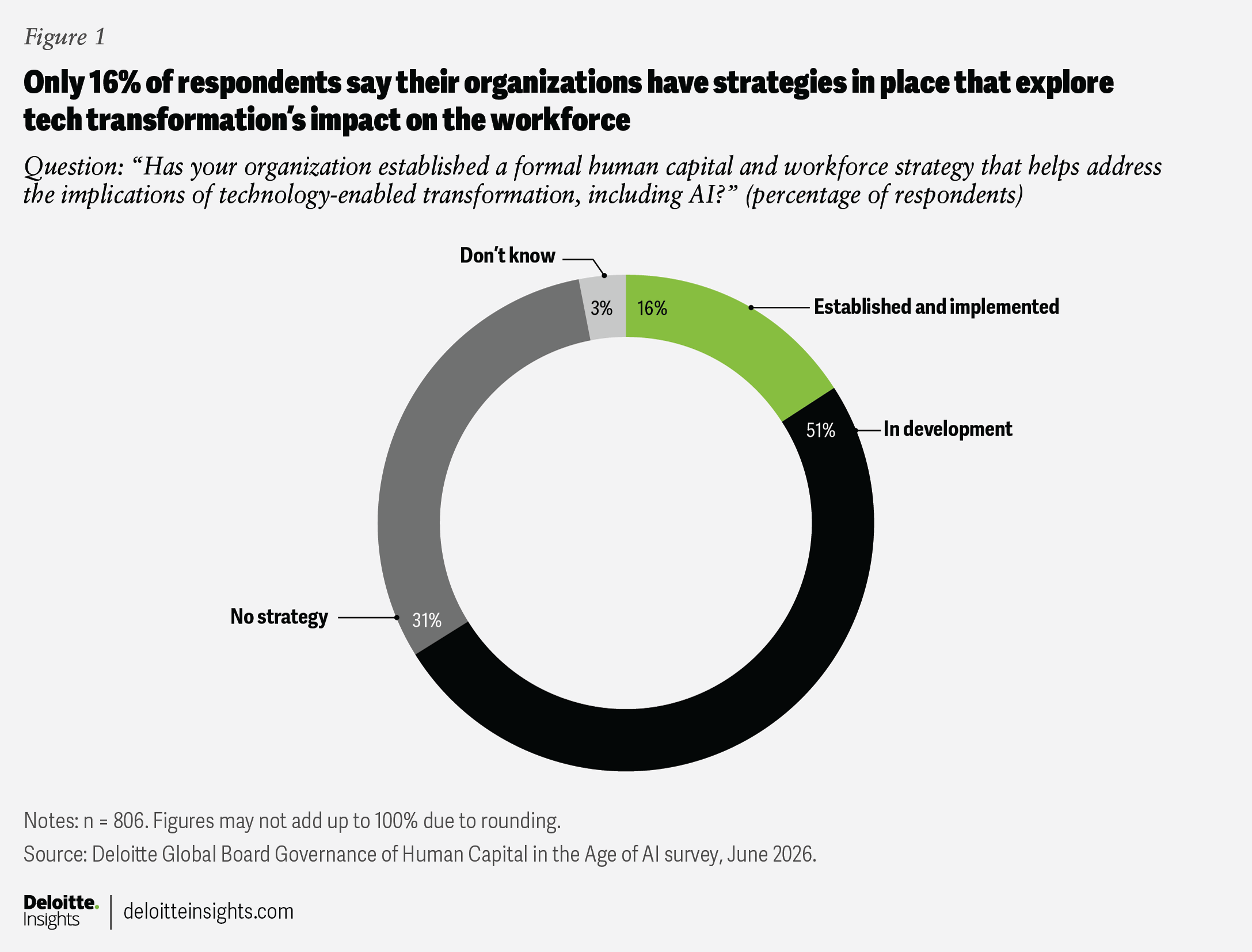
Among many surveyed organizations, including human capital considerations in the oversight of AI and other new technologies is still a nascent board oversight practice. While about half of respondents (51%) say their organizations are developing a formal strategy to help address the impact of tech transformation on the workforce, only 16% have an established strategy in place (figure 1).
While developing a formal strategy may be a work in progress for most surveyed organizations, 51% of respondents say they have made it standard practice to infuse human capital-related topics into boardroom discussions around AI and other tech transformation. The other half (49%), however, say their boards aren’t consistently including human capital in these discussions (figure 2).
There is growing recognition, however, that C-suite leaders should be connecting these conversations, with boards acting as their strategic thought partners. “Boards are increasingly recognizing that AI doesn’t merely automate tasks; it reshapes jobs. It might change organizational structures, leadership capabilities, and even the corporate culture,” says Yair Avidan, independent external director of Bank Hapoalim BM and Zim Integrated Shipping Services and former supervisor of banks, Bank of Israel. “In some ways, the technology has elevated human capital from a purely operational topic to a strategic one.”

Current workforce oversight discussions may be too narrowly focused
How, and to what extent, are C-suite leaders infusing workforce considerations into their boardroom conversations around tech transformation? The survey shows that when boards and management have discussions connecting workforce-related outcomes to technology transformation, they most frequently center on productivity (42%), which can include topics like efficiency gains from AI implementations and potential changes to workforce size or composition. However, there are risks to this narrow focus: “If, as a board, you’re just thinking about this as a cost-reduction exercise, you’re only going to achieve a fraction of the potential of AI,” says Anna Curzon, independent nonexecutive director of Fisher & Paykel Healthcare Corp.; board director of Gallagher Holdings Limited, Kiwibank, and Jade Software Corporation; and chair of Atomic.io. “But if you’re thinking about this as an opportunity to expand human capability, to accelerate learning, to unlock creativity—that’s going to provide enduring value to the organization.” Meanwhile, Derica W. Rice, independent director of Carlyle Group, Bristol-Myers Squibb, Walt Disney Co, and Target Corp., says broader drivers, like trade, inflation, and slower consumption, may be more salient reasons behind recent layoffs: “AI is a tool; it’s not the business strategy. Workforce reductions were on the table before AI, and AI may just be the scapegoat at the moment. The efficiency agenda did not start with AI. Business model transformation has frequently been a strategic discussion at the board level, for which AI is a new tool that may further that journey in a more fulsome and expedited fashion.”
When it comes to tech transformation oversight, the survey shows that topics around developing human capabilities and engagement, such as attracting and retaining employees (15%), maintaining decision quality and human judgment (10%), employee well-being (9%), and employee trust (6%) are less frequently discussed. This suggests that some boards may be thinking about tech transformation first before evaluating its impact on the workforce and organizational culture. “Boards love to talk about AI and new tools, but they tend to underestimate the scale of workforce transformation required to make them successful,” says Friederike Rotsch, lead independent director at SAP SE. Given the wide-ranging and long-term effects of technological transformation on work, careers, and personal development, it is crucial that boards apply a human lens to tech-related governance to help ensure technology augments, and not limits, human capability in their organization.
In the interviews, board leaders stress the need to incorporate talent oversight into tech transformation discussions. “AI challenges leaders to deconstruct roles, rethink what humans should do versus what AI can do, and redesign their organizations accordingly,” says Caroline Tsay, independent director of Coca-Cola Co., Morningstar Inc., and Nice LTD. “I think we have to essentially recognize that workforce strategy is, whether you like it or not, irreversibly entangled with AI governance,” says Sara Mathew, lead independent director of State Street Corp.
Challenges to amplifying governance of human capital
Most directors interviewed recognize the importance of approaching tech transformation and talent strategies cohesively. The interviews and survey data highlight, however, that board and C-suite leaders may face near-term challenges in their efforts to do so. Some of the most prevalent cited challenges are:
Limited oversight of how AI-related investments are balanced between tech and people: Nearly half (49%) of respondents say they have limited or no oversight of how investments in tech transformation are allocated between technology infrastructure and workforce enablement (figure 3). Just 12% report full oversight with active monitoring and discussion. “Nobody thinks human capital when we talk about capex [capital expenditures]—but most human spend isn’t capex, while investing in AI agents means real capex,” says Valerie Beaulieu-James, independent director of Orange SA and chief growth officer of ManpowerGroup Inc. “That’s a critical question about capital allocation we’re not yet having.”

Another director notes that AI spending may currently be another important priority alongside workforce investments. “With hundreds of billions invested and investors expecting returns, directors and management teams are increasingly worried about uncontrolled AI spend,” says Frédéric Oudéa, chair of Sanofi SA and independent director of Umicore SA. “That’s on the agenda in parallel to things like reskilling, role displacement, or how to keep training the next generation of seniors if fewer juniors are hired.”
Lack of reliable key performance indicators: Nearly half (46%) of respondents say they are somewhat or significantly concerned about the quality and sufficiency of the data and insights they currently receive related to human capital strategy amid technology-enabled transformation. So far, there are few established metrics for technology-related workforce transformation, as one director noted, and questions of return are genuinely hard to answer at this stage. “What are the KPIs? … How do you quantify this?” says Maria Kyriacou, chair of ProSiebenSat.1 Media SE and nonexecutive director of Informa Plc. “There’s no sensible answer to that at the moment.”
When asked which workforce risks represent the greatest opportunity to strengthen governance in their organizations, respondents rank skills gaps (54%), a lack of data integrity or misinformation (47%), and the erosion of human judgment (40%) as the top three risks (figure 4). As use of AI agents grows, board leaders will need to understand who is accountable for the work, how investments are balanced across human capital and technology, and how organizations are upholding human outcomes and the ethical use of AI in the workplace.

To help bring more rigorous oversight to the workforce, boards can ask management to provide a range of quantitative and qualitative workforce metrics, not just those showing productivity. “The board can weigh in on things like the balance between AI and human capital, how are our employees reacting to this, how are our employee engagement, satisfaction, and culture scores, what’s happening with turnover—and why are these things looking the way they are?” says John MacIntyre, chair of Toronto-Dominion (TD) Bank. “That’s where having a high level of [board] engagement is critical.”
Reliance on legacy organizational structures and board frameworks: Roughly 2 in 5 respondents (38%) say they lack confidence that current leadership models and structures—including human resources and IT functions—are fit for an AI-enabled workforce and deploying agents and automation (figure 5). At the board level, many committee charters, management responsibilities and reporting lines, and board agendas were built when technology and human capital were considered wholly separately. “As boards, we don’t have the structure or the expertise to govern that enmeshment. That’s new for us. That’s going to require work,” says Mathew.

Board knowledge and experience: According to nearly two-thirds (62%) of respondents, the most important factor for strengthening oversight of these matters is board knowledge and experience (figure 6). This ranks well ahead of greater management clarity (42%), more robust scenario planning (31%), and more dedicated agenda time (27%). Here, some respondents may be reflecting on the challenge of keeping pace with how tech advancements may impact the workforce, since board directors aren’t typically included in their organizations’ day-to-day flow: “Technology is moving at a six-month pitch and has created a mismatch relative to board governance, which is on a much slower cycle,” Mathew says. “The market is moving at what I call ‘AI agent speed’, and governance maturity is at ‘snail speed’. That mismatch is real, and this is why you've got to govern this redesign of work.”

However, each board member is ultimately responsible for their own level of tech proficiency. “You can’t delegate responsibility for something to one other director who might be a tech expert,” says Sally Orton, independent nonexecutive director of Nationwide Building Society. “Everybody should be focused on doing what they need to do to remain current. Otherwise, it’s a very uncomfortable place to be if the terminology gets ahead of you and you can’t keep up.”
Building more cohesive oversight of human capital and tech transformation: 3 actions
To help integrate human capital and tech transformation discussions and strengthen oversight of the AI-enabled workforce, board leaders can prioritize these steps.
1. Embed workforce strategy as a fundamental part of AI transformation and reimagining business models
Adopting AI and other emerging technologies has long-term human and cultural implications, far beyond short-term cost and productivity considerations. Board members have a responsibility to support and constructively challenge management to help ensure that the organization has an integrated strategy that addresses the impact of tech transformation on the workforce and that the strategy is reviewed and updated regularly. This should include whether current remuneration and talent strategies are competitive to attract and retain leaders with the right AI and tech skills and experience. The chair can play a key role as a strategic provocateur and sounding board to the CEO on how these two aspects are linked.
Boards can engage in strategy retreats and joint scenario-planning exercises for planning, soliciting feedback, and testing a range of possible futures. These serve as opportunities to understand the interdependencies at play and treat these two aspects as a single strategic discussion at the board level. Boards will need to engage with executives on how they are leading the workforce to maximize the opportunities tech transformation may afford.
2. Ensure management evaluates the impact of AI and emerging technologies on workplace culture
Interviewed directors note that leadership and culture will be critical to the success of transformation efforts. Boards can work with management to help set the appropriate “tone at the top” for the organization, act as role models for the organization’s core values, and help ensure that human capital and cultural considerations remain central during times of transformational change. To help position leaders and the workforce to thrive, boards should hold CEOs and their executive teams accountable for how they assess and respond to employee concerns, such as job security, redeployment, and sense of belonging. Relatedly, as AI adoption increases, boards should also ask management how they are cultivating the skills and judgment needed to sustain strong decision-making, and how career pathways and talent models may need to evolve accordingly.
Culture should be a regular item on the board agenda, and its key indicators should be evaluated with the same rigor as traditional financial metrics. Boards can request and review relevant qualitative metrics, such as employee engagement and turnover rates, to inform these conversations.
3. Invest in continuous learning to strengthen and align governance of tech and human capital
Providing effective and cohesive oversight of technology and human capital will require boards to have a balanced mix of skills and competencies. Where there are gaps, chairs and directors should take collective and personal responsibility to address them. Boards can engage in continuous, hands-on learning by participating in frequent training sessions, gaining input from experts, and spending time experimenting with new technologies. Some interviewees suggest having directors build their own agents and scheduling board education sessions at university AI centers or organizations’ own AI labs.
Some boards may want to add directors with specific tech experience. Ultimately, however, each director needs to develop enough fluency to effectively evaluate and challenge whether management plans and decisions consider both the long-term tech and human dimensions.
Toward a more human-centric approach to tech advancement
Overall, this research highlights why integrating workforce discussions into those around technology transformation in the boardroom may be just a starting point. “Don’t start with AI. Start with the purpose of the company—what kind of organization do we want to become over the next decade? Then, ask how AI helps us get there. Technology should serve the strategy, not replace it,” says Avidan. Rosa Vázquez, independent director of Fresnillo PLC, widens the lens still: “It’s the board’s duty to keep this conversation at the forefront, to help [management] understand we need to plan 10, 20, 30 years ahead.”
Deloitte’s 2026 Human Capital Trends report explains why boards should focus on technology for people’s sake, not the other way around: “Competitive advantage is now primarily less driven by technology differentiation and more by cultivating the human edge. Technology—especially something as increasingly ubiquitous as AI—is replicable. People aren’t. Humans create competitive differentiation through adaptivity, creativity, and judgment amid uncertainty and change.”3
Board leaders may need to think more expansively about their responsibility for working with management to help position employees to thrive amid transformation. “AI initiatives succeed or fail based on whether people have the skills, trust, leadership, and support to adopt new ways of working and thinking,” says Maggie Semple, OBE and independent nonexecutive director of Standard Life PLC and Crest Nicholson Holdings plc.
More broadly, actions board leaders take today can reverberate far beyond the confines of their organizations. Boards can play an important role in ensuring this transformation is human-led and AI-powered and carried out in a safe and trustworthy way—so that outcomes benefit society at large. “This is a human issue,” says Dr. Tunku Alina Alias, independent nonexecutive director of Nestle Malaysia, Telekom Malaysia Berhad, United Overseas Bank (Malaysia) Berhad, and Batu Kawan Berhad. “It affects humanity in a bigger way than just numbers—how many people are employed; how many are let go. An organization owes a responsibility to its people and its community to ensure that the integrity of what it means to be human remains.”
The views and opinions expressed by interview subjects are solely their own and do not necessarily reflect the views and opinions of Deloitte or any other individuals or organizations. These interviews provide general information only and are not intended to constitute advice or services of any kind. No individual or organization shall be responsible for any loss or damage whatsoever arising directly or indirectly in connection with any person relying on the views or opinions expressed in these interviews.
Continue the conversation
Meet the industry leaders
BY
Anna Marks
Lara Abrash
Prof. Dr. Arno Probst
The authors would like to thank the following individuals for their contributions to this report: Elise Heneghan, Karen Edelman, Benedicte Chung, Fiona Dickson, Krishnendu Bal, Shreya Patel, and Aparna Agrawal.
Editorial (including production and copyediting): Karen Edelman, Shyamili M, Pubali Dey, and Anu Augustine
Design: Natalie Pfaff
Cover image by: Sylvia Chang, and Alexis Werbeck; Adobe Stock
Knowledge services: Rohan Singh