
Resilience with a pinch of caution for the US labor market
The July 2026 Economics Insider analyzes the rebound in the US labor market this year, its drivers, and the risks it faces amid softer consumer spending and economic uncertainty
For much of 2025, a weakening labor market was an important consideration in US monetary policy decisions. Just seven months back, the US Federal Reserve cited downside risks to the labor market when it reduced the federal funds rate by 25 basis points.1 Indeed, total nonfarm payroll growth stalled to a monthly average of just 10,000 last year, with jobs even declining in the fourth quarter.2
Fast forward to July 2026, and we have a slightly different scenario: Recent US Fed statements seem to suggest that, right now, it is more concerned about inflation than the labor market. Job growth has picked up after all and unemployment remains relatively low.3 Is the labor market then set for a strong surge after a challenging 2025?
Evidence suggests that it may be a bit too early to say that: First, job gains remain below levels seen between 2022 and 2023, and are still lower than pre–COVID-19 times. Second, only a handful of sectors continue to account for a significant share of overall job growth in the economy. Third, US demographics trends continue to constrain labor supply even as participation rates edge lower. Finally, while wage gains remain healthy, they run the risk of being outpaced by rising inflation.4
Private sector job growth is picking up in 2026
Analyzing job growth within the post-pandemic recovery in the United States can be tricky—and, at times, potentially misleading. That’s primarily due to the nature of the last recession, in which the economy didn’t collapse due to economic or financial factors—like it did during the global financial crisis between 2007 and 2008 or the dot-com bust of 2001—but due to a rare public health emergency.5
The pandemic-driven recession of 2020 was therefore relatively short, but sharp. Total nonfarm payrolls dropped by 771,000 per month in 2020, which was much worse than the 296,000 average monthly loss in 2008. The recovery, too, has been comparatively stronger than previous ones: Payrolls rose by 606,000 per month on average in 2021, as the economy opened after the initial impact of the pandemic.
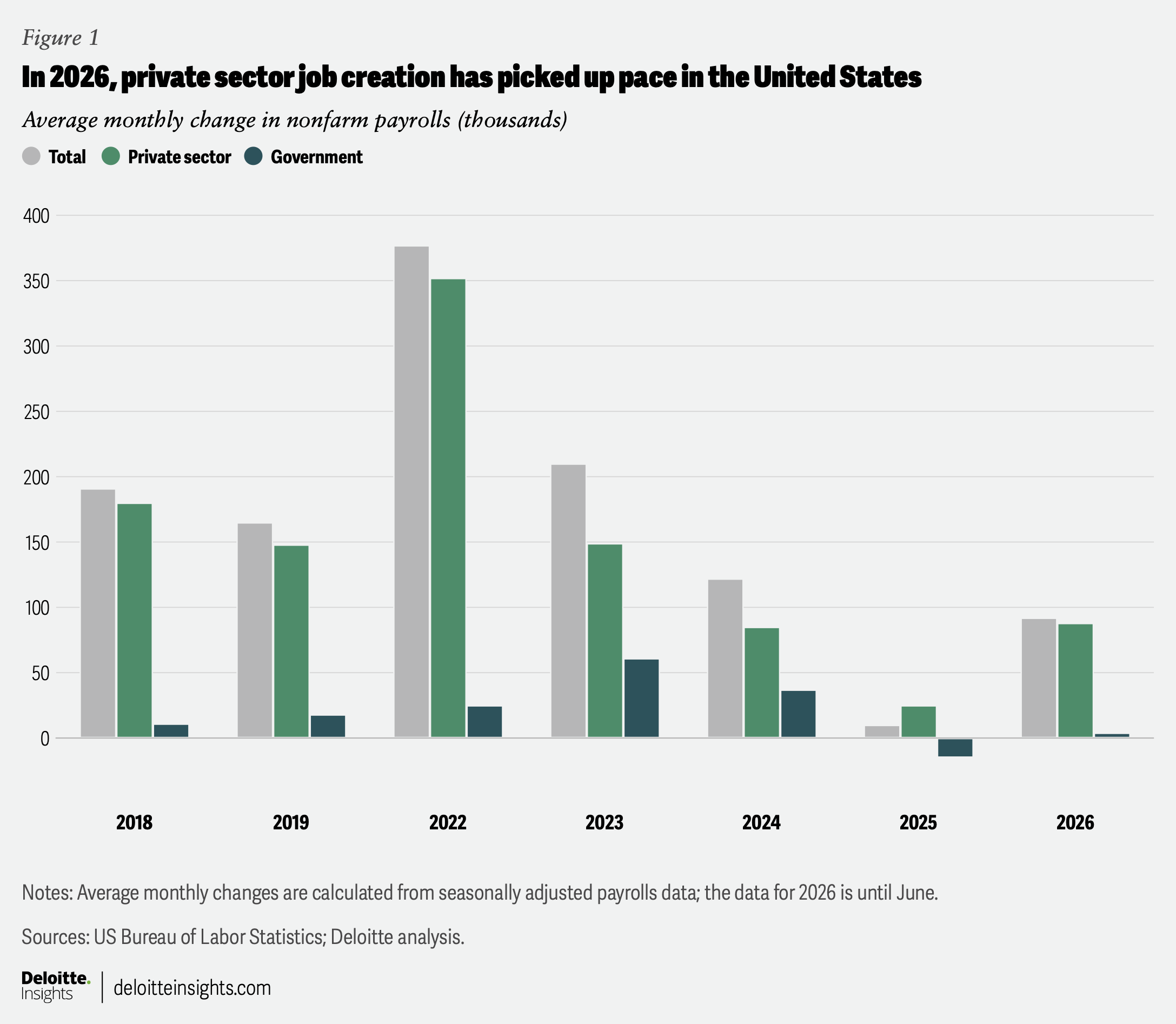
Therefore, to decipher recent job trends, it is useful to analyze data from 2022 and even compare them with the period right before the pandemic. So, what does the data indicate? According to the establishment survey by the US Bureau of Labor Statistics, job growth has picked up in 2026, with private sector payrolls growth averaging 88,000 in the first six months of the year, which is more than three times the pace seen last year and even slightly faster than in 2024. This pace of gains, however, is lower than in 2023 and the two years prior to the pandemic (figure 1).
Government payrolls growth remains subdued in 2026, following job losses in 2025. This largely reflects reductions in the federal government workforce implemented by the current US administration since last year: Federal government payrolls fell by 287,000 in 2025 and are down by another 36,000 in the first two quarters of 2026.
Only a few sectors are still driving a significant share of overall job growth
So far this year, jobs have increased across most of the private sector, albeit with some variance. Payrolls in professional and business services, for example, are up by an average of 23,000 per month this year after three consecutive years of contraction. Similarly, payrolls in wholesale and retail trade are also up after declining in the previous two years. In fact, in 2026, out of 14 broad sectors, payrolls are up in 11, compared to 2025, when payrolls increased in just five.
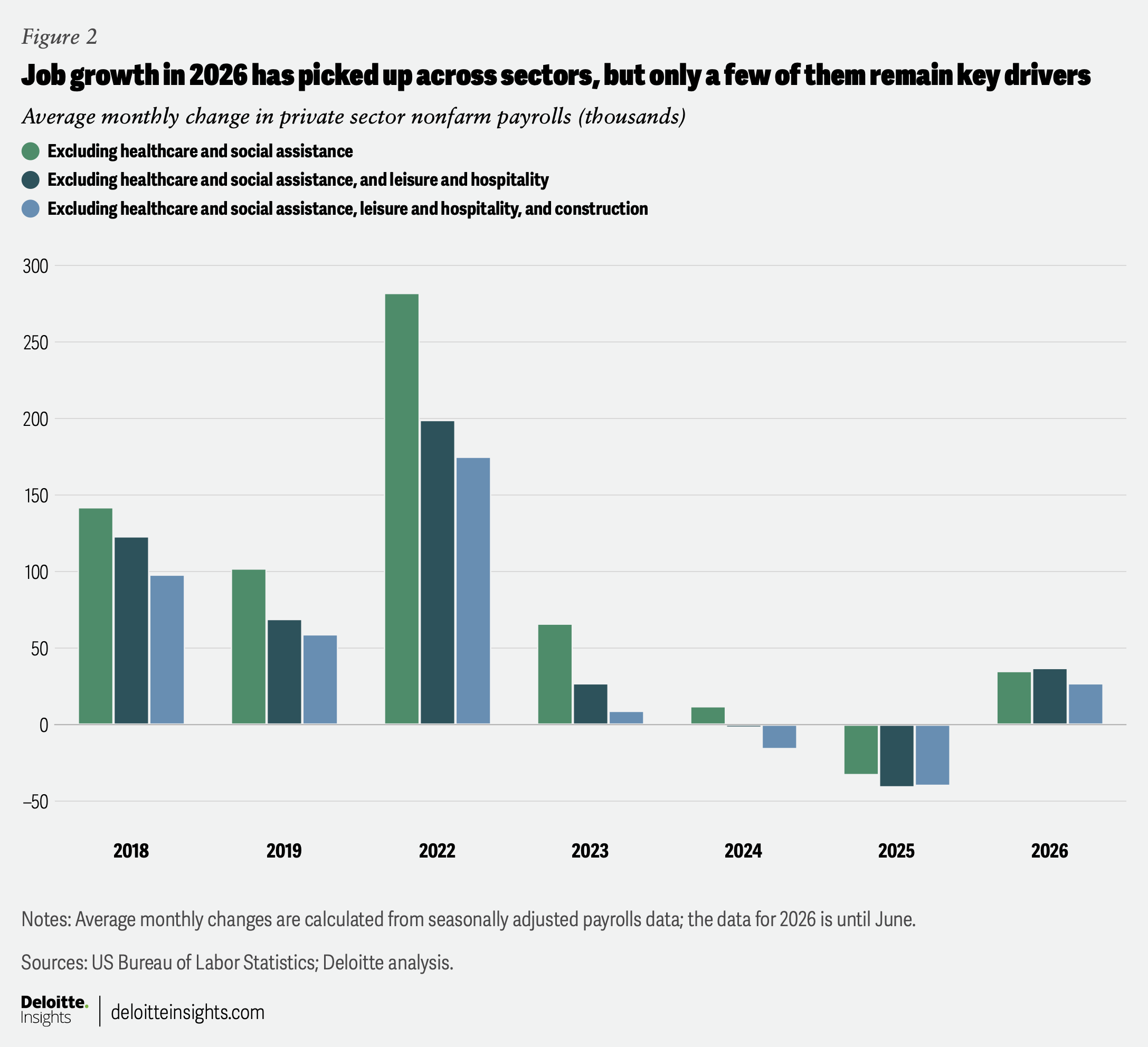
Nevertheless, healthcare and social assistance continue to account for a large share of overall job growth. If we remove this sector, payrolls in the rest of the private sector are up by just 35,000 per month, on average, so far in 2026. Till May 2026, leisure and hospitality also contributed strongly to overall job growth. Construction has also played a key role, especially in 2024 and 2026. In fact, without these three sectors, total payrolls growth in the economy would have been negative in both 2024 and 2025 (figure 2). However, the trend so far in 2026 has been an improvement compared to the last two years.
A relatively high concentration of job growth in a handful of sectors may leave the labor market and the wider US economy vulnerable to demand swings in those sectors. Leisure and hospitality jobs, for example, may face headwinds if the recent softness in demand persists. Real consumer spending on food services and accommodation—a key part of leisure and hospitality—fell for a second straight time in the first quarter of 2026 and hasn’t picked up pace so far in the second.6 Consistent with these spending trends, payrolls in food services and accommodation dropped by 54,600 in June, the sharpest decline since the end of 2020. Jobs in healthcare and social assistance, however, will likely keep growing due to an aging population. Since 2023, real gross value added in the sector has grown by 1.1% on average per quarter—up from an average quarterly 0.7% increase between 2010 and 2019.7
A tale of two trends from the survey of households
The household survey by the US Bureau of Labor Statistics shows that the unemployment rate is relatively low at 4.2%, although the figure is slightly higher than in 2024 and in the period right before the pandemic. The U-6—a broader unemployment measure that includes marginally attached and part-time workers for economic reasons8—shows a similar trend and has gone down since the last quarter of 2025.
An uptick in job growth this year partly explains why the unemployment rate has been stable. There is, however, one other factor that may be contributing to this trend—slowing labor supply. For example, net employment dropped by about 1.7 million in the first six months of 2026. Yet, the unemployment rate (which is a ratio of the number of unemployed people to the total labor force) has remained stable. That’s because the labor force has also declined: Net inflows into the labor force dropped by 2.1 million during the same period.
One factor likely weighing on labor supply may be the decline in net immigration, which has coincided with policy changes implemented since 2025. According to the US Census Bureau, net international migration fell to 1.3 million in 2025, from 2.7 million in 2024, and is projected to fall further to just 300,000 in 2026.9 There are two other medium- to long-term factors weighing on the labor force.
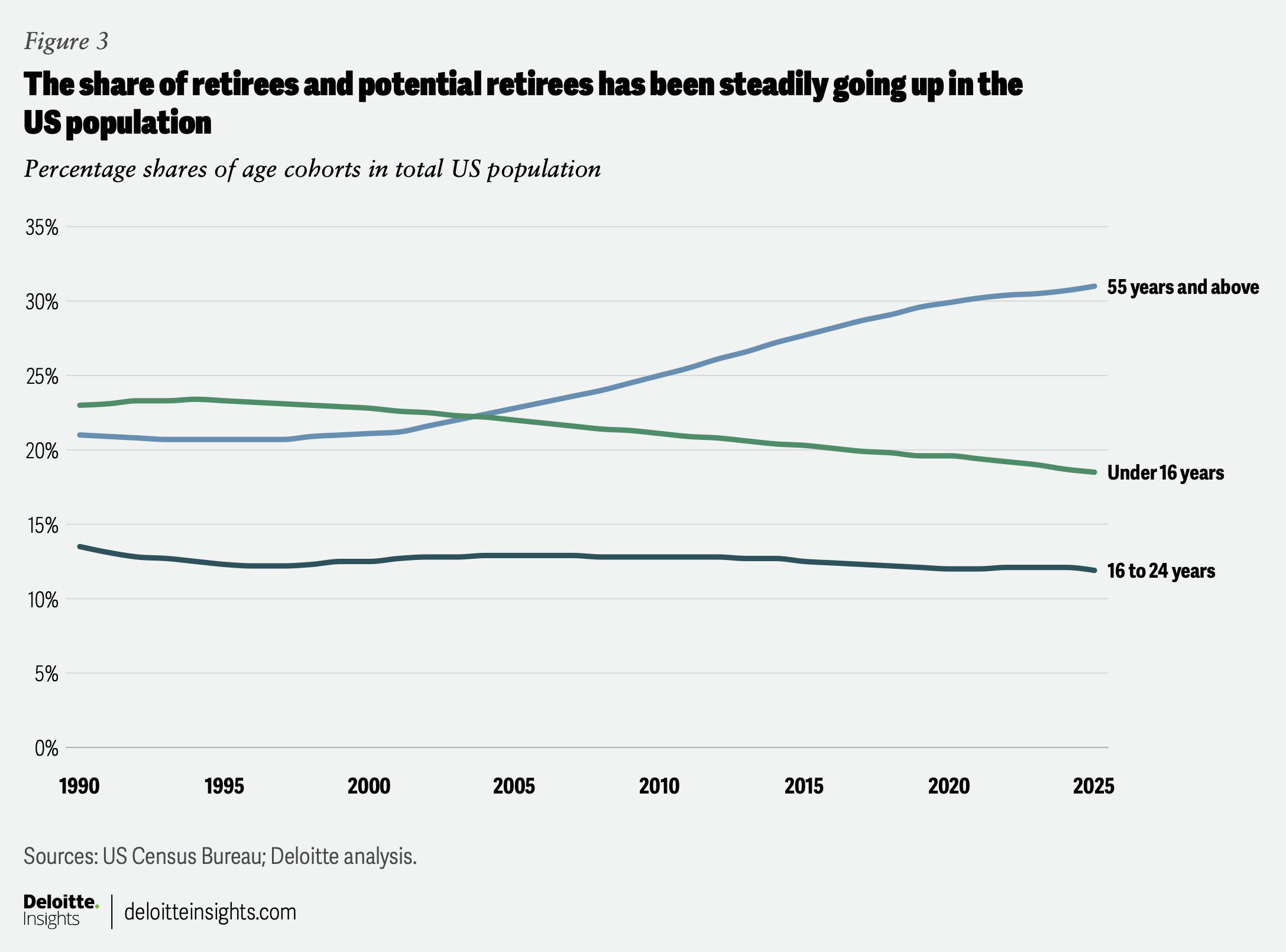
- First, an aging population is likely to remain a constraint on US labor force growth. The share of Americans below 16 years of age in the total population was 18.5% in 2025—down from 22.8% in 2000. The share of people between 16 and 24 has also declined slightly during this period (figure 3).10
In contrast, people at or above the age of 55 years now make up 31% of the population—up from 21% in 2000.11 This means that shares of potential and new entrants into the labor force have declined over the last 25 years, while shares of retirees and potential retirees have gone up. Indeed, people ages 55 and above now make up 23% of the US labor force, up about 10 percentage points over the past 25 years.12 And this isn’t likely to reverse: The US Census Bureau projects that nearly 35% of Americans will be 55 or older by 2050.13
- Second, these demographic changes have been accompanied by declining labor force participation. The labor force participation rate in June was 61.5%—nearly 1.8 percentage points below the rate before the start of the pandemic—and has been on a broad decline since 2000. Current projections from the US Bureau of Labor Statistics suggest that the overall participation rate (which is already lower) may continue to edge further downward, reaching 61.1% by 2034.14 With labor force participation declining, the employment-to-population ratio is now at its lowest in about 42 years.
The participation rate for 25- to 54-year-olds has slid by about 0.7 percentage points this year, breaking a broad increasing trend since the initial shock of the pandemic in 2020. This year, the rate has also declined for those between the ages of 16 and 24. The decline in the rate among 16- to 24-year-olds may be a positive for the economy if it reflects young people staying in school rather than entering the labor market with increased skills possessed by this cohort once they do enter the labor force. The fall in the participation rate for 25- to 54-year-olds, however, may warrant closer attention, especially since the participation rate for older people (55 years and above) has been on a steady decline since early 2022.
Slowing labor force growth may not only impact current hiring—and hence job growth—but may also weigh on future business investment decisions. After all, what good is a factory or a service outlet without workers to man it? An aging and relatively smaller workforce could also create longer-term fiscal challenges by increasing the burden placed on a comparatively smaller share of income earners.
Wage growth continues to provide some relief to workers
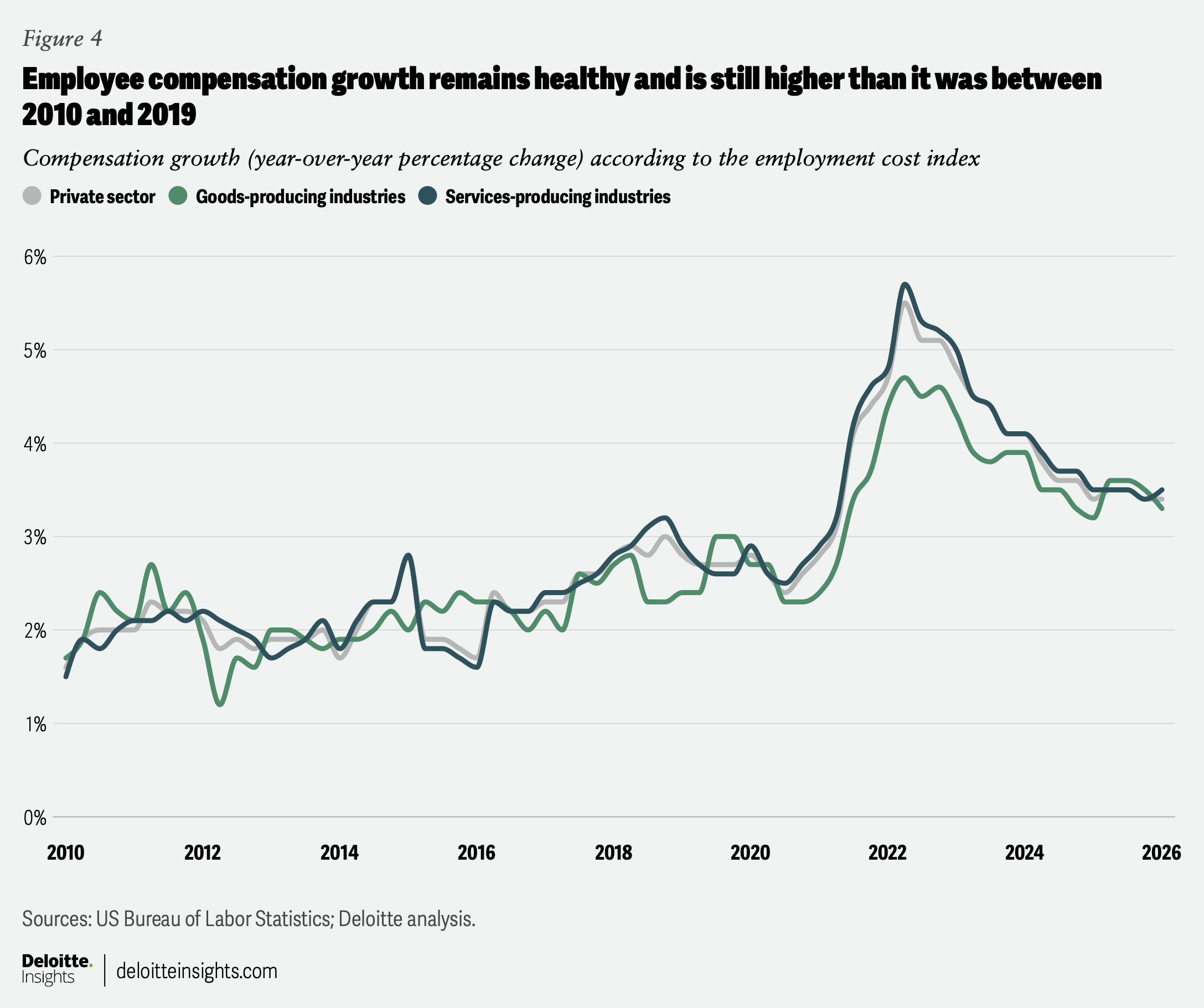
An uptick in jobs amid slowing labor supply growth has helped support continued wage growth. In the first quarter of 2026, private sector compensations, as measured by the US Bureau of Labor Statistics’ employment cost index, were up 3.4% year over year.15 That’s almost the same as the average quarterly pace in 2025. In the period right after the onset of the pandemic (2021 to 2023), compensation growth picked up as labor supply was unable to keep up with demand owing to the economic recovery. Since then, however, compensation growth has been stable, but still higher than in the previous decade (figure 4).
Also, unlike job growth, since 2024, the rise in compensation has been more broad-based. And for most major sectors, compensation growth continues to remain higher than in the period right before the pandemic. There is, however, a note of caution. Despite nominal compensation growth, workers’ purchasing power is again facing headwinds from rising inflation. In May, personal consumption expenditure inflation rose to 4.1%—the highest in more than three years.16 This will likely impact low-wage earners more.17 High-income earners, on the other hand, may be better-positioned to absorb rising prices, partly because they are more likely to benefit from gains driven by rising asset prices.18
Labor market clouds may reappear again
Overall, the US labor market appears to be springing back from a subdued 2025, but it may be too early to conclude that downside risks have dissipated.
First, the economy still isn’t firing on all cylinders. While business investment has surged, especially since 2025, consumers have lost some momentum. In the first quarter of 2026, real consumer spending grew at a seasonally adjusted annual rate of just 0.4%—the lowest in five years.19 Slowing consumer spending may weigh on sectors like retail trade and leisure and hospitality, potentially impacting job growth in these sectors.
Second, surging AI-driven tech investment isn’t translating into sharp job gains, especially in the tech sector.20 Since 2025, gross value added in the tech sector—combining five subsectors in the economy—has risen by 2.6% on average per quarter, but employment in the sector has declined during this period.21
Finally, the economic environment is still uncertain. Deloitte economists, in their downside scenario, assume that a combination of high oil prices—due to renewal of hostilities in the Middle East—along with an end to the current AI investment boom may lead to economic contraction by 2028, thereby leading to job losses and a rise in unemployment to an annual rate of as much as 6.5%.22
By
Akrur Barua
The author would like to acknowledge Dr. Ira Kalish, Deloitte's chief Global and US economist, for his reviews, and Rohini Sanyal from the Economics team for her Insights and contributions for this piece.
Editorial (including production and copyediting): Arpan Saha, Preetha Devan, Pubali Dey, and Anu Augustine
Design: Molly Piersol and Harry Wedel
Cover image by: Harry Wedel
Knowledge services: Agni Wagh
Visit the Deloitte Global Economics Research Center
Access more insights for the consumer spending, housing, business investment, globalization & international trade, fiscal & monetary policy, sustainability, equity, & climate, labor markets and prices & inflation sectors.