
AI sends hardware revenue—and share prices—surging, but pressures on profitability are also rising
AI infrastructure demand is booming as cloud providers and enterprises accelerate compute buildouts. Whether hardware companies can turn it into sustainable profit is less certain.
The hardware sector, long defined by modest growth and multiyear refresh cycles, has become one of technology’s most unexpected growth stories, driven largely by artificial intelligence infrastructure demand. The expansion we noted in Deloitte’s 2026 Global Hardware and Consumer Tech Industry Outlook currently shows little sign of slowing—but could that very success start to work against itself?
Already, order backlogs are growing as hardware original equipment manufacturers (OEMs) work to meet the surging demand for AI infrastructure. What’s more, high prices for key components such as memory chips are putting pressure on OEM margins that could require manufacturers to raise prices—and risk curbing future demand—or see their margins compress even further. These dynamics are shaping a new question for the industry: How can OEMs continue to meet AI hardware demand, and do it profitably?
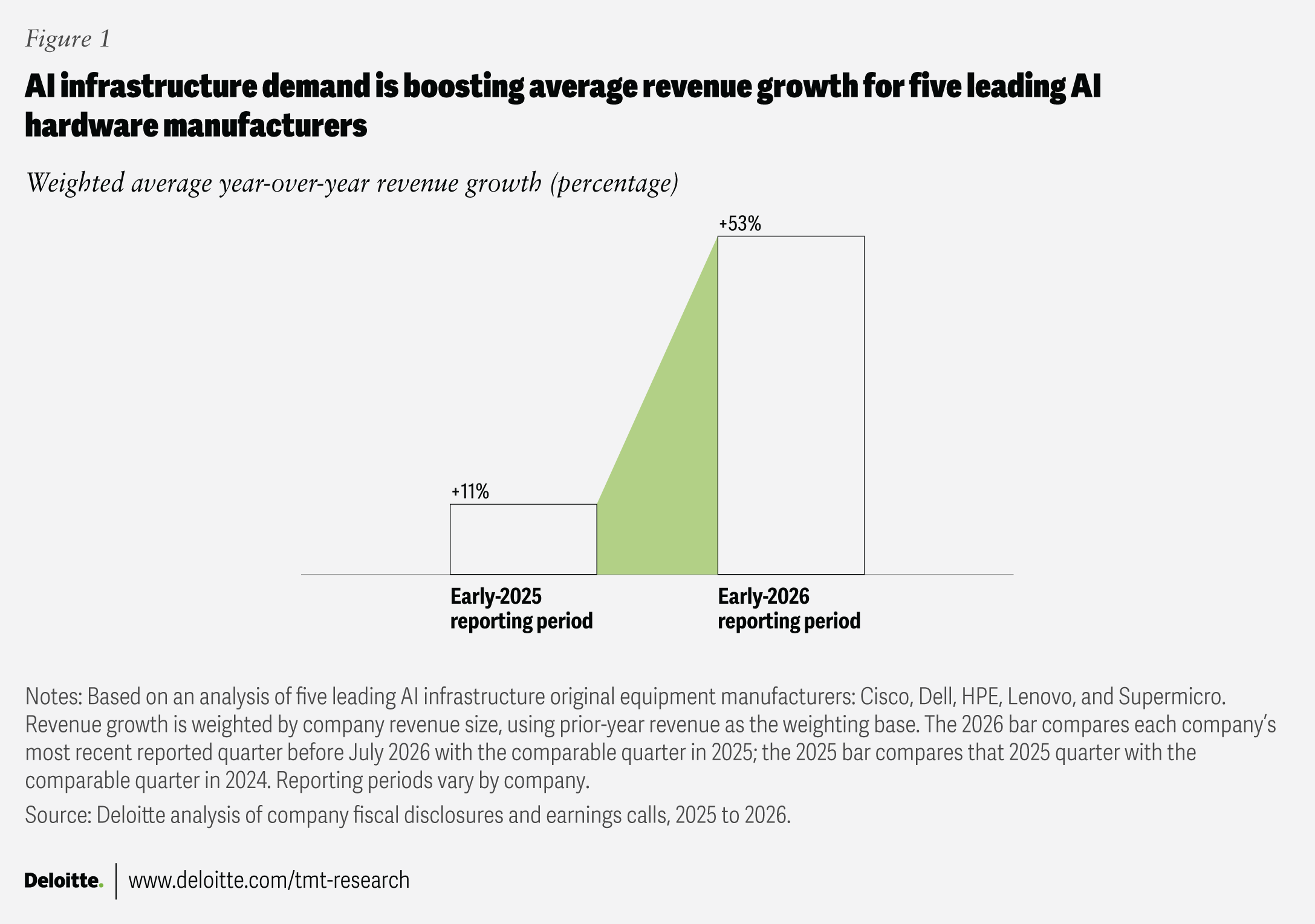
Hardware companies’ results from the latest earnings season underscore a story of exceptional growth. Across five of the leading OEM players in AI server infrastructure—Cisco, Dell, HPE, Lenovo, and Supermicro1—higher stock performance can serve as an immediate signal: As of July 27, average share prices were up 110% year to date, and the aggregate market cap of these five surpassed US$848 billion.2 Revenue is on the rise: Our analysis of the most recent comparable quarters for these OEMs shows aggregate revenue up 53% year over year, versus approximately 11% in the prior-year period (figure 1).3
The AI infrastructure buildout is happening across two demand pools at once. At the top end, hyperscalers, neoclouds, and telecommunications companies are building AI factories at scale.9 These facilities often require dense compute clusters, rack-scale architectures, specialized networking, advanced cooling systems, and unprecedented levels of power delivery, reliability, and operational coordination.10 At the same time, enterprises are modernizing on-premises and hybrid environments for AI workloads, especially where latency, data control, cost predictability, security, or compliance requirements may make a pure public-cloud model less attractive.11 For some enterprises, that investment may come partly at the expense of personal computer and legacy hardware refresh budgets.
It’s no longer a question of whether AI infrastructure spending is growing—four major tech companies are now projected to spend up to $730 billion in 2026 alone12—but how providers will satisfy the unprecedented demand for AI. Across the five OEMs analyzed, reported orders, backlogs, and pipelines for AI infrastructure have grown to more than $122 billion, pointing to demand running well ahead of deployment capacity.13 Increasingly, OEM operational constraints such as silicon availability, supply-chain resilience, manufacturing capacity, and the working capital required to fund procurement-heavy fulfillment cycles are likely to determine how quickly that backlog gets satisfied.14
Surging infrastructure demand also has pushed memory chip costs to levels that are squeezing OEMs responsible for building that infrastructure. The World Semiconductor Trade Statistics forecast for 2026 global annual chip sales now stands at $1.5 trillion—effectively doubling the $760 billion projection it issued just 12 months prior—fueled by both growing AI chip demand and rising prices.15 Most memory chip prices—one of the biggest factors in that jump—have quadrupled or more in the past year16 and may climb further, with memory chip sales projected to soar to $1 trillion in 2027, up from $230 billion in 2025.17 For OEMs, elevated memory costs can inflate both AI server and legacy server revenues—but the implications run deeper than just a topline lift.
Three compounding pressures tell a fuller story:
- A margin paradox: Elevated memory costs are creating a margin paradox for OEMs. Rising AI server revenues could compress gross margins if OEMs have difficulty passing through the higher cost of memory to their customers.18 Recent earnings calls suggest memory costs have become a broad-based margin concern across the group, with executives at four of the five companies analyzed flagging current or forward pressure.19
- Supply constraints: Advanced components are not just expensive—they’re scarce. Lead times to produce central processing units, GPUs, and memory chips currently range from four to 13 months for the most constrained components, simultaneously creating fulfillment risk across both AI and legacy server lines.20
- Risk of lower return on investment: Servers are the single largest cost item in an AI data center, representing about 60% of the estimated $38 billion required to build a typical one-gigawatt facility.21 As server prices rise on the back of sharply increased memory costs, cost per gigawatt is likely to face significant upward pressure. Should that pressure continue, the ROI case for new buildouts may weaken, possibly even to the point of slowing or stalling investment. That inflection hasn’t happened yet, but it’s a risk that OEMs and their chip suppliers should monitor.
In an environment where memory costs, margin compression, and component scarcity are compounding simultaneously, rapid growth in AI server revenue comes with growing questions about profitability and sustained margin performance.22 The capital intensity of fulfilling large AI infrastructure backlogs—funding component procurement ahead of delivery, managing customer timing shifts, and absorbing supply-chain variability—can introduce execution risks that could ultimately erode the financial benefits of strong demand.
While the OEMs we analyzed each take their own approach to protecting margins, potential levers are becoming clearer: pass on higher component costs to customers where possible, shorten the lag between price quotes and shipments, allocate inventory more flexibly, and shift the focus from commodity hardware toward higher-value infrastructure design and deployment.23 Those that locked in component supplies many months ago may face less immediate pressure, but if the component scarcity continues through 2027, OEMs will likely need to adapt to longer procurement cycles, secure allocation through long-term supply agreements, and even redesign configurations around available memory alternatives.24
Looking ahead
The backlogs and supply constraints, along with the multiyear lead time required to expand memory fabrication capacity, give enough visibility to sketch out what the next two to three years may look like:
- Prices for AI servers are likely to stay high. Component procurement will likely shift from just-in-time to just-in-case: Data center and enterprise buyers may need to plan 12 to 24 months ahead, locking in supply through advance payments and long-term agreements.
- Margin pressure is also likely to intensify as higher component costs, especially memory, work their way through the supply chain and squeeze OEM profitability even as revenues grow.
- While AI server volumes and revenues are expanding at unprecedented rates, that momentum may come at a cost elsewhere. Personal computer sales are likely to decline in volume, and potentially value, as AI hardware spending is prioritized over more traditional hardware refresh cycles.
The demand for AI infrastructure is well established; the profitability of that demand is not. Revenue is growing, margins are under pressure, and backlogs are long but vulnerable to cancellation. The companies well positioned for the next phase will likely be those that treat the margin problem with the same urgency they’ve brought to chasing growth—because in a market this capital-intensive, scale can amplify the margin problem rather than narrow it.
Continue the conversation
Meet the industry leaders
Dana Swanson Switzer
By
Steve Fineberg
Dana Swanson Switzer
Susanne Hupfer
Duncan Stewart
Prashant Raman
The authors would like to thank Jeff Loucks for his guidance and leadership on this project. We would like to thank David Jarvis, Karthik Ramachandran, and the Deloitte Insights team for their contributions and support.
Editorial (including production and copyediting): Aparna Prusty, Stacy Wagner-Kinnear, and Cintia Cheong
Design: Molly Piersol
Cover image by: Sonya Vasilieff
Knowledge services: Agni Wagh
Visit the Deloitte Center for Technology, Media & Telecommunications
Access more insights for the technology, media, and entertainment; semiconductor; telecommunication; and sports sectors.