
Power and utilities M&A 2026 midyear update: Deal activity reinforces scale, speed, and scarcity
Sector dealmaking reached a record high in the first half of 2026 as investors pursued deliverable, dispatchable power and larger portfolios
Article
•
8-min read
•
14 September 2026
•
Deloitte Center for Energy & Industrials
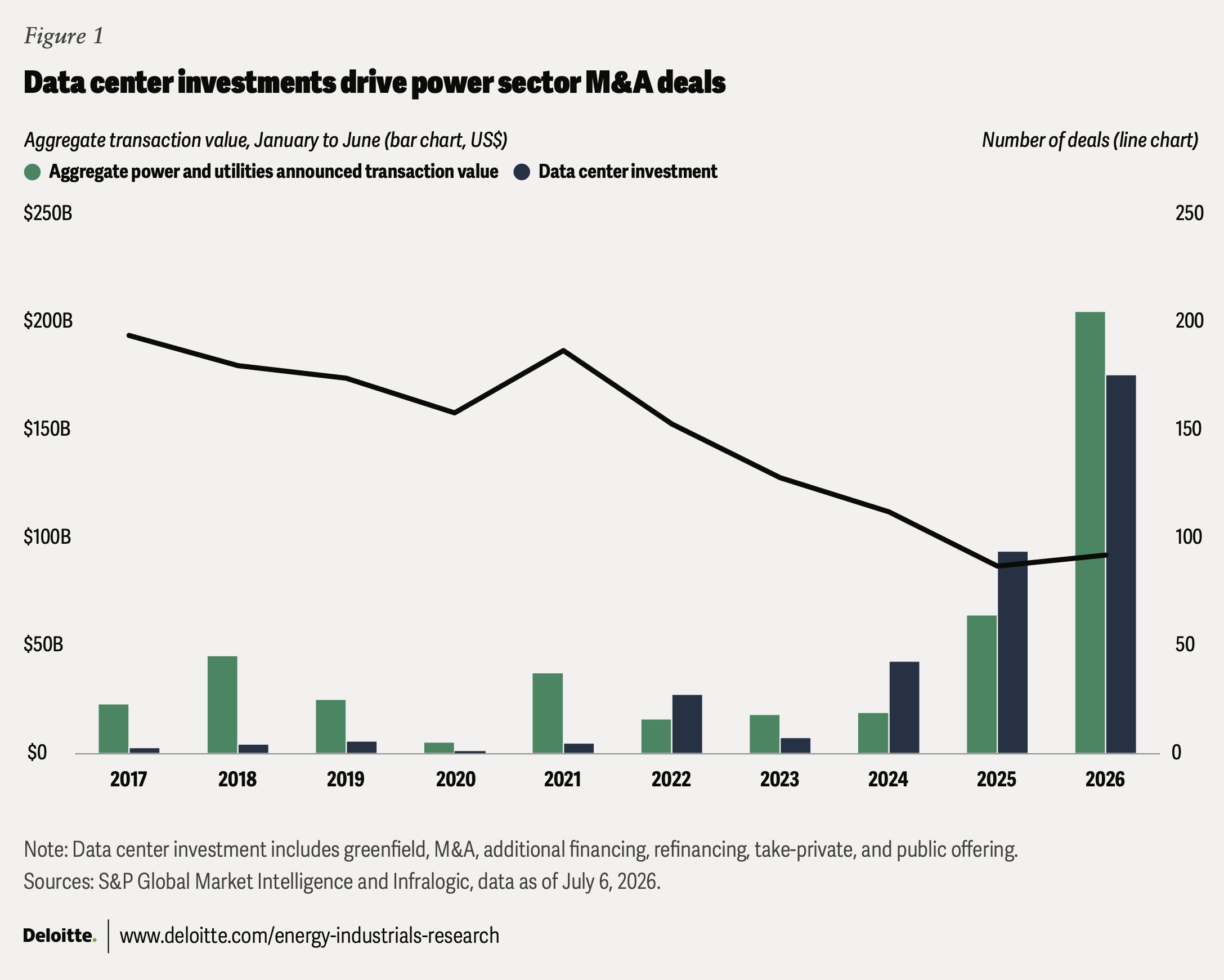
Power and utilities mergers and acquisitions reached a record US$205 billion in aggregate announced transaction value across 92 deals in the first half of 2026, more than triple the value for the same period in 2025 and higher than the combined first-half transaction values between 2019 and 2025.1 Two megadeals drove this record-setting six-month period: NextEra Energy’s US$124 billion merger with Dominion Energy and the US$48 billion AES take-private deal.2
The first-half surge builds on a record-breaking year in 2025, driven by continued expected demand growth from digital infrastructure buildout (figure 1). In our February 2026 report, “Who will own the power? AI data centers drive power and utilities M&A,” we highlighted key dynamics that were driving strong M&A activity across regulated utilities, natural gas generation, and renewables.
Power and utilities M&A activity in the first half of 2026 reinforces the thesis from our last report: As data center investment drives sector dealmaking, some utilities continue to recycle capital, gas-fired generation remains important, and renewables M&A has become more targeted. At the same time, investors appear to have become more selective, as regulatory scrutiny, affordability pressure, policy uncertainty, financing constraints, and execution risks have intensified since 2025.
Together, these dynamics underscore three central objectives across the sector: speed, scale, and scarcity. While the need for new power development remains important, M&A can help market participants accelerate existing portfolio development, improve asset optimization, and manage cost structure.
Speed: M&A is shortening the path to owning and controlling power assets
When building new development is slow, buying can be a fast route to ownership or control of existing and advanced-stage development assets. The 2025 rationale stands: As load growth accelerates, M&A can help buyers gain access to power faster than developing new generation infrastructure. Early-stage developments are likely to encounter long development timelines, permitting and interconnection backlogs, supply chain constraints, and rising capital costs, even despite streamlining efforts.
Speed considerations are showing up across several “speed-to” strategies.
- Speed to capacity for operating generation: Talen Energy’s acquisition of a 2.6 GW gas generation portfolio in Pennsylvania-New Jersey-Maryland Interconnection expanded its ability to serve large-load customers in the region.3
- Speed to market for regulated utility platforms: The proposed Dominion-NextEra merger brings together multiple fast-growing regulated service territories. With the added scale in the capital, development, and operational platform that NextEra provides, the merger could accelerate expansion and enhance service reliability and affordability for customers across combined service territories.4
- Speed to ownership for renewables and large-load customers: Amazon’s acquisition of up to 1.2 GW of shovel-ready solar and storage capacity in Oregon reflects a shift from traditional clean energy procurement via power purchase agreements toward direct ownership.5
- Speed to capital as a transaction strategy: Regulated utilities and power companies are also using strategic divestments to accelerate capital redeployment and fund growth in core operations. Examples include EDF’s sale of its North American renewable business to KKR and Spire’s sales of natural gas storage assets and its Mississippi business to I Squared and Delta Utilities, respectively.6
Scale: Companies pursue capacity and synergies
Some companies are using M&A to add owned generation capacity, expand portfolios, and capture development and operating synergies. At the same time, power and utilities M&A in the first half of 2026 was concentrated in larger deals. Deal volume remained near historical lows, with 92 transactions in the first half of 2026 compared with a record low of 87 deals in the first half of 2025. Yet, value remains concentrated in megadeals: Ten deals, each over a billion dollars, accounted for 97% of aggregate transaction value in the first six months of 2026.7
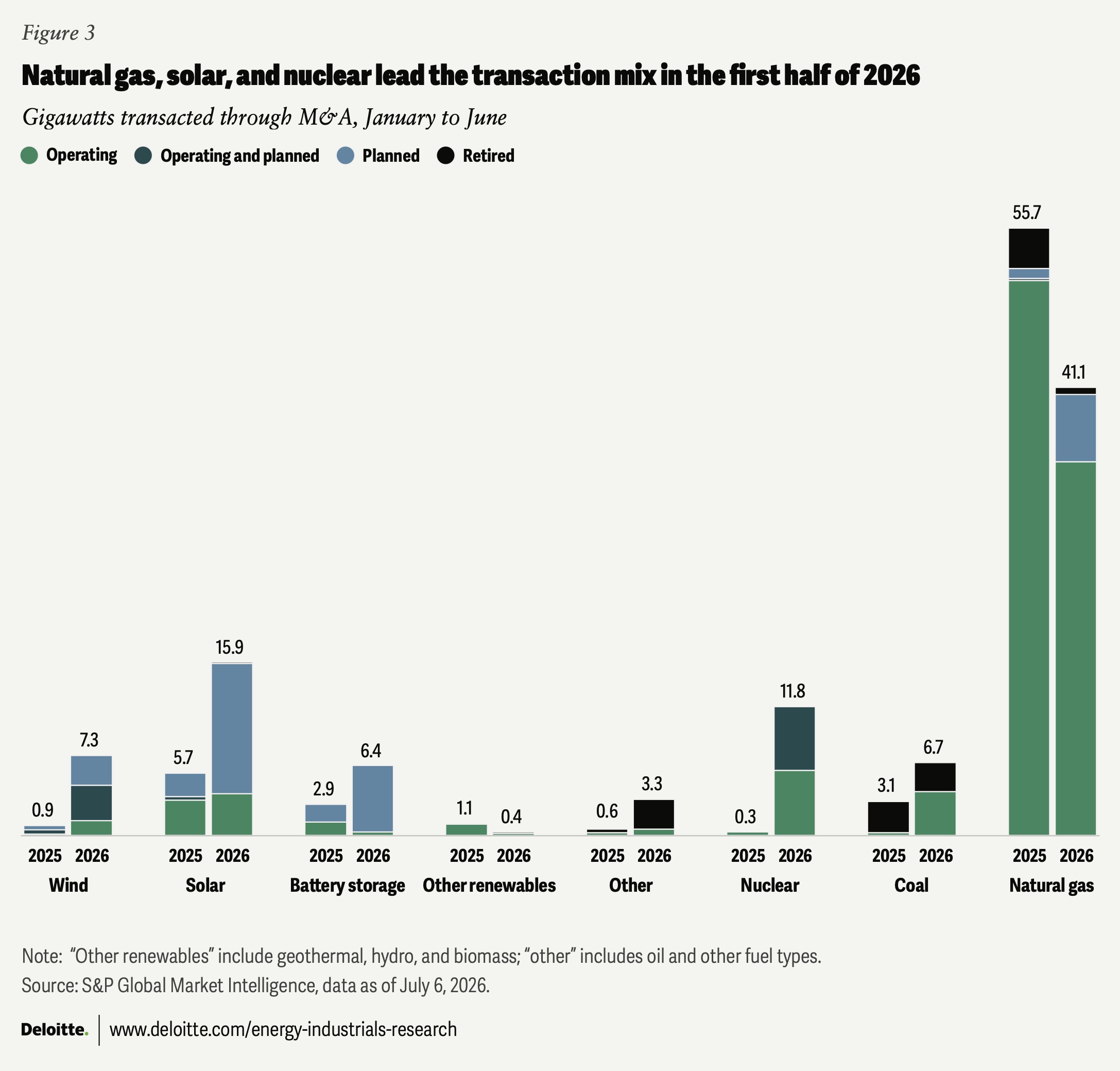
Generation capacity was similarly concentrated. Three megadeals, each with more than 10 plants in the portfolio and over 1 GW of aggregate capacity, accounted for nearly three-quarters of the 97 GW transacted in the first half of 2026.8 Those include the Dominion-NextEra deal, Vistra’s acquisition of Cogentrix, and Pattern Energy’s acquisition of Cordelio Power.9 The dominance of megadeals is consistent with the full-year 2025 data, which showed that megadeals accounted for 78% of the generation capacity transacted.10
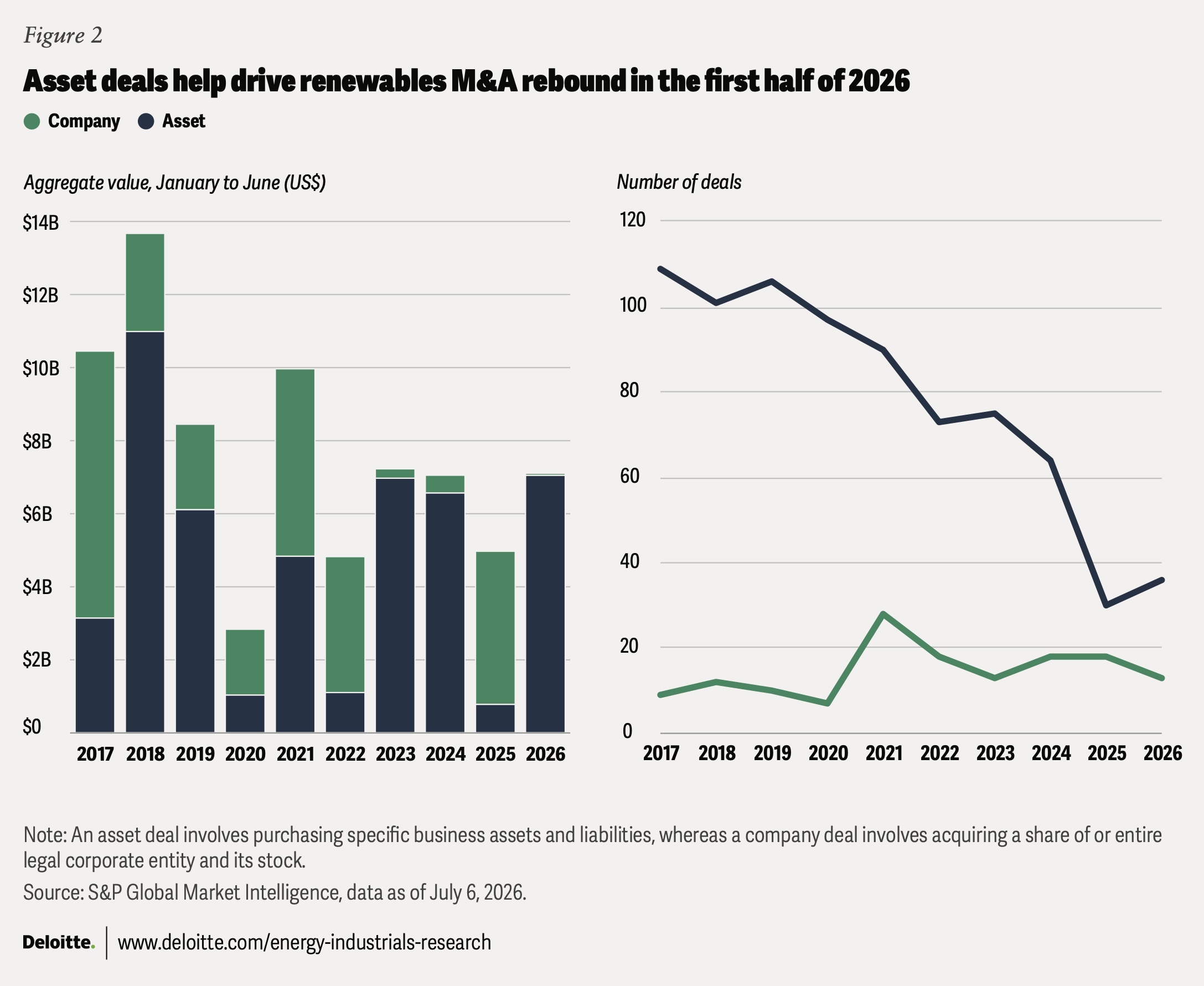
For renewables, scale is increasingly being pursued primarily through asset acquisitions with select platform deals. In the first half of 2026, asset deals accounted for most of the aggregate transaction value, a shift from the same period in 2025, when company acquisitions led. Renewables dealmaking rebounded in the first six months of 2026 after a dip in 2025 (figure 2), while deal count remained well below historical levels.11 Notable large-scale asset deals include Enel’s acquisition of an 830 MW wind and solar portfolio, Amazon’s 1.2 GW solar project acquisition, and Norges Bank’s acquisition of an interest in a 2.3 GW onshore wind and solar portfolio.12 Notable platform deals pursuing scale in North America include Pattern Energy’s acquisition of Cordelio Power and MN8 Energy’s proposed acquisition of Greenbacker Renewable Energy.13
Policy changes have added to the selectivity. The 2025 One Big Beautiful Bill Act accelerated wind and solar tax credit phaseouts, and subsequent guidance tightened qualification standards for many projects.14 That backdrop appears to be contributing to a broader shift among renewable investors toward assets with higher execution certainty over broader platform exposure, concentrating capital in fewer, larger-scale opportunities.
Scarcity: Dispatchable power is commanding a premium
Scarcity was the third priority that shaped power and utilities dealmaking in the first half of 2026. It reflects the need to secure deliverable power amid capacity constraints. Investors appear to be placing greater value on dispatchable, interconnected generation that can support reliability and deliverability in capacity-constrained markets.
On the buy side, scarcity centers on firm dispatchable generation. Natural gas remains central to securing firm power, accounting for 43% of the 97 GW generation capacity traded through M&A in the first half of 2026, followed by solar (16%) and nuclear (12%) (figure 3).15 Total capacity transacted through M&A rose 38% from 70 GW in the first half of 2025 to 97 GW in the same period in 2026, of which renewables and storage accounted for 35%, up from 15% in the same period in 2025.16 Battery storage also saw record capacity change hands in the first six months of 2026, with over 6 GW transacted, reaffirming its strategic role in supporting reliability and flexibility across resource types.17
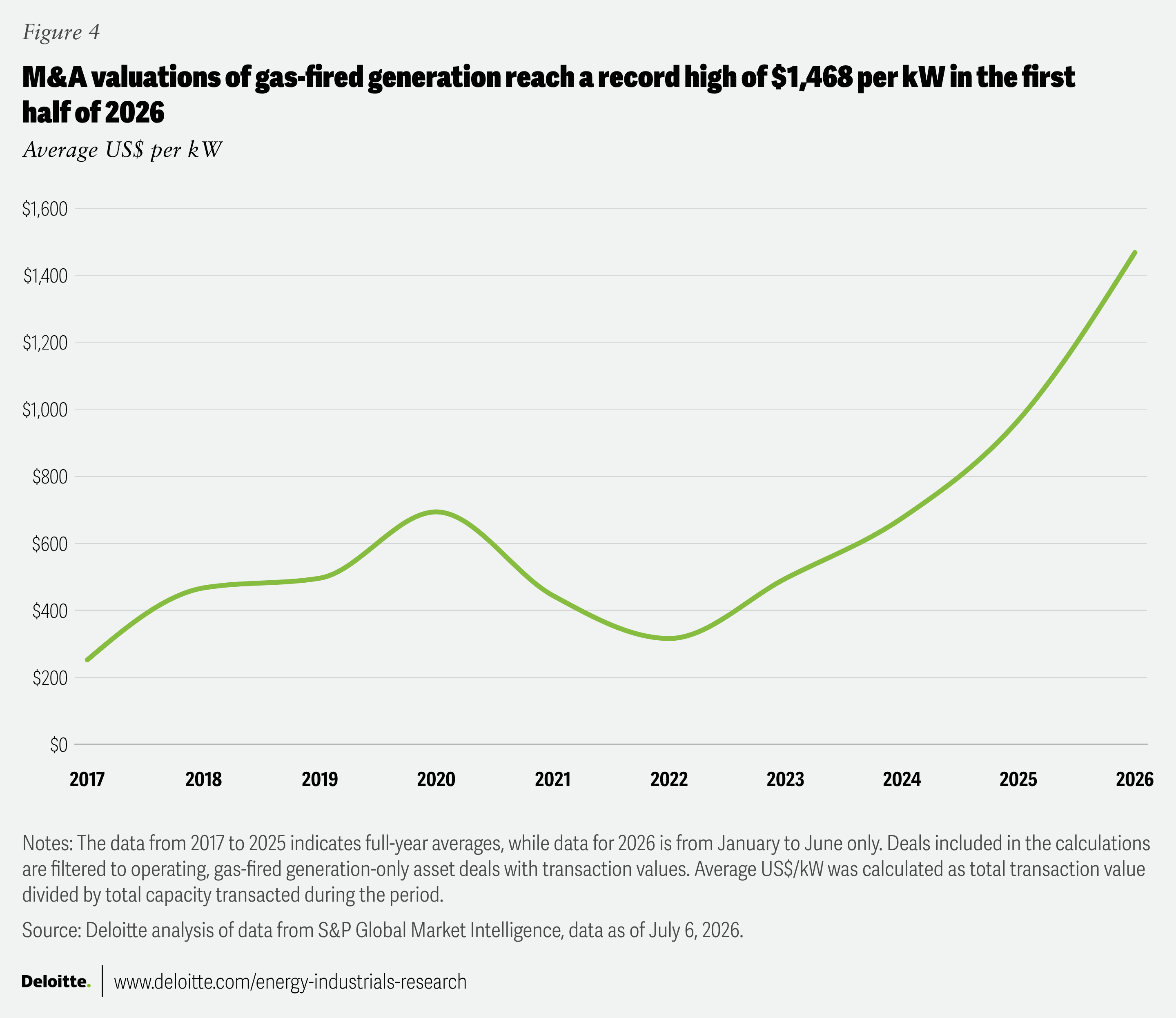
The valuation data further reinforces the scarcity premium that natural gas generation capacity offers. According to Deloitte analysis, gas-fired generation M&A valuations more than doubled in the past two years, from US$675 per kW for the full-year 2024 to US$1,468 per kW for January through June 2026 (figure 4).18 While transaction valuations can vary based on factors such as plant age, efficiency, fuel access, and market conditions, the increase is consistent with a market premium for operating, interconnected, dispatchable power.19
Considerations for the second half of 2026 and beyond
The first half of 2026 reinforces the core findings from our February report: Securing deliverable power at scale under tightening reliability, capital, and execution constraints remains a priority for companies. As the second half unfolds, market participants can approach M&A strategy through the lens of speed, scale, and scarcity—as a tool for capturing value, not a substitute for developing incremental capacity. This could include assessing how M&A can shorten the path to owning deliverable power, where capital recycling can fund higher-priority growth, and which assets warrant a premium for reliability attributes beyond nameplate capacity.
Continue the conversation
Meet the industry leaders
Thomas L. Keefe
Vice Chair, US Power, Utilities & Renewables Leader | Deloitte & Touche LLP
Deloitte United States
Keith Adams
US renewable energy leader | Partner | Deloitte Financial Advisory Services LLP
Deloitte United States
Kate Hardin
Executive director | Deloitte Research Center for Energy & Industrials | Deloitte Services LP
Deloitte United States
by
Brian Boufarah
Deloitte United States
Keith Adams
Deloitte United States
Kate Hardin
Deloitte United States
Shih Yu (Elsie) Hung
Deloitte United States
The authors would like to thank Carolyn Amon, Tom Keefe, Micah Bible, Catherine King, and Susanna Samet for their subject matter input and review.
The authors would like to acknowledge the support of Clayton Wilkerson for orchestrating resources related to the report; Rand Brodeur, Kim Buchanan, and Aditi Dilip Bhadwalkar, for driving the marketing strategy and related assets to bring the story to life; Mariel Balaban for leading public relations; Rithu Thomas and Aparna Prusty from the Deloitte Insights team for editing the report and supporting its publication, and Harry Wedel for creating the visual design.
Editorial (including production and copyediting): Rithu Thomas, Aparna Prusty, and Pubali Dey
Design: Harry Wedel and Sanaa Saifi
Cover image by: Sanaa Saifi
Knowledge services: Vanapalli Viswa Teja
Visit the Deloitte Center for Energy & Industrials
Access more insights for the aerospace and defense, chemicals and specialty materials, engineering and construction, industrial manufacturing, mining and metals, oil and gas, power and utilities, and renewable energy sectors.