
New models of public-private collaboration: Rethinking how governments create public value
Innovative mechanisms are reshaping how government agencies finance, govern, and deliver sustained public value
For decades, governments have partnered with the private sector to build and maintain infrastructure. Today, collaboration extends far beyond roads and airports to include digital infrastructure, social outcomes, innovation ecosystems, and data platforms.
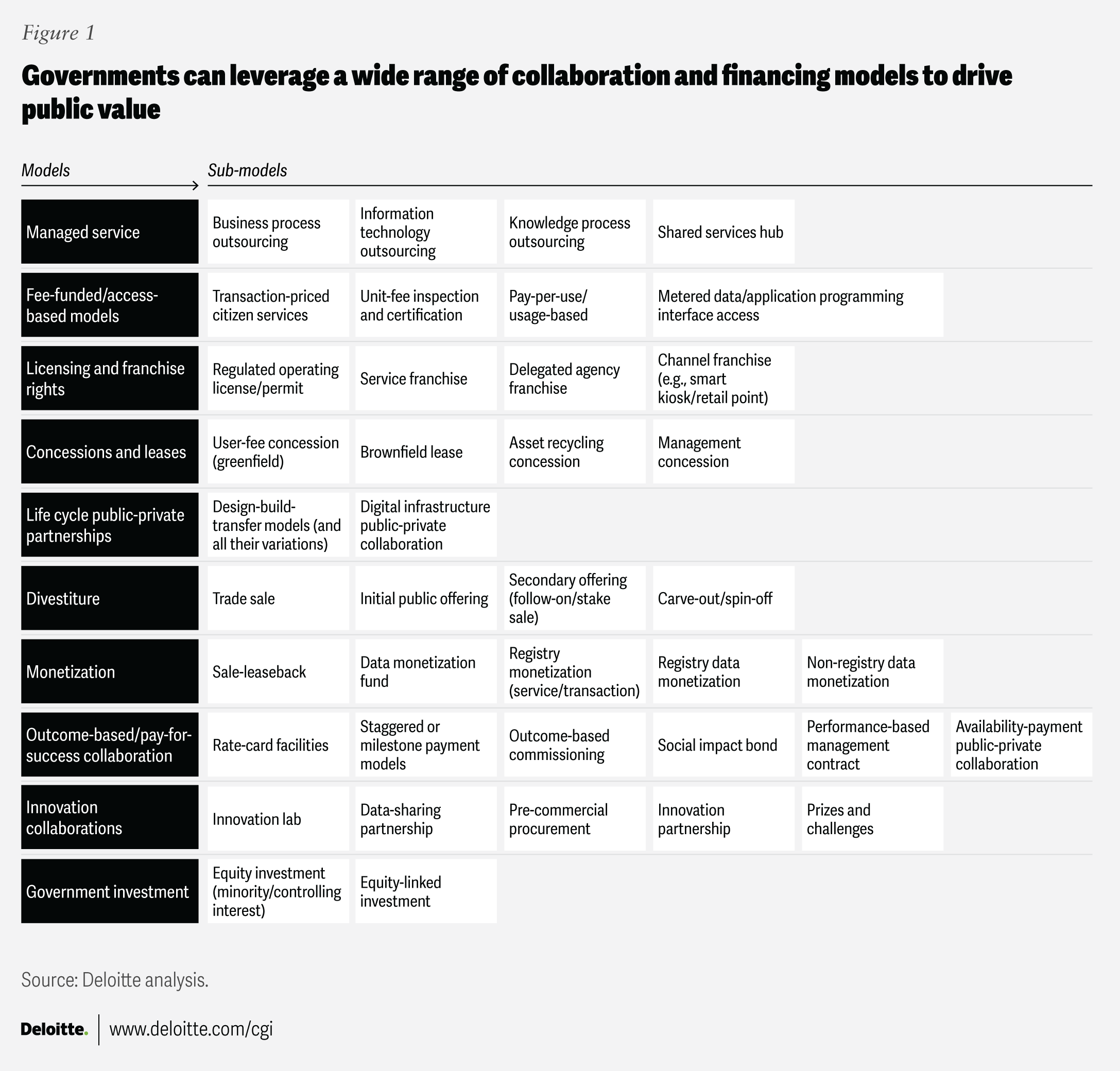
Traditional public-private partnership models remain important. What has expanded is the range and flexibility of collaboration structures (figure 1). Governments are using innovative contracting, blended finance, and digital governance mechanisms to share risk, accelerate delivery, and unlock value from assets, services, and data—while preserving core public safeguards.
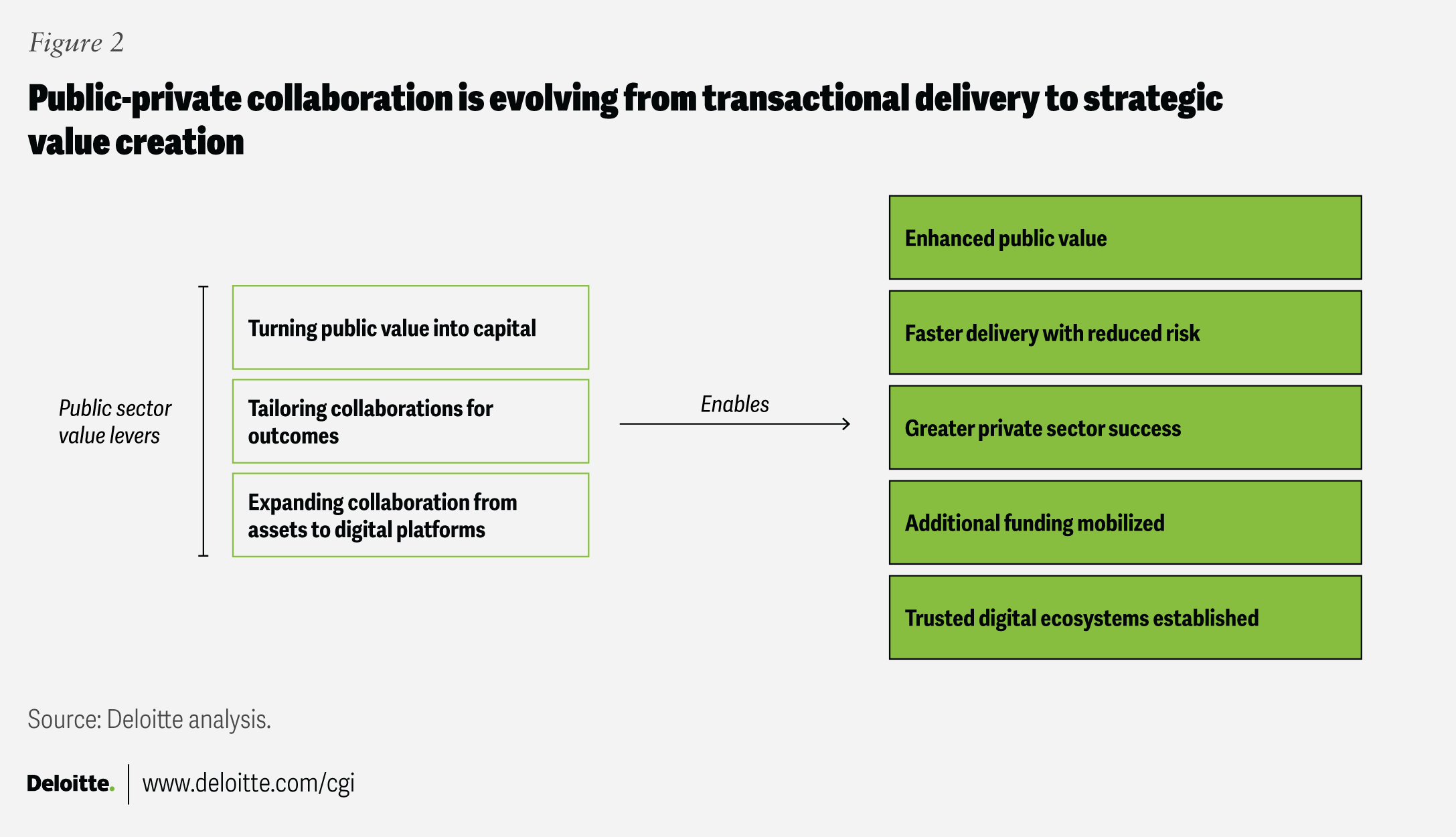
The fundamentals still matter: a clear business case, defined value capture, appropriate risk allocation, and the right collaboration model. What is new is the ability to combine these elements more flexibly and strategically to cocreate public outcomes (figure 2).
Signals: New models of public-private collaboration
Trend in action
Mobilizing new revenue for public priorities
As fiscal pressures intensify, many governments are turning to collaboration not only for delivery but also for capital. Three approaches, in particular, are gaining traction: capturing the economic uplift created by public investments; leveraging existing assets to fund new priorities; and monetizing government data responsibly.
Capturing economic uplift. Tools such as land-value capture, developer contributions, congestion pricing, and carbon markets channel a portion of economic gains back into public priorities. New York City’s congestion pricing program reduced traffic and pollution while generating over US$550 million in its first year to fund transportation upgrades.1 In Sydney, over-station and adjacent development at four new metro stations generated more than AU$1 billion for the New South Wales government.2
Using existing assets. Asset recycling arrangements—such as long-term leases and sale-leaseback arrangements—can generate capital without increasing debt. Victoria’s 50-year lease of the Port of Melbourne raised AU$9.7 billion to fund new infrastructure investments. New South Wales reinvested proceeds from leasing ports and electricity networks into its AU$20 billion “Rebuilding NSW” program.3
In 2024, Auckland Council completed the sale of its remaining NZ$1.3 billion stake in Auckland International Airport. Combined with an earlier 7% divestment, the proceeds are funding debt reduction and capitalizing the Auckland Future Fund, which is expected to generate NZ$60 million to NZ$70 million annually for long-term fiscal resilience.4
Monetizing data responsibly. Tiered-access models allow governments to preserve public ownership while charging for premium use. The United Kingdom’s Ordnance Survey charges for advanced geospatial products, generating significant revenue.5 Similarly, Finland’s Findata enables secure, paid access to health and social data through a controlled environment. The model helped generate €541,000 in revenue for the Finnish government in 2025.6
Expanding public-private collaboration from concrete to code
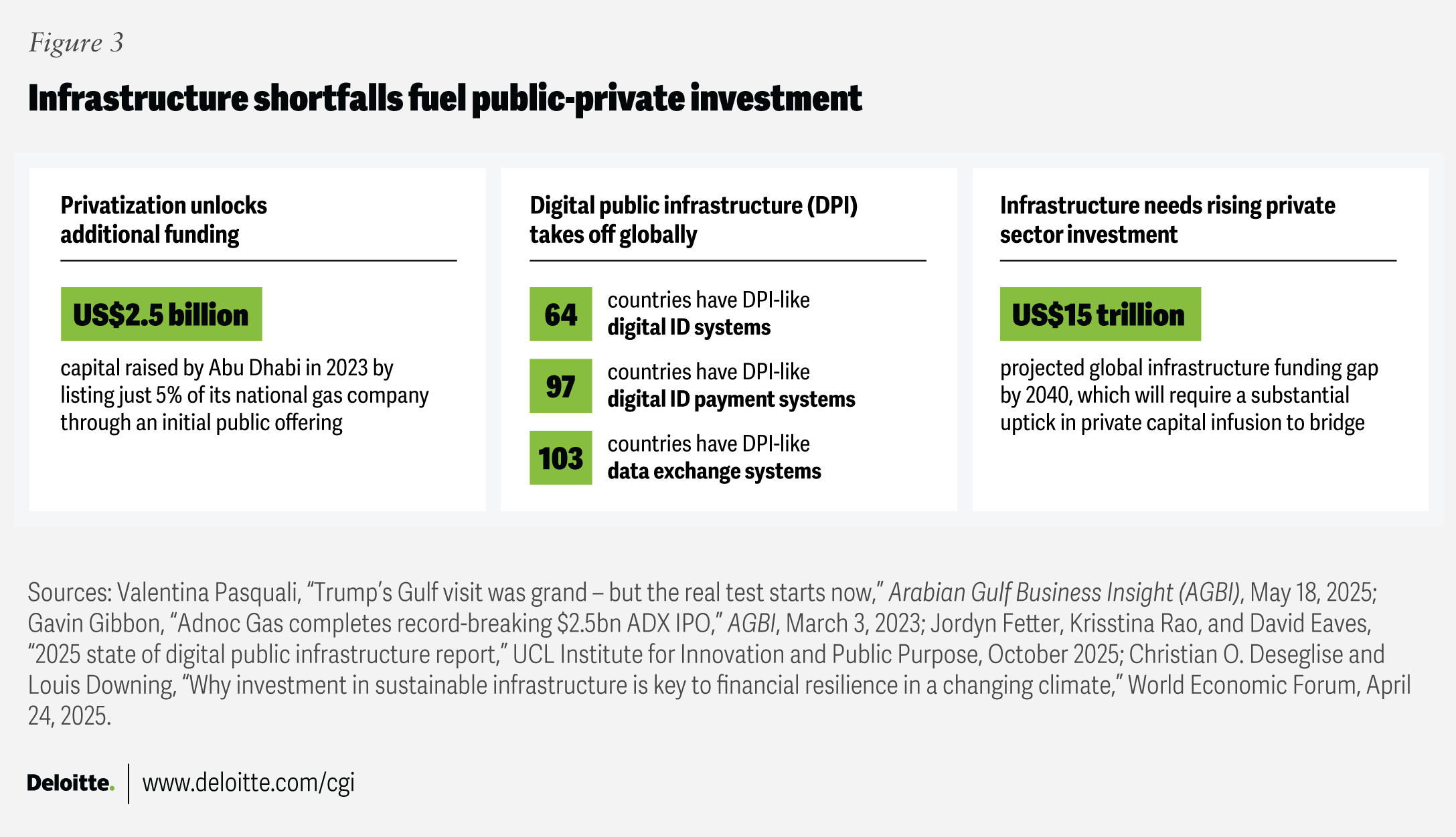
The next wave of collaboration centers on digital public infrastructure—identity systems, data exchanges, AI platforms, connectivity, and national technology stacks.
As partnerships expand into digital domains, data sovereignty and hosting requirements are becoming central design considerations.7
Delivering digital public infrastructure. Governments increasingly separate governance from delivery: defining standards and safeguards while enabling private actors to build services on shared infrastructure.
India’s Aadhaar digital ID illustrates this model. The government built the core identity infrastructure, while private banks and fintech firms developed user-facing services on top. Financial inclusion expanded dramatically, from roughly one-third of the population in 2011 to almost 90% by 2024, as the cost of opening and maintaining accounts fell and digital transactions became accessible to millions.8
Data and platform partnerships. Structured data partnerships are also emerging. Germany’s Mobility Data Space enables public and private actors to share and license mobility data through a decentralized platform integrated with Mobilithek, the national mobility data portal.9
Connectivity partnerships. Through partnerships, concession models, and municipal networks, governments are working with private providers to extend fiber and next-generation networks into rural, low-income, and commercially underserved regions. In the United States, more than 400 municipal broadband networks operate under open-access models, in which cities own fiber infrastructure while private providers compete to operate and deliver services to residents.10
Tailored, fit-for-purpose outcome-based partnerships
Governments are increasingly shifting from activity-based contracts to outcome-based arrangements that link payment to results. Such partnerships should be tailored to each agency’s specific needs and operating context.
Rate-card models define standardized payments for verified outcomes. Several US school districts work with the Center for Outcomes Based Contracting to tie payments to measurable learning gains across nearly 15,000 students. Districts agree on a menu of outcomes, such as growth targets in reading or math, with fixed payments to the center for each verified result.11
Milestone models release funding as providers meet interim goals. These are well-suited to projects in which results can take years to materialize. In Australia’s Capital Territory, an AU$64 million multimodal transport contract to deliver a new multimodal public transport ticketing system includes 30 milestones covering delivery, installation, and integration.12
Pay-for-success health models link reimbursement to patient and health outcomes rather than to the volume of services delivered. In Sweden’s Stockholm region, a value-based reimbursement program for elective spine surgery reduced average episode costs by 11% while increasing the number of treated patients by 22%, without evidence of worsening outcomes.13
Outcome-based commissioning generally defines clear results while giving providers flexibility in how they achieve them. This model is suitable when local needs differ, evidence of effectiveness is still emerging, or multiple partners must work together. In Virginia, a US$20 million program pays for verified reductions in actual pounds of pollution removed or prevented in the Chesapeake Bay watershed, regardless of method.14
As needs evolve, agencies should calibrate public investment by asset type, risk profile, and the incentives needed to attract private partners. Targeted public investment, often a modest share of the total project costs, can help de-risk projects, attract private capital, and deliver far greater impact beyond what the private sector would finance on its own.
Enablers and accelerators
Sustained collaboration requires institutional capability, not isolated deals.
- Assess partnership readiness. Agencies should evaluate mandates, fiscal flexibility, regulatory constraints, and delivery capacity before selecting collaboration models.
- Strengthen data for outcome contracts. Clear outcomes and reliable performance data are essential for effective value-based arrangements.
- Develop a strategic menu of models. Leaders should map collaboration options—financing structures, monetization pathways, and risk allocations—to align models with mission needs.
- Build a monetization pipeline. Review infrastructure, digital platforms, access rights, and data assets to identify long-term revenue opportunities.
- Invest in collaboration skills. Managing multi-party partnerships requires expertise in design, governance, and risk management. Agencies should cultivate these capabilities internally and externally.
Turning public-private collaboration into enduring engines of public value creation will require governments to institutionalize readiness assessments, context-specific collaboration model design, and long-term monetization planning as standard practice.
Toward 2030: The future this trend could unlock
By 2030, public-private collaboration functions as a continuously evolving delivery ecosystem. Value capture is embedded in planning, and digital public infrastructure provides a shared backbone for integrated services.
- Public-private collaboration ecosystems become essential delivery engines. These ecosystems mobilize capital, manage risk, and continuously evolve assets and services in a rapidly changing environment.
- Outcome-based models become routine. Payments link to verified performance, supported by shared standards and transparent validation.
- Value capture becomes standard practice. AI-powered forecasting tools help identify economic uplift generated by infrastructure investments, clarifying who benefits and ensuring that a portion of gains returns to public priorities.
- Digital public infrastructure operates as a trusted utility layer—identity, payments, registries, and data exchange—enabling multiple providers to deliver integrated services. Residents experience coordinated journeys rather than fragmented touchpoints.
- Programs replace projects. Public-private partnerships are managed as repeatable programs with standard templates, common identifiers, and integrated enabling systems. Shared physical and digital infrastructure support clusters of projects that deliver scale, efficiency, and resilience.
BY
William D. Eggers
Michael Flynn
Steve Porter
Matt Donovan
Mahesh Kelkar
Akash Keyal
The authors would like to thank Nicole Savia Luis from the Center for Government Insights for helping in the research and development of the draft. They would also like to thank Allan Mills for his thoughtful feedback on the draft. In addition, they would also like to extend their gratitude to Peter Regan, chief executive, Sydney Metro, for his valuable input in the “My take” section.
Editorial (including production and copyediting): Kavita Majumdar, Rupesh Bhat, Aparna Prusty, Anu Augustine, Cintia Cheong, and Pubali Dey
Design: Molly Piersol
Cover image by: Meena Sonar and Sonya Vasilieff
Knowledge Services: Rohan Singh
Visit the Deloitte Center for Government Insights
Access more insights for the defense, security and justice, government health care, state and local government, transportation and infrastructure, human services, and higher education sectors.