
Government Trends 2026: The future of government is now
Governments are entering a transformative period of redesign—not another modernization or digitization cycle
Across jurisdictions, the underlying government operating systems—the rules, workflows, decision rights, and learning loops that shape performance—are being rewritten for an accelerating environment.
Historically, governmental improvement has been incremental, marked by reform initiatives, modernization efforts, and successive waves of digitization. Each delivered progress, adding up over time. However, today’s operating environment no longer supports gradual change.
Rapid advances in artificial intelligence, tightening fiscal constraints, workforce demographics, and risks that cascade across interconnected systems are accelerating external pressures. The pace of change outside government is accelerating; government’s internal architecture often is not.
As a result, traditional cycles of reform—no matter how well-conceived—struggle to match the pace of external developments. Merely integrating new technology into outdated processes seldom yields lasting impact.
Forward-thinking governments are responding differently—adopting new approaches by pairing AI and digital capabilities with simplified rules, redesigned workflows, and adaptive operating models built for continuous learning.
There are clear signals that this future is already arriving:
- Deloitte’s Government Trends 2024 identified more than 200 global cases in which agencies delivered quantum-leap improvements—up to tenfold cost reductions or 90% cycle-time cuts—alongside major gains in mission outcomes.1
- In Australia, New South Wales has built a spatial digital twin that integrates 3D, 4D, and real-time data across more than 1,000 data sets, giving agencies and councils a shared environment to monitor assets, run scenario simulations, and support infrastructure and emergency-response decisions.2
- A UK government-led trial, involving more than 20,000 civil servants using generative AI tools for a three-month period, resulted in self-reported average daily time savings of 26 minutes, equivalent to nearly two working weeks per person per year.3
These examples are not simply digitization stories. They reflect a different operating rhythm. Agencies improve in weeks rather than years—without waiting for crisis-driven permission.
The core lesson in the AI era is clear: The biggest gains come not from automating old processes, but from redesigning the work itself. Simplifying rules. Redesigning workflows around outcomes. Configuring teams and governance so that advanced technologies are scaled responsibly.
Government Trends 2026 maps the contours of this shift. Across eight trends, we examine how AI, new delivery models, and new ways of organizing are reshaping the fundamentals of government: service delivery, regulation, procurement, technology leadership, ecosystems, talent, decision-making, and organizational structure.
A new operating reality for government
Many of the governments making the most progress are not just adopting new tools or reorganizing org charts. They are upgrading the underlying operating system that determines how work flows, decisions are made, risks are managed, and improvements endure.
In the AI era, this operating system will be more consequential than any single technology. It determines whether new capabilities scale or stall, whether learning compounds or resets, and whether performance gains survive and persist. Agencies that modernize only on the surface may find that old constraints reassert themselves. Those that change the operating system underneath can see durable gains in speed, quality, and outcomes.4
Five layers shaping the future of government
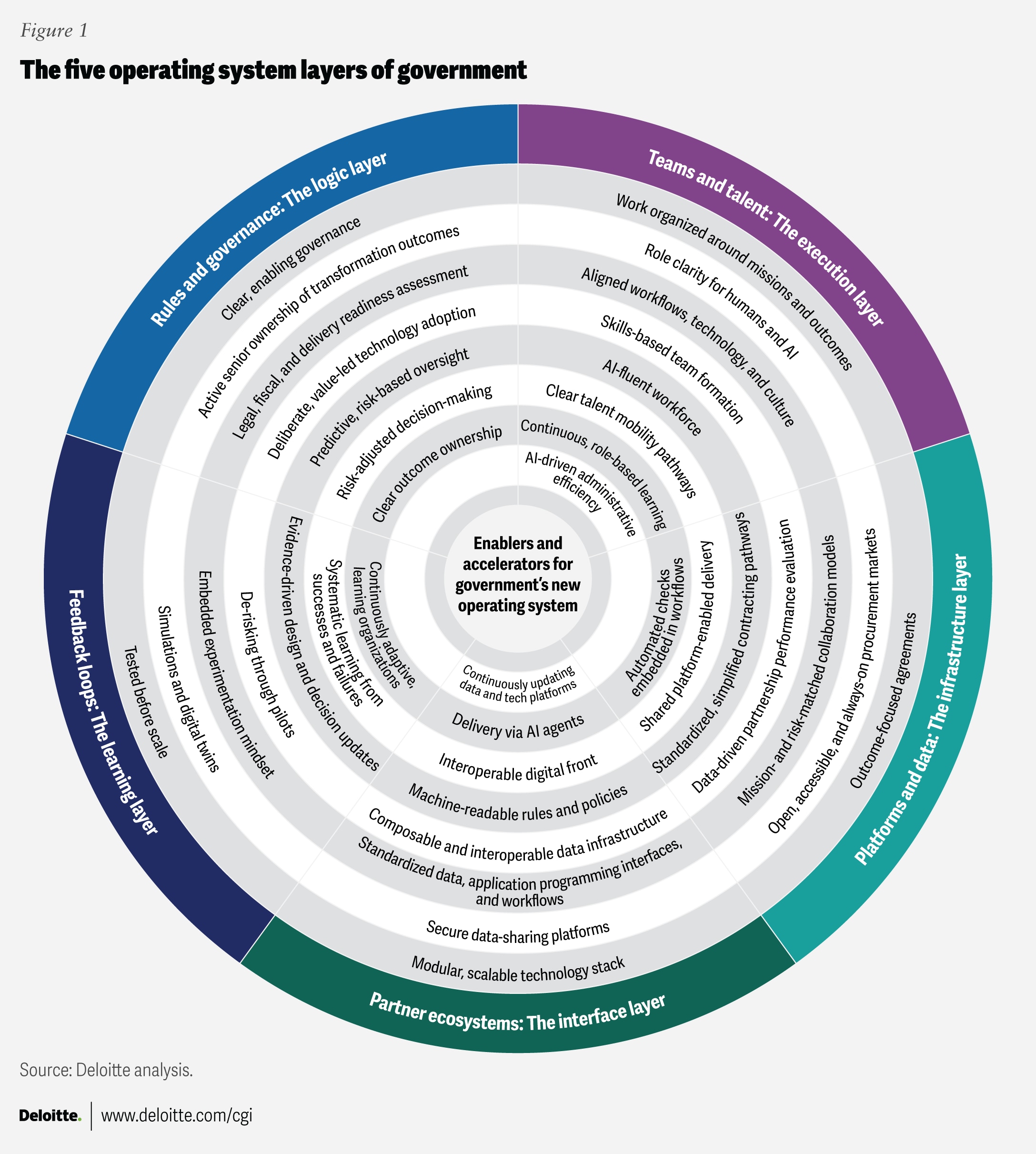
Across these trends, five operating system layers recur (figure 1).
Rules and governance: The logic layer
Every agency runs on formal and informal rules that determine what is allowed, who decides, and how risk is managed. Over time, rules accumulate, adding friction even where policies and law allow flexibility. Leading governments are simplifying decision rights, removing unnecessary approvals, rewriting requirements in plain language, and translating policy into structured, machine-readable forms. Safeguards are embedded directly into workflows rather than layered on through manual review.
Teams and talent: The execution layer
Transformation succeeds or fails at the level of effective teams. Technology creates real value when work is redesigned around outcomes.5 Rigid roles and static structures give way to mission-driven teams that combine human judgment with AI-enabled analysis. Teams now form based on skills instead of job titles, making ongoing learning an essential part of the process.
Platforms and data: The infrastructure layer
Modern government runs on shared digital foundations. Fragmented systems and siloed data keep innovation isolated and costly to scale. Leading organizations invest in interoperable platforms, common services, application programming interfaces, and reusable components that can be recombined across missions. Capabilities are reused rather than rebuilt, allowing innovation to compound.
Partner ecosystems: The interface layer
Governments no longer deliver outcomes alone. Private firms, nonprofits, and civic organizations provide essential capabilities.6 Simplified rules of engagement and shared digital interfaces can reduce friction and expand participation. The focus shifts from simply managing individual contracts to stewarding ecosystems that evolve with changing needs.
Feedback loops: The learning layer
High-performing organizations embed learning directly into operations. Real-time data makes performance visible as work happens. Policies and services adjust based on evidence rather than anecdote. Continuous feedback shifts reform from episodic to sustained adaptation.
Eight trends shaping the future of government in 2026
Launched in 2019, the Deloitte Center for Government Insights’ annual Government Trends report surfaces major trends that over time have demonstrated relevance—often for years to come. The 2026 report identifies eight trends that showcase how governments are navigating the future.
Adaptive by design: The next operating model for government
Traditional operating models—built around fixed structures, functional silos, and multiyear modernization cycles—are proving too rigid for an era defined by AI acceleration, cross-agency missions, and fiscal pressure.
Leading governments are reorganizing work around reusable platforms, mission-driven teams, and modern people practices. Shared platforms provide common digital, data, and AI capabilities without requiring wholesale system replacement. Small, multidisciplinary teams form around missions, work in short cycles, and disband when objectives are met. Governance shifts from process compliance to stewardship of standards and risk, enabling faster action without sacrificing accountability.
Toward 2030: Operating models are designed for continuous adaptation rather than episodic reform. Composable platforms provide reusable capabilities that teams assemble around priorities. Decision authority moves closer to execution, guided by clear standards and real-time data. Government functions as a coordinated learning system, reallocating capacity quickly and scaling what works.
From enabler to architect: How technology leadership now shapes mission delivery
Technology leadership continues to move from a supporting role to a central position in mission delivery as AI, automation, and digital platforms become embedded in core operations.
Technology leaders must still ensure security and reliability, but they increasingly shape how AI is adopted, how work is redesigned, and how digital capabilities deliver outcomes. In many governments, the line between strategy and execution is narrowing. Gen AI is transforming software development, cybersecurity, and operations while positioning technology leaders as architects of shared platforms, data standards, and governance guardrails.
The shift elevates technology leadership from enabling mission to shaping how the mission is delivered.
Toward 2030: Technology leadership is embedded across mission delivery rather than limited to “traditional” IT functions. Strategic and operational responsibilities converge. Leaders orchestrate shared platforms, data, and workflows across the enterprise, making technology the connective tissue of mission delivery. Success depends less on system ownership and more on orchestrating how technology, people, and workflows integrate to drive continuous improvement and measurable outcomes.
Customized for constituents: Agentic AI accelerates personalized public services
Governments have long aspired to deliver personalized, proactive services. While many initiatives have made progress, personalization has been difficult to scale across siloed agency structures.
That constraint is weakening. After years of investment in digital identity, data exchange, and shared platforms, many governments now have the foundations to deliver individualized services more consistently. Layering agentic AI onto these systems enables service journeys that cut across agencies. Instead of navigating multiple departments, individuals increasingly interact through unified entry points, with AI assistants helping determine eligibility, prefill forms, and coordinate services.
Toward 2030: Service delivery becomes proactive, focused on life events and outcomes instead of agency org charts. Information is shared once and reused securely. AI assistants help navigate eligibility, applications, and updates across agencies.
Rewiring regulation: From static rulebooks to adaptive, data-driven oversight
Regulators are rethinking how rules are designed, implemented, and enforced as traditional processes struggle to keep pace with rapid technological and market change.
In many jurisdictions, dense rulebooks are being simplified, rewritten in plain language, and translated into machine-readable formats. One-stop portals, automated pre-checks, and AI-assisted reviews reduce friction while preserving oversight. Regulators are also using sandboxes, simulations, and digital twins to test reforms and gather evidence before scaling.
Regulation is shifting from static rulemaking to adaptive oversight grounded in data and continuous learning.
Toward 2030: Regulation functions as a dynamic system rather than a static rulebook. Structured, machine-readable requirements embed compliance into digital services. Supervision shifts from episodic audits to risk-calibrated, data-informed monitoring. Sandboxes and simulations become standard tools. Rules, guidance, and enforcement evolve together to deliver clarity, predictability, and trust at the speed of innovation.
Cognitive government accelerated: From aspiration to operational reality
Governments are shifting from reactive decision-making toward a cognitive model that can sense emerging signals, predict outcomes before committing resources, and coordinate action across government systems.
Advances in AI, sensing, simulation, and agentic workflows—layered onto mature data and digital foundations—are accelerating this shift. In many cases, what began as situational awareness is evolving into predictive insight and cross-system coordination. Governments are fusing data from sensors, satellites, administrative records, and digital platforms to detect risks earlier, simulate choices before acting, and align responses across previously siloed domains.
Cognitive capabilities are moving from experimental pilots toward operational practice.
Toward 2030: Government operates as a continuous learning system. Integrated data supports simulation, scenario planning, and coordinated decision-making. Digital twins and analytics inform choices before resources are deployed. Automation handles routine coordination, letting leaders focus on strategy and trade-offs. Performance improves through feedback embedded directly into operations.
New models of public-private collaboration: Rethinking how governments create public value
Governments are expanding public-private collaboration models beyond traditional infrastructure partnerships. Increasingly, they include digital infrastructure, social outcomes, innovation ecosystems, and blended finance.
The transition is progressing from isolated initiatives to integrated approaches that harmonize incentives, establish unified data standards, and embed accountability mechanisms. Digital public infrastructure—identity management, payment systems, and data exchange platforms—functions as a foundation for cross-sector service delivery. Contracts are increasingly designed to tie payments to measurable outcomes rather than solely to activities performed.
Toward 2030: Collaboration centers on clearly defined outcomes supported by shared standards and interoperable platforms. Engagement is continuous rather than episodic, with transparent guardrails and outcome-linked payments. Governments steward networks of partners, aligning incentives across public, private, and nonprofit actors while maintaining accountability and performance transparency.
The procurement reset: Adopting a simplicity-first mindset
Procurement modernization often stalls when governments digitize complex, outdated processes rather than fixing them. New platforms too often replicate old approval chains and unclear decision rights, delivering little improvement in speed or outcomes.
Many reformers now simplify first—mapping common buying journeys, eliminating unnecessary reviews, clarifying decision rights, and standardizing reusable pathways—before applying AI and other digital tools. This approach is delivering real gains: faster contract awards, broader supplier access, and greater focus on outcomes rather than activity.
Toward 2030: Procurement runs through simplified, rules-driven pathways leveraging unified digital standards. Supplier markets remain open through a single front door with reusable credentials. Major buys anchor on measurable outcomes, with oversight proportionate to associated risk. Procurement becomes a strategic enabler of speed, access, and public value.
Scaling the public sector’s human edge: Making human-AI collaboration work
As AI shifts from tool to teammate, governments face a deeper challenge: redesigning work itself. The greatest value comes not from substitution but from amplifying human judgment, empathy, and creativity.
In leading organizations, workflows are being redesigned so AI handles analysis and routine coordination while people focus on complex decisions and oversight. Adoption depends on human-centered design, embedded tools, and continuous learning. Workforce strategies increasingly emphasize AI fluency while strengthening uniquely human capabilities.
Toward 2030: Public-sector work revolves around human–agent teams. AI handles analysis and coordination tasks, while humans retain accountability for major decisions. Decision rights are defined by risk, and learning becomes continuous. The human edge—discernment, systems thinking, and legitimacy—plays a crucial role in delivering trusted results for the public.
From trends to trajectory
Taken together, these trends are not isolated innovations or a checklist of reforms. They outline a shift in how government operates.
From reform as an event to adaptation as a system.
From activity to outcomes.
From siloed programs to shared platforms.
From episodic learning to continuous feedback embedded in daily work.
This is not a distant vision. The trajectory toward 2030 is already visible as governments move faster, coordinate better, and deliver stronger outcomes.
Government’s challenge today is not whether to change, but whether its operating architecture is designed to keep pace with rapid change.
In an accelerating environment, institutional architecture shapes performance.
By
William D. Eggers
Beth McGrath
Jennifer J. Walcott
The authors express their gratitude to Nicole Savia Luis, Aniruddha Bapat, and David Noone from the Deloitte Center for Government Insights for their invaluable operational and research support.
This report owes its publication to the dedicated support of the Deloitte Insights team. The authors would like to acknowledge Kavita Majumdar, Rupesh Bhat, Stacy Wagner-Kinnear, Aparna Prusty, Shyamili M, Anu Augustine, Cintia Cheong, and Pubali Dey for their editorial contributions. They would also like to thank the following members of the visual and design team for their artwork and data visualizations: Jim Slatton, Sonya Vasilieff, Meena Sonar, Molly Piersol, and Harry Wedel.
The author team extends their gratitude to various members of Deloitte’s Government and Public Services global leadership and account teams for their insights, feedback, and continued support, including Liam A. Davies, Christopher Hamilton, Sean McClowry, Allan Mills, Tom Pickthorn, Shanley Vetter, Phoebe Baker, Mason Chin, and Duke Wu.
Finally, the author team would like to thank the GPS marketers, Shane O’Hagan, Leslie Wolf, Neelangana Noopur, Adina Preiss, and Zishan Ali, for their support in promoting Government Trends 2026 across various geographies.
Editorial (including production and copyediting): Kavita Majumdar, Rupesh Bhat, Aparna Prusty, Anu Augustine, Cintia Cheong, and Pubali Dey
Design: Molly Piersol
Cover image by: Meena Sonar and Sonya Vasilieff
Knowledge Services: Agni Wagh
Visit the Deloitte Center for Government Insights
Access more insights for the defense, security and justice, government health care, state and local government, transportation and infrastructure, human services, and higher education sectors.