


VAT Modernisation in Ireland
E-Invoicing & Digital Reporting - where to from here?
There have been important developments on Ireland’s e-invoicing journey with the publication of Special Finance (No.2) Bill 2026, and Revenue’s guidance “VAT Modernisation - Implementation of e-invoicing in Ireland.” Revenue has also published a landing page on their website as E-invoicing Hub.
E-Invoicing
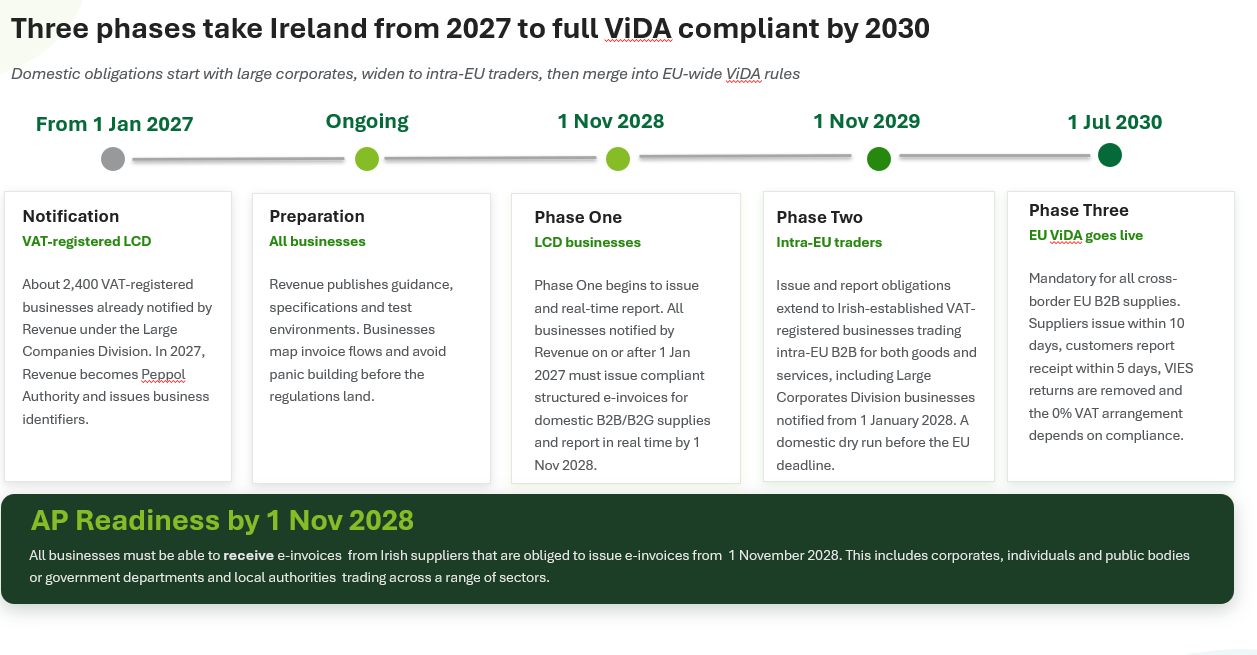
The introduction of the VAT Modernisation programme was signalled in the Revenue press release of 10 February 2026, which confirmed that a domestic e-Invoicing and e-Reporting requirement would be introduced on a phased basis with Phase 1 applying from 1 November 2028 for “large corporates”. You may recall that “large corporates” are VAT registered businesses established in Ireland (or with a fixed establishment) which are dealt with by Revenue’s Large Corporates Division (“LCD”). In April 2026 Revenue issued letters to notify businesses of the criteria to be included in Phase One in their ROS inbox.
If you are not managed by LCD, you will fall into Phase Two with effect from November 2029 if you have an “Intra EU” VAT number. All businesses will have to be able to accept e-Invoices from vendors from 1 November 2028.
The Finance Bill 2026, and associated regulations and guidance add the detail to these obligation by amending parts of the VAT Consolidated Act of 2010 (“VATA”) to provide for the Issue of invoices and other documents in structured electronic format in a new s66A. In addition, the bill introduces a new section 83A, providing for VAT digital reporting for supplies of goods and services made within the State.
Together these sections provide the framework for the introduction of VAT modernisation in Ireland. Although VAT modernisation is brought about through a change in VAT legislation meeting the requirement is a business process change that will necessitate a cross organisational response, Involving, but not necessarily limited to, finance, procurement, IT/engineering and of course tax. We have found that “C-suite” sponsorship is also a key factor in successful implementations.
An electronic invoice is an invoice issued in machine readable format and transmitted automatically from the supplier to the customer through a common electronic network known as OpenPeppol (in the case of Ireland). This will fundamentally change how invoices are issued and processed, removing much of the manual intervention in the AR and AP process.
An e-invoice will contain all the “specified data” currently required on a VAT invoice but you will also have to include your customer’s VAT number or where your customer is a “business customer” but not VAT registered its “customer identification number”. Non VAT-registered businesses will be contacted by Revenue and issued with this customer identification number.
E-Reporting
Digital reporting is often the subject of less focus than e-invoicing, however it is a very significant development that will materially alter how taxpayers interact with Revenue. Each time an invoice is issued, the data on the invoice will be automatically transmitted to Revenue. This is a truly real time transfer of ledger data from the taxpayer to the revenue of the type we have not seen before under Irish VAT law. It is vital therefore that businesses are comfortable that master data sets are complete and correct and that the correct treatment is being applied to invoicing flows.
Next steps
We appreciate that these dates may still seem a little far out, however, from experience, these initiatives take time to design and implements so we strongly encourage you (if you have not already done so) to begin internal strategic planning and work toward developing a detailed implementation roadmap. This is necessary to allow sufficient time for all aspects of the project to be managed effectively, including implementation of new technology, data and process requirements, assessing and selecting external e-Invoicing solutions, timely communication with key stakeholders, etc.
How we can help
At Deloitte, we are helping companies navigate these complex implementations such as:
- Understanding the regulations and their application to the business
- Ireland’s phased e-invoicing and real-time reporting implementation roadmap
- Flows of transactions streamlined and resource management
- Real-world impact scenarios for Irish business under the LCD
- Proven implementation strategies to systems feasibility and selection and implementation
- Technology solution approaches, including third-party vendor solutions


