
Weekly Global Economic Update
What’s happening this week in economics? Deloitte’s team of economists examines news and trends from around the world.
The US–Canada trade war intensifies
- President Trump announced that he will impose a 50% tariff on automobiles imported from Canada. This followed an announcement of a 50% tariff on US$20 billion of imports, and follows Canada’s announcement that it will impose retaliatory tariffs on the United States. The nations are now engaged in a major trade dispute, with potentially serious consequences for both. How did it come to this?
When Ronald Reagan announced his bid for the US presidency in late 1979, the centerpiece of his announcement was a proposal for a North American Free Trade Agreement (NAFTA), which ultimately came about under President Clinton. However, during the Reagan administration, a free-trade agreement between the United States and Canada was signed. In the United States, the principal opposition came from the far left and the far right, but much of the business community was on board.
NAFTA was controversial but was widely viewed as effective, and led to massive integration of supply chains across North America in key industries, especially automotives. When Donald Trump became president in 2017, he proposed a renegotiation of the NAFTA.
This happened, and the new agreement was called USMCA, or United States-Mexico-Canada Agreement, in the United States, while Canadians called it CUSMA, or the Canada-US-Mexico Agreement. It mostly left in place the efficient supply chains that came about under the NAFTA. Any issues surrounding North American trade appeared to be resolved. President Trump called the deal “the largest, fairest, most balanced, and modern trade agreement ever achieved.”
However, when Trump returned for a second term in 2025, he launched a broad shift in US trade policy that, initially, included threats of steep tariffs on Canadian goods. However, he ultimately exempted goods covered under the USMCA. Again, any conflict appeared to have been resolved. Still, under the terms of the USMCA, the parties would have to decide, in 2026, whether or not to renew the agreement for another 16 years. Both Canada and Mexico favored renewal. The United States, however, did not, and chose to leave the agreement in place but in limbo. For global companies operating supply chains across the region, this created uncertainty that could have a chilling impact on investments in supply chains.
Which brings us to the current impasse: The United States and Canada recently engaged in talks aimed at creating a final settlement. Both sides sought to remove the trade restrictions placed by the other. The United States sought to retain tariffs on certain vehicles that are assembled in Canada, hoping to shift production to the United States. Canadian Prime Minister Mark Carney said that the United States sought to restrict Canada’s ability to enter into trade agreements with other countries. This was rejected as diversification of trade is one of Carney’s major strategic responses to US trade policy. Of the United States, he said, “they asked too much and they offered too little.” In addition, the US officials said that Canada made “new demands” that were unacceptable. In the end, the talks broke down.
Consequently, the United States announced significant tariffs on some Canadian goods. This was done under Section 338 of the US Tariff Act of 1930, which has never been previously used. Under this law, the United States can impose tariffs of up to 50% on a specific country or specific goods from that country. This can be done without a time-consuming investigation. Section 338 is meant to be used when a foreign country takes action that allegedly hurts US goods. As with previous cases involving tariffs, this, too, will likely face legal adjudication.
The principal US complaint has been around the persistent US trade deficit with Canada. Yet the deficit largely reflects massive US imports of energy, including oil, gas, and hydroelectric power. These imports play a critical role in energy consumption in northern US states. Absent energy trade, the United States still has a trade surplus with Canada, in both goods as well as services. Moreover, the dominant role of the US dollar in global finance has historically given the country greater flexibility to sustain trade deficits than many others.
The tariffs announced by the United States may boost US inflation modestly and may disrupt supply chains in the automotive industry, possibly leading to higher costs. If automotive companies perceive these tariffs as permanent, it could lead to a wholesale redesign of North American supply chains. Meanwhile, the retaliatory action by Canada is expected to hurt US export volume in certain products. As for Canada, the US action will likely hurt exports and potentially have a negative impact on investment in export-intensive industries. Although Canada is actively seeking new export markets, it will likely not be sufficient to offset the loss of US trade.
For the United States, Canada is the second largest trading partner after Mexico and far ahead of China in terms of trading volumes. For Canada, the United States is, by far, its largest trading partner. Thus, this new episode of trade conflict between the two has the potential to seriously disrupt an important part of the global trading environment. It is also seen as potentially disruptive of other aspects of the relationship, including military cooperation.
Fed Chair Warsh signals potential shift in policy
- Federal Reserve Chairman Kevin Warsh gave his much-awaited speech at the central banker’s conference in Jackson Hole, Wyoming, last Friday. Although he did not offer guidance as to when or even if the Fed will raise interest rates, he did comment on the persistence of above-target inflation. Investors appeared to interpret this as an indication that the US Fed could raise interest rates.
Markets reacted strongly: In the futures market, the implied probability that the Fed will raise the benchmark interest rate at its next policy meeting in September rose from 35.4% on Thursday to 57.5% on Friday. Meanwhile, the probability that the US Fed will raise the rate at least once before the end of the year increased from 74.1% on Thursday to 88.4% on Friday. Plus, the implied probability of two or more rate hikes before the end of the year increased from 29% on Thursday to 49.8% on Friday.
These changes in investor sentiment were fairly dramatic. So, what exactly did Chair Warsh say? First, he offered a very positive assessment of the US economy, pointing to the considerable impact of investments in artificial intelligence that are driving economic growth. He expected strong growth to continue, which would naturally lead to higher inflation than otherwise. He did not discuss any of the commonly sighted headwinds facing the US economy such as tariffs and geopolitical risks. He suggested that financial markets are working smoothly, pointing to relatively low-risk spreads on debt issued by the private sector. However, he did not discuss the high and rising cost of insuring tech-company bonds against default, which is an indication of market stress. He also noted the very low unemployment rate. However, while noting slow labor-force growth, he offered no explanation, contrary to his predecessor who cited restrictive immigration policy as a contributing factor.
Next, he explained why he opposes forward guidance in the communication of the Federal Reserve. He said that, if the Fed offers predictions about its future action, market prices will reflect expectations based on such forward guidance, thereby removing the signaling impact of market pricing as an input in the Fed’s decision-making.
Finally, he addressed the issue of inflation, which is what many investors were eagerly awaiting. He called the data on inflation “concerning.” He said that, by a variety of measures, inflation is running above the Fed’s 2% target. As such, “the Fed’s predominant focus right now should be on prices.” However, he repeatedly noted that various measures of inflation were currently much lower than they were at the end of the pandemic in 2022, thus suggesting that progress had been made. Still, he noted that “progress over the past two years has been modest.” He acknowledged that while recent “readings were better than expected, they do not tell […] that underlying trends have meaningfully improved.” Noting that commodity prices had risen, he said that “what we need to judge is whether trends indicate upside inflation risks.” Finally, he noted that inflation expectation measures have been stable. He said that “market prices show confidence that we will deliver price stability. And I can assure you … they’re right.”
These statements did not offer guidance about the degree to which one should worry about inflation. What drew particular attention, however, is what he said regarding the role of the Federal Reserve. Here is the statement that many investors evidently interpreted to suggest a future tightening of policy: “We must be confident that underlying inflation is moving to our objective, clearly and at sufficient speed. Otherwise, we have work to do.” Given his assessment that inflation is not currently moving in the right direction, this can be seen as suggesting that the Fed does indeed have work to do. And that work could necessarily involve a tightening of monetary policy.
On the other hand, Warsh concluded that “I stand here today committed to a discipline, not to a decision.” Based on that final statement, it is not clear why expectations for Fed policy dramatically shifted overnight. Perhaps it was a recognition that Warsh’s comments were more in tune with market sentiment than the comments he made in a press conference following the Fed’s July policy meeting. At that time, he appeared to signal that there was no hurry for the Fed to address above-target inflation.
Meanwhile, given that investors interpreted Warsh’s speech as signaling a greater likelihood that the Fed will tighten monetary policy this year, it is not surprising that the yield on the US Treasury’s 10-year bond increased sharply following his speech. And, in line with that, the value of the US dollar increased against both the euro and the Japanese yen.
Finally, Warsh said nothing about the effort by the US Treasury to suppress long-term bond yields through market intervention. Clearly the speech and investor interpretation of the speech led to higher yields, thus negating the impact of the Treasury intervention. As such, the US Fed and US Treasury appear to be at odds. And there is an old saying that one ought not to bet against the Fed.
Is US$40 trillion of debt worrisome?
- Recently there was much discussion about US government debt surpassing US$40 trillion. That sounds like a lot of money—and it is. It caused angst in the media and might have contributed to elevated yields on government bonds. Yet, this number is somewhat misleading. Some of that debt is held by the US Federal Reserve, while some of it is held by the Social Security Trust Fund. These amounts are not consequential to financial markets. What matters is the debt held by the public, which is roughly US$32 trillion—still a lot of money. And yet, it is simply a number that is only relevant in relation to other numbers. We generally look at debt held by the public as a share of economic value, which for the United States, has now reached about 100%—the highest for the country since the end of World War II.
Historically, in advanced economies, debt reaches this level only to fund major wars. In the United Kingdom, debt far exceeded 100% of gross domestic product for much of the last two centuries, largely to fund the Napoleonic Wars as well as the first and second World Wars. For the United States today, this level of debt has little to do with military expenditures, however. Rather, it has much to do with demographics as well as a gap between revenue and the rising costs of supporting an aging population. Meanwhile, some bond investors appear to be increasingly concerned about the trajectory of US fiscal policy.
The question now is whether or not the United States has finally reached its own “Liz Truss moment.” Recall that when Ms. Truss became the British prime minister and proposed major tax cuts, bond markets recoiled in horror, ultimately leading to her quick exit. As US political consultant James Carville once said, “I used to think that if there was reincarnation, I wanted to come back as the president or the pope or as a .400 baseball hitter. But now, I would like to come back as the bond market. You can intimidate everybody.”
The US situation is different than the one faced by Liz Truss. The US dollar is the world’s dominant currency while the US bond market plays a central role in global finance. As such, the United States has generally been able to borrow at scale without facing the same degree of market discipline as other countries. Yet, we always knew that there would reach a point when the country would face consequences for rising debt levels. It is possible that such a point has been reached.
Global trade buoyed by AI despite headwinds
- Despite significant headwinds such as tariffs and the Middle East conflict, global trade has continued to grow, partly fueled by massive investments in AI, which entails significant trade in information technology equipment and software. We can infer this from the latest data published by the Netherlands Bureau for Economic Policy Analysis, also known as the CPB. It publishes monthly data on trade and industrial production volumes for the world’s major economies.
The latest report, which encompasses data for June 2026, shows that the volume of global trade (which is adjusted for inflation) was up 8.8% in June versus a year earlier. In addition, trade volume was up 3.3% from May to June—the second fastest monthly growth since 2023. Meanwhile, global industrial production was up 2.1% in June versus a year earlier.
What is particularly interesting is the data on growth of exports, imports, and production by region or country (figure 1).
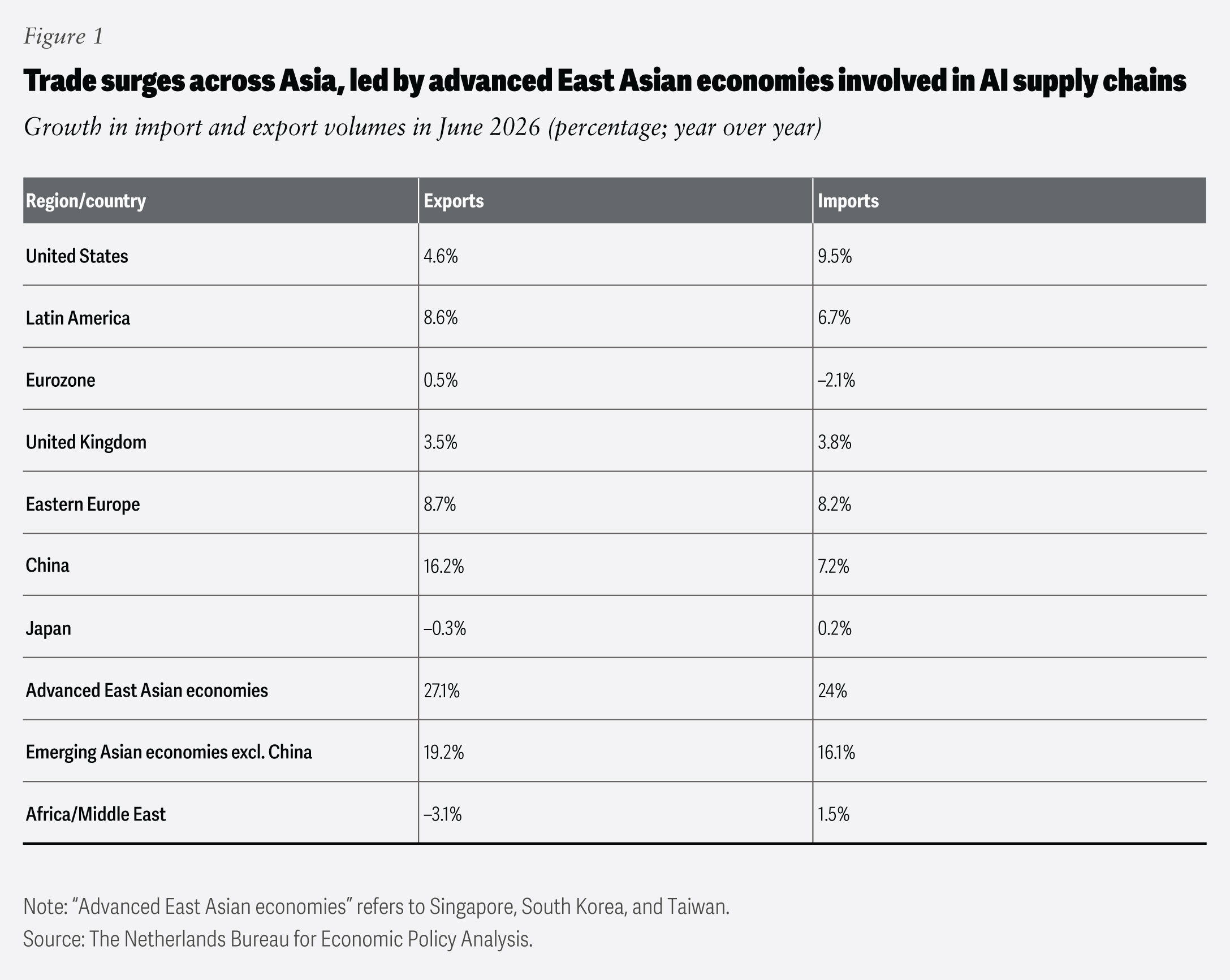
Excluding Japan, trade grew rapidly in Asia in June: Both exports and imports in advanced East Asian economies (South Korea, Taiwan, and Singapore) grew at an astonishing pace, likely related to these countries’ participation in global AI-related supply chains.
China, of course, experienced very strong growth in the volume of trade as the country continued to focus on boosting exports related to information technology and clean energy. Indeed, this was the only significant source of economic growth for China. Meanwhile, emerging Asian economies besides China (which includes India and much of Southeast Asia) also saw strong trade growth as some lower-value–added processes shifted from China to lower-wage countries. Plus, some of these countries also participated in AI-related supply chains.
On the other hand, trade was largely stagnant in the eurozone as well as in Africa and the Middle East. The two were likely related. Trade in the Middle East was negatively affected by the conflict in the region as well as the closure of the Strait of Hormuz. For the eurozone, which relies heavily on natural gas imports from the Middle East, the energy shock had a negative impact on both production and consumption, leading to stagnant trade. On the other hand, more recent data shows a significant rebound in exports from Germany.
Finally, US trade held up reasonably well despite significant headwinds. This likely reflected the impact of AI investments, especially strong imports likely coming from East Asian countries that are heavily involved in the AI supply chain. Perhaps the greatest surprise in the data was Japan, where trade stagnated in June. Evidently, trade in non-tech products weakened, offsetting any benefits from AI-related trade.
Further comments on US government bond yields
- Last week’s financial headlines largely focused on the sharp rise in yields on government bonds around the world: Notably, the yield on the US government’s 30-year bond hit 5.33%—the highest since 2007. The yield on the US government’s 10-year bond hit 4.75%—the highest since January 2025. Meanwhile, the yield on Japan’s 10-year bond hit 2.96%—its highest level in 30 years. And the yield on Germany’s 10-year bond hit 3.26%—the highest since 2011.
Why did this happen? First, consider the determinants of government bond yields. Theoretically, a bond yield is a forecast of short-term interest rates in the future. As such, they are also a forecast of future monetary policy, which, in turn, has much to do with expectations of future inflation. When the conflict in the Middle East began, bond yields increased, which reflected expectations for higher inflation and, consequently, tighter monetary policy.
However, in recent weeks, as oil prices stagnated, expectations of inflation remained tame, while expectations of tighter monetary policy tended to ease. Yet despite that, bond yields have lately increased once again. Why?
The reason is that, in addition to expectations of inflation and monetary policy, bond yields also reflect expected supply and demand conditions in the bond market. If supply increases rapidly, investors might require a higher return to absorb a bigger supply of bonds into their portfolios. If investors feel that there is likely to be excess supply in the market, they will boost the so-called “term premium,” which is the additional yield investors require for the risk of holding longer-term securities.
There are two things currently happening that might be causing a rise in the term premium:
o First, there has been a dramatic surge in the volume of corporate debt issued by technology companies, mainly to fund the buildout of AI infrastructure. The rise in the cost of insuring this debt may indicate that some investors are becoming concerned about the volume of debt and the potential ability of issuers to service those debts. Although most of this debt has been issued by US-based companies, it is not simply a US issue, because tech companies have increasingly sold debt outside the United States.
o The second factor, which appears to be common to several countries, is increasing investor concern about the sustainability of fiscal policy. In the United States, Japan, France, Italy, and the United Kingdom, the level of government debt relative to gross domestic product is high and rising. The surge in debt first began during the global financial crisis, and then accelerated during the COVID-19 pandemic. Consequently, debt levels in several key economies are now close to historic highs relative to GDP.
This would not be such a problem if not for two factors: First, demographics are working against fiscal probity, with rising elderly populations and stagnant or declining working-age populations. Second, political fragmentation and policy gridlock are hampering countries’ ability to take difficult steps to rein in their borrowing levels.
Yet, why are investors suddenly worried when they mostly ignored fiscal policy for so long? Consider the United States. I can recall back in the 1980s hearing analysts warn that fiscal deficits were not sustainable and that, ultimately, they would lead to a financial crisis. That didn’t happen. Rather, for nearly half a century, bond yields gradually declined despite lack of fiscal discipline. This partly reflected the dominant role of the US dollar in global finance. It also reflected confidence that the US economy would grow strongly, thereby creating the conditions for strong growth of tax revenue. And it reflected confidence that the government would ultimately take the steps required to reduce borrowing. When the US Congress agreed to significant reforms to Social Security in the 1980s, this engendered confidence in fiscal integrity.
Now, things are changing. Today’s deficit is unusually large. Taxes have been cut, defense spending has increased, programs for the elderly continue to grow due to demographics, and there is no clear political consensus for tax increases. Thus, it is difficult to envision a scenario in which fiscal policy moves in a contractionary direction in the near term. Meanwhile, last year’s combination of rising bond yields and a declining US dollar was viewed by some analysts as evidence that global investors were becoming somewhat less amenable to absorbing large amounts of US government debt.
On the other hand, it is worth keeping in mind that, in the United States, the yield on the benchmark 10-year bond is actually lower than it was for much of the 1990s and early 2000s. Thus, panic is not warranted. Indeed, for a while, we became accustomed to unusually low bond yields. During the period between the global financial crisis (2008 to 2009) and the pandemic (2020 to 2021), yields were historically low. One could say it was an aberration and that we may now be returning to normalcy, at least in terms of bond yields. But this is not normalcy in terms of fiscal policy.
For the United States, the risk is that, if an economic or financial crisis takes place, the government may not have the kind of fiscal space it previously had to fight such crises with fiscal stimulus. The risk will be that any such action could lead to a sharp rise in bond yields, thereby offsetting the positive impact of stimulus.
- Following concern in financial markets about rising bond yields, on Wednesday, US Treasury Secretary Scott Bessent announced that the US Treasury would engage in purchases of long-dated Treasury securities, funded by the sale of short-dated securities, thereby shifting the mix of maturities held by the public. The idea was to put downward pressure on the yield from long-dated securities, thereby offsetting the recent trend toward much higher yields.
This action was initially successful in moderately taming long-term bond yields. But the success did not last long. By the next day, yields resumed their upward journey. Investors appeared to believe that the fundamentals of supply and demand in the bond market have not changed and that, consequently, there is no need to permanently change the pricing of government bonds. Indeed, the Treasury action did not adjust the actual supply of government debt.
The Treasury action was similar to what the US Federal Reserve did in 2008 and in 2020, when it engaged in quantitative easing (purchases of long-term bonds), which was meant to revive a failing economy by lowering long-term borrowing costs. It was also done at a time when inflation was unusually low. This time, however, is different.
Inflation remains elevated while the economy continues to show relative strength. Plus, the US Federal Reserve is considering tightening monetary policy, not loosening it. Notably, Fed Chair Kevin Warsh justified the decision to not raise the benchmark interest rate despite elevated inflation by saying that the market is doing the Fed’s job. That is, rising bond yields have the effect of reducing inflationary pressures. Yet, if the Treasury attempts to suppress bond yields, will the Fed then decide to raise rates? We shall see.
Also, it is worth noting that the price of crude oil has risen sharply in recent days as investors became more pessimistic about a prospective end to the US-Iran conflict. If the conflict continues and, as a result, the Strait of Hormuz remains closed, there could eventually be a further rise in the price of oil. That is because, eventually, the ability to fill the gap between supply and demand with reserves may diminish for most economies.
In this context, China is key: It has been tapping its massive reserves, thereby enabling a sharp reduction in imports. But this cannot continue indefinitely. Thus, the current increase in the price of oil reflects a growing belief that this scenario could eventually play out. If the price of oil rises further, it could contribute to higher inflation in major economies and, consequently, tighter monetary policy. Thus, elevated bond yields make sense.
Meanwhile, the fundamentals (increased debt issuance by tech companies combined with increasing concerns about fiscal probity in major economies) remain. If the US government wants to reduce bond yields, a good strategy would be to offer a credible long-term plan to rein in government borrowing. In any event, it appears that the Treasury action, which was relatively small compared to the massive size of the US Treasury market, did not have the desired impact on bond yields. It did, however, coincide with a decline in the value of the US dollar.
The drop in the value of the dollar goes against the Treasury’s stated goal of engendering a strong dollar. The decline in the value of the US dollar due to the Treasury action has been called a “debasement trade.” That is, it suggests investors are fearful that, rather than taking difficult steps to rein in borrowing, governments will debase the currency by inflating away government debt. Plus, if the government artificially suppresses bond yields (as has been true in Japan), the only way investor portfolios can reflect the true risk of holding bonds is for the currency to depreciate. As the economist Robin Brooks said, the current strategy of the US Treasury is like “playing with fire,” as it could lead to a sharp decline in the value of the US dollar.
Notably, the dollar was not the only asset that responded to the Treasury action. The price of gold shot up, as did the price of Bitcoin. This is not surprising as non–interest-bearing assets become more attractive when the return on interest-bearing assets declines. Plus, if investors perceive the Treasury action as boosting the likelihood of higher inflation, then inflation hedges such as gold become more attractive.
Also, the latest intervention in the bond market follows the intervention by the US Treasury Department in the currency market to support the Japanese yen. That, too, failed to significantly move the dial for the yen. One possible explanation is that the intervention did not materially alter the fundamentals influencing the yen’s value.
European economies face climate-driven disruptions
- When I was young (which was a long, long time ago), my parents and I used to take holidays in Europe during several summers. It was great, and the weather was great. There were no air conditioners, nor were they needed. That, however, is no longer true. In the past decade, there have repeatedly been record high temperatures throughout Europe—a trend that many researchers associate with climate change. And although European governments, businesses, and people have taken substantial action to mitigate climate change, it didn’t matter. After all, climate change is a global problem. If the world’s largest emitters of carbon (such as, China, the United States, India, Russia, and others) don’t rapidly reduce emissions, all of Europe’s efforts will be for nought.
From an economic perspective, the recent summer heat is significant. High temperatures caused water levels in rivers to decline, thereby disrupting inland transportation. At the shallowest point in the Rhine in Germany, the water level is now at a record low. This has created shortages and bottlenecks, leading to higher costs of transporting goods. Indeed, it is reported that transport vessels are only being filled to 30% capacity to avoid grounding. This will likely lead to lower economic activity and higher inflation than would otherwise be the case.
Meanwhile, the low water level is having an impact on energy production as well as on the rollout of data centers. The latter will be crucial if Europe is to become competitive in the artificial intelligence arena. As for energy, low water levels mean less hydroelectric power. It also means that nuclear power plants must operate below capacity as water is needed to cool reactors.
Interestingly, a modest rise in temperatures can have a positive economic impact. This is the insight from researchers at a major European insurance company. They found that, below a certain threshold, “warming reduces heating costs and is associated with modest productivity gains.” That, in turn, can boost economic activity.
However, they also found that, when temperatures rise above a critical threshold, there is an opposite effect, mainly through labor-market channels. That is, high temperatures can undermine labor productivity. Allianz noted that “wage adjustments follow productivity with a lag, so the short-run cost falls disproportionately on firm profitability before gradually transmitting to household income and consumption. A second smaller channel runs through energy: Consumption rises by around 1.2% per degree, raising firms’ input costs at exactly the temperatures where labor productivity is falling.”
The conclusion is that, if temperatures continue to rise as they have in recent years, there could be a significant negative impact on real GDP. Moreover, this will have serious fiscal consequences for governments as tax revenue will decline while expenditures to support an aging population continue to rise. To contend with this new environment, Allianz recommends new regulations regarding labor and buildings.
China’s economy shows signs of weakness
- The Chinese government released several monthly economic indicators that reveal continued weakness. First, retail sales were up 0.6% in July from a year earlier—the third month this year, in which sales were up less than 1%. This represents very modest growth and may reflect continued caution to spending by households, some of which have experienced a loss of wealth in the property market. Notably, sales of automobiles were down 17% from a year earlier. Excluding autos, retail sales were up a more healthy 2.5%. Still, sales of other large durable products were down sharply including furniture and building materials. On the other hand, sales of communications equipment were up sharply.
Meanwhile, Chinese industrial production was up a modest 4.5% in July from a year earlier. This was slower than in most months in the past three years. Growth was strong in certain industrial sectors including computers and communications (up 19.1%), railway and shipbuilding (up 13.6%), and automotives (up 8.7%).
Importantly, fixed-asset investment continued to decline sharply. In the first seven months of this year, fixed-asset investment was down 6.7% from a year earlier—the worst performance since the heart of the pandemic. Property investment was down a stunning 19.2%. When property is excluded, overall investment was down 5.7%. Manufacturing investment was down 1.7%. On the other hand, industries favored by the government saw big increases in investment including information transmission (up 26%), air transport (up 15.7%), and computer, communication, and electronics (up 7.8%). Exports remain the only broad area of strength for China’s economy—rising 23.9% in July from a year earlier—and are growing rapidly.
China continues to exhibit an unbalanced economy: Domestic demand is relatively weak, largely due to continuing troubles in the property market. Export strength derives from aggressive pricing of attractive and innovative products. Reliance on exports, however, could present challenges given that some major trading partners are complaining about alleged subsidies and are increasingly discussing protectionist measures to restrain imports from China. As such, China may seek additional ways to stimulate domestic demand. However, although there has been some fiscal stimulus from the government, it has not yet led to an acceleration in domestic demand.
Fiscal policy is driving bond yields higher in some developed economies
- Why are bond yields so high for developed countries? One possible reason is that fiscal probity appears to have weakened. Many countries currently have historically high debt levels and deficits compared to their gross domestic product. Moreover, this is happening despite the lack of a crisis, which is normally the time when fiscal probity come under greater pressure.
Why is this happening? First, deficits are, in part, due to demographics. That is, almost every major developed economy is currently facing rising costs of servicing the needs of an older population through pensions and healthcare.
For example, in the United States, the number of people receiving retirement benefits from Social Security has risen from about 31 million in 2000 to 56 million today—a trend that is likely set to continue. Absent tax increases, offsetting spending cuts, or accelerated economic growth, such pressures could keep the deficit elevated.
Second, in most developed countries, there is an increasing consensus on the need to spend more on defense—especially following the Ukraine-Russia conflict and questions surrounding the North Atlantic Treaty Organization and other alliances—which will likely exert further fiscal pressure on their economies.
Third, many countries are facing political fragmentation, which can make it increasingly difficult to reach a consensus on how to address fiscal imbalances. In the United States, for example, significant changes to taxes, defense spending, or things like Social Security or Medicare, have often proven politically difficult to enact.
Finally, the decades-long period in which borrowing costs were historically low appears to have largely ended. The rise in borrowing costs came about following the pandemic, when governments significantly boosted spending, and when supply-chain disruptions led to much higher inflation. Today, borrowing costs are high and could go higher depending on a variety of factors such as inflation, monetary policy, and confidence in fiscal policy. And higher borrowing costs also exacerbate deficits.
The challenge now is that, if governments do not take credible steps to restore fiscal probity, borrowing costs could rise further. Moreover, when the next economic crisis comes (and it will come eventually), governments might not have sufficient fiscal space to respond in a way that does not cause a further rise in borrowing costs.
- In the United States, government borrowing costs have increased sharply, with the yield on the 30-year bond hitting its highest level in two decades. This suggests that investors are seeking additional compensation for perceived risks associated with holding long-term government debt.
- Even the US government—while intervening in the currency market to support the Japanese yen—did not sell US government bonds. Rather, it sold euros to boost the yen. This suggests that there was concern that the selling of US dollars could boost US borrowing costs further.
What is notable is that, even with inflation appearing to decelerate and with some evidence that the economy is slowing (slow employment growth and slow retail sales growth), bond investors still expect higher returns. Moreover, expectations for monetary policy have shifted, with investors now seeing a high probability that the Fed will not raise rates in September and a high probability of only one rate hike before the end of the year. Despite the shift in sentiment toward a less tight monetary policy, investors want to be compensated for the risk of holding government bonds.
What does this tell us? One interpretation is that investors are likely not focusing on inflation expectations, monetary policy expectations, or even economic growth. Rather, they are focusing on fiscal policy. That is, it could be the case that they are increasingly worried about the unusually large budget deficit. Plus, they might be concerned that neither major political party in the United States is having a serious discussion about reining in the deficit.
The rise in government borrowing costs is already influencing US economic conditions. Mortgage interest rates have risen to their highest level in a year. Considering all else remains the same, this could dampen activity in the housing market. This is also an example of what Fed Chair Warsh suggested, that is, markets will do the work of the US Federal Reserve by adjusting borrowing costs on their own.
The implication is that the US Fed does not need to do anything. Plus, if borrowing costs are rising primarily because of concerns around fiscal policy, the Fed’s ability to directly address those concerns may be limited. All it can do is adjust policy in response to inflation and employment data. If, however, fiscal policy contributes to a sharp rise in yields, which, in turn, suppresses economic activity, the Fed will likely have to absorb that information into its future deliberations.
- In Japan, Prime Minister Takaichi intends to boost government investment by about US$2.3 trillion in the coming years. This is meant to fund investments in key technologies, the goal of which is to boost productivity and, consequently, economic growth. For economists, the most common measure of productivity is known as total factor productivity, which measures the impact on labor and capital output due to more efficient use of resources. It is often driven by the adoption of new technologies.
In the last quarter-century, total factor productivity remained flat in Japan, while rising in the United States, Germany, and neighboring South Korea. The current government is keen to change this trend: The idea is that, although the expenditure will boost the budget deficit, it could ultimately lead to faster economic growth and, consequently, faster growth of government revenue, thereby reducing the deficit.
Meanwhile, the planned expansive fiscal policy of the Japanese government has already put upward pressure on government bond yields. One challenge is that, even by the government’s most optimistic projections, the boost to productivity growth will likely come long after the government issues debt that must be serviced. In addition, there remains uncertainty as to whether the government’s program will be successful in boosting productivity growth. If not, the fiscal implications could become more challenging, which may partly explain why there is upward pressure on bond yields.
Also, despite projections of productivity acceleration, the government will still need to deal with a demographic challenge. That is, there is a growing elderly population in Japan, combined with a declining working-age population. This demographic trend is likely to add to fiscal pressures for the government.
The recent depreciation of the yen had much to do with fiscal policy. Even though bond yields have risen sharply, there remains downward pressure on the yen. So long as investors are concerned about long-term fiscal sustainability, they may seek to diversify portfolios away from Japanese bonds and toward assets denominated in other currencies. Thus, short-term intervention by central banks may have a limited or temporary impact.
US inflation eases
- Inflation eased in July in the United States, although it remained far higher than it was prior to the start of the Middle East conflict. On the other hand, core (underlying) inflation fell to a level last seen just prior to the conflict. Not surprisingly, this latest data led to a decline in investor expectations for a tightening of monetary policy. Let’s look at the details:
In July, the consumer price index was up 3.4% from a year earlier, down from 3.5% in June. This was the lowest inflation rate since the 3.3% rate recorded in March. In February, just prior to the start of the Middle East conflict, the inflation rate had been 2.4%. Also, in July, consumer prices were up 0.1% from the previous month after having fallen by 0.4% in June.
Energy prices are the key: In July, energy prices were up 14.7% from a year earlier and down 1.5% from the previous month. The year-to-year increase was the lowest since March, reflecting the easing of crude-oil prices following the temporary ceasefire in the Middle East. Meanwhile, the price of gasoline in the United States was up 24.6% in July versus a year earlier and down 2.9% from the previous month. Thus, although events in the Middle East led to some easing of energy prices, prices remain significantly above the level seen prior to the start of the conflict.
When volatile food and energy prices are excluded, core (underlying) prices were up 2.5% in July versus a year earlier—the same as in February just prior to the conflict. Core prices were up 0.2% from the previous month.
The bottom line is that inflation is mostly responsive to shifts in oil prices. Given the current scenario in the Middle East, it is difficult to predict the path of oil prices and, consequently, difficult to predict future inflation. Meanwhile, fluctuating oil prices have had a big impact on the prices of specific energy-intensive products and services. For example, in July, airline fares were up 25.5% from a year earlier.
In addition, the price of computer software and accessories was up 21.2%, which partly reflected the closure of the Strait of Hormuz and the subsequent shortage of commodities used in producing semiconductors. It likely also reflected strong demand on the part of technology companies that are rolling out data centers.
The easing of US inflation coincided with a shift in expectations about monetary policy. At the time of writing, the futures market’s implied probability of the Federal Reserve hiking its benchmark interest rate next month was 37.9%—down from 48.4% a day before and 54.4% a week before. Indeed, with inflation easing and the job market weakening, the argument for increasing the interest rate is becoming less strong. On the other hand, the futures market’s implied probability of a rate hike before the end of the year is 72.5%. While down from yesterday and a week ago, this still indicates that investors anticipate a need to tighten monetary policy in the face of persistent inflation. Moreover, investors are likely concerned that inflation could rebound if the situation in the Middle East does not improve.
When it comes to predicting monetary policy, there are many moving parts. Investors must consider the possibility that a continued closure of the Strait of Hormuz could contribute to higher oil prices and, therefore, higher inflation. They must also consider the potential impact on inflation from AI investment, US labor market conditions, and tariffs.
Finally, they must attempt to gauge the sentiment of newly installed Fed Chair Warsh, who has, till now, held his cards close to his chest. And they must consider the degree to which other Fed policy committee members may influence policy deliberations. After all, there is a long history of committee members showing considerable deference to the Fed chair’s wishes.
Whither US consumers?
- After rising for several months at a healthy pace, US retail sales declined in July from the previous month. This follows a sharp slowdown in retail spending growth in June. It appears that US households are starting to respond to the loss of purchasing power that has taken place because of the rise in energy prices. Let’s look at the details:
In July, US retail sales were down 0.6% from the previous month. This was the worst performance seen since May 2025, and follows a 0.2% increase in June, which was the lowest in several months. There was a big decline in sales, of 0.9%, at gasoline stations, mainly due to the decline in oil prices. In addition, there was a 2% decline in sales at automotive dealerships. When these two categories are excluded, retail sales were down 0.2% from the previous month, suggesting underlying sales were weak.
Some categories saw declining sales: For example, sales at non-store retailers (mostly online) were down 2.2% in July versus a year earlier. Sales were also down 0.5% at electronics and appliance stores. Plus, sales were down 0.1% at grocery stores. On the other hand, sales were up 1.9% at clothing stores.
In recent months, the strength of US consumer spending was made possible by continuing declines in the personal saving rate (the share of disposable income that is saved). By June, the saving rate was close to a historic low. Thus, it is possible that the decline in savings is coming to an end. This is important as incomes are now rising more slowly than prices, thereby reducing real purchasing power.
- It appears that US households are easing up on debt accumulation, as well. The Federal Reserve Bank of New York reports that, in the second quarter of this year, total household debt declined from the previous quarter. This was mostly due to a sharp drop in mortgage debt. However, the Fed commented that this was due to one-off technical circumstances, the absence of which would have left mortgage debt unchanged. Still, the number of mortgage originations declined in the second quarter. This was the first time this happened since the fourth quarter of 2024.
Meanwhile, credit card and automotive debt continued to rise, with the number of automotive loan originations increasing sharply. The aggregate delinquency rate fell slightly but remained elevated. However, the rate of loans that are “severely derogatory” increased.
Overall, the debt situation for US households appears to have been stable during the second quarter. Consumer spending held up well despite the decline in real (inflation-adjusted) income.
There are two main reasons: First, the personal saving rate has declined while households have been willing to take on more revolving debt. Second, upper-income households have seen an increase in wealth due to ongoing equity-market conditions. However, two things could pose risks to consumer finances: First, much higher oil prices could contribute to higher inflation and drive tighter monetary policy. Second, a correction in equity valuations related to artificial intelligence could reduce household wealth and contribute to tighter credit-market conditions.
Week of August 11, 2026
A weakening US job market
- The US government’s jobs report for July surprised many investors. The government reported a decline in payroll employment, the first drop since February. Moreover, the government also downwardly revised job growth for the previous two months. As such, it now appears that, for the past several months, there has been a steady deterioration in the labor market. Still, despite a decline in employment, the unemployment rate fell, as a large number of workers dropped out of the labor force. Finally, the report found that inflation-adjusted wages declined in July as wage growth failed to keep pace with inflation. Let’s look at the details.
The US government releases a monthly report on the labor market that encompasses two surveys: a survey of households and a survey of establishments. The establishment survey found that, in July, employment declined by 23,000 from the previous month. This followed downwardly revised growth of only 20,000 in June. In July, the decline was due, in part, to a 53,000 decline in government employment. That, in turn, was mostly due to a decline in employment at local schools.
Excluding government, private sector employment grew by 30,000. This included gains of 22,000 in construction and 18,000 in durable goods manufacturing. Thus, aside from these two categories, private sector employment declined.
Several sectors saw a significant decline in employment. These included retailing (down 19,400), financial services (down 14,000), non-durable goods manufacturing (down 13,000), and leisure and hospitality (down 40,000). Within the last category, restaurants and bars were down 26,100. Meanwhile, employment was up only modestly in most other categories. The only category that saw significant growth was professional and business services (up 18,000).
Also, the establishment survey found that average hourly earnings of workers were up only 0.1% from June to July, the lowest increase since April 2025. Even on a year-ago basis, earnings were up only 3.2% in July. This was the lowest annual increase since May 2021, when the pandemic was receding. Moreover, the consumer price index was up 3.5% in June and will likely rise even faster when the July numbers are published. As such, wage growth is not keeping pace with inflation. This means that workers are losing purchasing power. Consumer spending has held up well, but that was largely due to a decline in the personal savings rate. Given that the savings rate is now historically low, it seems unlikely for spending to continue growing indefinitely. There are reasons to expect a slowdown in its growth.
A separate survey of households, which includes self-employment, found that the labor force declined by 264,000 from June to July. The labor force participation rate fell to 61.4%, the lowest since February 2021 during the pandemic. The survey also found that the number of people employed declined by 87,000. Consequently, the unemployment rate fell from 4.2% in June to 4.1% in July. These numbers suggest a significantly weak labor market, especially given the very low rate of participation. The participation rate measures the share of the above-16 population who is either working or seeking work. This includes retirees, too. Some of the decline may reflect slower net immigration, which shrinks the pool of the working-age population available to the labor force. It also means a lower unemployment rate, as supply of labor is falling faster than the demand for labor. Consequently, a low unemployment rate becomes somewhat misleading.
What does the jobs report mean for monetary policy? The Federal Reserve has a dual mandate to seek low inflation and high employment. Inflation has been seen as the primary challenge given that it has persistently been above the Fed’s 2% target. Yet, the weakening labor market could become cause of concern for the Fed. Plus, a weakening labor market will likely lead to less inflationary pressure. As such, today’s report likely reduces the probability of a rate hike anytime soon. Indeed, following the release of today’s report, the futures market’s implied probability of a rate hike in September fell from 55% yesterday to 41.9% today.
The United States faces AI-driven layoffs
- Job dismissals in the United States are down this summer, according to a survey by Challenger, Grey, and Christmas, an outplacement firm: “The pace of layoffs fell dramatically this summer.”
In July, there were 33,429 job cuts, down 46% from a year earlier. This was the lowest number of job dismissals in two years. For the first seven months of 2026, job reductions were down 41% from a year earlier. Recall that, in early 2025, there was a large number of job dismissals by the US government.
Meanwhile, the technology sector accounted for 29.5% of all job reductions in July and 31% for the first seven months of 2026. Technology sector dismissals in the first seven months were 149,023, up 67% from a year earlier.
The industry that had the second largest number of dismissals was transportation with 41,748 dismissals in the first seven months, up 303% from a year earlier. According to Challenger, the industry has had to absorb rising costs and shifting trade patterns.
The US economy remains dependent on China
- Even after nearly a decade of US tariffs on China, potential tariffs, and other restrictions on trade, evidence suggests that the US dependence on Chinese goods has not significantly changed. This comes from a study conducted by the Peterson Institute. It found that, although US direct imports of Chinese goods has fallen significantly as a share of total imports, the Chinese share of the value added in US imports has barely changed. That “includes Chinese products, parts, and other content shipped from other countries.” The latter reflects the decision by suppliers to “reroute supply chains through third countries to avoid shipping directly from China to the US.” The countries that most benefited from this shift were Taiwan, Vietnam, and Mexico. Notably, the US government is seeking to limit the ability to transship through Mexico.
This study demonstrates that, despite the intention of both the Biden and Trump administrations to de-couple the United States from China, it remains a challenge. In fact, the Peterson study predicts that the newest round of tariffs will fail at this de-coupling.
The challenge for the United States is that China has developed a massive capacity to produce and distribute some of the most important products in the world. While this might change in the future, especially if India continues to grow and move up the value chain, it is not likely to change anytime soon. Moreover, China’s role has been maintained by shifting supply chains to avoid direct economic interaction between the United States and China.
Mexico depends on AI
- Much of the discussion about the economic impact of investment in AI has centered on the United States and several countries in East Asia. However, Mexico has also played a big role in the rollout of AI. Specifically, Mexico has become the second largest supplier of servers to the United States after Taiwan. In May, Mexican deliveries of servers to the United States were actually greater than deliveries from Taiwan. The two countries combined account for more than 80% of servers imported into the United States. In part, Mexico’s role grew due to the investments in the country made by several Taiwanese companies. One notable result of this is that Mexican exports of servers now exceed its exports of automobiles. Indeed, servers and related equipment now account for about one-fifth of Mexican exports. All AI-related exports are roughly 33% of Mexico’s exports.
US imports of server-related equipment have reached about US$25 billion per month, up from about US$6 billion per month in early 2025. Plus, Mexican exports of automative data-processing equipment have nearly tripled in the past two years. Not only is AI-related investment fueling economic growth in the United States; it is also fueling growth for Mexico, Taiwan, South Korea, and Japan. For Mexico, which continues to grow at a very modest pace, it is likely that the economy would not be growing at all without the surge in AI-related exports.
On the other hand, because the production of server technology is far less labor intensive than producing automobiles, the current surge is not having as large an impact on employment as would be the case if it involved other products. Also, server production mostly involves importing and then assembling parts. As such, it has been estimated that Mexican content in locally produced servers is only about 3% to 7% compared to 39% for locally produced automobiles.
The US government recently chose not to extend the trade agreement with Mexico and Canada for another 16 years, especially while it talks to China. Rather, the trade agreement continues but remains in limbo. The United States is keen to avoid Chinese goods entering its territory through Mexico. Yet when it comes to servers for AI, the parts are coming from Taiwan. Moreover, if the United States wants to continue developing the AI industry, it may have no choice but to import those parts, at least in the short run. Thus, it is not likely that the United States will be averse to imports of Taiwanese servers made in Mexico. Meanwhile, the surge in Mexico’s AI-related exports comes at a time when exports of automobiles have been faltering, in part because of trade tensions with the United States.
Poorer countries could benefit from AI
- AI might be less disruptive to labor markets in poorer countries than in affluent countries, according to a study by the World Bank. It estimated that 16.2% of jobs in developing countries could “see productivity meaningfully boosted by AI.” In addition, an estimated 18.7% of jobs in high-income countries will see such gains.
The chief economist of the World Bank says: “AI has thrown developing economies a lifeline, and they should seize it. By adapting small, low-cost AI tools to local conditions, they can bring better medical care, education, judicial services and agricultural extension within reach of millions.”
This report is welcome news given that, on average, developing countries are now experiencing relatively poor economic growth. AI evidently provides an opportunity to boost growth later this decade. However, it is not guaranteed. As the World Bank noted, “the most advanced AI systems are being built by a small number of countries and companies, while many developing economies still lack the power, internet access, data, skills, and institutions needed to use AI effectively.” As such, the World Bank offered some policy suggestions for developing countries.
Finally, the World Bank said: “There is a huge upside for doing things that would otherwise have taken decades, maybe even a century.” For example, it talked about how better weather forecasting could dramatically improve food output, thereby boosting agricultural productivity and freeing up workers to perform other tasks. In other words, the potential is vast.
Rising cost of insuring tech-company debt
- Remember credit default swaps? They had played a role in the near collapse of the financial system in 2008, when there was a sharp rise in defaults on mortgage-backed securities. Now CDSs are back in the news, and this time, it has to do with technology companies.
First, a quick primer: When investors purchase a security—such as a corporate bond, a government bond, or a collateralized debt obligation—they often want to purchase insurance against the possibility of default. They purchase such kinds of insurance in the form of CDSs, which are derivative products usually sold by financial institutions. The price of a CDS reflects the perceived risk of default.
Currently, the notional value of the market for CDSs issued by a single debtor is about US$9 trillion. CDSs are quoted in the form of a spread priced in basis points. Currently, an index of CDSs for investment-grade corporate bonds is trading at 53 basis points.
Lately, the prices of CDSs issued by many tech companies have risen sharply. Tech companies, many of which are flush with historically high levels of cash, are investing so much in artificial intelligence that they’ve chosen to go to the bond market for financing. As this has taken place, and as perceived risks have increased, the cost of these CDSs has also risen.
There are several potential explanations for the rise in CDS prices. First, there is increasing concern about tech companies’ ability to generate sufficient cash to cover debt-servicing costs. A major tech company reported its first quarter of negative free cash flow since it went public two decades ago. Moreover, bond yields have risen, and further tightening of monetary policy could push them higher, increasing the cost of servicing debts.
Meanwhile, the sharp decline in the equity prices of semiconductor companies could be a signal that investors are concerned about a sharp slowdown in the buildout of AI capacity, which, in turn, could reflect concerns about excess capacity.
Second, there is increasing concern in the United States about competition from AI companies in China. The selloff of tech shares this week was, in part, attributed to concerns about the rise of Chinese AI companies. Many can offer good-quality AI services at relatively low prices. The challenge for US-based AI companies is that the massive investments they are making as first-movers could be undermined by cheaper second-movers—in this case, Chinese companies.
Third, Nikkei Asia reported that the volume of off–balance sheet debt incurred by big tech companies is now significantly large: Off–balance sheet debt had quadrupled in the past four years at five major US-based tech companies, hitting US$1.65 trillion. This is greater than the volume of debt appearing on their balance sheets.
Finally, there is increasing concern about so-called “circular financing.” An example would be where a semiconductor company provides funding to an AI company to build tech capacity. In return, the AI company purchases the semiconductor company’s chips. The main concern with this arrangement is that, if the AI company is unable to generate strong cash flow, it becomes not only a concern for the AI company but also for the semiconductor company. This is reminiscent of the dot-com bubble 26 years ago when telecom companies invested in internet companies that were buying telecom equipment. When the internet companies had issues, so did the telecom companies.
- Meanwhile, the concern about a potential AI bubble stems from the possibility of overinvestment. That is, if companies are building more capacity than can be profitably used over a reasonable period of time, then challenges can crop up, including a reversal of investment spending, a drop in equity prices, and even defaults on bonds. In a recent report, the Bank for International Settlements, which advises the world’s leading central banks, described the concern as follows:
“Technological breakthroughs are typically accompanied by investment booms and buoyant macroeconomic activity. Exuberance about the promise of new technologies intensifies competition among firms eager to capture a share of the revenues. The race to get ahead can result in excessive investment that makes the boom unsustainable and prone to a disruptive ending. This fragility is further aggravated by the leverage that accompanies the rapid ramp-up of investment. This boom-bust pattern recurs across history, from the US canal mania in the 1830s and the British railway mania in the 1840s, to the roaring ’20s, and the dot-com boom in the late ’90s. These episodes all ended in sharp corrections, with wider economic fallout.”
The Bank for International Settlements goes on to note the massive scale of investment taking place. It said that “the potential demand for AI services is clearly vast and could justify a substantial expansion in computational power. Yet, relative to its pre-boom trough, the current build-out is on track to outgrow every previous episode only three years in.” It also said that the huge increase in leverage to finance the buildout, along with a lot of circular financing, has increased the risk of potential troubles on the road ahead.
To better understand what could happen, the Bank for International Settlements developed a simple theoretical model, in which, numerous AI firms compete in a “winner take most” environment. With most of the reward from the investment accruing to a small number of players, the end result is excess capacity. Ultimately, “an AI boom creates fragility that undermines itself. The more capacity the sector builds, the higher the productivity bar it must clear to sustain the boom, so a larger boom is both more likely to disappoint and more damaging when it does.” The Bank for International Settlements concluded that “the larger the boom, the deeper the eventual bust. The race to commit early through debt and circular financing also makes a bust more likely.”
There are three important things to note about this analysis. First, it does not imply that a debilitating correction is likely. It simply implies that such an outcome is a realistic possibility. Second, even if a correction is likely, it is impossible to estimate the timing. That is, in past episodes, naysayers accurately predicted doom only to find that the doom came much later than anticipated. A boom can go on for a prolonged period before trouble emerges. Third, even if a correction comes, it does not imply that the investments made were foolhardy. It simply implies that the path toward a revolutionary change is not a straight line. There was a sharp correction during the dot-com bubble. It did not mean that investment in the then burgeoning internet was wrong. After all, the internet eventually changed everything—which will probably be true for AI, as well. But along the path to that idyllic future, there could be tears.
The US Federal Reserve waits
- In recent years, it has usually been the case that announcements by the Federal Reserve on interest-rate policy were not a surprise. Usually, the direction of monetary policy was widely anticipated, often having been signaled by the Fed itself. This time is different, however. Prior to the announcement by the US Fed last week, the futures market was signaling an implied probability of 33% that the Fed would raise its benchmark rate that day, and a probability of 67% that the Fed would leave the rate unchanged. That indicates there was significant uncertainty in the minds of investors, which likely reflects the fact that Fed Chair Warsh did not previously offer a hint vis-a-vis his thinking.
On July 29, 2026, the Federal Reserve’s Open Market Committee announced that the benchmark interest rate will remain unchanged. The 12-member committee voted 9-to-3 to keep the rate unchanged, with three members voting to boost the rate by 25 basis points. The committee commented that “economic activity is expanding at a solid pace despite elevated uncertainty that owes, in part, to the conflict in the Middle East. Productivity growth and capital investment are strong. Job gains have kept pace with the workforce, and the unemployment rate has changed little. Inflation remains elevated relative to the committee’s 2% goal, in part reflecting supply shocks that have driven price increases in certain sectors, including energy. The committee will deliver price stability.”
In his press conference, Fed Chair Kevin Warsh reiterated that the Fed intends to maintain the 2% target for inflation, which he deemed the definition of price stability. Moreover, he said he wants to anchor investor expectations, that is, he wants to convince investors that the Fed intends to maintain the 2% target. Warsh also said that, if inflation remains elevated, interest rates could be “part of the equation” for the Fed in targeting lower inflation. However, Warsh was repeatedly asked by reporters why the Fed was not simply acting now to raise interest rates. His answer was that such impatience was not warranted.
Meanwhile, investors evidently now expect the Fed to raise the benchmark rate at its next meeting in September. The futures market’s implied probability of a rate hike in September is now 68%. Plus, there is an implied probability of 89% that the Fed will raise the benchmark rate at least once before the end of the year, as well as a roughly 48% likelihood of two or more hikes before the end of the year.
The expectation that the Fed will tighten monetary policy this year reflects concern that oil prices are likely to remain elevated or even rise further, mainly due to the risk of continued conflict in the Middle East. Following an Iranian attack on US facilities this week, the United States and Saudi Arabia attacked Iran-allied facilities in Iraq. These actions led to a sharp rebound in the price of oil.
Following Warsh’s press conference, yields began to soar, with the yield on the 30-year bond hitting the highest level since 2007. Plus, the gap between the yields on 30-year and two-year bonds shot up by almost 20 basis points.
Why did this happen? First, many investors were hoping that the Fed would increase the benchmark rate and were disappointed, especially given current inflationary pressures. Moreover, in his press conference, Warsh indicated that inflation remains too high. Yet, when asked several times why the Fed did not raise rates immediately, his answers may not have been satisfactory to many investors. He largely indicated that there is no need for impatience.
Second, Warsh did not indicate an intention to raise rates. When discussing how the Fed would respond if inflation remains elevated, he said that interest rates were one “part of the equation,” suggesting that there might be other inflation-fighting tools—although he did not say what those tools might be. Moreover, he said that there could be indicators other than the personal consumption expenditures deflator for measuring inflation, yet he did not indicate what those indicators might be. Finally, he suggested that, by boosting yields, the market is already tightening monetary policy, thereby suggesting that the Fed might not need to do anything.
Third, he reiterated his opposition to forward guidance. And, unlike in the past, there were no dot plots. Thus, investors have no guidance as to the Fed’s future intentions, thereby creating a perception of greater risk.
Normally, a Fed meeting that leaves the benchmark interest rate unchanged means no news and no significant movement in asset prices. But this time, the situation was different. Although the benchmark rate remained unchanged, asset prices moved a lot, as comments from the chair evidently created uncertainty.
US economic growth decelerates while consumer and business spending are strong
- The US economy decelerated in the second quarter, although underlying growth in consumer spending and business investment remained strong. These were offset by a sharp increase in imports and a sharp decline in inventories. The strength of consumer spending reflected a continuing decline in the rate of personal savings—something that cannot be sustained indefinitely. The strength in business investment was largely due to the continuation of massive AI-related investments. Let’s look at the details:.
In the second quarter, real (inflation-adjusted) gross domestic product was up at an annualized rate of 1.5% from the previous quarter, down from 2.1% in the first quarter. Real consumer spending grew at a very strong rate of 3.2%, accounting for more than 100% of GDP growth. This was partly offset by a strong 14.7% rise in imports.
Households appear to be keen to maintain a high level of spending despite the sharp rise in the price of gasoline. Consequently, the personal savings rate (share of disposable income that is saved) fell from 3.5% in March to 2.7% in June—the lowest rate in four years and one of the lowest rates on record. This probably cannot continue indefinitely, in which case, the pace of spending growth should weaken in the months to come absent offsetting factors. Meanwhile, spending growth was largely fueled by demand for durable goods.
Meanwhile, real nonresidential fixed investment grew at a rate of 8.4% in the second quarter. Notably, growth was strong despite investment in structures falling at a rate of 5%. Investment in equipment grew at a rate of 15.2%, while investment in intellectual property was up 8.8%. These numbers were likely fueled by AI. Investment in AI largely involved investment in information technology equipment as well as software. These two modest categories accounted for 46% of real GDP growth in the second quarter. These categories had accounted for 129% of GDP growth in the first quarter. In other words, absent investment in AI, the economy would barely have grown in the first half of the year.
BY
Ira Kalish
Editorial and production: Arpan Saha and Aparna Prusty
Audience development: Kelly Cherry
Cover image by: Sofia Sergi
Knowledge services: Rohan Singh
Visit the Deloitte Global Economics Research Center
Access more insights for the consumer spending, housing, business investment, globalization & international trade, fiscal & monetary policy, sustainability, equity, & climate, labor markets and prices & inflation sectors.