
Long-term vs. one-off: A new take on brand-creator collaborations
Creators deliver purchasing influence that can double consumers’ likelihood to buy. For brands, the opportunity may be in sustained partnerships, not one-time campaigns.
As consumers increasingly shift their attention toward social media platforms, creators, and the content they produce,1 advertisers have followed suit. But while global ad dollars continue to shift away from traditional media buys in favor of creator and social platforms,2 the brand-creator collaboration model remains largely transactional, often structured around one-off campaigns and deals.3
This dynamic exposes a gap—and an opportunity—for brands. Many consumers who interact with creator content report habitual engagement, according to our 2026 Digital Media Trends survey of 3,518 US consumers.4 Rather than establishing creator partnerships that largely come and go with a single campaign, brands and advertisers have an opportunity to build more sustained relationships with creators who have intentional audiences, communities, and influence.
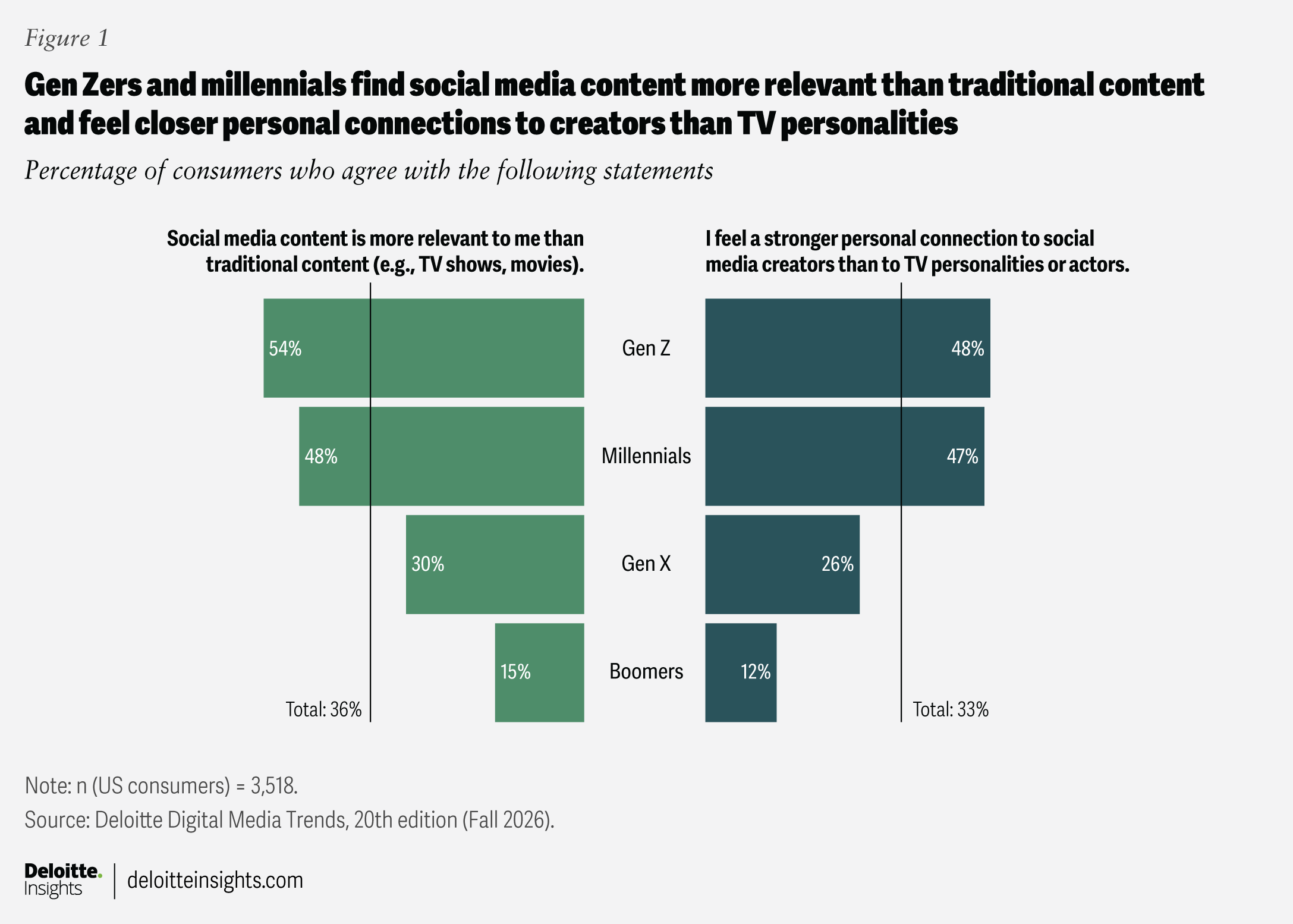
This opportunity looks to be particularly strong for Gen Z and millennial consumers. These cohorts make up a significant share of the US buying population,5 and many of them report feeling stronger personal connections to creators than to traditional media personalities (figure 1). For brands, it’s important to understand where these younger cohorts encounter advertising and whom they trust for recommendations.
The case for long-term creator partnerships
Creators command consumer attention. According to our data, 65% of US consumers overall say they engage with creators or creator-led content across platforms. Among those who engage with creators, about 60% do so daily. But there is more to the creator value proposition than reach alone.
Some creators have amassed followers who are aligned around a unifying topic or niche (for example, gaming, parenting, and beauty). About 70% of consumers who engage with creators say they return regularly to watch content from the same creators, suggesting a deliberate decision to engage with that specific creator rather than simply coincidental viewing. Indeed, in our study, 40% of consumers who engage with creators say one of the top reasons they follow a specific creator is that the creator talks about a topic they’re interested in. As a result, a creator with a smaller audience but with strong influence and high brand alignment may be a more valuable partner to a given brand than a larger creator whose audience is not well-aligned.6
Creators are also often adept at creating communities, which can help engender trust and credibility. As noted, nearly half of Gen Z and millennial consumers say they feel stronger personal connections to social media creators than to TV personalities or actors (figure 1).
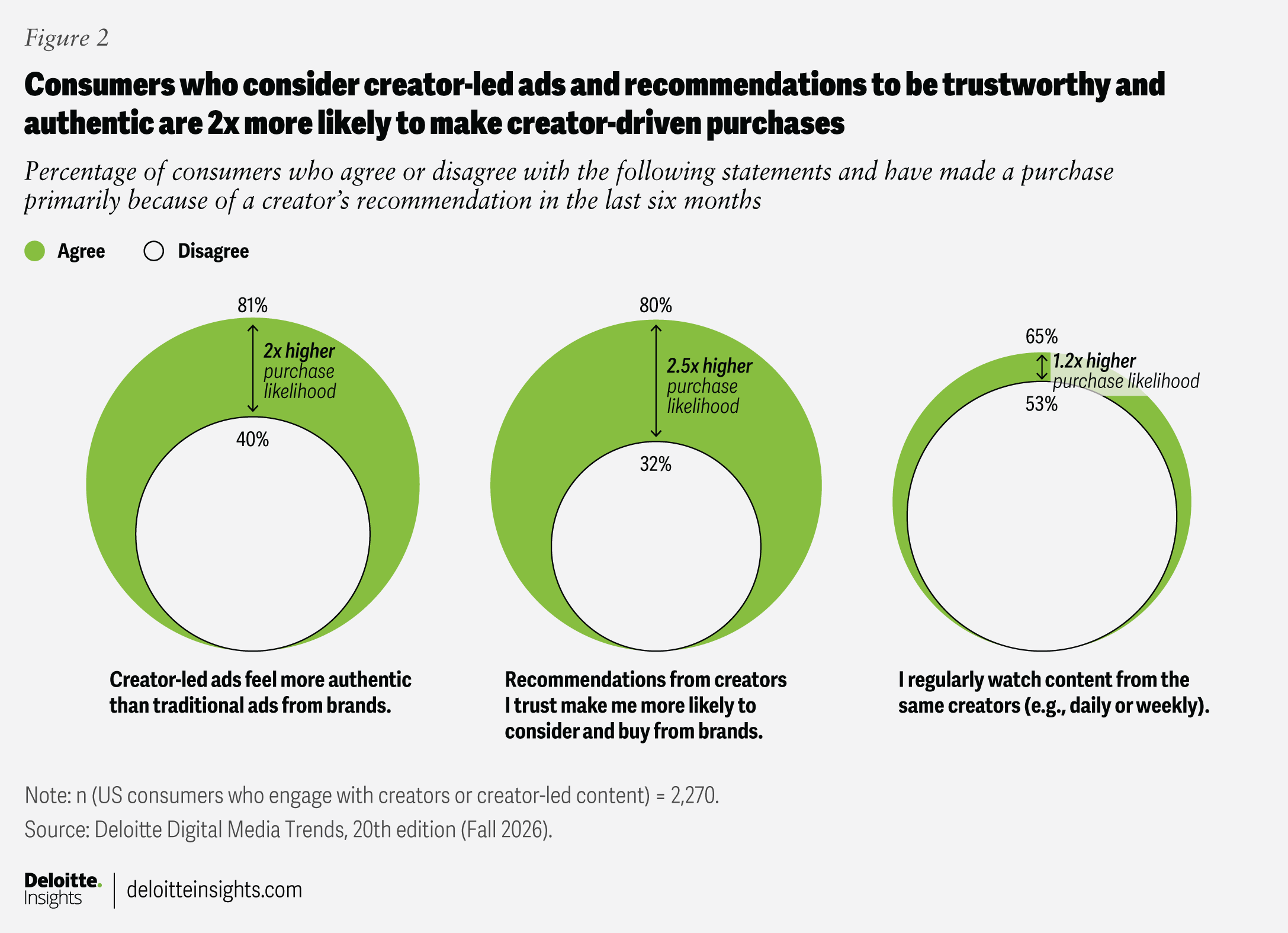
These connections have the potential to be an important asset for brands: More than half of consumers who engage with creators say recommendations from creators they trust make them more likely to consider and buy from brands. Another 45% say creator-led ads feel more authentic than traditional ads. Still, some consumers are more resistant to creators promoting or selling products—highlighting the importance of authenticity and fit in these partnerships.
These figures suggest that brands that partner with the right creators may be able to “borrow” trust and credibility and turn it into purchasing influence. Roughly 60% of US consumers who engage with creators have made a purchase based primarily on a creator’s recommendation or sponsorship in the last six months. For Gen Z and millennials, that share rises to nearly 75%, with the average buyer in these cohorts making three creator-influenced purchases in the last six months.
Consumers who perceive creator-led ads to be trustworthy and authentic are significantly more likely to purchase based on a creator recommendation (figure 2). Purchase likelihood is 2.5 times higher for those who say recommendations from trusted creators influence them, 2.0 times higher for those who consider creator-led ads more authentic than traditional ads, and 1.2 times higher for those who repeatedly engage with the same creators, compared with consumers who do not share these sentiments. These findings suggest that the perceived authenticity of creators, along with the resulting trust and community they build with consumers who follow them, can drive measurable commercial outcomes.
These insights suggest that creators have built long-term, intentional relationships with their audiences, who keep coming back for more. Brands have an opportunity to follow this model by moving away from one-off creator campaigns toward true partnerships that can foster audience familiarity, build credibility, and deliver commercial value that grows over time.
Considerations for shifting the creator ad strategy from single deals to strategic partnerships
Adopting a new brand-creator collaboration model—where creators are strategic, long-term partners rather than just one-time media buys—could drive brands to rethink who they partner with, how they share the creative process, and how they measure return on investment over time. And while many social platforms already offer marketplaces and creator tools, they have opportunities to enable more strategic matches between creators and brands, as well as more effective ad measurement, which could help attract more advertisers and drive the value of ad inventory.
Focus on brand fit
Identifying creators with strong brand alignment and shared audience segments—not just those with the most followers or broadest appeal—can help form a successful creator-brand partnership. Some creators can even offer brands insight into specific consumer segments: how they behave, how they interact with content and products, and what messaging resonates with them.
Leveraging artificial intelligence to apply specific brand-fit criteria and to collect and synthesize large volumes of data can help streamline the identification of brand-aligned micro- or nano-influencers who may otherwise be difficult for brands to uncover. Existing platform marketplaces could go beyond enabling transactions to provide more meaningful insights that help brands and creators align around affinity communities, values, and predicted performance.7 Better creator-brand matching systems could give brands greater confidence in their creator investments, increase ROI, and reduce the number of one-off deals with creators that may or may not pay off.
Tap into creators’ creativity
Creators will likely bring their own creative processes and content playbooks—the approaches that attracted their audiences in the first place. As noted in figure 1, more than 50% of Gen Zers say social media content is more relevant to them than traditional content like TV shows or movies. And many say they follow creators for their entertainment value. Brands should understand the primary formats creators use to reach their audiences (for example, tutorials, unboxing, reviews, and demos) and give creators freedom to integrate the brand into their content strategy authentically.
Build relationships, not just campaigns
Brands that pivot toward more sustained partnerships with creators might consider ways to maximize and extend those relationships across platforms, campaigns, moments, and experiences. For example, they could feature a creator across multiple ad formats or offer longer-term contracts that allow creators to talk about products over a sustained period, not just when new products are launched. Continuity can give creators time to understand the brand and audiences the opportunity to connect with it. Platform tools that more effectively track campaign and creator partnership performance over time could give brands, other advertisers, and creators more visibility into longer-term engagement and ROI.
by
Doug Van Dyke
Daniel Ledger
Dennis Ortiz
James Yu
Akash Rawat
Brooke Auxier
Editorial (including production and copyediting): Aditi Rao, Preetha Devan, Pubali Dey, and Cintia Cheong
Design: Molly Piersol
Cover image by: Sonya Vasilieff; Adobe Stock
Knowledge services: Vanapalli Viswa Teja
Visit the Deloitte Center for Technology, Media & Telecommunications
Access more insights for the technology, media, and entertainment; semiconductor; telecommunication; and sports sectors.