

No results found

EU Pay Transparency Directive Legal Tracker
Last updated: 30 September 2026
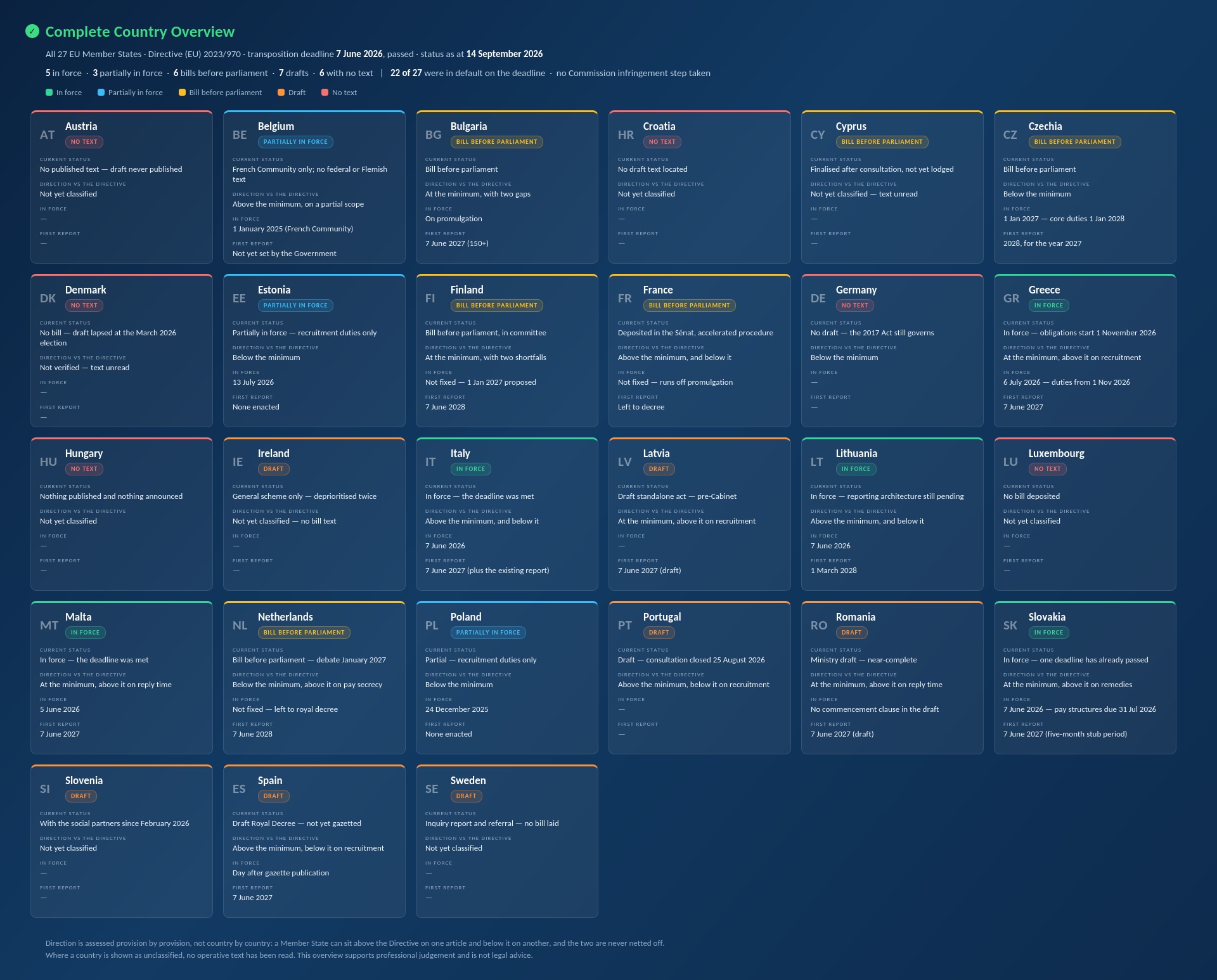
This review provides a summary of some key developments to date in certain countries, helping you understand the evolving legislative landscape and prepare for upcoming compliance obligations. If you would like to know more or receive a more detailed transposition update, feel free to reach out.
Austria
Status: No published text. Austria has missed the transposition deadline.
- A draft was circulated internally on 6 June 2026 but has never been published and has not entered the formal consultation stage.
- Nothing appears in the federal legal information system or the index of ministerial drafts.
- Austrian employers have no national pay transparency obligation today.
- Existing Austrian equal-pay law continues to apply unchanged.
Belgium
Status: Partially in force — two public-sector regimes, one in each Community. No federal instrument, so no private-sector duty anywhere in Belgium.
- Two Communities have legislated, each for the public sector within its own competence, and both instruments are in force: the French Community since 1 January 2025, the Flemish Community since 7 June 2026. They are parallel regimes, not one Belgian rule.
- French Community: pay information must be available from the moment a vacancy is published — stricter than the Directive — together with a pay-history ban covering current and previous employment, gender-neutral notices and job titles, and pay and pay-progression criteria that must be accessible to staff with no exemption for small employers.
- Flemish Community: the Directive's own reporting calendar on the face of the decree — employers of 250 or more and of 150 to 249 report by 7 June 2027, employers of 100 to 149 by 7 June 2031 — with a two-month reply period, annual notification of the right, and a joint pay evaluation where an unjustified gap of 5% is not corrected within six months.
- The two diverge on the most visible recruitment duty. The French Community requires pay in the advertisement; the Flemish decrees impose no pre-employment disclosure at all. Neither prohibits pay-secrecy clauses.
- Neither regime is fully enforceable yet. Every penalty in both Flemish decrees is suspended, each tied to a reform of the Criminal Code that has no commencement date; the French Community decree creates no fine for its transparency duties, and its employer reporting dates are still left to a Government order that has not been made.
- There is no federal instrument, so private-sector employers are not covered anywhere in Belgium.
Belgium does not have a single pay transparency regime and is not close to one. Two Communities have acted, each for its own public sector, and the federal legislator — which would cover the private sector — has published nothing. Planning should treat these as separate timetables rather than looking for one Belgian answer.
Bulgaria
Status: Bill before parliament.
- The bill is a complete regime: all seven reporting metrics, a two-month reply period, and a joint pay assessment triggered by a 5% unjustified gap left uncorrected for six months.
- The reporting calendar matches the Directive exactly — first report 7 June 2027 for employers of 150 or more, covering calendar year 2026, and 7 June 2031 for 100 to 149.
- Where a worker would be identifiable the information is routed to the union or the equality body rather than refused.
- Two gaps: the recruitment disclosure duty states no time by which the information must be given, and the bill creates no penalty of its own.
- The obligations sit in anti-discrimination law and in the Labour Code at the same time.
Bulgarian entities belong in a group-wide 2027 reporting cycle, unlike the Netherlands, Czechia, Lithuania, Finland and France. Agency workers are counted in the user undertaking's report.
A compliance review scoped to the Labour Code alone will find only half of the obligations. Because the bill legislates no fine, exposure runs through the existing anti-discrimination sanctions. This is a bill, not law, and it can still change in committee.
Croatia
Status: No published text. Croatia has missed the transposition deadline.
- Transposition is expected through amendments to the Labour Act, which are also expected to carry the platform work directive.
- The responsible minister said on 26 August 2026 that the amendments were ready and would be taken by urgent procedure.
- On 9 September 2026 the labour ministry published a free job-evaluation methodology: written guidance, separate models for small, medium and large employers, and spreadsheet tools that score a post and return its pay grade.
- The ministry states that the Labour Act is being aligned with the Directive and that the amendments will create a national pay transparency system through which employers report the gender pay gap. Use of the methodology itself is expressly voluntary.
- Croatian employers have no national pay transparency obligation today.
Cyprus
Status: Bill finalised after consultation, still not lodged in the House.
- A revised post-consultation text exists and is formatted for gazette publication, but it has not been enacted or tabled.
- The parliamentary index of bills lodged in 2026 has advanced to the plenary sitting of 24 September 2026. The pay transparency bill was not among the nine bills lodged there, as it was not among the fourteen lodged on 17 September.
- The Minister of Labour said on 6 September 2026 that the bill would go to the Council of Ministers within September. That has not happened, at what appears to be the last September sitting.
- No substantive provision can be stated: the operative text has not been read.
Cyprus is in default and what exists is a bill that has not been published. An original and a revised text both sit on the consultation portal and they differ, so any figure circulating for Cyprus should be treated as version-dependent until the final text appears.
Czechia
Status: Bill before parliament — reached the Chamber of Deputies on 8 September 2026.
- The headline commencement date of 1 January 2027 covers only four duties: recruitment disclosure, the pay-history ban, the duty to operate a pay system, and the pay-secrecy prohibition.
- The information right, the reporting chain, the joint pay assessment and the agency-work rules are deferred to 1 January 2028, and the 100-employee band to 2031.
- First report in 2028 for the year 2027, for employers of 250 or more and of 150 to 249.
- The gender pay gap is computed from the payroll-tax base, so pay outside that base does not appear in the figure.
- Job grading is by complexity, responsibility and demands — working conditions is not a named criterion.
Czechia defers the individual information right by nineteen months, against a Directive obligation that carries no headcount threshold and no phase-in. An employer told that Czechia starts in January 2027 will plan the wrong things for the wrong year.
The headline gap figure is computed by the State from administrative data. The employer's own filing is a by-job-group report due each 30 April, against job groups it defines itself — so the preparation work is job-group architecture rather than report drafting. Build that architecture against all four Directive criteria, because a grading that satisfies the Czech list may still fall short of the Directive.
Where there is no trade union, the route for information withheld on identifiability grounds has no destination in the bill as drafted. That is a live legal question rather than a settled position.
Denmark
Status: No bill. A consultation draft exists but was never introduced in the Folketing.
- The draft amendment to the Equal Pay Act went to external consultation in February 2026. Parliament was dissolved for the March 2026 election and no bill was ever tabled.
- The ministry's own list of bills for the parliamentary year contains no entry on equal pay, and no replacement text has appeared.
- On the draft as written, the reply period for a pay-information request is two months — the Directive's own floor.
- On the draft as written, first reports would fall on 1 September 2028 for employers of 250 or more and of 150 to 249 — fifteen months after the Directive's own date — and on 1 September 2031 for the 100 to 149 band.
- Danish employers have no new national pay transparency obligation today.
Nothing is in force in Denmark and nothing can be, because no bill was ever introduced. The consultation draft is nevertheless worth planning against, because it is the best available indication of the shape a Danish regime would take, and any replacement text may differ on any provision.
Estonia
Status: Partially in force since 13 July 2026 — recruitment duties only.
- Pay or a pay range must be given in a form that can be reproduced in writing, in the advertisement or otherwise, before the job interview, together with any applicable collective-agreement pay terms.
- Candidates may not be asked about pay in current or previous employment.
- Employers may not obstruct an employee from disclosing their own pay, but a pay-secrecy clause is not made void.
- There is no reporting duty, no individual information right, no joint pay assessment and no gender-neutral job title rule. In their place Estonia offers a voluntary State service that calculates an employer's own gender pay gap indicators on request, with no threshold, no frequency and no submission to any authority.
- Only the recruitment disclosure duty is supervised by the labour inspectorate. The pay-history ban, the duty not to obstruct disclosure and the equal-pay duty itself sit outside state supervision.
Finland
Status: Bill before parliament — the committee has finished its expert hearings.
- Close to the Directive on almost every number that matters: all four equal-value factors, all seven metrics, a two-month reply, a 5% and six-month joint assessment trigger, and identifiability handled by routing rather than refusal.
- The employment and equality committee closed its expert hearings in late September 2026. Its report — the document that can still change the bill — has not been published.
- The reporting threshold is 100 employees. The first report for employers of 250 or more and of 150 to 249 is deferred to 7 June 2028, a year later than the Directive requires; the 100 to 149 band reports from 7 June 2031.
- A penalty of €5,000 to €80,000 applies for filing the joint pay assessment late, scaled by turnover. The public sector is exempt from it.
- Gender-neutral job titles are not transposed; the bill relies on existing equality legislation, which addresses sex-restricted advertisements only.
There will be no Finnish transposing law before 1 January 2027 at the earliest, and the bill leaves its own commencement date blank. A Finnish entity will not be part of a group-wide 2027 reporting cycle.
France
Status: Bill deposited in the Sénat on 10 September 2026, under the accelerated procedure.
- The penalties are in the statute and they are severe: up to 1% of total payroll, and up to 2% for a repeat within five years, imposed administratively.
- Indicators must be declared from 50 employees — lower than the Directive, because the existing French Index already bites at that level.
- A job advertisement may not be published without a pay range, and questions about a candidate's current or past pay are prohibited.
- A sanctioned employer may be excluded from public procurement for one year from the date of the sanction.
- Nearly every other figure — the indicators themselves, the joint-assessment trigger, the reply period, the identifiability floor and the first reporting date — is left to implementing decree.
The accelerated procedure allows a joint committee of both chambers after a single reading in each, so the French bill is on a compressed track. No adoption date can be inferred from that: no committee has been seized and no rapporteur has been named.
France legislates the architecture and delegates the numbers. Anyone planning a French compliance programme today is planning against a structure rather than a ruleset. What can be planned for now is structural: worker categories have to be defined by collective agreement before the information right commences, and that is the critical path. Branches have six months from promulgation to open negotiations on a categorisation method.
Recruitment changes fastest — once the law is promulgated, no advertisement may go out without a pay range. The existing Index is replaced rather than run in parallel: the ministry publishes the first six indicators, the employer's own publication becomes optional, and the per-category indicator is never published but must go to workers and their representatives.
Germany
Status: No published text. The 2017 Pay Transparency Act still governs.
- No ministerial draft has been published and the indicated August 2026 cabinet slot passed without one.
- Transposition is intended as an amendment to the existing 2017 Act rather than a new statute.
- The 2017 regime sits below the Directive on three counts: the individual information right applies only above 200 employees, the reply period is three months, and the employer may refuse where the comparator group is identifiable.
- There is no pre-employment pay disclosure duty in German law today.
Germany is in default and has no national text to design against, three months after the deadline. A German implementation project should be built directly on the Directive.
The practical warning is the opposite of the usual one: do not treat the German standard as sufficient for group-wide design. Three of its core provisions sit below the Directive and will have to rise.
Greece
Status: In force since 6 July 2026 — but the substantive obligations start on 1 November 2026.
- Law 5316/2026 was published on 6 July 2026. Its substantive articles — pay-setting transparency, recruitment, the information right, reporting, joint assessment, remedies and burden of proof — apply only from 1 November 2026.
- All seven reporting metrics are reproduced and the Directive's calendar is met exactly: 7 June 2027 for employers of 250 or more and of 150 to 249, 7 June 2031 for 100 to 149.
- Two-month reply period; compensation expressly uncapped; pay-secrecy terms prohibited in contracts, collective agreements and work rules.
- The fine amounts have not been set — a ministerial decision is still outstanding.
- Agency workers count in the user undertaking's report.
An employer told that "Greece has been in force since July" will under-plan for a 1 November start and for a first report in June 2027 over a part-year reference period.
Greek exposure cannot yet be quantified, because the instrument that sets the fines has not been issued. The Ombudsman is designated as both equality body and monitoring body, and a dedicated equal-pay unit has been created inside the Labour Inspectorate.
Hungary
Status: No published text and nothing announced. Hungary has missed the transposition deadline.
- No transposing instrument has been published, nothing appears in the official gazette and nothing is before parliament.
- No responsible draft or timetable has been announced.
- Hungarian employers have no national pay transparency obligation today.
Ireland
Status: General scheme only — the bill has been deprioritised.
- Only a general scheme — an outline of heads of a bill — exists. There is no bill text.
- The Pay Transparency Bill was not given priority drafting status in the Summer 2026 legislative programme; its heads remain in preparation.
- No Autumn 2026 programme has been published.
- Existing Irish gender pay gap reporting continues to apply and is not a transposition of the Directive.
Italy
Status: In force since 7 June 2026 — the deadline was met.
- Pay ranges must be given in job advertisements, and the pay-history ban extends to information obtained indirectly through recruiters.
- The category of workers is not designed by the employer: both "same work" and "work of equal value" are anchored to the classification levels of the applicable national collective agreement.
- Applying a comparatively representative national collective agreement carries a statutory presumption of conformity with the equal-pay and transparency principles.
- First report 7 June 2027 for employers of 250 or more and of 150 to 249 — in addition to, not instead of, the existing biennial gender report, so employers of 100 or more carry two parallel reports.
- Weaknesses to be aware of: pay level excludes non-structural individual awards, effort is missing from the equal-value criteria, the penalty scale is €250 to €1,500, and no limitation period is set.
The collective-agreement anchor is the defining feature of the Italian regime and it cuts both ways. It removes most of the job-architecture work that Dutch, Finnish and French employers face, and it brings a presumption of conformity. But reporting categories, quartile bands and the 5% trigger are all set by the sectoral agreement, so a group with entities on different agreements will not have comparable categories across them.
The largest practical burden is dual reporting: the decree makes no coordination with the pre-existing regime. Two ministerial instruments remain outstanding, including the one that would settle how classification systems are tested in practice.
Latvia
Status: Draft standalone act, not yet before the Cabinet.
- The draft is the most complete transposition text read in this watch: twenty-five sections and transitional provisions covering the whole Directive.
- The reporting calendar is the Directive's own — 7 June 2027 for employers of 250 or more and of 150 to 249, 7 June 2031 for the 100 to 149 band.
- Pay must be stated in the job advertisement itself, which is stricter than the Directive's requirement that it be given before the interview.
- Pay-secrecy terms would be void across collective agreements, employment contracts, work rules and employer orders alike.
- Enforcement is unusually sharp for a draft: the burden of proof reverses in the labour inspectorate's own proceedings as well as in court, and an unjustified gap above 5% would be a ground for exclusion from public procurement.
A Latvian entity can sensibly plan against this text now, even though it is pre-Cabinet, because the reporting dates are the Directive's own and are unlikely to move with the bill.
Three things drive the work. Recruitment templates change first, because pay goes in the advertisement. Any confidentiality wording covering pay should be removed rather than narrowed. And the enforcement design means a Latvian entity should expect the inspectorate, not only a claimant, to test its documentation.
The rules on how employers will actually file are to come in Cabinet regulations due by 1 May 2027; they do not yet exist.
Lithuania
Status: In force since 7 June 2026 — but the reporting architecture and the information right start on 1 January 2027, and one deadline falls on 31 December 2026.
- Every employer, of any size, must have its pay system approved, or reviewed and where necessary amended, by 31 December 2026, with posts grouped on objective gender-neutral criteria and staff information and consultation completed first. This is the nearest Lithuanian deadline and it is backed by a fine.
- Employers do not calculate or publish a gap. They file a monthly per-employee payroll dataset with the social insurance authority, which computes all seven metrics. Monthly filing starts on 28 February 2027.
- The first pay gap report is 1 March 2028 for employers of 150 or more, and 1 March 2031 for 100 to 149 — later than the Directive requires.
- From 1 January 2027 the social insurance authority publishes, every month, the average hourly pay of men and of women for every employer with at least eight employees.
- The reply period to an employee's pay information request is one month, not two. Pay must be stated in job advertisements, and agency workers sit in the agency's own report.
Luxembourg
Status: No bill deposited. Luxembourg has missed the transposition deadline.
- No transposition bill has been deposited in the Chamber of Deputies.
- At a parliamentary committee exchange on 24 June 2026 the minister said consultation with the social partners would continue before a bill is presented.
- The position was re-confirmed on 8 September 2026.
- Luxembourg employers have no national pay transparency obligation today.
Malta
Status: In force since 5 June 2026 — the deadline was met.
- An employer must answer a pay information request in writing within eight days. This is the tightest operational duty found in any Member State, against a two-month floor in the Directive.
- Substantively Malta is one of the closest transpositions in the EU: the seven metrics, the reporting calendar, the 5% and six-month trigger, the three-year limitation period and all four equal-value factors all match.
- Employers of 25 or more must internally document their pay, pay-level and pay-progression criteria; those under 50 are exempt from the progression element.
- Recruitment disclosure is owed before the recruitment process concludes, subject to the requirement that negotiation be informed and transparent.
- Fines are criminal and imposed by a court: €2,500 to €5,000, or €5,000 to €7,000 for equal-pay breaches, increased on repetition.
The eight-day reply needs a standing process rather than an ad-hoc one. It is the single operational point that should lead any Maltese client conversation.
Two weaknesses are worth naming honestly. Pay-secrecy clauses appear to survive — the instrument permits disclosure to authorities, representatives and unions for enforcement purposes but does not void a confidentiality term. And damages above lost pay are available only where the discrimination was wilful and vexatious. Enforcement is split between the employment relations department as monitoring body and the equality commission as equality body.
The Netherlands
Status: Bill before parliament — plenary debate scheduled for the second week of January 2027.
- There is still no Dutch start date. Commencement is left to royal decree, and the draft implementing decree's own commencement article is blank.
- First report 7 June 2028 for employers of 150 or more, and 7 June 2031 for 100 to 149 — later than the Directive requires.
- What is measured is the payroll-tax wage. Taxable benefits in kind are included; untaxed reimbursements and work-related cost scheme items are not.
- The works council consents to the job-evaluation and classification criteria and to the pay evaluation and its action plan. It is consulted on the pay report — it does not approve it.
- The Netherlands has deliberately not taken the identifiability carve-out, so a request cannot be refused because a colleague would be identifiable.
A group timetable should not hang on 1 January 2027. The bill fixes no date, the plenary debate is not until January 2027, and the implementing decree is still a consultation draft.
Run the gap on the payroll base because that is what must be filed, and run a second check against total reward, because the Directive's pay concept is the wider one and a claim will be argued on it. Budget remediation properly: the Government's own list runs to pension premiums and pension accrual, share and profit-sharing schemes and the salary scale itself, and an unjustified difference below five per cent must still be corrected — the threshold only decides whether the formal evaluation is triggered.
Two quiet deliverables are easy to miss: a data protection privacy notice covering pay transparency processing, and an authenticated filing identity at assurance level 3 for the entity that will file. The draft decree also provides for employers to be named on the inspectorate's website for three years.
Poland
Status: Partial — recruitment duties in force since 24 December 2025. A complete transposition bill exists but has not reached the Council of Ministers.
- Every employer recruiting under a contract of employment must give each candidate the initial pay or range plus applicable collective-agreement terms, early enough to be read and to allow an informed negotiation.
- Vacancy notices and job titles must be gender-neutral and the recruitment process non-discriminatory. Candidates may not be asked about pay in current or previous employment, and candidates engaged on civil-law or business-to-business terms are outside the duty entirely.
- Nothing else is in force: no reporting duty, no individual information right, no joint pay assessment, and no fine for the duties that do bind.
- Equal value is still measured on three factors. Working conditions, the fourth factor the Directive requires, is absent from the provision in force and would be added only by the bill.
- The bill is complete — 74 articles amending nine further statutes, reporting from 100 employees, all seven metrics, a 30-day reply, void pay-secrecy clauses, fines of 2,000 to 60,000 złoty and a ground for exclusion from public procurement — but it has not moved since 4 May 2026.
Portugal
Status: Draft proposal, published in August 2026; public consultation closed on 25 August.
- Reporting would start at 50 employees, half the Directive's floor, with agency workers counted in the headcount.
- The reporting calendar is the Directive's own: 7 June 2027 for employers of 250 or more and of 150 to 249, and 7 June 2031 for 50 to 149.
- Pay-secrecy clauses would be void, in employment contracts and in collective instruments alike.
- The information right would extend expressly to temporary agency workers.
- On recruitment the draft requires the information only before the employment contract is concluded, which is later than the Directive's standard of early enough to inform a transparent negotiation.
Portugal over-delivers on scope and under-delivers on the recruitment moment, and both need saying in the same breath. The 50-employee threshold is the number that decides whether a Portuguese entity is in scope at all, and counting agency workers in the headcount will pull in employers that would otherwise fall below it.
Two things can be acted on now and cheaply: pay-secrecy wording should come out of contracts and collective instruments rather than be narrowed, and the duty to publish pay criteria can be prepared before the text is final.
This is an amending act, so there will be no Portuguese pay transparency statute to look up. The obligations will sit across the existing equality legislation and the Labour Code, and a review scoped to a single instrument will miss half of them. No Portuguese fine figure can be stated: the penalty scale sits in the Labour Code and has not been read.
Romania
Status: Draft — ministry text, and one of the most complete drafts anywhere in the EU.
- A standalone law of 25 articles, plus amendments to the Labour Code and two other acts.
- The reply deadline is 30 working days — roughly six weeks, and tighter than the Directive's two months.
- The reporting calendar matches the Directive: 7 June 2027 for employers of 150 or more, 7 June 2031 for 100 to 149.
- All four equal-value factors, all seven metrics, a 5% and six-month joint pay assessment, and fines of 10,000 to 20,000 lei, rising to 20,000 to 30,000 on repetition.
- A second clock, unrelated to the 5% trigger: any unjustified pay difference revealed by the report must be corrected within 90 working days.
A Romanian entity could not run on a group-standard two-month service level for information requests. The 30 working day deadline is the single most operationally significant Romanian deviation.
Half the obligations land in the Labour Code rather than in the new law, so a review scoped to the standalone act misses the pay-secrecy prohibition and the worker's information right.
Two health warnings. The draft as published contains no entry-into-force provision. And a later parliamentary version is reported to change the prescription period and the penalties; it has not been located, so nothing from Romania should be quoted without the date of the text it comes from.
Slovakia
Status: In force since 7 June 2026 — and one compliance deadline has already passed.
- Every employer that existed before 7 June 2026 had to have gender-neutral pay-setting criteria and pay structures in place by 31 July 2026. That date has passed and the duty is enforceable by the labour inspectorate.
- Slovakia matches the Directive on the 5% trigger, the six-month remedy window, the two-month reply, the seven metrics and the reporting calendar.
- First report 7 June 2027 for employers of 150 or more, over a five-month reference period running from 1 August to 31 December 2026. The 100 to 149 band reports from 7 June 2031.
- Pay-secrecy terms are void, compensation is uncapped and the limitation period is three years.
- Enforcement is split: the ministry fines a reporting failure at €4,000 to €8,000 after a 15-day grace period, and the labour inspectorate fines the other duties.
The expired pay-structure deadline should lead any Slovak conversation. An employer that has not done that work is already non-compliant, not preparing for a future obligation.
The five-month stub first reference period makes annualised and quartile metrics awkward to compute and is worth flagging to reporting teams early. Note also that the obligations sit in a standalone act rather than in the Labour Code, even though the Labour Code was amended in parallel.
Slovenia
Status: Draft with the Economic and Social Council since February 2026 — not tabled.
- A draft act was sent to the social partners in February 2026 and has not been tabled in parliament.
- Nothing has been opened on the public consultation portal or the legal register.
- No text has been located or read, so no provision can be stated.
- Slovenian employers have no national pay transparency obligation today.
Seven months with the social partners and no tabling is a slow-track signal rather than a neutral one.There is nothing to implement. Advice should rest on the Directive.
Spain
Status: Draft Royal Decree — consultation closed, not yet published in the official gazette.
- The pay register binds every employer whatever its size, and must now carry both the mean and the median, in annual and hourly terms, component by component, with the workers' representation consulted ten days before it is drawn up.
- Reporting starts at 50 employees, on the Directive's own calendar: 7 June 2027 for employers of 150 or more, 7 June 2031 for 50 to 149.
- The pay audit is unconditional for every employer of 50 or more, negotiated inside the equality plan, with unjustified gaps closed within six months. There is no 5% trigger and no separate joint pay assessment.
- The instrument contains nothing on recruitment: no duty to give candidates a pay range, and no pay-history ban.
- Pay-confidentiality clauses are not prohibited.
Spanish entities are already inside a pay register and pay audit regime and the draft extends it rather than creating it. Spain does belong in a group-wide 2027 reporting cycle, unlike the Netherlands, Czechia, Lithuania, Finland and France.
Recruitment is the gap that matters most in practice. Spain has no candidate disclosure duty and no pay-history ban, and nothing in the pipeline would create them — so a group recruitment standard cannot be justified by reference to Spanish law. Pay confidentiality should be treated as an open exposure rather than a settled alignment.
A new tripartite monitoring commission will collect and publish the data. The instrument itself describes the transposition as partial.
Sweden
Status: No bill, and the Government has said it does not currently intend to introduce one.
- A fully drafted regime exists — a law council referral of 15 January 2026 proposing a new chapter in the Discrimination Act — but it has not been introduced.
- On 26 March 2026 the Government stated that it does not currently intend to lay a proposal and that it wants the Directive reopened at EU level. Nothing has moved since June 2026.
- The drafted regime is closely aligned: a two-month information right for every worker regardless of headcount, all seven metrics, and a three-year limitation period.
- On the drafted text, reports would go to the equality ombudsman by 20 May, first in 2027 for employers of 150 or more and in 2031 for 100 to 149.
- Swedish employers have no new national pay transparency obligation today, and Sweden has missed the transposition deadline.
The advice for Sweden has changed shape. It is no longer that a bill is coming and should be prepared for; it is that a drafted regime exists and the Government has said it does not currently intend to introduce it.
For a group with Swedish entities that means two things at once. Swedish entities should not be sequenced early in a group programme, because no Swedish obligation exists and may not for some time. But the drafted text remains the best available forecast of what Sweden would eventually enact, and it is close to the Directive, so designing to the Directive will not be wasted work.
Appendix: EU
Status of Transposition
Transposition deadline
All member states are required to have implemented the Directive by 7 June 2026.
Scope
Directive scope and coverage
The key measures introduced by the Directive are:
- Member states are required to establish gender pay gap reporting regimes, with company-wide results as well as results broken down by categories of workers. Employers must conduct a pay assessment where pay reporting reveals a gender pay gap of at least 5% in any category of workers that cannot be justified by objective and gender-neutral factors, and which has not been remedied within six months of submission of the report;
- Requirement to disclose the pay level or pay range for an advertised role to ensure pay transparency for jobseekers;
- A prohibition on asking job candidates about their current pay and pay history;
- Limits on the extent to which employers can control workers discussing their rate of pay;
- Increased transparency in setting rates of pay;
- A right to information about pay rates in an effort to ensure that workers are able to identify disparities; and
- The requirement to identify categories of workers for pay reporting, joint pay assessment and pay transparency purposes brings the concept of equal value to the forefront of the approach to equal pay in the EU.
Employer thresholds under the Directive
The Directive provides that employers with 100 or more workers must meet the reporting thresholds, but member states can implement reporting requirements on a phased basis should they wish:
- Employers with at least 150 workers must submit their first report in 2027;
- Employers with at least 250 workers must report annually thereafter;
- Employers with between 150-249 workers must report once every three years; and
- Member states may delay the first reporting for employers with between 100-149 workers to 2031.
Pay Transparency & Secrecy
Pay transparency obligations at recruitment stage
Prospective employers are obliged to give job applicants information about the initial pay or pay range for a particular position. The Directive provides that the information must be provided in a manner that ensures a transparent and informed negotiation on pay, such as "in a published job vacancy notice, prior to the job interview or otherwise".
Employers are not allowed to ask applicants about their pay history and must ensure that job adverts and job titles are gender neutral, with the recruitment process being led in a non-discriminatory manner. This right to information does not explicitly extend to internal applicants but is expressed to be incumbent on prospective employers only.
Employee right to request pay information
Workers have the right to request and receive, within two months, written information on their individual pay level and the average pay levels, broken down by sex, for categories of workers doing the same work or work for equal value during their employment. Employers are required to inform all workers of this right on an annual basis.
Pay secrecy clauses
Employers cannot prevent workers from disclosing their pay for the purpose of the enforcement of the principle of equal pay. In particular, member states are required to put in place measures to prohibit contractual terms that restrict workers from disclosing information about their pay.
Transparency on pay and pay progression criteria
Employers must make easily accessible to their workers the criteria that are used to determine workers’ pay, pay levels and pay progression. Those criteria shall be objective and gender neutral. Member states may exempt employers with fewer than 50 workers from that obligation.
Gender Pay Gap Reporting
Differences with the Gender Pay Gap Reporting metrics
N/A
Non-Compliance
Employee remedies
Member states must ensure that workers are entitled to unlimited compensation in respect of all of the losses sustained where their equal pay rights have been breached. This must include: full recovery of back pay and related bonuses or payments in kind (together with interest); compensation for lost opportunities; non-material damage; any damage caused by other relevant factors (which may include intersectional discrimination); and interest on arrears.
Penalties / enforcement mechanisms
Member states are required to put in place penalties for employers that break the rules and workers who have suffered gender pay discrimination can receive compensation. Member states must also establish specific penalties for infringements of the equal pay rule, including fines that guarantee a real deterrent effect.
Other Relevant Provisions
Categories of worker performing same work or work of equal value
Work of equal value is determined by taking the following factors into account:
- Objective, gender-neutral criteria should be used, and they should be agreed with workers’ representatives, where such representatives exist;
- The criteria should not be based directly or indirectly on workers’ sex;
- The objective criteria should include skills, effort, responsibility and working conditions. These factors have been identified as being essential and sufficient for evaluating the tasks performed in an organisation regardless of the economic sector to which the organisation operates. If appropriate, any other factors which are relevant to the specific job or position should be taken into account; and
- Relevant soft skills should not be undervalued in the process.
Did you find this useful?

Thanks for your feedback
Your feedback is important to us
To tell us what you think, please update your settings to accept analytics and performance cookies.

Contact us for deep-dive questions on legal transposition statuses


