

Japan and Australia – Economic security through stronger ties
Japan and Australia, friends for decades, look to further strengthen the ties that have bound them together.
The global economy has been shaped by decades of increasing trade openness that has raised living standards for a vast majority of participants. Recently, that trend has stalled. Since 2008, trade as a share of global output has flattened. Several factors have contributed to increasing protectionism over the last two decades: a slowdown in trade reform, the financial crisis, a rise in populism, and increased competition between great powers.
The headwinds against free and fair trade have intensified. Over the last few quarters, the global economy has seen the threat and imposition of significant tariff barriers. The current global economic environment is increasingly influenced by a focus on sovereign capabilities and national resilience. It is characterised by uncertainty, distrust, and geopolitical tension.
In a world fraught with risk, it is more important than ever to seek out a trusted friend. Strategic economic collaboration with like-minded countries has become a cornerstone of both foreign and economic policy.
It is against this context that Japan and Australia, friends for decades, look to further strengthen the ties that have bound them together. Deloitte Access Economics, in collaboration with Deloitte Australia’s Japanese Services Group, explored this topic in the recently published paper titled Japan and Australia – Economic security through stronger ties.
Japan and Australia’s relationship is an outlier among neighbouring and similarly advanced economies. Japan ranks above all other countries in terms of economic complementarity with Australia. United Nations General Assembly voting records indicate that Japan is also more politically aligned with Australia on global issues than many other countries.
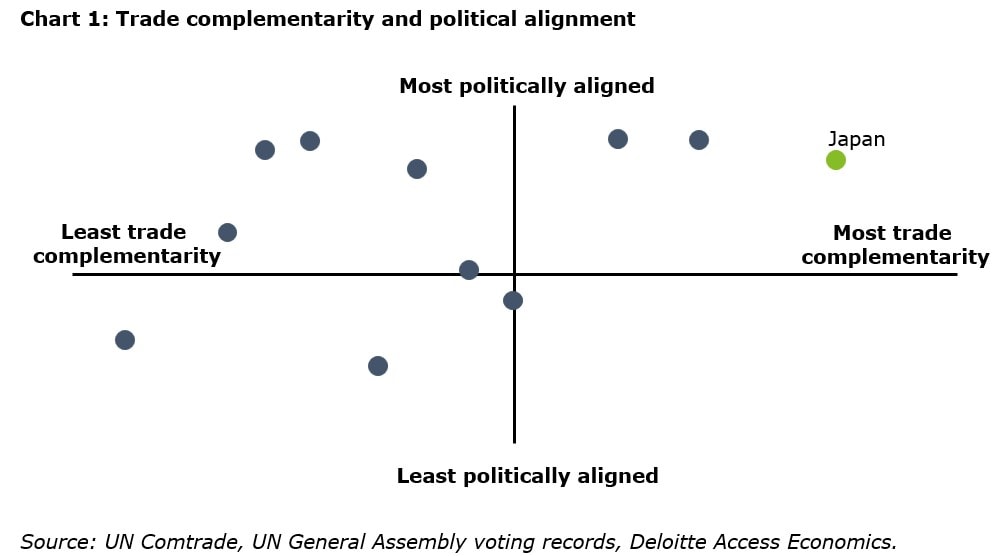
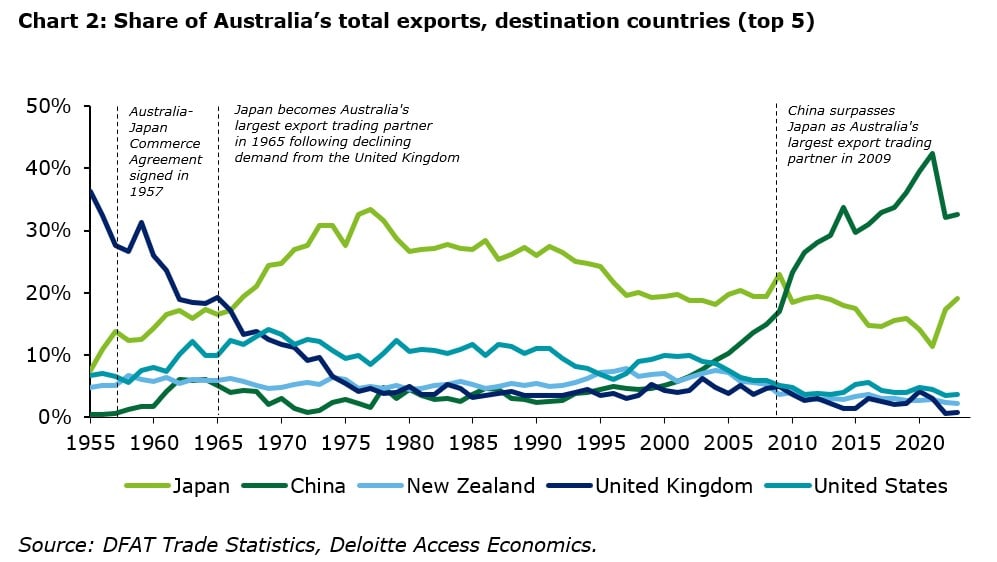
The stability of the Japan-Australia trade partnership also stands in stark contrast to the fractures in global trade. For more than four decades, Japan was Australia’s top destination for exports. Over the last two decades it has been Australia’s second largest export destination.
At present, two-thirds of Japan’s coal imports, half its iron ore imports, and more than a third of its liquefied natural gas imports come from Australia. This mutually beneficial trade in energy was enabled by early visionary Japanese investment in the Pilbara region in Western Australia, the Bowen Basin in Queensland, and in the North West Shelf Project, and by a solid commitment to long-term purchase contracts.
In 2026, Australia and Japan mark 50 years since signing the Basic Treaty of Friendship and Co-operation. This historic agreement, signed in 1976, was the first of its kind for Australia and laid the foundation for deep and lasting ties. The milestone, along with strong political mandates in both countries, heralds an opportune time to act towards building economic resilience. Deloitte identifies five areas for deeper collaboration. These are:
- Decarbonisation – Collaboration on hydrogen, ammonia, and critical minerals presents opportunities.
- Infrastructure – Japan’s expertise in infrastructure investment can benefit Australia’s clean energy expansion and housing supply bottlenecks.
- Defence and Security – The Mogami-class frigate deal between both countries presents significant upstream and downstream opportunities for closer collaboration. Space science, technology, and exploration is likely to be of increasing importance.
- Supply chain resilience – Though challenging, the current global risks make a solid case for Japan and Australia to collaborate on fortifying critical supply chains.
- People-to-people links – Boosting people-to-people links by enhancing student exchanges, tourist flows, and skilled migration can help the relationship reach its full potential in the future.
Deeper and broader collaboration between Japan and Australia also will help both countries to achieve the shared interests of stability, peace, and prosperity across the broader Indo-Pacific region.
This newsletter was distributed on 27th February 2026. For any questions/comments on this week's newsletter, please contact our authors:
This blog was co-authored by Lester Gunnion (Manager, Deloitte Access Economics).
Click on the links below to read our previous Weekly Economic Briefings:


