

Employee Earnings and Hours: a spotlight on young Australians
Despite facing higher unemployment and wealth inequality, the good news is that recent ABS data shows that the earnings of young Australians have been on the rise.
The Australian Bureau of Statistics’ Employee Earnings and Hours (EEH) is a biennial survey that provides detailed insights into employee earnings and paid hours. The latest release offers a snapshot of earnings in May 2025, with the results highlighting emerging trends among Australia’s young workers.
Young Australians are seeing the highest growth in full-time earnings
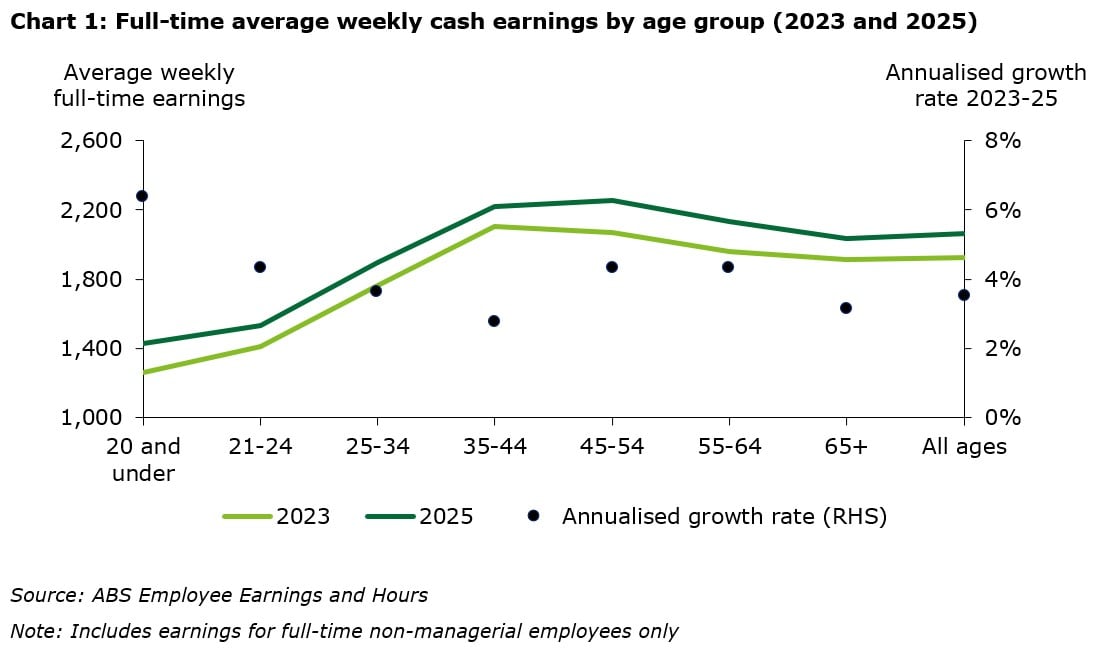
The EEH survey reports that average weekly cash earnings for all full-time workers grew at an annualised growth rate of 3.9% between 2023 and 2025. This outpaced trimmed mean inflation which grew at an annualised growth rate of 3.4% over that period , indicating a moderate level of real wage growth for workers.
Since 2023, average weekly cash earnings for full-time workers have increased for all age groups, however worker cohorts below the ages of 35 have experienced the strongest wage growth (between 3.7% to 6.4% per annum). This has been supported by persistently tight labour market conditions. Wages for younger workers have benefited from strong demand for workers in youth-intensive industries, such as health care and social assistance.
Top-earning industries are also shifting for young Australians
Across all age groups, earnings are growing fastest in traditionally high-growth industries, such as information, media and telecommunications, as well as industries experiencing critical skill shortages such as construction. However, for younger workers, wage growth is concentrated in a different set of industries.
- Mining: The industry has delivered some of the strongest wage growth for younger workers over the past two years, with average full-time wages growing by 8.1% and 6.6% per year for 21-24 year olds and 25-34 year olds respectively. Wage growth in the industry has been driven in part by strong wage growth outcomes for workers covered by enterprise agreements.
- Female-dominated industries: The Fair Work Commission’s Gender-Based Undervaluation Review has driven significant increases in award rates for traditionally female-dominated industries, such as health care and social assistance. Younger workers, who are more likely to be award reliant, have benefited significantly from these wage increases.
Australia’s youngest workers are tipping the gender pay balance
The Workplace Gender and Equality Agency regularly studies Australia’s Gender Pay Gap (GPG), revealing a gap of 21% in 2025. This measure captures average total remuneration across all age groups for all employees.
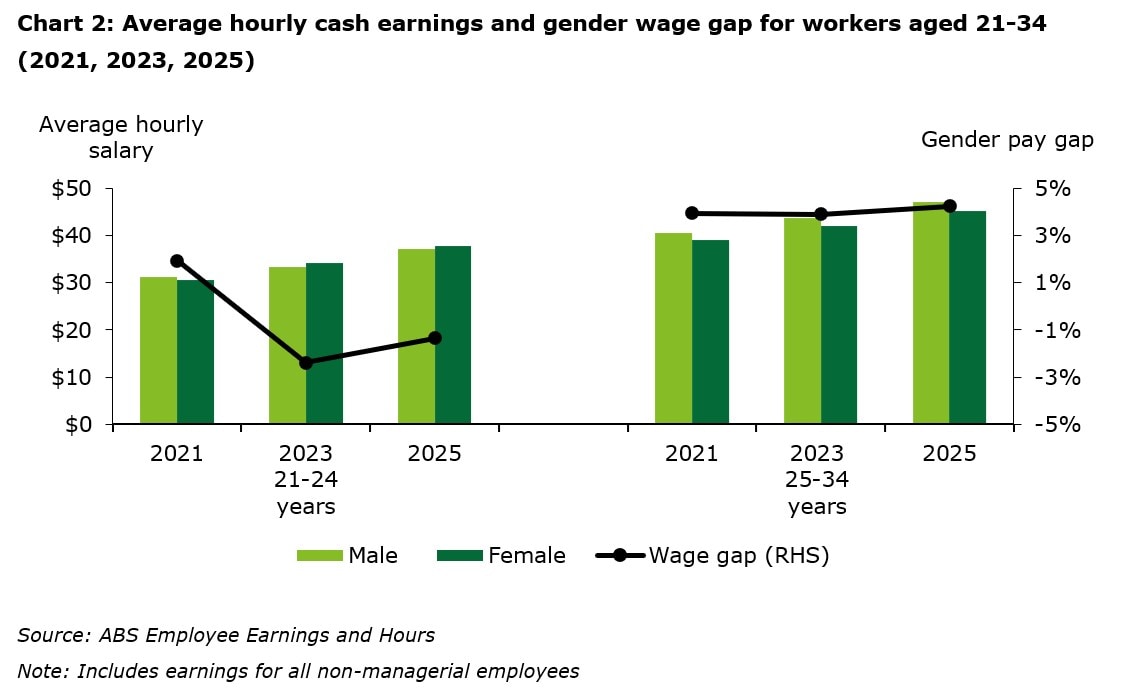
The EEH survey can also be used to estimate a GPG, capturing average hourly cash earnings for all non-managerial employees. This means that the measure removes the effect of differences in hours worked. Using this measure, Australia’s hourly GPG was estimated to sit at 8.4% in May 2025, down from 1.5 percentage points two years earlier.
The EEH also enables the GPG to be estimated for younger cohorts. The change in the gap is mixed for cohorts below 35 years. For 21-24 year-olds, the GPG has narrowed since 2021, with female workers now earning higher average hourly wages than men. For 25-34 year-olds, there has been little progress made on closing the GPG over the past four years.
This may be caused by the industry and occupation distribution of male and female workers. Younger women are typically concentrated in industries experiencing strong entry-level wage growth, such as health care and social assistance. For 25-34 year olds, men may dominate higher-paying industries like mining or senior roles, while women remain more likely to take career breaks due to caregiving responsibilities.
Ultimately, while it’s good news that Australia’s younger workers are earning higher wages, there is still progress to make in closing the gender pay gap.
This newsletter was distributed on 30th January 2026. For any questions/comments on this week's newsletter, please contact our authors:
This blog was co-authored by Chris Bates (Economist, Deloitte Access Economics) and Jess Weavis (Graduate Economist, Deloitte Access Economics).
Click on the links below to read our previous Weekly Economic Briefings:


