

Dire Straits: Consumer confidence falls to all-time low
Consumer confidence is at its lowest level since records began in 1973, driven by higher inflation and increasing economic uncertainty.
Subscribe to our Weekly Economic Briefing Newsletter
Yesterday’s consumer confidence figures from ANZ-Roy Morgan reflect a stark pessimism amongst Australians about the economic outlook. The weekly headline index fell 5.4 points to 63.1 – the lowest since records began in 1973.
The closure of the Strait of Hormuz and possibility of a prolonged conflict between the United States and Iran has put upwards pressure on global prices of oil and gas. This is already feeding through to domestic prices, with average petrol retail prices in Australia reaching $2.38 per litre this week, up from $1.71 last month according to the Australian Institute of Petroleum.
This not only impacts consumers at the pump, but also the cost of transporting goods, with flow-on impacts to industries such as manufacturing, construction and agriculture. This has added to the inflationary pressures already seen across the economy, contributing to the RBA’s decision to increase the cash rate again last Tuesday to 4.1%. With uncertainty surrounding when the conflict may cease, consumers are increasingly concerned about the implications for their finances and the wider economy.
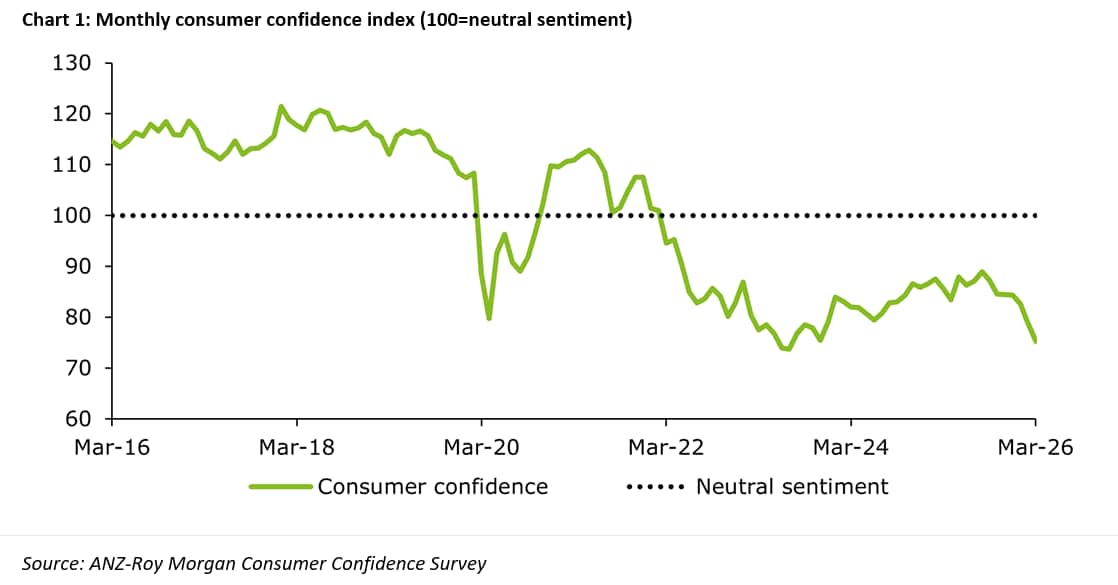
Components within the consumer confidence index — current and future financial conditions, current and future economic conditions, and time to buy a major household item — all declined sharply over the month. The ‘economic conditions next year’ sub-index saw the largest fall, now sitting at an index reading of 52.2 compared to 75.5 only a month ago. Meanwhile, ‘2-year ahead inflation expectations’ have increased to 6.9%, higher than during the peak of the cost-of-living crisis, underlining the impact of the Middle East conflict and higher energy prices on domestic price expectations.
Notably, the confidence spread between current and future economic conditions is now at only 20 points, in comparison to the prior low for consumer confidence during the COVID-19 pandemic of 47 points. This highlights that consumers’ pessimistic expectations for the economy are now anchored to a much longer time horizon than during previous periods of low confidence.
Other consumer sentiment surveys also point to deteriorating consumer sentiment driven by the Middle East conflict. While the Westpac-Melbourne Institute Consumer Sentiment Index showed a rise from 90.5 in February to 91.6 in March, it was conducted in the week that the Middle East conflict began (March 2nd to 6th). It was noted that respondents in the last three days of the survey period reported a sharp fall in sentiment, consistent with an index read of just 84. This suggests that subsequent surveys are likely to reflect a more pronounced decline in sentiment.
There are signs that business confidence is also starting to deteriorate. Recent business surveys by both Roy Morgan and NAB point to declining business confidence even before the start of the Middle East conflict. The Roy Morgan Business Confidence Survey reported that business confidence was down 8.8 points to 88.7 in February - the lowest level since September 2020. Meanwhile, the NAB Monthly Business Survey showed that business confidence unwound its gains over the prior two months, falling 4 points to -1 in February.
Together, these readings point to a large degree of pessimism across the broader economy. This pessimism won’t be aided by the fact that, with inflationary pressures on the rise, the RBA will consider further cash rate increases in the months ahead, despite these record low confidence readings.
This newsletter was distributed on 25th March 2026. For any questions/comments on this week's newsletter, please contact our authors:
This blog was co-authored by Ben Chamberlain (Graduate Economist, Deloitte Access Economics).
Click on the links below to read our previous Weekly Economic Briefings:


