
The next tech infrastructure advantage is intelligence orchestration
As AI spreads across cloud, edge, applications, and devices, organizations should consider a common framework for coordinating how it acts
Article
•
12-min read
•
21 August 2026
•
Deloitte Center for Integrated Research
Artificial intelligence is changing what enterprise technology infrastructure needs to be able to do. Simply supporting applications, data, and transactions might no longer be enough, as tech infrastructure increasingly has to coordinate models, agents, workloads, and decisions across the enterprise.
As AI becomes more agentic and the landscape expands to include dozens of frontier, open-source, and derivative models, enterprises may need to govern model selection, routing, and life-cycle management as an ongoing operational discipline rather than a one-time technical choice.1
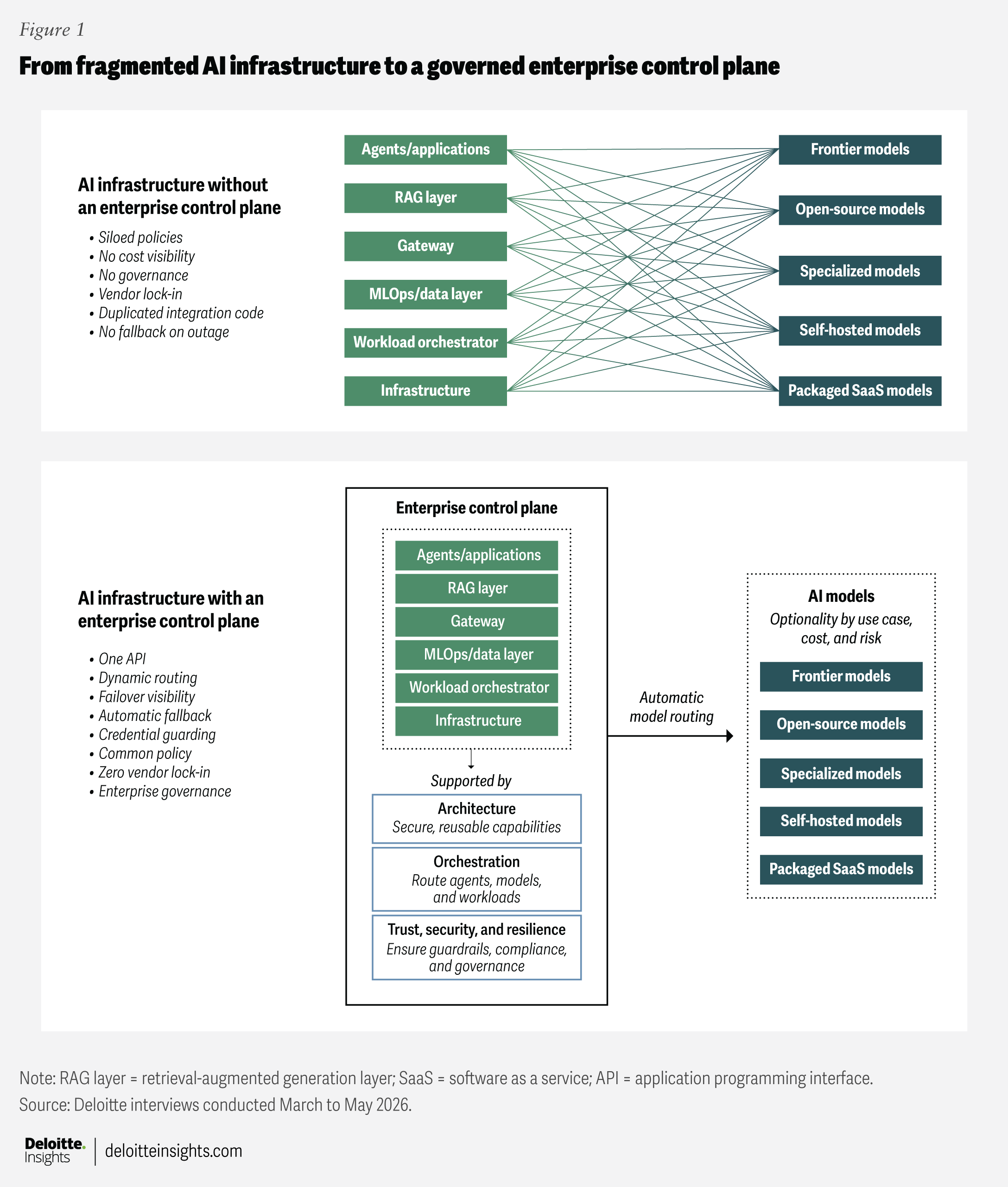
In this technology landscape, organizations could benefit from an enterprise control plane: a governed, intelligent layer that mediates decisions across systems, determining who can act, what data can be accessed, how workloads execute, and how AI agents operate within defined cost, latency, and regulatory boundaries.2
The benefit of having this coordinating layer is becoming more urgent as the next five years are likely to be shaped by two major uncertainties: whether platforms become more concentrated or federated, and whether interfaces remain human-mediated or agent-mediated. Each uncertainty may introduce entirely different organizing logic. Rather than optimizing for a single expected end state, enterprises will likely need adaptable infrastructure and governance.
Based on more than 30 expert interviews and foresight analysis, our research identifies three capabilities that could help C-suite leaders orchestrate intelligence across distributed systems:
- Architecture that exposes enterprise capabilities securely and flexibly
- Orchestration that coordinates models, agents, workloads, and decisions enterprisewide
- Cybersecurity resilience capabilities that establish identity, authority, integrity, and control across human and machine interactions
These capabilities can form the foundation of a control plane (figure 1). A control plane resembles the service-oriented architecture but is more event-driven: instead of simply exposing reusable services, it should coordinate workflows as conditions evolve.
One challenge for leaders over the next 12 to 24 months might be to begin architecting the controls that can support an AI-native enterprise.
Architecture for an agentic enterprise
Architecture is the foundation that makes a control plane possible. It determines whether enterprise capabilities can be exposed securely and flexibly across channels, agents, platforms, cloud, edge, and on-premises environments or whether they will remain trapped inside systems that are hard to access, govern, and orchestrate.
Many organizations are still modernizing toward a point-in-time target state. But an agentic enterprise needs a horizon architecture3 that provides a two- to five-year vision tied to business priorities and maturity gaps.
There’s no market consensus on what that target state looks like. Some expect hyperscale platforms to consolidate control, while others suggest that a defining constraint—sovereignty, latency, or resilience, for example—should be the organizing principle for the system. As one banking leader told us in an interview, “I believe we are heading toward a world where infrastructure becomes almost invisible to the end user. It’s going to be a handful of hyperscalers plus a few AI platform providers. They’re going to dominate the control plane.”4
While the precise future remains uncertain, the architectural requirements are becoming clearer. As customer discovery and enterprise interaction shift toward AI-mediated interfaces,5 organizations should consider rearchitecting for a resilient, agent-first future. Enterprise capabilities should be accessible through secure service layers; computation should be placed across cloud and edge; and identity and orchestration should be built in, not bolted on.
The following architectural principles can help build the foundation that the enterprise control plane may require.
Start with capabilities, not channels
Enterprises have traditionally designed architecture around the places they expect to interact with users, such as websites, mobile apps, call centers, and other channels. But as agents increasingly become the primary consumers of enterprise services, architecture might need to shift from channel-centric design to capability-centric design, organized around functions such as search, pricing, or identity verification.
This builds on the “headless architecture”6 principle, in which capabilities are decoupled from any fixed presentation so they can be used across interfaces and autonomous agents can act on them directly. When an agent, rather than a human, becomes the primary consumer of an application programming interface, the definition of good service design changes.
Capabilities should be exposed through secure, auditable, and standardized service layers. They should also be designed for failure, allowing critical functions to continue with downgraded capabilities if necessary.
Choose the architectural paradigm before the platform
As different architectural patterns for AI emerge, leaders should understand the design choices available to them and the trade-offs each may create. Our foresight research points to multiple plausible futures for technology infrastructure, ranging from a concentrated integrated platform ecosystem to an embodied edge. Each implies different choices for architectural orchestration.
Deloitte’s client experience suggests that leaders should first choose the architecture paradigm that best supports the business strategy, and only then select platforms. Some broad patterns may help leaders define the best choice:7
- Embedded: Agentic capabilities are woven into each layer, often through software as a service
- Dedicated orchestration: A purpose-built agentic tier that centralizes runtime and governance
- Hybrid or federated: A central control plane governs identity, audit, cost, and policy while execution remains distributed across domains
The specific choice will often depend on the organization’s strategy, maturity, and constraints. But the guiding principle remains the same: paradigm first, platform second.
Architect around outcomes and economics
Architecture should also move beyond the applications and systems through which work currently moves and reflect the business outcomes AI is expected to produce. An outcome-first architecture can help leaders determine how much of the process requires deterministic, rules-based execution, and where a more flexible, AI-driven approach is needed.8
One hyperscaler’s AI leader told us that “The real questions for AI system design are: What is the task? How do you define it? Who designs it? And is the workforce ready for that change?”
Cost-aware architecture shouldn’t be a runtime-only decision. It should pivot as financial decisions change, with parameters that can be adjusted. A centralized product management team with integrated workflows can help guide architectural decisions toward a more cost-aware architecture based on the business case.
Balance composability with sovereignty and control
Enterprises should decide how much of the stack should be modular and composable, and where nonnegotiable requirements like sovereignty, latency, or control should anchor the architecture.
The answer to these questions will likely vary. A tier-one US bank executive described a full-stack model where hyperscalers provide computing, managed services, AI models, and developer platforms. A defense technology executive shared a different picture: Sovereign AI may require a separate environment because data may need to remain pinned to a specific country.9
Neither approach is universally correct. The architectural choice should follow the organization’s operating requirements and risk profile. As one pharma company’s director of digital architecture notes: “Multi-cloud only makes sense where there is a strong operational or resilience rationale. Every movement of data creates additional cost and complexity, and engineering overhead.”10
Control boundaries should be embedded from the start, not retrofitted. At the same time, leaders should design for planned impermanence: replaceable components, explicit re-evaluation, and an architecture capable of change as the environment evolves.11
Orchestrating intelligence across the enterprise
Orchestration is the decision layer that determines who and what can act, in which environments, and under what constraints. It translates governed capabilities into coordinated action.
Agents need boundaries and rules governing access, authority, and autonomy, but many current efforts focus instead on connecting individual platforms and protocols. The greater source of operating leverage may be the ability to orchestrate intelligence across the enterprise.
A central component of that capability is model orchestration: an intelligent router that determines, in real time, which model should handle a task, where inferencing should occur, and what cost, latency, and regulatory constraints should govern the decision. As contexts shift, the control plane will need to coordinate a distributed network of agents while accounting for their dependencies and intent.
Agentic systems rely on context engineering, in which the context available to an agent shapes what it can decide and do. As open-source AI12 and thousands of autonomous or semi-autonomous agents are integrated into enterprise systems, humans won’t be able to anticipate every interaction or encode every possible path in advance. The chief of technology operations at an oil exploration company says, “Future systems will behave like cognitive entities, reasoning all the data, areas of planning, workflows—more like organizational agents rather than static tools.”13
Enterprises will likely need a combination of rules-based and behavioral controls across software, platforms, and infrastructure. These controls allow the control plane to coordinate intelligence from the interface, through the model layer, to the environment where work is executed.
Coordinate software and agent behavior
Laptop, mobile, robot, and drone interfaces all run on software. Physical AI systems may look different from traditional apps, but they require the same kind of end-to-end orchestration. The control plane needs a consistent way to determine what an agent is permitted to do across those environments. Enterprises can begin by tiering agent autonomy according to levels of authority and connecting those tiers to specific controls, monitoring, and rollback paths.14 This creates a governable system where agents operate within explicit boundaries that can change according to the task, context, and level of risk.
Enable platforms to coordinate dynamically
Many agent orchestration platforms today are hard-coded, with functions linked through rules, workflows, and controls baked into system architecture. That approach becomes a liability as agents act across tools, files, and open networks15 in ways engineers can’t fully anticipate.
Context engineering16 can help govern those interactions by shaping what agents know and what they can do. Emerging approaches, such as distributed dynamic dependency injection,17 also point toward systems that allow agents to discover and coordinate by capability rather than through fixed instruction—closer to how human organizations adapt than how traditional software is wired.
Model orchestration is another important platform capability. As the model mix changes, an intelligent routing layer can normalize interactions across different models and determine which one is best suited to a particular task. Model context protocol servers and similar standards can support interoperability without requiring enterprises to rewrite systems for every provider or model-tool combination. Practically speaking, this means one model could hand off a request to another model mid-workflow, without requiring bespoke connectors for every possible handoff.
Route workloads across infrastructure
Orchestration should also extend to the infrastructure layer. As AI systems become more interdependent, enterprises need a digital gateway that can route workloads dynamically based on cost, latency, security, and data sensitivity.
This is the strategic nervous system of the enterprise control plane, coordinating AI agents, models, policies, identity, governance, and workloads across the tech stack. The difference is a shift from raw computing to the ability to orchestrate intelligence securely and at scale.
That shift means moving from static hosting decisions to policy-based workload routing. Infrastructure should decide, in real time, where inference is best executed. A latency-sensitive workload in a manufacturing or hospital environment, for example, may need to run at the edge even when cloud execution is less expensive. The control plane applies the enterprise’s priorities and constraints to decision-making, and the result is a coordinated intelligence system in which software, platforms, and infrastructure can adapt together. Over time, this may extend beyond a single enterprise to an ecosystem in which multiple organizations need shared standards for trust, cost, compliance, and payments.
Building trust, security, and resilience into the control plane
Cybersecurity is the trust layer that makes the control plane safe to operate. It should verify the integrity of interactions, so architecture and orchestration can act with confidence rather than relying on assumed trust.
Many enterprises are still modernizing infrastructure based on yesterday’s security model. Risk management often remains a separate function,18 even as agentic systems create new attack surfaces through prompt injection, data poisoning, hallucinations, and adversarial attacks.19
The control plane therefore needs security and risk controls that operate continuously rather than only at the point of deployment. It should be able to identify both human and machine identities, enforce runtime guardrails, validate outputs and provenance, isolate compromised paths, and preserve auditable records of who acted, on whose authority, and under what conditions.
Without that foundation, organizations risk embedding weak trust boundaries and brittle controls into the systems they’re building for the future. The following priorities can help leaders establish the trust, security, and resilience the enterprise control plane requires.
Extend identity and authority beyond human users
An agentic enterprise should have a next-generation identity fabric that extends identity and access management to agents, devices, workloads, and services.20 That identity model should be anchored in cryptographic identity, hardware roots of trust, and explicit authority controls, so every actor is traceable, but none is implicitly trusted. Agents should not receive default entitlements or automatically inherit the full identity context of a human user. Access should be explicitly delegated, limited to the task, and bounded by time, data, authority, and risk.21
Authentication and authorization should also remain distinct. The control plane should attach verification to the moment of action and preserve the reasoning behind each request, making intent part of the verifiable record. One hyperscaler’s AI and data leader notes, “Right now, agents or bots are outside the authority authentication, and that’s where organizations are trying their best to put the guardrails in place.”22
Blockchain is one option for a sovereign identity control plane; centralized policy with distributed enforcement is another. A services registry or gateway can resolve identity, authority, and revocation consistently across a distributed control plane without forcing every action through a centralized choke point.
Modernize the cryptographic foundation
As quantum computing advances, some of today’s cryptography (specifically, asymmetric cryptography) will likely become easier to break, creating a significant risk. Adversaries could store encrypted data now and try to decode it later when quantum capabilities arrive. At the same time, always-on agentic systems are creating more vulnerable connections that are also at risk. For example, recent security testing23 showed that an advanced AI model was able to break a weakened version of a widely used encryption method, highlighting how AI could accelerate the speed and sophistication of online attacks.
This is beyond a technical issue for the security team. US technology standards bodies recommend that organizations begin moving toward quantum-resistant cryptography now to protect information technology systems from future attacks.24 A recent US executive order set a deadline for federal agencies and contractors to adopt quantum-resistant cryptography by 2030 to 2031.25
These updates to quantum-resistant technology should be treated as part of the build-now foundation for digital trust.26 Organizations should map where asymmetric encryption is currently used, focusing first on the most critical data and transactions, and upgrade their system in phases. The transition will likely require board oversight and cross-functional coordination, rather than implementing it as a narrow security team initiative.27
Establish AI-specific runtime controls
A perimeter-only security model28 is likely not sufficient for systems that act continuously across models, tools, networks, and edge locations. Enterprises need an adaptive security architecture that can respond dynamically and faster than an attacker.
This is the next evolution of zero trust (a security approach that assumes no trust by default and requires verification before access is granted). Runtime controls should separate traffic by use case, isolate higher-risk paths, and design the environment so that one compromised edge can be pulled without disrupting core web activity.
As enterprises route sensitive queries through multiple model providers, each handoff increases exposure. A model gateway can strengthen runtime control by enforcing consistent guardrails and logging every model interaction. One US bank executive says, “It’s moving from ‘Let’s build a better wall’ to ‘Let’s detect, decide, and respond faster than the attacker.’”
Govern AI output integrity and protect human judgment
Trust should extend beyond access and model performance to output integrity and the decisions that follow from it. The control plane should be able to verify provenance, continuously validate outputs, and detect behavioral anomalies across models and agents.29 This can help the control plane identify inaccurate, manipulated, or out-of-policy results before they influence a human decision30 or customer interaction. These controls can reduce the risk of automation bias, keep human judgment central where it matters most, and prevent bad outputs from being scaled across the enterprise.
From infrastructure to intelligence: Moves that matter
The challenge now goes beyond simply modernizing infrastructure and extends to building the architecture, orchestration, and trust foundations required to coordinate intelligence across a distributed system. Market advantage will likely come from a governed, intelligent system that decides which model runs which task and under what constraints, and that enforces security at every step with modernized permissions and cryptography. Investing now in a control plane that can adapt as technologies, interfaces, business needs, and risks evolve can help enterprises preserve the flexibility to respond to whatever comes next and avoid locking themselves into today’s platforms. The priority for the next 12 to 24 months should not be completing the transition to an agentic enterprise, but rather architecting a stronger foundation for competitive advantage.
Continue the conversation
Meet the industry leaders
Chris Thomas
Principal, Hybrid cloud infrastructure offering leader | Deloitte Consulting LLP
Deloitte United States
Oniel Cross
Principal | Government and public sector hybrid cloud infrastructure offering leader | Deloitte Consulting LLP
Deloitte United States
Diana Kearns-Manolatos
Senior manager, Subject matter specialist | Deloitte Services LP
Deloitte United States
by
Chris Thomas
Deloitte United States
Parth Patwari
Deloitte United States
Ram Ravi
Deloitte United States
Oniel Cross
Deloitte United States
Diana Kearns-Manolatos
Deloitte United States
Iram Parveen
Deloitte India
We would like to thank Deloitte’s subject matter experts—Adnan Amjad, Arpan Tiwari, Colin Soutar, Dhyan Raj, Duncan Stewart, Faruk Muratovic, Gopal Srinivasan, Jason Chmiel, Prakul Sharma, Scott Buccholz, Tim Davis, and Vinit Shah—for taking the time to speak with us and for sharing their valuable insights, which helped shape this research.
We are also grateful to the marketing and PR team—Andrew Ashenfelter, Anushka Bose, Christian Parsons, Cindy Chang, Jen Reid, Kaneez Fizza, Matt Merwrill, Nicole Bostock, Rachel Freya Rosenberg, Rebecca Lalez, Saurabh Rijhwani, Tafline Laylin, and Winslow Sowards—for their guidance and leadership in extending the impact of these insights.
Finally, we appreciate the support of our research partners at 10EQS for collating input from market leaders and providing data analysis and synthesis that were instrumental to this work.
Editorial (including production and copyediting): Corrie Commisso, Elisabeth Sullivan, Shyamili M, Pubali Dey, and Anu Augustine
Design: Molly Piersol and Sonya Vasilieff
Cover image by: Jim Slatton and Sonya Vasilieff
Knowledge services: Vanapalli Viswa Teja
Visit the Deloitte Center for Integrated Research
Access more insights on some of the most complex issues facing businesses today.