
Navigating the data dilemma: Can organizations build trust while using workforce data to improve performance?
Organizations may find themselves at odds with employees over surveillance as access to worker data grows. But when data is used to build trust and shared value, it can be a win-win.
Desktop body heat and motion sensors that track when an employee is at their desk. Location tracking via an employee’s company-issued smart phone. Software that logs keystrokes and web activity. Video monitoring. Artificial intelligence (AI)–driven performance coaching. Biometric identification systems.
With an array of data tools like these continuing to expand the amount of available work and workforce data, organizations could find themselves at odds with employees over what data gets collected and how that data gets used. The tension between companies’ desire for data-driven insights that could help improve performance and their employees’ concerns about surveillance and privacy is coming to the forefront as digital tracking of worker activity continues to increase. Between the beginning of the pandemic and late 2022, approximately one-third of medium and large companies surveyed had adopted new worker-monitoring tools.1
Seventy-eight percent of employers surveyed are using remote tools to monitor their employees.
There is a wealth of newly available and largely untapped data generated by the workforce in the course of their everyday work. This can help organizations improve their business with greater agility, innovation, and customer satisfaction—and at the same time, help workers be happier, safer, more employable with relevant skills, and enjoy a fairer, more inclusive experience at work, increasing trust between the two entities.
But organizations that rush to adopt these new tools risk alienating their workers and undermining the very productivity they are attempting to optimize.And perhaps more critically, they may miss out on opportunities to use work and workforce data to help create organizational impact beyond the individual worker and potentially build trust across the board.
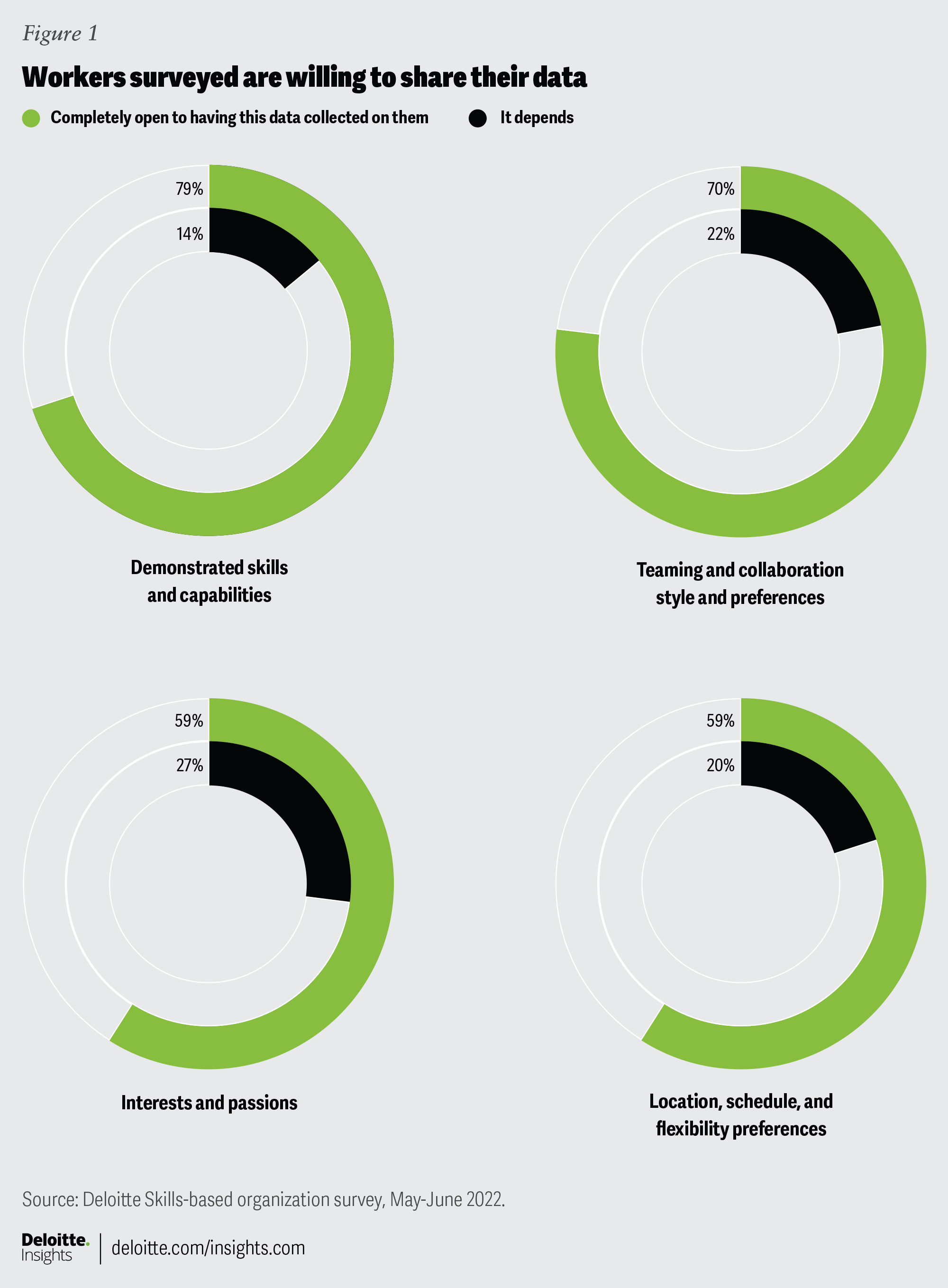
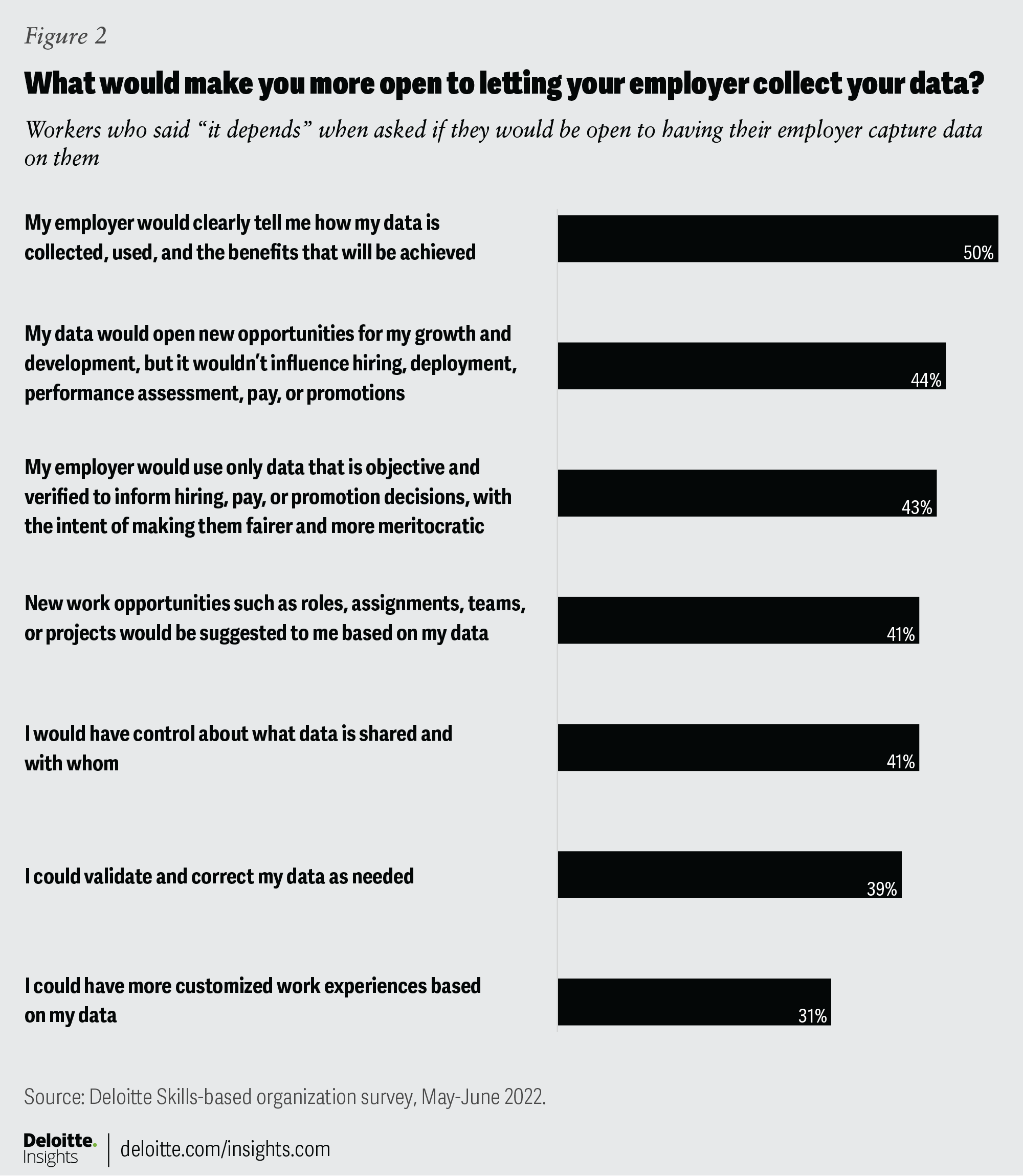
Instead of designing initiatives that collect and use worker data as a top-down exercise, consider involving workers from the start in cocreating the data collection practices themselves. This could include involving them in choosing what metrics will be useful and relevant in improving their experience at work and collaboratively deciding how the data can be used to inform action by AI or human judgement.
Who benefits from data collection? Start with your workers if you want to realize organizationwide impact.
When an organization uses the data they collect about their workforce to benefit everyone—individual workers, teams and groups, the organization, and society as a whole—they are creating shared value. The value created at each level can flow between them, reinforcing and amplifying the value created at other levels. By designing data-collection efforts with worker benefits in mind from the start, organizations can create new value for workers while realizing performance impacts across the organization (figure 3).
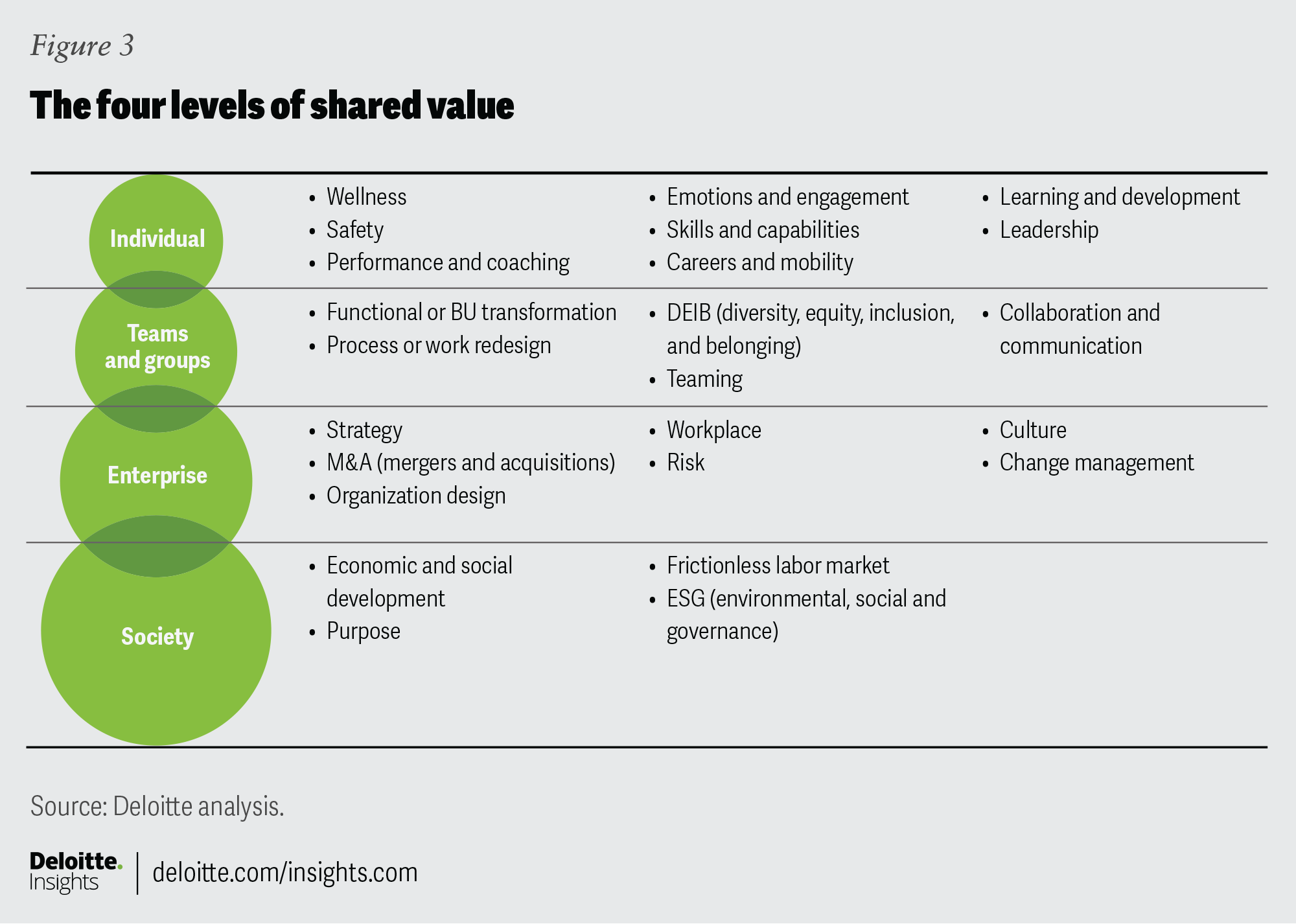
Consider worker happiness as an example. In addition to the individual benefits of being happier at work, such as improved wellness and performance, worker happiness could also improve teamwork and social encounters at the group level.10 It has been linked to improved engagement, productivity, and culture, and reduces attrition risks at the enterprise level.Japan-based technology firm Hitachi experimented with improving the happiness levels of its employees using wearables and an accompanying mobile app that offered employees suggestions for increasing feelings of happiness.11 During testing, the psychological capital of workers rose by 33% and profits increased by 10%. Sales per hour increased 34% at call centers, and retail sales increased by 15%, demonstrating how creating value at the employee level had far-reaching impacts on the business.12
How does an organization know what data it should be collecting and measuring to create value for its employees?When workers feel like their data is being used to judge them, and it leads to a potential dismissal or other penalty, distrust and other overall negative consequences can result. In general, data should be used to help workers learn, grow, make their jobs easier, find meaning or happiness at work, and realize their potential. Consider these opportunities for creating shared value when developing a data strategy with workers in mind.
The collection and use of workforce data as described herein may be subject to restrictions and/or conditions under applicable law. Before implementing any of these activities, consult with your legal and human resources advisors to understand and address any relevant legal and regulatory requirements, and brand/reputational and human resources related risks. Deloitte makes no expressed or implied representation whatsoever regarding the use or effectiveness of any workforce data collections tools or analyses discussed herein.
Provide opportunities to improve job performance
- When used with consent, employee-communication data and internal social-network analysis can help identify the activities, roles, actions, and workers that create the most value in your organization. Identify “rockstar” performers and use AI to help others learn from them.
- Use audio or video analytics (e.g., of a sales or call center employee, or a retail clerk) or work and collaboration data to identify behaviors that help drive results and use this data to create algorithmic coaching personalized to the employee. Personalized insights can be used to help improve skills such as communication, focus, self-awareness, and time management.
Automated coaching can help improve worker performance
Advances in real-time analytics can help organizations provide in-the-moment feedback to enable workers to improve their performance. Cogito is a provider of real-time data analytics for customer service centers. They analyze customer service calls for tone, word frequency, speaking pace and more to understand agent interactions with customers and look for signs of distress. The tool is designed to then suggest subtle adjustments—such as encouraging an agent to speak faster or slower—to help improve the quality of the call.13
In work environments like call centers that feel more anonymized, a model like Cogito’s can provide real-time coaching to individual workers about how to best communicate with customers, helping achieve organizationwide outcomes. Other technologies can analyze interactions with colleagues in a similar way, augmenting traditional approaches to mentorship and coaching by providing targeted, real-time feedback at scale.
Personalize learning and development
- Track how well people are learning through virtual reality/augmented reality (VR/AR) that captures reactions in real time or through neurotechnology wearables that use AI to deliver adaptive learning tailored to the individual.
- Use wearables like AR goggles to overlay learning on top of physical reality as people move (e.g., providing directions on how to place objects in fulfillment centers).
- Use information collected about what workers are working on to recommend relevant, just-in-time learning opportunities and suggest others with whom they may want to connect.
- Measure the impact of learning and track behavior change from social discussions, metaverse interactions, videos watched, articles read, use of performance support tools, and calls with mentors.
Build employee leadership skills
- Use internal social-network analysis to help identify the presence of cross-functional leadership teams and the strength and type of a leader’s connections across the enterprise.
- Identify inclusivity by measuring an employee’s degree of listening and communication. Use video and audio analytics to infer leadership qualities like a learning mindset.
- Help growing leaders stay focused on strategic priorities by using work applications to assess time spent on various activities, comparing it to their actual priorities and goals.
Improve career mobility
- Use data on transferable or adjacent skills, interests, and worker activity to suggest which skills employees can develop to be more marketable and employable as organizations evolve. This data can also be used to match them to new opportunities, projects, learning, or roles.
- Help employees identify valuable skills and adjacent skills from project and work histories (including volunteering, military service, or other lived experiences), digital work products (e.g., code or support tickets), work applications (e.g., project systems), and text analysis (e.g., performance feedback, collaboration sites, etc.)
- Analyze external data from job and project postings, social profiles, skilled vendor industry benchmarks, and more to predictively see future skills needed and skills migrations. Help workers connect these trends to their existing skill sets to suggest learning and work experiences that can help them prepare for the future.
Fluid skill development
14 These models have the potential to improve work processes for the organization and can provide development and growth opportunities for individuals (e.g., taking on new tasks based on their transferrable or adjacent skills). Deloitte research found that organizations that use skills data to make decisions about work and the workforce are not only more likely to have a reputation as a great place to grow and develop but are also more likely to innovate and respond to change with agility.15
Enhance employee wellness
- For those who opt in, wearables, sensors in the environment, or video analytics can track body movements to reveal patterns of physical wellness.
- Detect patterns of stress, attention, and other mental states when workers opt in to using wearable neurotechnologies like headphones and AR headsets designed to measure mental state. Transparently tracking the amount of time spent on work (including after hours) through work applications can help detect potential burnout. Audio, video, and wearable data can help identify other signs of stress, as well as opportunities to help workers improve mental health.
- Data from employee communications, voice and video data, location data, or embedded sensors in the workplace can reveal relationship patterns, interactions, and socializing styles. That data can then be used to make suggestions on improving interactions and relationships with others, as well as suggesting mentors, coaches, or other colleagues an individual worker might want to connect with. When implementing these kinds of efforts, it is critical to ensure that these tools are not biased against neurodiverse individuals and those with disabilities and are implemented with consent of workers.
Support safe working conditions
- Improve safety by connecting location or biometric data from wearables to smart devices in the physical environment that enable workspaces and processes toadapt to the worker (e.g., having robots or machinery move based on a worker’s movements).
- Useneurotechnology wearables to put cognitive ergonomics16 into practice, measuring the cognitive load of workers in physical work environments and detecting and alerting overload, which can produce safety hazards, errors, and health issues.
- Wearables, smart sensors on devices or in the environment, or video analytics can track and alert workers to improper physical movements (like posture) that could lead to injuries. Use this data to feed simulation tools that can predict injuries and lead to new safety policies.
Organizations that are able to successfully tap into work and workforce data without alienating their employees will likely be those seeking to create a new relationship with workers based on trust and prioritizing new value opportunities for their workforce. It is possible to reconcile worker-privacy concerns with organizational needs for data to improve performance—but it could require a transparent data strategy that gives workers ownership of their data and builds organizational trust. Combined with a focus on understanding what data shouldbe collected—not just what canbe collected—and linking those initiatives to specific organizational goals and outcomes, organizations will better be able to make the most of important sources of value that might otherwise be left on the table.
Learn more in our full report, Beyond productivity: The journey to the quantified organization.
BY
Steve Hatfield
Brad Kreit
Sue Cantrell
Cover image by: Alexis Werbeck