
Reinventing performance management processes won’t unlock human performance. Here’s what will.
While performance management processes enable business and talent decisions, engineering human performance takes more than a process
For years, headlines have made clear how much workers and their leaders dislike performance management, largely because they think it is ineffective. In fact, Gallup recently published survey results showing that only 2% of chief human resource officers (CHROs) think their performance management system works.1 Possibly even worse, people largely don’t trust it. In Deloitte’s 2025 Global Human Capital Trends survey (see “Methodology”), 61% of managers and 72% of workers could not say that they trust their organization’s performance management process.
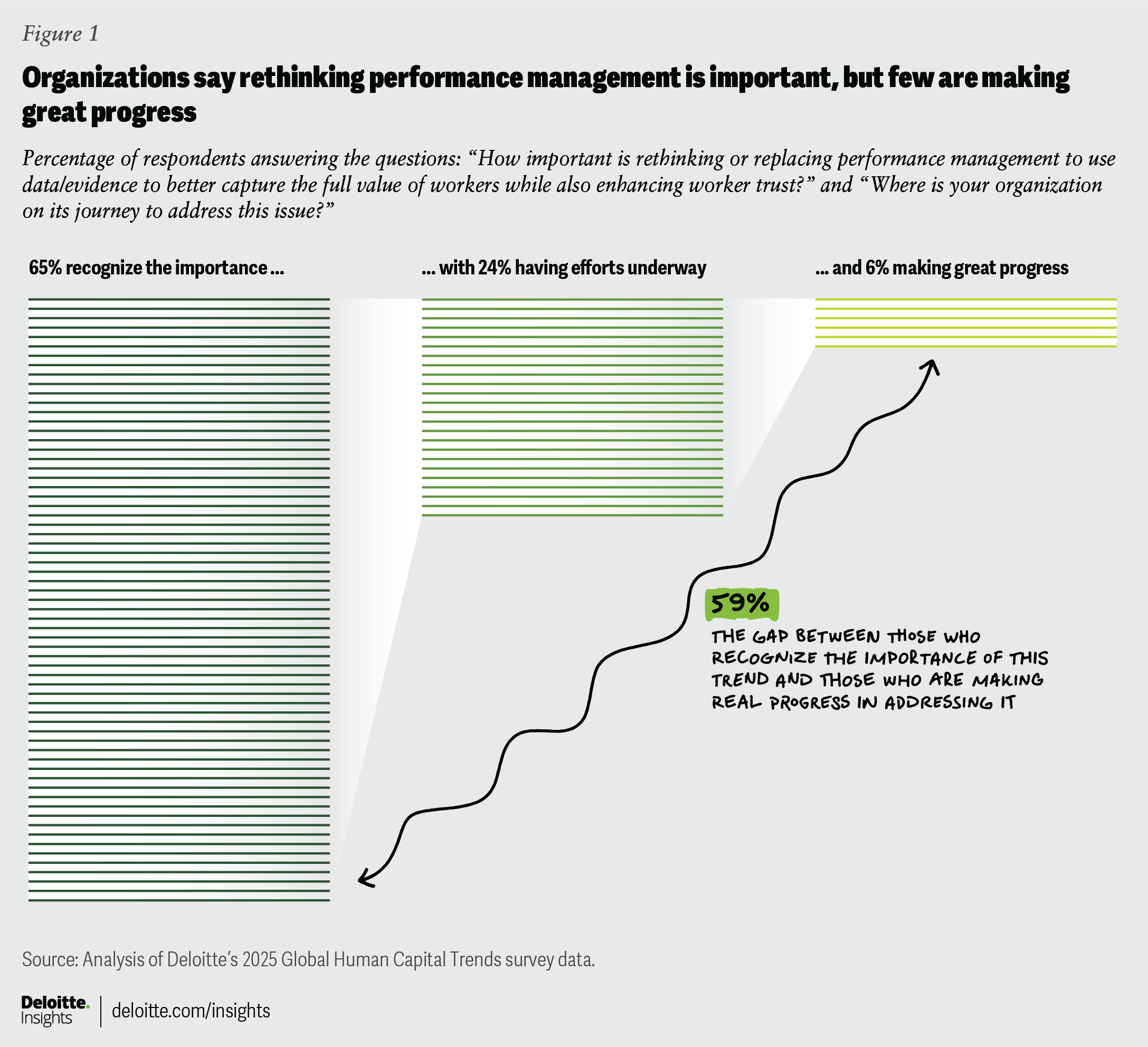
That lack of trust is a major concern. Fewer than one in three workers surveyed by Betterworks think performance reviews are “very fair and equitable.”2 Despite these pervasive concerns, just 6% of organizations surveyed said they’re doing great things using data and evidence to capture the value of workers’ performance while enhancing worker trust (figure 1).
Given that these negative views have persisted over decades of reinvention, the question arises: Do we even need performance management? The real issue is that we are expecting too much from the performance management process. We look at it as the primary driver of human performance. But the reality is that many things must happen to drive human and business outcomes—what we call human performance—in today’s complex world of work, more than a single human resources process can achieve. Relying on a single process to drive human performance is just unrealistic.
We will always need the ability to assess people’s performance to make people decisions such as rewards allocations. And we may not always love it. But if continually reinventing the process won’t solve our core need to unlock how people create business and human outcomes, we may need to move beyond process to a broader, more long-term effort to engineer human performance in the flow of everyday work.
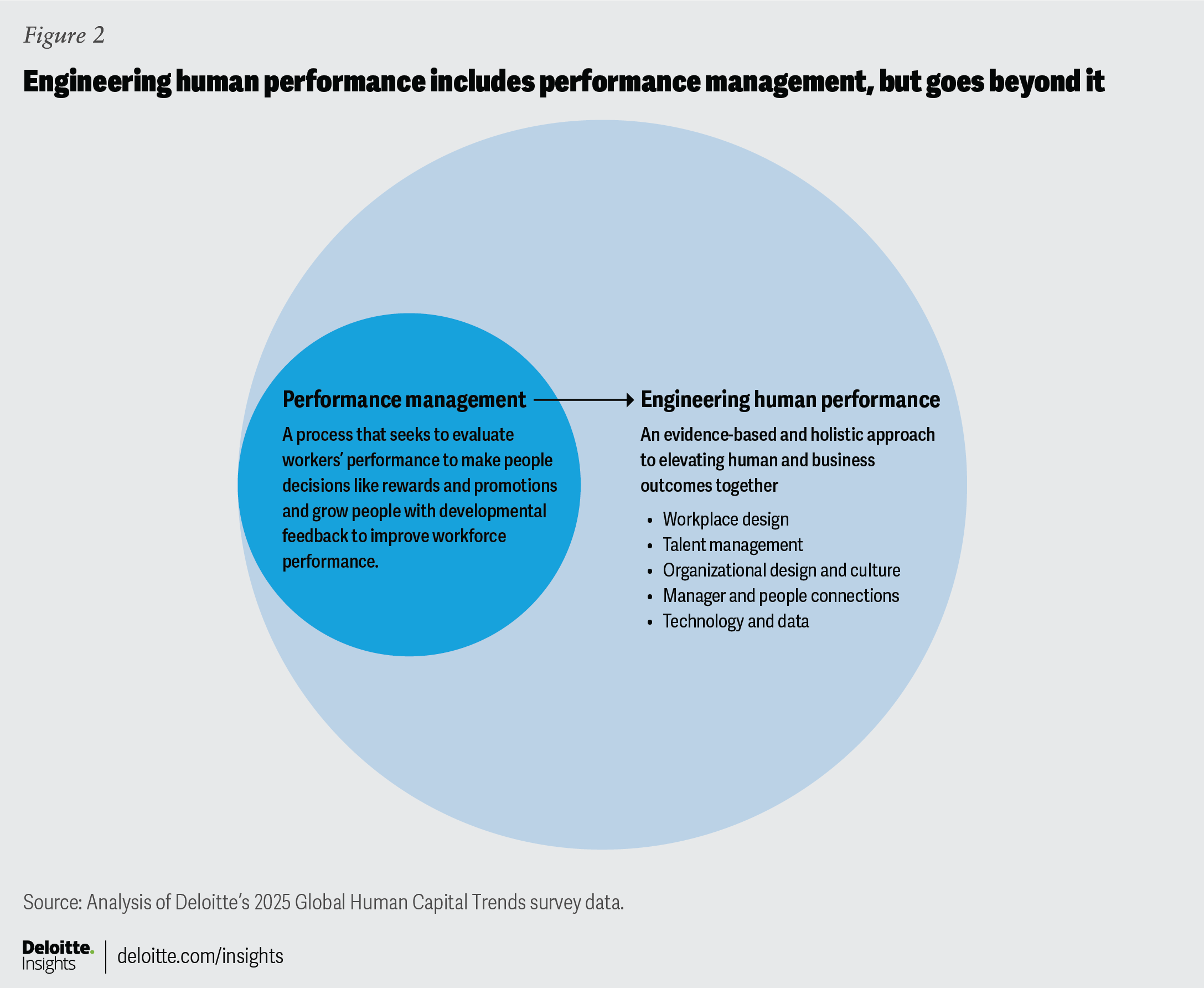
As we shared in last year’s Trends report, human performance will be the differentiating factor going forward, requiring a holistic approach that drives human outcomes and business outcomes together. To effectively drive human performance, we need to adopt additional practices and tools beyond performance management processes. We call this expanded approach engineering human performance (figure 2).
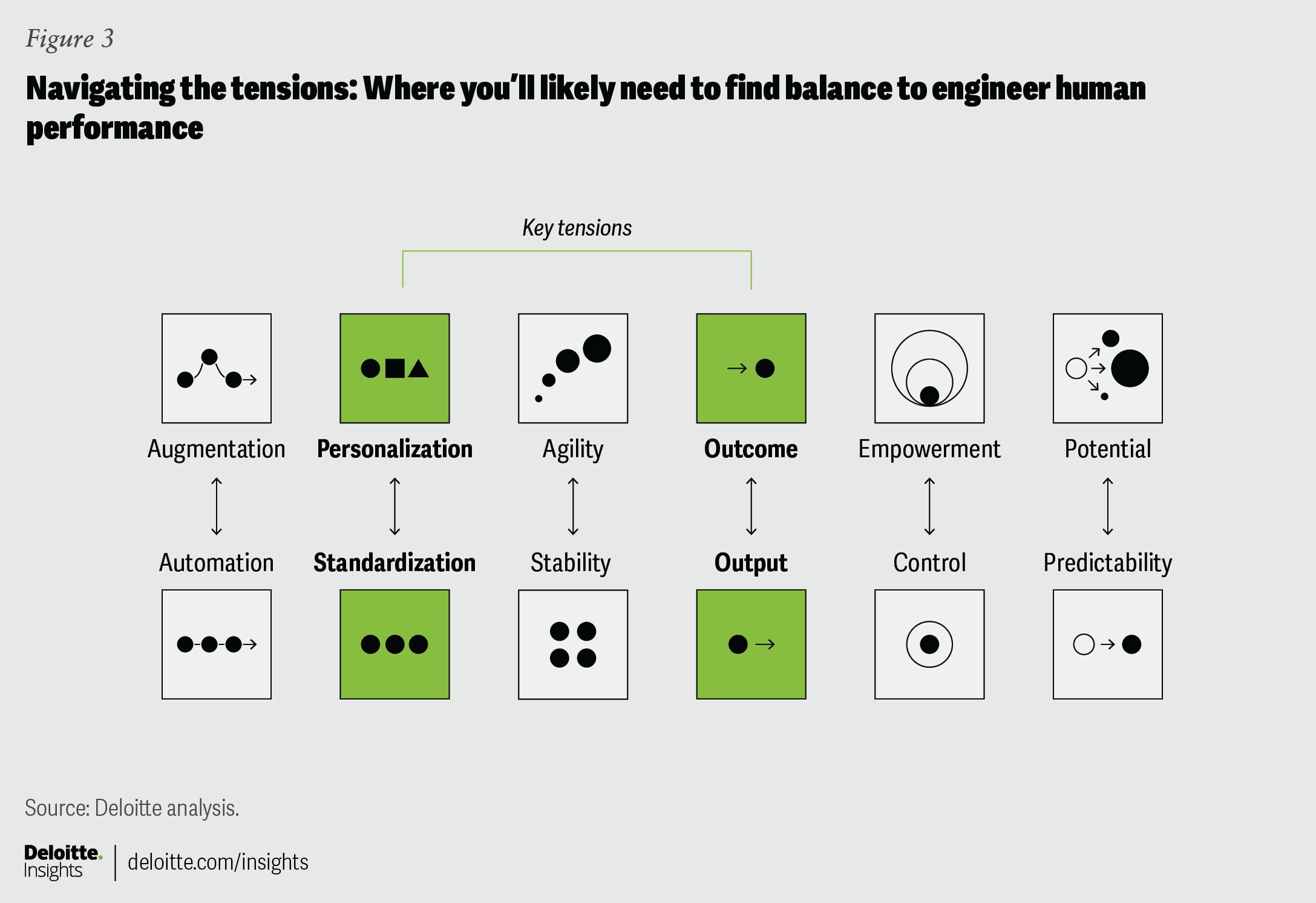
The human performance equation requires both business and human outcomes supporting each other. However, outdated organizational mindsets often prioritize business over human. Organizations are also torn between the short-term cost of a focus on managing compensation and low performance, and the long-term value of fostering future performance growth.
Organizational choices around these tensions (figure 3) affect how performance is measured (outputs versus outcomes), leader and worker autonomy in setting and completing goals (control versus empowerment), and how customized tools and approaches are (standardization versus personalization). Left unresolved, these tensions can undermine trust and cause problems in the strategy, design, and execution of efforts to engineer human performance.
Performance management: An unavoidable reality
Performance management by its very nature assesses performance. It’s inescapable: Organizations need some way to make defensible people decisions like allocating rewards and promoting people. Even if organizations try radical redesigns—like having peers assess one another’s performance or doing away with ratings altogether—the reality is that performance will still be assessed, with people compared to one another. This will inevitably breed strong emotions; when your bonus and promotion is dependent on your performance assessment, deeply personal feelings come into play. And no matter what variation you use, a few people may try to game the system. Although performance management also seeks to provide developmental feedback to help people learn and grow, this often lives in the shadow of assessment.
Consider a few statistics about the design and execution of performance management that are likely not surprising:
- It’s just not useful—for anyone. In many cases, organizations’ performance management processes, tools, and required practices are not having an impact. Two-thirds (64%) of workers see performance reviews as “a complete waste of time that doesn’t help them perform better,” according to Betterworks.3 In our 2025 survey, only a third of executives (32%) said their approach enabled timely, high-quality talent decisions about high and low performers.
- It’s time consuming and inefficient. The performance management process can often require a lot of time spent doing something neither workers nor their managers believe adds value. One Gallup report projected that performance management evaluations cost organizations as much as US$2.4 million to US$35 million a year in lost working hours.4 In addition, a strategy focused on activity and outputs leads to busywork by workers trying to prove their worth—which gets in the way of driving real results, including human and business outcomes.
- Managers don’t always provide clear, useful feedback tied to organizational goals. What managers say day-to-day often fails to align with what workers hear at the end of year. In Deloitte’s 2025 Global Human Capital Trends survey, only about a quarter (26%) of organizations report that their managers are very or extremely effective at enabling the performance of people on their teams. This dynamic may be related to managers’ analysis that they only spend 13% of their time developing people.
- Expectations and goals aren’t clearly communicated. Workers cannot perform if they do not know what they are aiming to achieve. In a Gallup survey, less than half of workers (47%) know what’s expected of them.5 Some of this disparity may be due to the challenge of accurately describing what someone is supposed to do in a period when we are moving from job-based to skills-based work.
- Individual worker outcomes are difficult to measure. In last year’s Global Human Capital Trends survey, we discussed organizations’ focus on easy-to-measure productivity numbers, rather than credible, objective metrics that assess the actual value of work—its quality, complexity, or level of innovation, for example. The challenge continues this year: 75% of organizations rated their ability to accurately evaluate the value created by individual workers as not very or not at all effective.
The common response to these challenges is to reinvent performance management entirely. But despite a flurry of reinventions over the past decade—including everything from eliminating ratings to skills-based rewards and performance management to peer-based evaluations—some people are still unhappy with the process.
We need to live with some kind of process. But we need to design it in a way that is cost and time effective, builds trust, and if possible, promotes personal growth and development. Organizations can make shifts today to address the tensions and challenges preventing better outcomes:
- Clearly define the purpose and scope of performance management. Deloitte research reveals that organizations with better business and organizational outcomes define their performance management strategy around purpose and mindset, rather than processes and models.6 Performance management can have a wide range of intents—including development and coaching of people. Organizations should be clear about which intents their performance management process wants to pursue and jettison the rest. For example, organizations may seek to decouple developmental conversations from assessments and instead embed them in the flow of work.
- Design to build trust and fairness. Starting from a foundation of cocreation increases the likelihood that workers and managers will buy in. That means not just asking their opinions but granting them influence and decision rights.7 Build trust by ensuring assessments are evidence-based, with a transparent, clearly communicated process for making assessments and people decisions. To help with this, people managers will need training in assessing performance using data and eliminating bias from their assessments. Organizations can also consider rewarding high-performing workers with compensation without penalizing lower-performing workers.8 At Rolls-Royce, top performers are now rewarded more significantly, while there is less impact on low performers, to encourage differentiation of outcomes and make direct and open feedback easier to give and receive.9
- Simplify the process and model it from the top. If performance management process can only play a limited role in improving human performance, it is best to simplify it so that it is as painless as possible for both workers and leaders. Tufan Erginbilgiç, CEO of Rolls-Royce Holdings plc, sent a rallying cry to the workforce in January 2023, and set out a significant transformation agenda to address the aerospace and defense company’s performance issues. He identified the performance management culture as a priority for transformation. As part of the systemic shift, personal performance management expectations were reset with processes simplified, clear goal setting aligned to a granular strategy, and more honest performance dialogue enabled by calibrated ratings. The impact of the changes is being felt across the whole organization and the leadership shadow has been a critical success factor.10
Use of technology can also be used to simplify performance management. GenAI, for example, can be used to identify feedback providers, aggregate and synthesize data sources (goals, self-reflections, feedback, etc.) for evaluation, and identify potential bias.
Engineering day-to-day human performance
Continually reinventing performance management won’t solve our core need: to truly unlock how people create business and human outcomes. To do this, we need to consider moving beyond the mere process of performance management to a broader and longer-term effort to engineer human performance in the flow of everyday work.
To engineer performance in the flow of everyday work, we need to build a human performance strategy—not just a performance management strategy. Setting a human performance North Star requires focus from the C-suite, with a clear desired state and a well-defined path forward. In the example above, the new Rolls-Royce CEO saw the potential for much greater results, sent out a clear call to action, and has continued from there.11
Once the human performance strategy is set, organizations can consider the following actions:
- Create a human performance culture and org design. The culture of an organization must support valuing business and human outcomes equally to achieve the multiplier effects of human performance. Consider the high-stakes world of Formula One, where McLaren Racing’s approach to performance extends beyond the track. Daniel Gallo, McLaren’s chief people and sustainability officer, emphasizes that the welfare of the team is as crucial as the performance of the car. McLaren has implemented various strategies to support the physical and mental well-being of its employees, including access to in-house doctors, psychologists, and fitness coaches for manufacturing staff and race teams alike. “We’re very clear that human performance equals car performance and that’s a fundamental competitive differentiator for us,” Gallo told Raconteur.12 Ultimately, Gallo’s methods show that investing in employee well-being and fostering a strong culture can lead to stronger business results. McLaren’s number-one finish in the 2024 Constructors’ Championship is a testament to the impact of these efforts.13
A fit-for-purpose organizational design can also help unlock human performance; Deloitte research shows that organizations with a mature organization design capability that continually senses the external environment and responds to changes through redesign are over five times more likely to manage change effectively than other organizations.14 Other Deloitte research shows that designing work and organizations for well-being can have a far greater impact on worker well-being than bolt-on well-being programs like gym memberships or new benefits.15
- Improve manager and people connections. Managers know they need the training and tools to provide clear, honest, actionable feedback that helps workers grow. Yet only 54% of managers say they’re confident coaching for career development, according to Betterworks.16 Standard Chartered, however, created a robust development and accreditation process for managers based on developing capabilities such as building trust and aligning teams, and a separate one devoted entirely to coaching. It also fostered a community of middle managers to learn from one another.17
At the same time, driving human performance means encouraging the formation of positive, fruitful connections among workers. Teams should be designed to support one another, versus assuming one strong employee can somehow lift the group. In one study, a professor at the Rotterdam School of Management divided students into groups to complete a management task, with a prize for the best team. However, each team included someone playing a negative role. One negative member reduced team effectiveness by 30% to 40%, regardless of other members’ talent and intelligence. Negative attitudes quickly spread, causing others to mimic the poor behavior.18
Establishing clear norms can enable smooth working relations. Team cultures should encourage taking risks and potentially failing, augmented by a practice of providing real-time feedback on both points of improvement and successes. Deloitte’s High-Impact Total Rewards research found that organizations with a strong culture of recognition report significantly stronger talent and business outcomes.19
- Redesign workforce practices for human and business outcomes. Workforce practices—from hiring to learning to rewards and recognition—can be crafted to unlock human performance. However, many organizations today design these practices instead to primarily manage employment; our Deloitte 2024 Human Capital Trends research on boundaryless HR found that only 20% of C-suite leaders strongly agree that their HR function and the workforce practices that it manages improve their workers’ performance.20 Instead, organizations should make workforce practices more relevant to individuals or workforce segments, create more human-centric practices co-designed with workers themselves, use technology in new and innovative ways, and design practices to meet customer and business needs.
Some organizations, however, are redesigning their workforce practices to elevate human and business outcomes. For example, Roche used technology to enhance its learning and development approach to rapidly equip its engineers and specialists with the latest and greatest skills required to build biotechnology for its customers. The new approach simplified the learning experience by allowing learners to simultaneously engage in both mandated and skill-based training, with clear pathways and checkpoints throughout the journey to support individual learning, while also ensuring competence. As a result, Roche established a straight line from learning to human performance with speed to competency reduced from 1.5 years to 90 days, which both reduced turnover and improved customer satisfaction.21
Another example is AXA, the global insurance provider. Recognizing that workers’ well-being is a significant driver of human performance, the organization launched a comprehensive “We Care” program for all employees worldwide. It extends far beyond traditional benefits offered by most organizations, such as the ability for workers to take paid leave to care for family members, a robust set of benefits to support those facing domestic violence, and a Healthy You program with support for both mental and physical well-being, including fertility treatment, menopause, in-person medical checkups, and more. Taeko Kawano, executive officer and chief human resources officer of AXA Holdings Japan, highlighted that “the program is designed not just for employees but also for their families, underscoring that holistic wellbeing—at work and in life—is crucial for employees to bring their whole selves to work and perform at their peak.” Since its launch, the organization has seen improvements in both business and human outcomes, including worker well-being and satisfaction.22
- Use technology and data to support how work gets done. Historically business technology mainly has served to automate or augment work; new technologies have the potential to enhance human capabilities in ways that achieve human performance and potentially reduce unnecessary work. Workers partnered with tech can perform more effectively than either people or technology could independently, and leaders and managers can better develop and interact with their workers using tech. Not only can greater performance be unlocked, but when workers and machines work in close proximity, it can be easier to distinguish and measure individual human performance.
A major US-based electronics company has seen this firsthand. At its repair facility, implementing robots to assist workers significantly improved the ability to observe individual employee productivity. Managers were able to collect data that allowed them to more easily distinguish between human and machine errors. Noting that the robots consistently made the same type of error, human errors became easier to identify and correct.23
In addition to using technology as a collaborator in the work, tech tools can use all the data they collect about work to provide real-time performance insights. New technologies like Gong.io and Salesforce Einstein Sales Coach Agent, for example, provide real-time feedback to sales professionals helping them adjust and learn real time in the flow of work. Likewise, smart factory technology can guide a worker to use safer or more efficient techniques, while a software pop-up could tell a worker that the data they are entering is outside of expected ranges and should be double-checked. The key is that workers receive feedback while they are working, enabling them to put the guidance into action immediately.
Technology can also help drive human outcomes in the flow of work—one of which is well-being. Examples abound showing how data-enabled tech can highlight safety concerns or identify toxic interactions so they can be addressed. Indeed, the job matching and hiring platform, used communication software to embed its inclusive language guide into the flow of work, providing inclusive language suggestions in real time and empowering workers to have better conversations with clients and each other.24
- Optimize workplace design. As many organizations have pulled their workforce back to the office, a long-held belief in the importance of serendipitous encounters has regained prominence. Google designed its Bayview campus in Silicon Valley to optimize these interactions. It also focused on mental and physical well-being, using biophilic design principles to add greenery, natural daylight, and outdoor views.26
Can workspace design help or hinder human performance? Data collected at a pharmaceuticals company indicated that a 10% increase in interactions between sales personnel and co-workers from other teams correlated with a 10% increase in sales performance. To facilitate these interactions, management transitioned from having one coffee machine for every six employees to one for every 120 and introduced a new large cafeteria accessible to everyone. As a result, sales increased by 20%, or US$200 million, within just one quarter, swiftly validating the capital investment in the redesign.27
Physical space design has an impact on non-office work environments as well. Optimizing the design of a manufacturing facility can boost productivity and efficiency while enhancing workforce well-being, safety, and comfort. By considering the sequence of operations and positioning workstations to minimize unnecessary movement, production speeds up and worker fatigue is reduced. One executive mentioned that before renovating a 50-year-old facility, the company surveyed employees to identify key workplace improvements. Improved lighting, including natural light, and better air quality topped the list, and the smart factory design was based on this feedback.28
Unlocking human performance for the future
Despite years of reinvention and retooling, performance management processes still fall short when they’re relied on as the sole means to unlock human performance. That’s because one, singular process isn’t big enough to encompass the many factors that drive both human and business outcomes. Rather, organizations need to expand beyond the performance management process if they want to meet the very goals that they hoped performance management would deliver. Engineering human performance includes a robust performance management process, but it goes beyond process to incorporate organizational culture and design, manager and people connections, tech and data, workforce practices, and workplace design.
The potential benefits are evident: Our research indicates that organizations that are very or extremely effective at enabling human performance are 2.08 times more likely to report positive financial results than the rest. When we get engineering human performance right, humans and organizations thrive.
BY
Julie Duda
Jason Flynn
Sue Cantrell
Nicole Scoble-Williams
Amy Sanford
The authors would like to thank Chelsea Pyrzenski (WalkMe), Joel Griffin (Rolls-Royce), Jon Pitts (IHP Analytics), and Taeko Kawano (AXA) for their contributions to this chapter.
In addition, we’d like to recognize the expertise of the following team members who contributed their insights and perspectives: Joan Goodwin, Elizabeth Faber, and Erica Bank.
Special thanks to Bridget Acosta for her involvement in the development of this chapter.
Cover image by: Alexis Werbeck and Sonya Vasilieff; Adobe Stock