
The 4:1 change management return most organizations are leaving on the table
70% of surveyed leaders say their latest transformation fell short of intended value. Traditional change approaches appear to be struggling to keep pace with continuous change.
Every year, organizations pour millions of dollars into large-scale transformations: digital transformations, AI implementations, restructurings, and operating model overhauls. Business leaders approve these investments, expecting them to pay off in stronger business performance. Yet 70% of the leaders in Deloitte’s latest change management research say their most recent transformation initiative failed to deliver its intended business value.
In collaboration with independent research firm Workplace Intelligence, Deloitte surveyed 1,000 change management leaders in C-suite or other executive leadership roles who were responsible for large-scale change initiatives at their organizations in the United States, United Kingdom, Australia, and Canada (see methodology).
An organization’s latest transformation initiative is also seldom the only change workers are facing. Eighty-three percent of surveyed leaders say they are running multiple large-scale initiatives concurrently. But 60% of change leaders say their company still treats change management as a project cost, not a business capability. The findings paint a picture of an increasingly familiar paradox: Organizations are launching multiple major changes at once, shifting from episodic change to continuous change, but their management and change systems haven’t kept pace.
While organizations might struggle with change adoption, efforts to improve it generally focus on refining existing approaches rather than reimagining change as a continuous, always-on business capability.
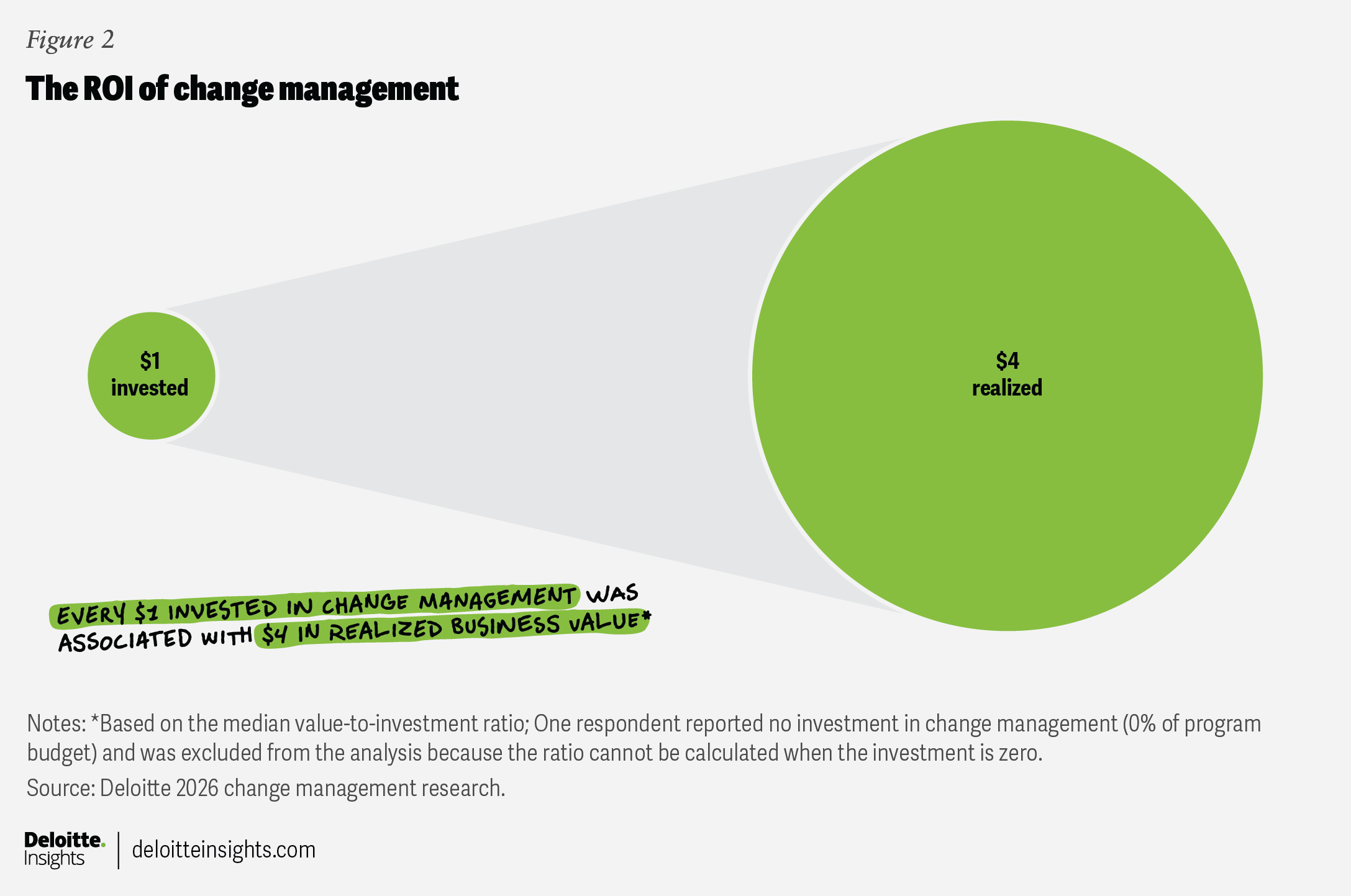
Our research suggests a reason to rethink that traditional approach. Across respondents, the median return on investment for change management was 4:1, meaning that every $1 invested in change management was associated with $4 in realized business value. Companies with the highest change management investments were also 1.7 times more likely to say employee adoption exceeded expectations.
Closing the gap between investment and results likely means treating change management as a durable, always-on capability, not a one-off project cost. And building that capability should start with understanding the combined demands of change initiatives on workers and giving leaders the authority to adjust the pace, scope, or sequence of change when those demands exceed what people can realistically absorb.
The capacity constraint no single initiative can see
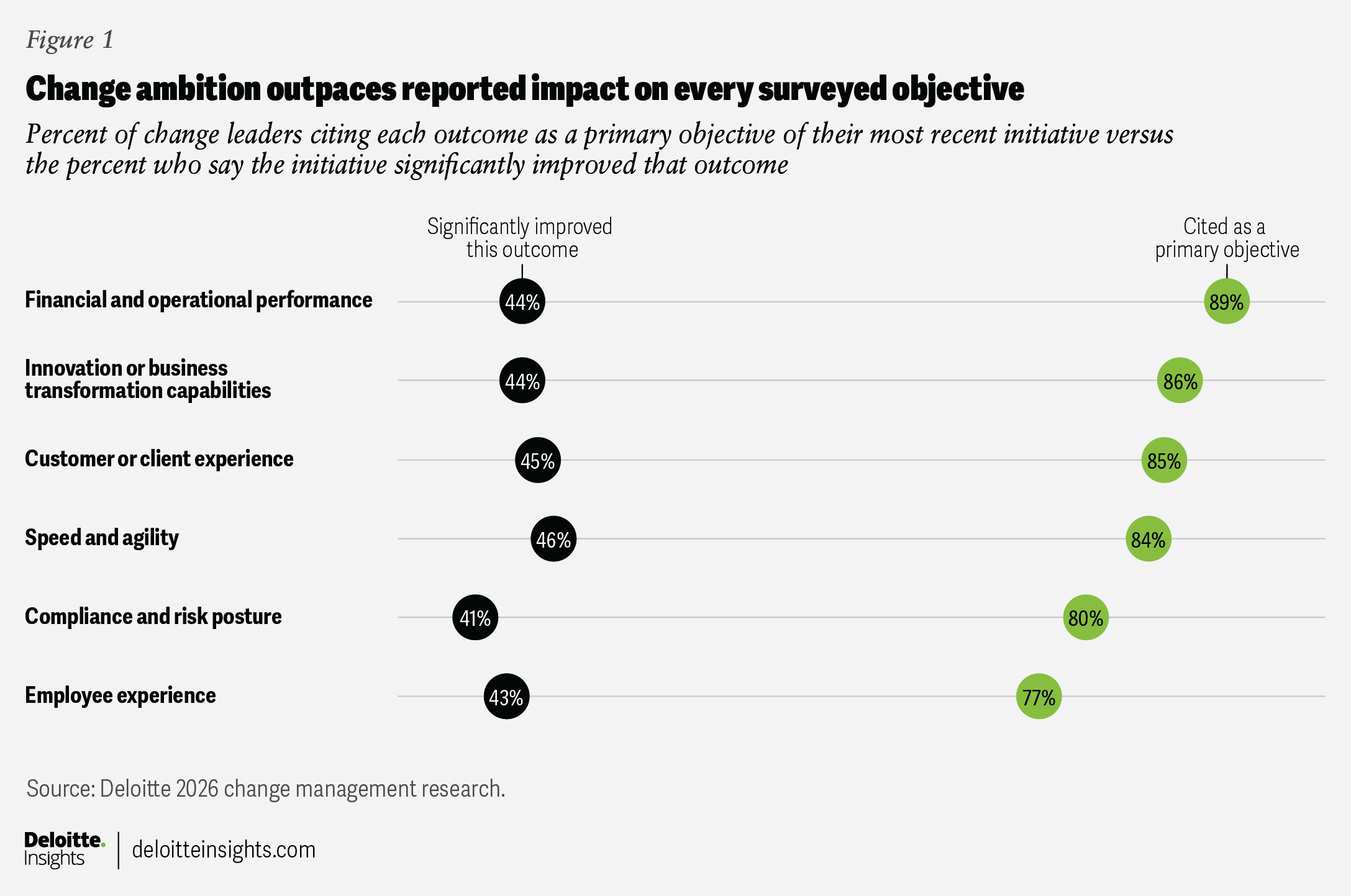
Change leaders are not lacking for objectives. The vast majority cite ambitious goals for their most recent initiative, yet fewer than half report significant improvement in the areas they sought to change (figure 1). More than half (55%) say their most recent initiative required a significant restart or major course correction.
One possible reason for the gap between ambition and results is that employees are being asked to carry out transformation without relief from their existing responsibilities. Eighty-four percent of surveyed change leaders say employees are expected to manage transformation-related tasks on top of their existing workload. That raises a question of change capacity—a read on whether the workforce absorbing a change initiative has any room left to take it on.
66% say employees left their company as a direct result of poorly managed change, which could equate to an average of $20.5 million in potential replacement costs.
The findings suggest that employees are feeling the strain. Sixty-nine percent of respondents say their most recent initiative increased employee workload and burnout; 66% say employees left their company as a direct result. The losses might include some of their strongest performers: Forty-five percent of surveyed leaders believe poorly managed change has contributed to the departure of high-performing employees. For the companies reporting such turnover, this could equate to an average of $20.5 million in potential replacement costs.1
The burden becomes more difficult to manage when initiatives overlap. Seventy-three percent of leaders report change fatigue among their employees. Respondents at companies that typically run four or more large-scale initiatives concurrently were 6.4 times more likely to report high change fatigue than those at companies running only one.
AI also makes the capacity question more immediate. Its implementation can reach across functions and alter how people do their jobs even while other change initiatives are underway. Sixty-one percent of surveyed leaders feel AI transformation is moving faster than their employees can handle. Nearly half (49%) believe AI implementation has contributed to employee burnout, unwanted turnover, and a loss of trust between employees and leadership. Among leaders overseeing AI implementation, estimated turnover-related costs climb to an average of $25.5 million. According to our research, AI initiatives tend to see higher percentages of departing employees than other types of change.
54% say that no one at their company has the authority to slow down or pause an initiative based on employee change capacity.
Yet few organizations appear to be equipped to act. Only 40% of respondents say their company proactively delays or redesigns initiatives based on change-fatigue risk. More than half (54%) say that no one at their company has the authority to slow down or pause an initiative based on employee change capacity, and 27% admit that there’s no formal process for tracking or managing total change load. A leader might be able to manage the demands of one change rollout without knowing what other teams are asking of the same employees—or having a way to resolve the collision.
From project cost to business capability
Managing the combined demands of change will likely require a new capability that extends beyond any one initiative. For leaders trying to build the case for investing in change management, the 4:1 return associated with change management investment in this research is a strong argument for funding it on an ongoing basis rather than establishing and winding it down with every new initiative (figure 2). A standing change capability should combine demand planning, assessments of culture and organizational readiness, and ongoing tracking of value.
Respondents also see a direct connection between change management and the value their initiatives deliver: Eighty-three percent of change leaders believe poor change management contributed to their latest initiative falling short of its intended business value. Their assessment reinforces the case for examining how change is funded and managed alongside how much is invested in the transformation itself.
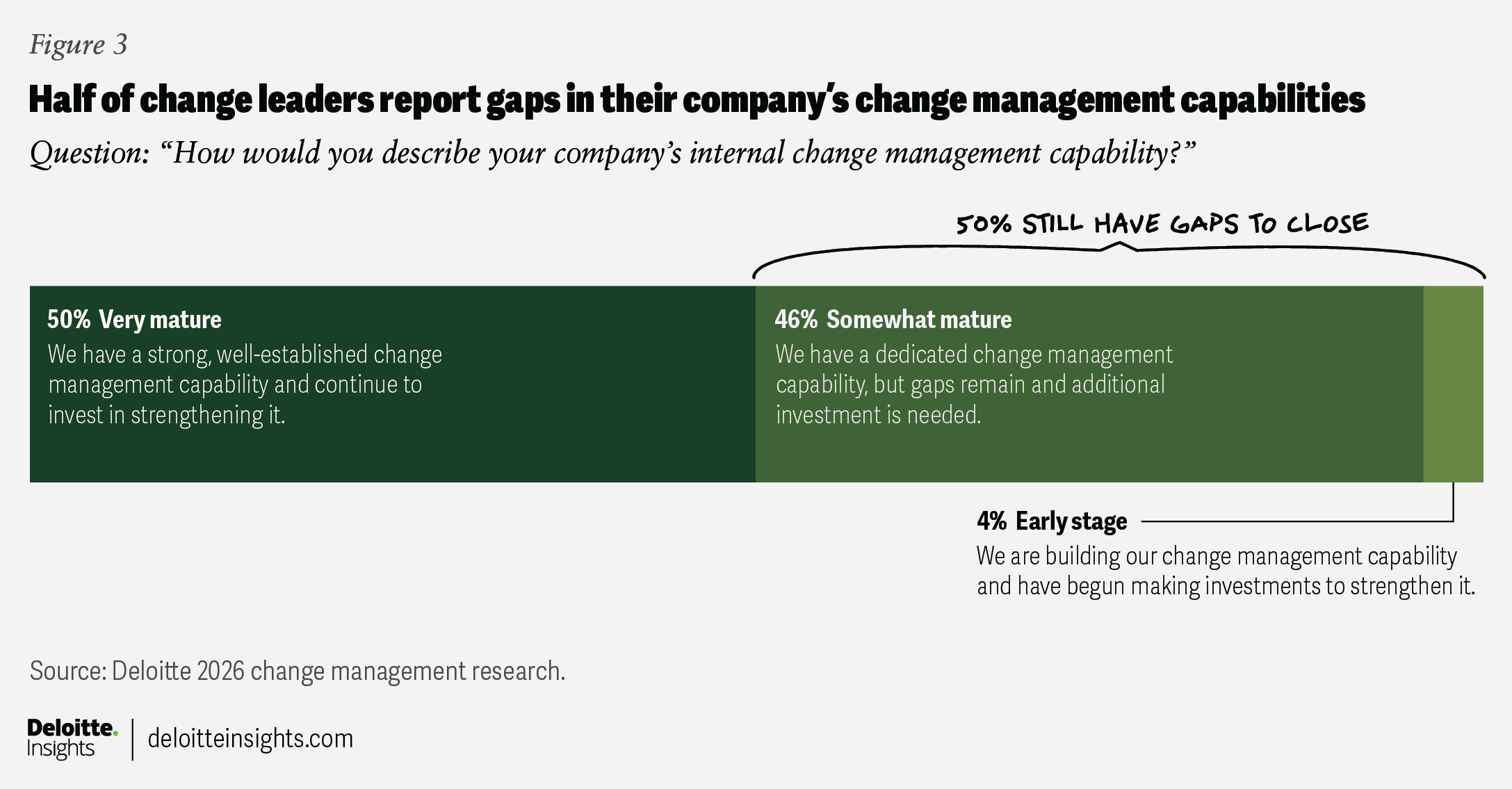
Beyond funding, leaders could also consider how a standing change capability would work. Only half of respondents describe their company’s internal change management capability as very mature (figure 3), and 53% say their company uses the same playbook for every change, regardless of type, scale, or audience.
A durable change capability should allow organizations to adapt their approach to each initiative while managing combined demands across the enterprise. What might this kind of capability look like in practice? Based on Deloitte’s experience guiding large-scale transformations, the following five priorities can help organizations build it.
1. Embed change support in everyday work
Around half of respondents (52%) say their company relies more on a traditional approach to change management, primarily using communications, training, and change champions. The other 48% lean more on an approach that embeds technology or AI-enabled support directly into the flow of work, such as real-time behavioral nudges, coaching, and micro-learning.
The traditional approach was built for episodic change: a defined initiative with a start and end date, supported by a campaign that wraps up when the rollout does. That playbook might be harder to sustain when organizations are running several initiatives at once, on an ongoing basis. Approaches that embed support into how people already work could help employees adapt without repeatedly stepping away from their day-to-day responsibilities. Such support is likely better suited to the pace and volume of overlapping change, yet fewer than half of respondents say their organization relies on this approach.
2. Manage change capacity across the enterprise
Workforce readiness for one initiative only tells part of the story. Without visibility into the combined demands of change, it’s difficult for any single leader to know whether their initiative is landing on a workforce that has the capacity to take it on or one already stretched across several other transformations.
Technology can help by creating a single view of planned and ongoing initiatives, mapping each change to the teams and capabilities it affects. Dashboards can highlight cumulative change load, flag capacity risks, and support scenario planning when leaders adjust timing, scope, or sequence. With timely data and clear ownership, leaders can move from identifying overload to actively managing it, establishing who has the authority to resolve competing demands and authorize adjustments to timing, scope, or sequence.
3. Measure the human cost alongside the business case
Around one in five surveyed organizations doesn’t formally measure the human impact of its initiatives or assess workforce readiness before launching a new initiative. Leaders could build human-impact measures into initiatives from the start and track them throughout, treating workload, readiness, and fatigue with the same rigor as financial measures. That visibility can inform decisions to slow a rollout, add support, or adjust scope.
The measurement gap is also evident in AI rollouts. Forty-three percent of change leaders say they don’t know how AI is actually affecting their employees. Assessing that impact throughout implementation could help leaders recognize emerging problems and adjust their approach.
4. Connect adoption measures to business outcomes
The majority of surveyed change leaders (61%) say their company primarily measures the success of change management efforts through business outcomes such as cost savings, productivity gains, or revenue growth. The remaining 39% mainly use activity or adoption metrics, such as training completion, process compliance, or stakeholder engagement scores.
Training completion and engagement scores can show that people participated, but they don’t establish whether employees have adapted how they work. Even compliance with a new process might reveal little about whether it’s helping people make better decisions or deliver better results.
A new AI implementation, for example, could assess not only tool usage data but also how employees are changing their workflows and whether those changes are improving the outcomes that matter, such as quality, customer satisfaction, or speed. If participation is high but outcomes remain unchanged, the approach might need to be revisited.
Companies where leaders model change are twice as likely to report strong ROI and employee adoption that exceeded expectations.
5. Equip leaders to model the behaviors they’re asking for
One-third of respondents say their company’s leaders don't consistently model the behaviors and changes they ask employees to adopt. At companies where leaders model change, respondents were at least twice as likely to report a strong positive ROI for their most recent initiative and employee adoption that exceeded expectations.
Leaders might also need support themselves. Thirty-two percent of respondents believe leaders and managers would benefit from additional training, skills, tools, or support to guide employees through change. Providing that support could help leaders demonstrate the changes they sponsor and guide employees as new ways of working take hold.
Build the capacity to make change stick
The findings suggest that many organizations are still trying to manage a continuous, accelerating rate of change with tools and structures built for a slower, more linear era. The initiatives falling short of their intended value, the widespread burnout and turnover, and the AI investments still searching for their return point to reasons to reconsider how change is managed.
Recognizing that mismatch could help leaders make more deliberate choices about how they fund, sequence, and support transformation. And treating change management as a durable capability could give them a clearer view of what employees can absorb and a way to adjust when the demands become too great. The organizations that recognize this mismatch and invest accordingly might be better positioned to turn their next initiative into one that delivers.
Continue the conversation
Meet the industry leaders
Allyson Dake
BY
Allyson Dake
Chloe Domergue
Jenny Ahn
Sue Cantrell
Editorial (including production and copyediting): Corrie Commisso, Shyamili M, Anu Augustine, and Pubali Dey
Design: Natalie Pfaff and Manya Kuzemchenko
Cover image by: Manya Kuzemchenko
Knowledge services: Rohan Singh