
Optimizing, not abandoning: How streamers can earn a core spot in consumers’ entertainment portfolios
As consumers actively manage their entertainment portfolios and balance their budgets, streaming providers should focus on durability
Subscription fatigue and churn have long dominated the streaming conversation.1 Yet, consumers’ appetite for streaming video on demand (SVOD) has remained stable in recent years. Most US households have at least one paid SVOD service, and the average number of services per subscribing household has held steady, according to Deloitte’s fall 2026 Digital Media Trends survey of 3,518 US consumers.2
But there’s more to the story beneath that surface. As more entertainment activities and services compete for their time, attention, and money, some consumers are actively managing their SVOD subscriptions like a portfolio—holding onto the content they value while looking to reduce costs by tactically swapping services in and out, and exploring bundles, promotions, and ad-supported tiers.
This fast-moving, competitive landscape makes durability—the ability to earn a lasting spot in the increasingly elastic household entertainment mix—an important competitive metric for streamers. Those that combine attractive pricing, high-engagement content, and flexible subscription options may be well positioned to earn that spot.
Streaming remains stable, but consumers are frustrated with rising costs
Streaming is a mainstay in US households. More than 90% of consumers say their household pays for at least one SVOD service, and subscribing households average four services, according to the data. But the cost of staying subscribed continues to rise. Subscribing households surveyed report spending an average of $76 per month across services, a 9% year-over-year increase.3
That increase reflects a pattern that may be familiar: periodic emails informing subscribers that their monthly bill is set to increase—again.4 Many leading SVOD services have increased their monthly subscription fees at least once in the previous 12 months, with an average monthly price increase of $1.20.5
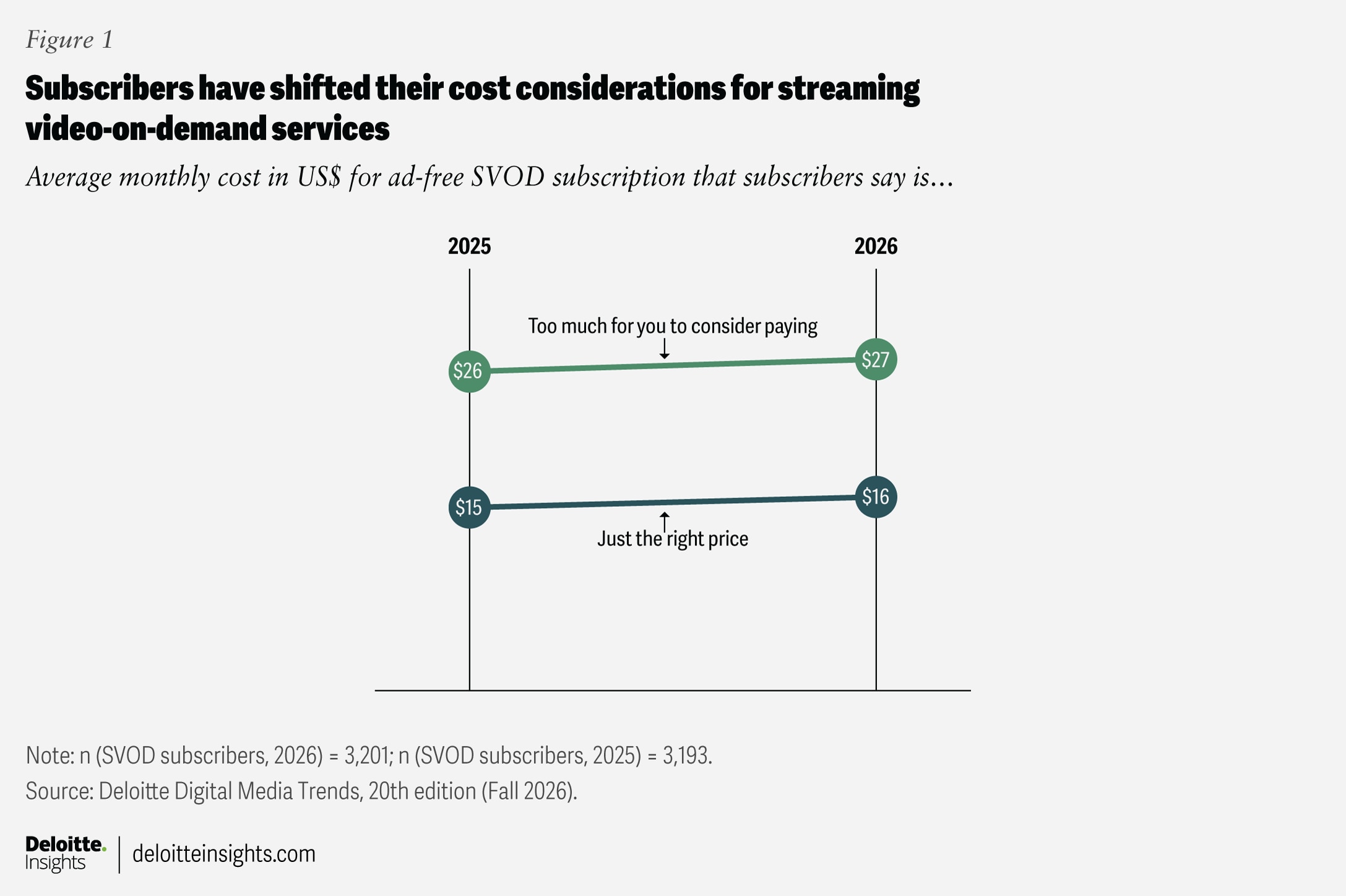
Consumer cost expectations have shifted accordingly. The average “just right” and “too much to consider paying” price for an ad-free SVOD service both rose marginally over the past year for subscribers (figure 1).
Despite showing some price flexibility, 45% of consumers say they pay too much for the streaming services they use, and about 50% say they are actively looking for ways to lower their monthly streaming costs.
45% of consumers say they pay too much for their streaming services, and around 50% are looking for ways to lower their monthly streaming costs
But instead of simply reducing the number of subscriptions they carry, some are swapping, switching, and adjusting their subscriptions based on the best combination of cost and value for their needs.
Consumers are actively managing and optimizing their streaming lineups
When it comes to managing costs, consumers use different strategies. Some may cancel services with no intention of returning. Others may do so with the intention of resubscribing when new content becomes available. Another type of subscriber might move between lower-priced and premium tiers or look for bundles that could offer more value while lowering their bill. Some who are especially savvy and cost-conscious might do all of the above.
Metrics in Deloitte’s Digital Media Trends data point to evidence of these cost-saving strategies. Churn—the percentage of consumers who have canceled at least one SVOD service in the last six months—has been inching higher, reaching 43%, up from 39% one year ago. Gen Zs and millennials remain the most likely to churn through SVOD services, when compared to other generations. Churn and return (the percentage who cancel and then resubscribe to the same service within six months) rose to 27% from 23% the prior year (figure 2).
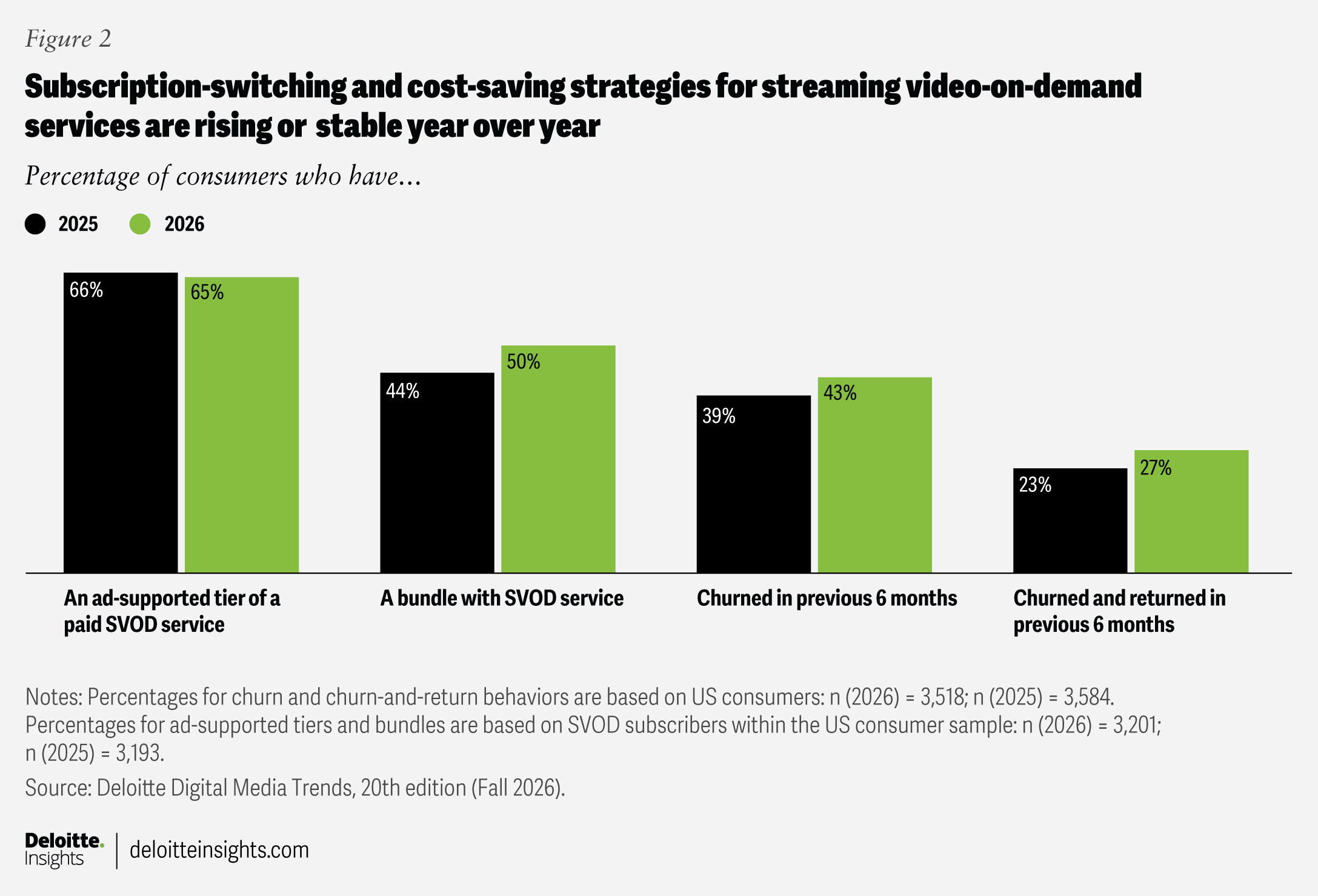
Consumers also continue to look to cheaper, ad-supported tiers and bundles to manage their entertainment portfolios. Many subscribers (65%) already have an ad-supported tier of a paid SVOD service, a cost-saving trend that has remained stable year over year.
At the same time, half of SVOD subscribers report having at least one bundle (up from 44% in 2025), with the most commonly bundled services being cable or satellite TV, live-streaming TV, another SVOD service, home internet, and wireless mobile plans or devices. Younger subscribers like Gen Zs and millennials, however, are more likely to have SVOD services bundled with lifestyle-focused, cross-category services such as music, gaming, fitness, shopping, or ride-hailing services, suggesting they may use bundles to get more value from multiple services, not just streaming video.
Streamers compete within diverse entertainment portfolios
The challenge for streaming providers is not limited to consumers’ willingness to pay for or subscribe to SVOD. It’s increasingly about winning the competition for attention—and subscription dollars—amid so many other entertainment choices.
The average consumer pays for a number, and variety, of media and entertainment services. Nearly 70% of consumers say their household maintains access to live TV content via either a live-streaming TV service or a cable or satellite TV subscription, up from 65% a year ago. More than 6 in 10 (62%) have a paid streaming music service in the home, and subscribing households average two music services. Another third (36%) of US households pay for a gaming service; again, subscribing households have an average of two services.
In addition to making trade-offs with their money, consumers are also deciding how to allocate their time. Across generations, consumers say they spend an average of six hours daily on media and entertainment activities, with 25% of that time spent watching TV shows or movies on streaming video services. The rest is spread across a range of other entertainment activities, like watching cable or live TV, using social media or watching user-generated content, listening to music or podcasts, and gaming.
To help earn a durable spot, a service should be worth the money and the time
As consumers manage crowded and costly entertainment portfolios, streaming providers should aim to provide enough value to justify a place in the portfolio, rather than becoming one that consumers swap out or cancel.
HundredX consumer data for the major SVOD services shows that price, value, and subscription options are the biggest differentiators between loyal subscribers and those considering a switch. Net favorability gaps are 37 percentage points for price and 29 points each for value and subscription options.6
These gaps suggest that consumers are reviewing the services in their streaming portfolio for appropriate and aligned pricing, sufficient value, and subscription options and flexibility that fit their needs.
Engagement may also be another indicator of service-switch risk. HundredX consumer data across leading streaming services finds that 26% of consumers who watch a particular service for only one hour or less per week say they are considering (or may consider) switching away from that service. For comparison, only 18% to 20% of consumers who spend more than an hour per week watching a service said they’d consider switching away (figure 3).7 The lightest users could represent a more vulnerable group. When a service occupies very little of a consumer’s entertainment time, its place in their subscription portfolio may become easier to question.
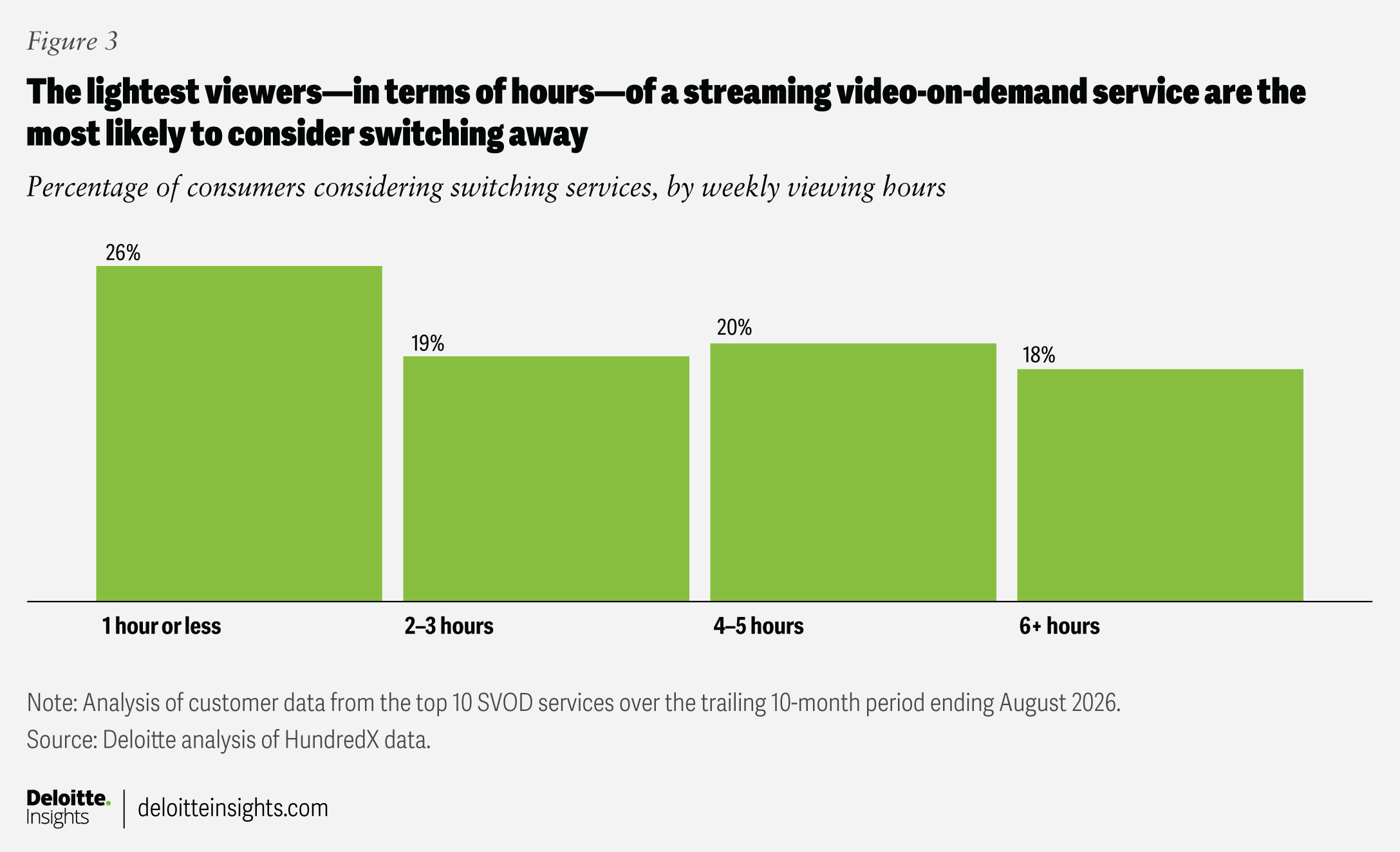
For streaming providers, low engagement could become an important intervention point. Rather than waiting until subscribers attempt to cancel, SVOD providers could identify light-engagement users or those with declining viewing time and find ways to reinforce the value of the service. For example, streamers could surface higher-engagement formats (such as gaming and short-form content), or reinforce value through better discovery and recommendations, relevant and targeted programming, or subscription options that better reflect how the customer uses the service.
The most durable services in the household lineup may not be the cheapest. They are likely to be the ones that give consumers a reason to engage continuously at a price that feels reasonable—justifying their place in customers’ media and entertainment portfolios.
by
Doug Van Dyke
Daniel Ledger
Trevor Boll
Akash Rawat
Brooke Auxier
The authors would like to thank Holly Stevens and the HundredX team for their contributions and partnership.
Editorial (including production and copyediting): Aditi Rao, Preetha Devan, Anu Augustine, and Pubali Dey
Design: Molly Piersol
Cover image by: Harry Wedel
Knowledge services: Viswa Teja Vanapalli
Visit the Deloitte Center for Technology, Media & Telecommunications
Access more insights for the technology, media, and entertainment; semiconductor; telecommunication; and sports sectors.