
Rethinking streaming bundle strategy with audience intelligence
Media companies can use targeted audience insights to develop strategic brand partnerships, build can’t-cancel offerings, and create valuable advertising opportunities
Streaming bundles—packages that combine multiple streaming services into one—have largely been shaped by shared content ownership or distribution strategies.1 But as streaming video-on-demand (SVOD) subscriber growth stabilizes,2 media companies may need to do more than simply package additional media services together to sustain and grow their businesses.
These core media bundles are often offered by telecommunications, broadband, and cable providers,3 and may include simplified billing. But there are other possible outcomes.
Consumers increasingly prefer personalized content, brands, and experiences.4 Deloitte’s analysis of HundredX data indicates that media companies have an opportunity to leverage audience intelligence to identify more meaningful co-branding partnerships through smarter bundles, benefits, and advertising opportunities. Using artificial intelligence to turn these insights into actionable recommendations can create can’t-cancel subscription packages, generate new value for advertisers, and strengthen the customer relationship.
Consumers are sold on bundles, but could the bundles be better?
Currently, 50% of US SVOD subscribers say at least one of their paid streaming video services is part of a bundle—up from 44% one year ago, according to Deloitte’s 2026 fall Digital Media Trends data, which surveyed 3,518 US consumers.5 While Generation Z and millennials are only slightly more likely than older generations to have SVOD bundles, their selected bundles tend to include more varied types of services (figure 1).
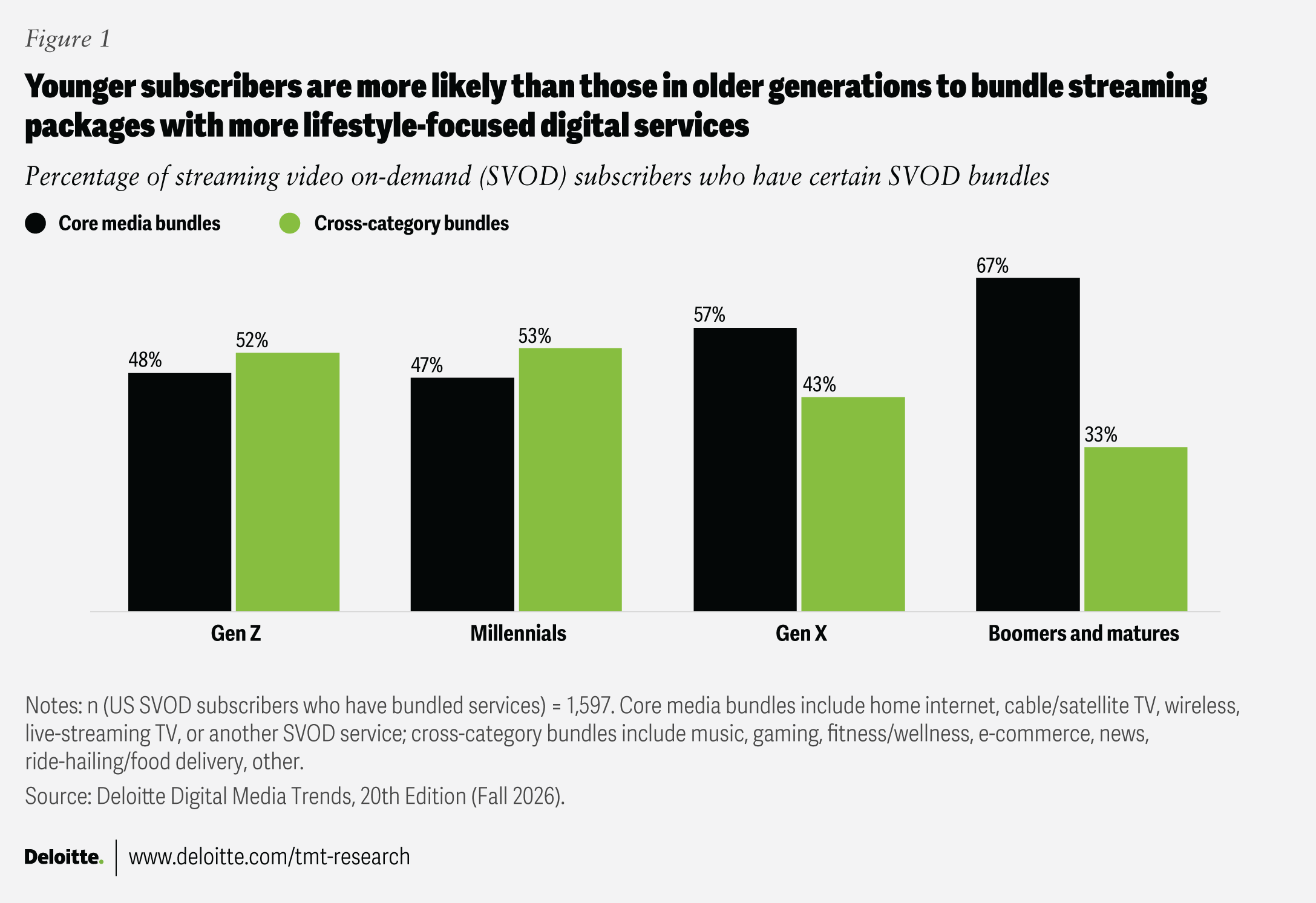
SVOD bundles for the combined baby boomer and mature subscriber group largely center on utilities and core media services (for example, home internet, cable, or satellite TV services). By contrast, Gen Z and millennial subscribers are experimenting with cross-category bundles that may extend to music, gaming, fitness or wellness, e-commerce, news, and ride-hailing or food delivery services.
This differentiation suggests that the current bundles offered by media companies may miss the mark, as younger subscribers look toward broader cross-category ecosystems. Put simply: Bundles have become mainstream, but they still should keep pace with consumer expectations that have become increasingly personal.
SVOD subscribers are consumers, too—and they have strong brand affinities
A more unified view of consumers—and their affinities, shopping habits, travel patterns, and priorities—may be central to the next generation of partnerships and the bundles they could enable. Instead of asking which streaming service to bundle next, providers should consider asking, “Which brands already share our customers, and how can those relationships create more relevant offerings, deliver more targeted advertising, and unlock new audience monetization opportunities?”
Deloitte analyzed HundredX data for the top 10 SVOD services to identify potential high-affinity brands with strong audience overlap, purchase intent, and positive sentiment for both the SVOD service and the brand in question.6 Nearly half of the qualifying brands fall within the food, beverage, and dining or retail, beauty, and apparel categories (figure 2), reflecting consumers’ everyday shopping, dining, and lifestyle habits.
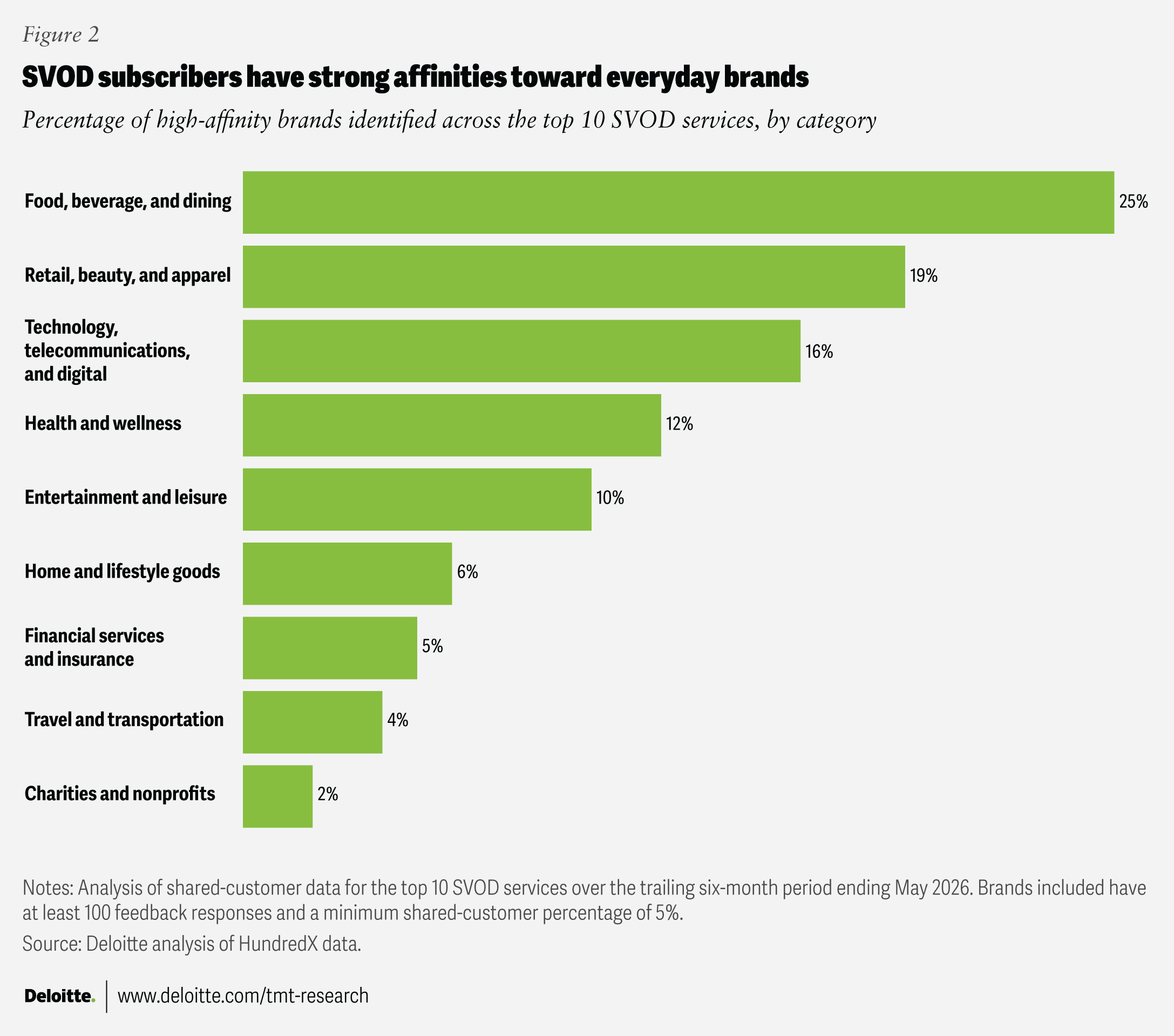
Notably, many of the strongest partnership signals come from outside the media sector, meaning media companies have an opportunity to expand their potential partner base. AI could streamline this process by identifying audience patterns at scale in ways that could be challenging manually.7 With these insights, media companies could find brands with strong consumer overlap, tailor messaging and campaigns in real time, and measure impact.
Better consumer insights can drive brand collaboration strategy
Some streaming video providers have already begun developing partnerships beyond the media sector, activating them through subscription bundles and membership perks.8 But better audience intelligence could help media companies make more strategic decisions about bundle composition by identifying the brands their customers are already predisposed to buy. For ad-supported streaming video-on-demand services, these insights could also be used to make advertising more relevant to viewers, which may lead to increased retention.9
Granularity in targeting has the additional potential to transform ad inventory from a commodity into a premium product. Potential partners—especially niche or nontraditional advertisers—may be more receptive to a sales conversation when a platform can demonstrate that its audience has a strong affinity for that specific brand and that bundling may improve sentiment for both parties.
These partnerships could be shaped by audience affinities for specific franchises, viewing behaviors, or fandoms and then activated in various ways. A golf-focused series, for example, could connect viewers with offers for golf retail, recreational play memberships, or tournament access. A food competition show could support partnerships around meal delivery, grocery rewards, or local culinary experiences. In both examples, partnerships are built around existing audience affinities, helping create a positive engagement loop across content, fandoms, commerce, and experiences, which can drive value for both the streaming platform and the partner brand.
The goal isn’t simply to build another bundle. It’s to build a smarter network of partnerships that makes subscriptions feel less like a generic collection of services and more like a premium membership that connects consumers to the experiences, purchases, and moments they value.
Takeaways to consider on subscription bundling strategy for media and entertainment companies
- Tap into audience data to identify partnerships—and the best ways to activate them. Invest in understanding who consumers are, what they value, their household needs, and which brands, companies, and experiences already own their loyalty. Use those insights to identify partnerships, test activations, and refine based on what drives engagement and revenue.
- Expand the traditional media bundle. Consider developing strategic partnerships—not just subscription packages—that get closer to consumers’ everyday habits and interests. Doing so can create compelling advertising opportunities, broader audience monetization strategies, and more durable customer relationships.
- Leverage AI to make this process seamless and effective. Embed AI throughout the partnership development process to identify the right partners, customize bundle packages and benefits based on audience signals, improve ad targeting and personalization, and measure commercial impact.
by
Doug Van Dyke
Daniel Ledger
Brooke Auxier
The authors would like to thank Akash Rawat and Holly Stevens for their contributions to this article.
Editorial (including production and copyediting): Arpan Saha, Anu Augustine, and Aparna Prusty
Design: Alexis Werbeck, Molly Piersol, and Jaime Austin
Cover image by: Jaime Austin
Knowledge services: Rishitha Bichapogu
Visit the Deloitte Center for Technology, Media & Telecommunications
Access more insights for the technology, media, and entertainment; semiconductor; telecommunication; and sports sectors.