
Consumers navigate financial ups and downs
Deloitte’s financial wellbeing index reveals an unfolding story of consumer resilience, but Americans won’t likely be quick to put recent financial hurdles behind them
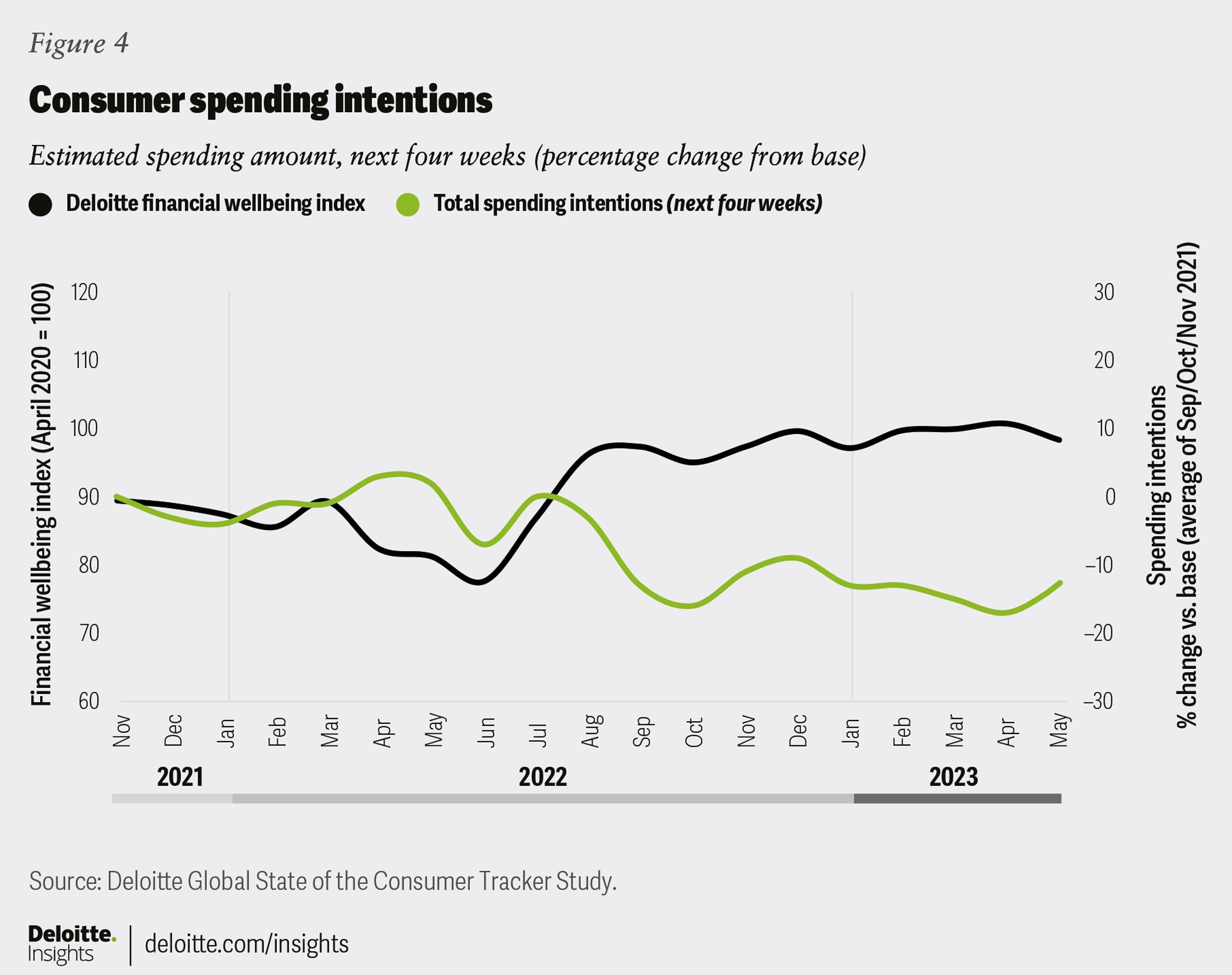
When Americans feel better about their finances, many would expect spending confidence to follow suit. But over the past year, financial well-being in the United States tells a story of resilience and recovery, while spending intentions tell one of calculation and caution.
For insight into these seemingly opposing trends, it’s helpful to look back on the roller-coaster ride of financial well-being sentiment in the United States—and what’s been shaping it—since the start of the pandemic.
Resilience and recovery
Surprisingly, financial well-being sentiment sustained an uptrend early on in the pandemic. In March 2021, Deloitte’s financial wellbeing index (FWBI) climbed to a three-year peak of 105.5 (figure 1).
A confluence of factors was likely the reason behind the trend. By early 2021, some of the early pandemic shock had worn off, even though health concerns were still high. People were adjusting to lockdown measures. Vaccines were rolling out. And with limited spending avenues, consumers were padding their savings. Perhaps more importantly, historic government stimulus programs provided immense financial relief. In March 2021, the US personal savings rate spiked to 26.3 (roughly 4x prepandemic rates) and the US government announced the US$1.9 trillion American Rescue Plan that extended and built upon the Coronavirus Aid, Relief, and Economic Security (CARES) Act from the prior year.1
Calculation and caution
Spending intentions provide some evidence that Americans have yet to undergo a complete financial reset.
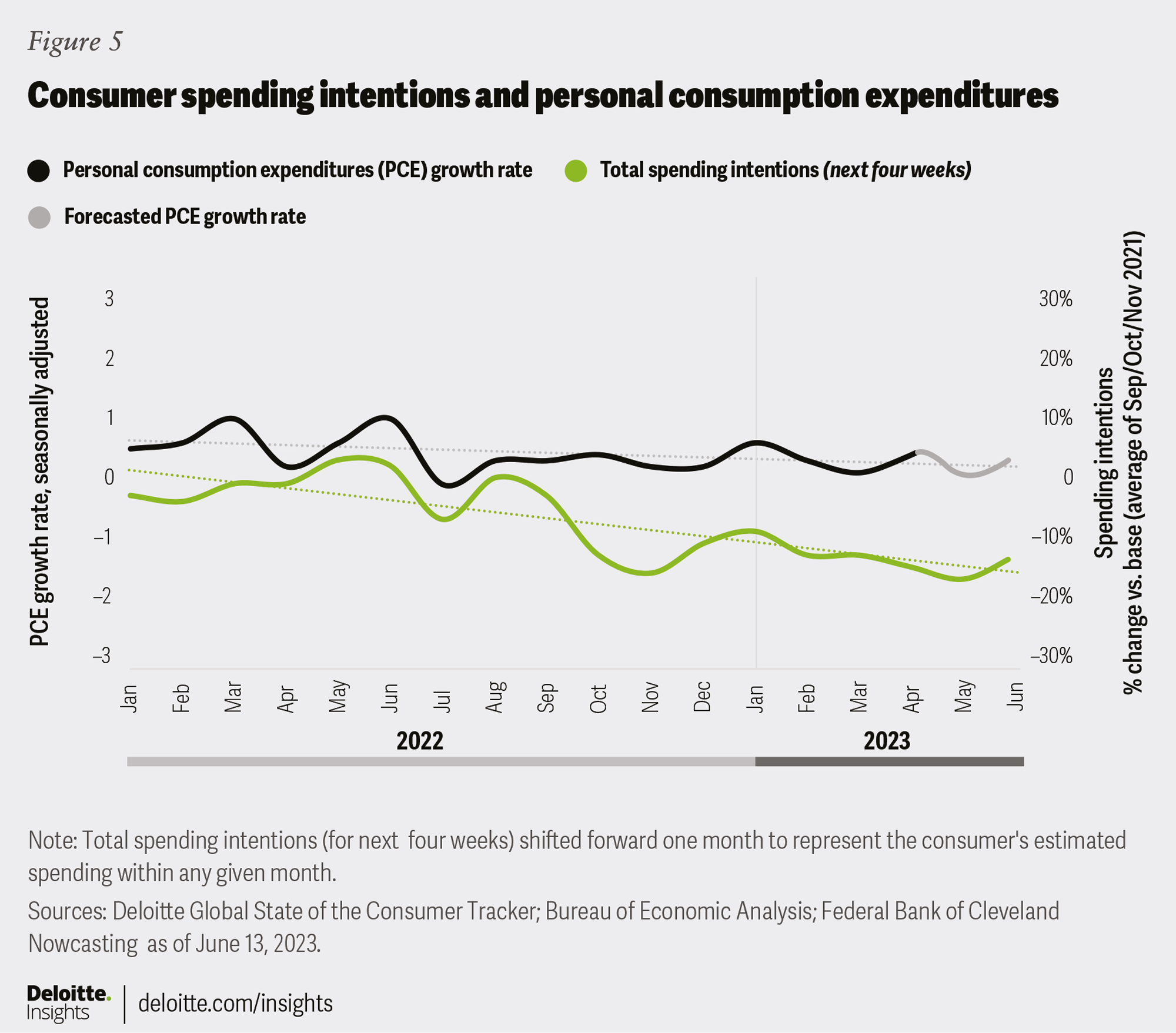
Even though financial well-being sentiment has recovered somewhat, spending intentions aren’t following suit. In fact, over the past year, spending intentions (measured as the amount consumers estimate spending in the month ahead) have slipped as financial well-being has improved (figure 4). Other consumer spending data, including personal consumption expenditure (PCE) from the Bureau of Economic Analysis also point to weakened spending confidence (figure 5).
While the trend seems counterintuitive, there are likely a few reasons why spending intentions have decoupled from financial well-being:
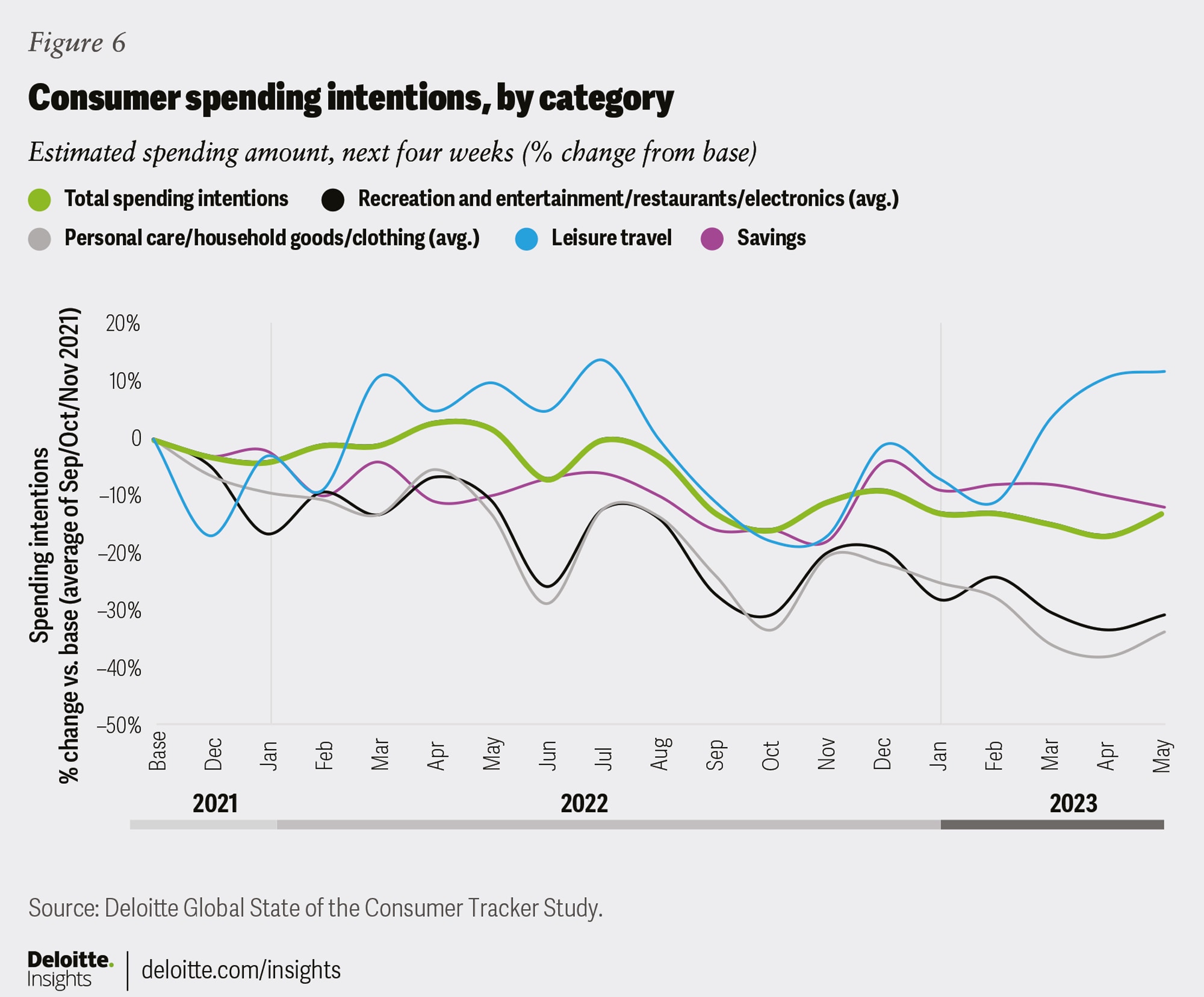
- A refocus on savings: Consumers saved at historic rates during the early part of the pandemic. But after months of leaning on savings, many are likely eager to see that extra zero on their bank statements again. As financial well-being recovers, consumers are taking the opportunity to refocus on saving—likely at the expense of spending more. In recent months, savings intentions grew at a higher rate than spending intentions (figure 6). The gap, however, is narrowing.
- Calculated consumers: A year of unrelenting sticker shock is likely to have some long-term effects on spending behavior. Spending confidence shows signs of healing, just not everywhere, and not at once. For example, spending intentions are up year over year for leisure travel (figure 6). And the trend makes good sense. After two years on the travel sidelines, many are eager to reconnect with lost vacations.2
- Passive protest: While inflation has eased, prices remain high relative to a year ago. Weakened spending intentions may be a form of protest to higher prices, particularly considering more than half of consumers believe companies are using this moment of high inflation to price gouge.3
Improvements in Americans’ financial health are always a welcome trend. But it’s particularly critical now as strong headwinds to economic growth emerge on the horizon and a potential recession looms. Consumer spending accounts for more than two-thirds of US GDP.4 With Deloitte’s US Economic Forecast still showing the economy slowing down substantially in the second half of 2023 and economic risks such as high borrowing costs already leading to banking strains and weighing on economic growth, any dip in consumer spending may just be enough to tip the economy in the wrong direction.5
BY
Anthony Waelter
Stephen Rogers
The authors would like to thank Jim Eckenrode and Marcello Gasdia for his contributions to the article.
Cover image by: Natalie Pfaff