
How a $527 billion growth opportunity in women’s health can improve health outcomes
A Deloitte model explores how proactive, life-stage-aware care could improve outcomes and reduce downstream costs in the United States in 2030
Women’s health in the United States is evolving as demand grows for more personalized solutions and healthcare increasingly emphasizes prevention and earlier detection.1 Deloitte’s Future of Health framework suggests that moving from reactive treatment toward more proactive, individualized disease management may improve patient health and help use healthcare resources more effectively. This approach could support earlier diagnosis, more coordinated care, and better outcomes across life stages for women—and it may also generate broader economic benefits across the healthcare ecosystem.
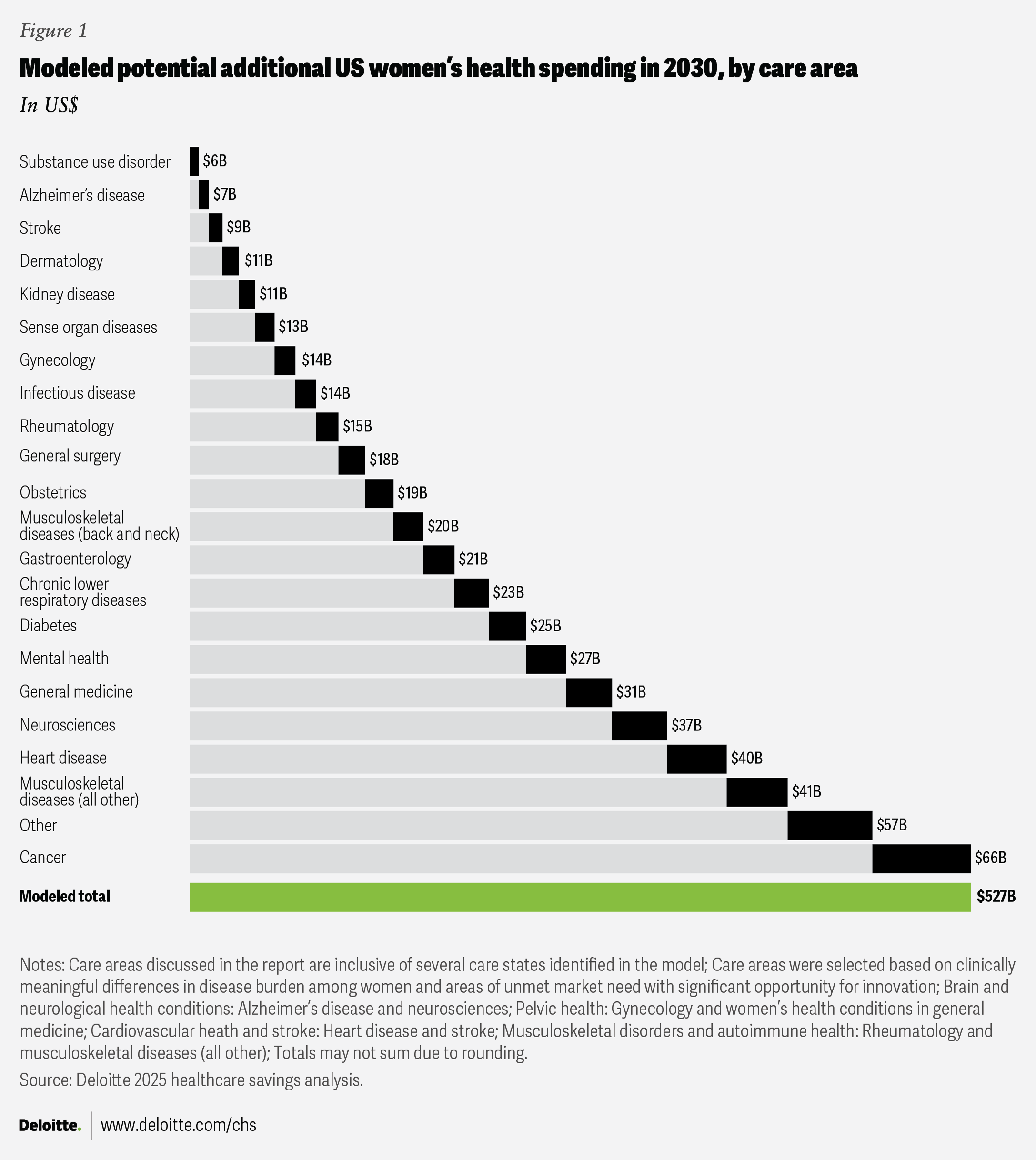
Building on this framework and applying a women’s health lens, the analysis models a 2030 scenario in which care is more proactive, coordinated, and responsive to women’s needs across life stages. Under this intervention scenario, our analysis estimates $527 billion in additional potential spending on US women’s health in 2030, compared with the modeled baseline trajectory (figure 1). This increase could create an opportunity for care to shift toward earlier, more personalized, and life-stage-aware care in women’s health.
The women’s health analysis draws on five years of longitudinal medical and pharmacy claims data from approximately 60 million lives to assess disease prevalence, spending patterns, and the potential effects of earlier intervention and improved disease management (see methodology). A related Deloitte Future of Health actuarial analysis examines how similar shifts in care delivery could affect health span.2 The two analyses use related concepts but address different outcomes, time horizons, and modeling inputs.
At a glance
- 56%: Potential modeled share of total US healthcare spending associated with women’s care in 2030
- Up to 20 years: Potential long-run modeled increase in women’s health span under a related prevention and improved disease-management scenario3
- $527 billion: Modeled additional potential spending on US women’s health in 2030, compared with the modeled baseline trajectory, under the report’s Future of Health intervention scenario
Several forces are motivating women to engage with this shift. By 2030, an estimated 60 million to 70 million US women will be over age 45.4 This group includes women who may be entering or progressing through perimenopause and menopause, as well as those moving into life stages when chronic conditions become more common. Women are also increasingly active participants in healthcare decisions, reinforcing the importance of earlier and more tailored solutions.5 Innovative solutions across diagnostics, therapeutics, care delivery, and consumer health are being developed to respond more directly to women’s needs.6 Together, these trends reinforce the importance of care that’s earlier, more tailored, and better connected across life stages.
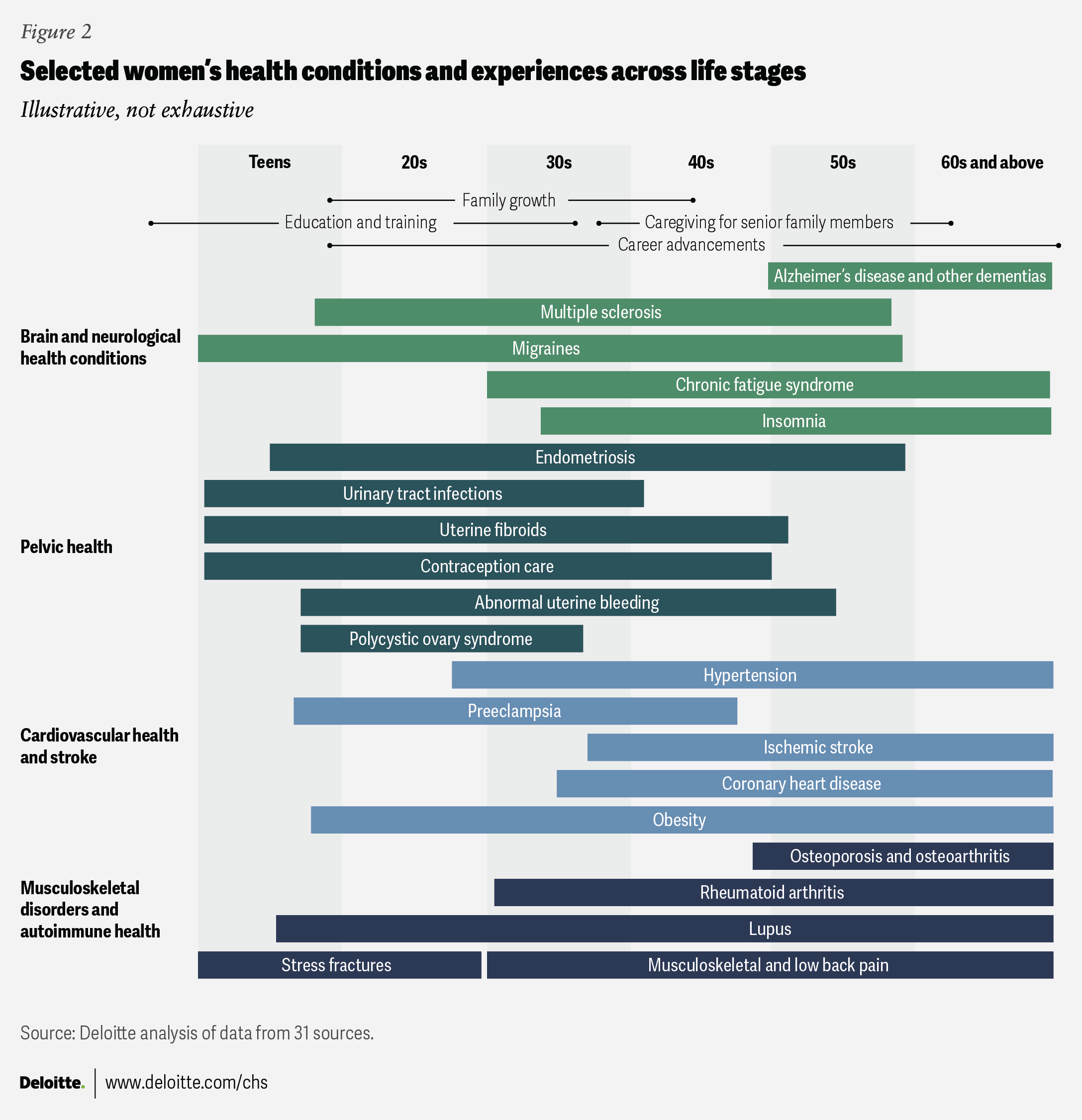
Women account for a significant share of healthcare need and utilization across life stages, reflecting the cumulative nature of their care needs within the system.7 Women’s health needs and associated conditions can emerge and persist across their lifetimes, often intersecting with experiences such as education, family growth, caregiving, and career transitions (figure 2). Deloitte’s model estimates that 56% of total US healthcare spending could be associated with women’s care in 2030.
Four areas of women’s health stand out for the scale of need and potential for meaningful health impact: brain and neurological conditions; pelvic health, including reproductive, hormonal, and sexual health; cardiovascular health and stroke; and musculoskeletal disorders and autoimmune health. This report examines how earlier, more coordinated, and life-stage-aware care could address needs across these areas. For stakeholders across the healthcare ecosystem, including pharmaceutical and medtech companies, health systems, health plans, consumer health companies, and investors, the implication is that improving outcomes and access may also reduce downstream costs.
The breadth of women’s health conditions
Women’s health is often framed narrowly around reproductive care. A broader view captures conditions and care needs that affect women throughout life as well as the scale of unmet needs across the health system. This report organizes the market into three overlapping pillars: conditions that disproportionately affect women, conditions that present differently in women, and conditions linked to female biology across life stages.
Conditions that disproportionately affect women
Some significant unmet needs occur in conditions that affect both men and women but may disproportionately affect women’s health because of higher prevalence, greater severity, longer diagnostic journeys, or more complex management.8
Autoimmune disease is one example: An epidemiologic study found that autoimmune disorders affect nearly 5% of the US population, with women affected at roughly twice the rate of men.9 Better detection, continuous monitoring, and tailored care pathways could improve outcomes while expanding the role of solutions like at-home testing, remote monitoring, and virtual specialty programs.
Conditions that present differently in women
A second pillar includes conditions that affect both men and women but may involve different symptoms, risk profiles, disease trajectories, or treatment responses in women.10 Heart attacks illustrate this challenge, as women may experience symptoms that are less readily recognized as a heart attack, increasing the risk of delayed diagnosis and intervention.11 Progress likely depends on better diagnostic accuracy, stronger sex-specific evidence, and care models designed around how disease manifests in women.
Conditions linked to female biology
This pillar includes conditions related to reproductive anatomy and hormonal changes, as well as care needs that can evolve from puberty to menopause and beyond. Examples include endometriosis; polyendocrine metabolic ovarian syndrome (PMOS), the recently adopted name for polycystic ovary syndrome;12 pelvic floor disorders; menopause-related needs; and maternal health.13 These needs can be persistent and may be underdiagnosed or fragmented across providers and life stages. For example, endometriosis can take years to diagnose, and patients may have multiple healthcare visits before receiving an accurate diagnosis.14
Together, these gaps may create room for models that connect diagnosis, treatment, symptom management, and prevention more seamlessly over time. The growth of specialty women’s health programs may reflect both unmet need and demand for more accessible, coordinated solutions.15 Each of the four areas of women’s health highlighted in this report falls into one or more of these pillars.
Four potential areas of focus in women’s health
The following four areas illustrate where unmet needs and market demand may converge. Recent trends and emerging market signals point to growing demand for products and services designed around women’s needs across life stages, as care becomes more continuous, precise, accessible, and preventive.16 These selected areas represent only part of the analysis and therefore don’t sum to the total modeled estimate of $527 billion in additional potential spending to help improve outcomes across 22 care areas.
Brain and neurological conditions
Brain and neurological conditions represent an estimated $44 billion in additional potential spending focused on improving outcomes in 2030, compared with the modeled baseline trajectory. The model suggests this category has potential for expanded products, services, and care in the United States. At the same time, advances in research and growing awareness highlight a need for care that reflects women’s neurological risks and needs.17
Prevalence
In 2025, more than 7.2 million Americans age 65 and older were living with Alzheimer’s disease, including about 4.3 million women.18 Multiple sclerosis affects nearly one million US adults, approximately 74% of whom are women, and typically develops between ages 20 and 40.19 Migraine or severe headache affects roughly 40 million people in the United States, while about 21% of women report experiencing migraine or severe headache within a three-month period.20
Biological and life-stage drivers
Biological and hormonal factors may contribute to some of these differences. In Alzheimer’s disease, menopause-related estrogen decline is associated with changes in brain metabolism, structure, connectivity, and tau biology that may increase vulnerability.21 In multiple sclerosis, symptoms and disease activity can change during hormonal transitions, including menstruation, pregnancy, the postpartum period, and menopause.22 Migraine is especially prevalent during the reproductive years, with hormonal fluctuations influencing its frequency and severity. Symptoms may worsen during perimenopause but often improve after menopause and later in life.23
Midlife may offer an important window for risk reduction and earlier intervention. During the menopausal transition,24 sleep disruption affects approximately 40% to 60% of women ages 40 to 65 and is often associated with a higher risk of dementia later in life.25 Physical activity is also associated with cerebrovascular benefits, with some evidence suggesting particularly meaningful benefits after menopause.26 Together, these findings point to midlife as a potential window for earlier detection, risk reduction, and targeted lifestyle interventions.
Market signals
Market activity is emerging around earlier diagnosis and nonpharmacological care,27 as developments in Alzheimer’s disease and migraine illustrate.28
Confirming amyloid pathology associated with Alzheimer’s disease has historically depended on PET imaging or cerebrospinal fluid testing, which can be costly, resource-intensive, or invasive.29 However, blood-based biomarkers are emerging as a more scalable and minimally invasive approach, with studies showing that plasma measures such as p-tau217, p-tau181, and the amyloid-beta 42/40 ratio show promise for detection of the disease.30 As obstacles to clinical adoption are addressed, these biomarkers could enable more accessible and earlier Alzheimer’s diagnosis for more patients across care settings.
In migraine, FDA-authorized prescription digital therapeutics and FDA-cleared neuromodulation devices are expanding nonpharmacological options alongside medication.31 Prescription digital therapeutics can incorporate cognitive behavioral therapy, targeting sensory, autonomic, and affective brain networks to reduce migraine frequency.32 Neurostimulation devices use electrical stimulation to calm primary pathways for migraine pain, and may support at-home acute or preventive treatment, depending on the device.33
Where the market is shifting
Population aging is likely to increase demand for dementia care among women, while earlier-onset conditions like migraine can affect women during early and mid-adulthood, potentially disrupting work, caregiving, and daily life (figure 2). Improving neurological care at scale may depend on translating insights about sex-specific biology and life-stage factors into earlier, more accessible interventions.
Pelvic health: Reproductive, hormonal, and sexual health
Conditions like PMOS, uterine fibroids, endometriosis, abnormal uterine bleeding, and urinary tract infections (UTIs) can affect women at different life stages, yet purpose-built solutions remain limited relative to need.34 Our analysis estimates that pelvic health represents $21 billion in additional potential spending focused on improving outcomes in 2030, compared with the modeled baseline trajectory.
Prevalence
The opportunity in this category reflects both the scale of these conditions and the extent of unmet need. Endometriosis affects about 1 in 10 women of reproductive age,35 and an estimated 60% of cases remain undiagnosed.36 Between 20% and 50% of women of reproductive age are estimated to have uterine fibroids, and some estimates suggest that up to 77% of women will develop them over their lifetimes.37 In 2026, an estimated 68,270 US women will be diagnosed with uterine cancer. Women have a 3.1% lifetime risk of developing the disease, with most cases occurring between ages 55 and 64.38 Acute abnormal uterine bleeding affects about 1.4 million US women each year.39 More than half of women will experience a UTI during their lifetime, and about 27% of those affected experience a recurrence within six months.40
Biological and life-stage drivers
Hormonal changes, menstrual patterns, and age can influence the onset and care needs of pelvic health conditions. PMOS symptoms often emerge around puberty,41 abnormal uterine bleeding is common during perimenopause,42 and the risk of UTIs increases with sexual activity and again after menopause, when declining estrogen can affect the protective genitourinary tissues.43 These patterns show how pelvic health needs can change across women’s lives.
Market signals
Recent innovations suggest that the market is beginning to respond through more accessible diagnostic options and research into new uses for existing treatments. Such innovations and growth in at-home testing could signal a shift toward care that’s more consumer-driven, less invasive, and available earlier.44
More than one-quarter of US women age 21 and older aren’t up to date on routine cervical cancer screening, often because of awareness or access challenges.45 In May 2025, the FDA authorized a prescription device that allows users to collect a vaginal sample at home and send it to a laboratory for testing with a validated, FDA-approved human papillomavirus (HPV) assay.46 Because HPV causes nearly all cervical cancers, at-home collection could help reduce some of the access and privacy barriers associated with screening.
In PMOS, GLP-1 receptor agonists are being studied as potential treatment options. A 2024 meta-analysis of randomized controlled trials found that these drugs reduced BMI, waist circumference, and total testosterone levels, while also potentially improving insulin resistance which reduces androgen levels and can restore ovulation.47 Although no medications are currently FDA-approved to treat PMOS, research into new uses for existing drugs could expand the options available to address its metabolic and reproductive effects.48
Where the market is shifting
As both incidence and awareness shift, the next phase of market development in pelvic health may center on easier diagnosis, access beyond traditional clinical settings, and products built to fit more readily into women’s daily lives.49 These trends point toward the potential for pelvic health care that is more convenient, private, and proactive.
Cardiovascular health and stroke
Cardiovascular disease is a leading cause of death for US women, yet risk, presentation, and outcomes have often been viewed through a sex-neutral lens.50 Growing recognition of how heart disease and stroke can present differently in women is beginning to shape research, diagnostics, and care.51 Our analysis estimates that cardiovascular health and stroke represent $49 billion in additional potential spending focused on improving outcomes in 2030, compared with the modeled baseline trajectory.
Prevalence
Heart disease affects 60 million US women, representing about 44% of the female population.52 In 2023, it accounted for approximately 1 in 5 deaths among women in the United States.53 Hypertension, a major risk factor for both heart disease and stroke, increases sharply with age. Prevalence ranged from 13.6% among women ages 20 to 34 to 84.1% among those age 75 and older in 2017 through March 2020.54 Stroke is the third leading cause of death for women, and the risk can triple during pregnancy relative to nonpregnant women of similar age. Stroke risk also remains elevated during the postpartum period.55
Biological and life-stage drivers
Women’s cardiovascular risk develops over life stages and is shaped by reproductive milestones and the menopausal transition.56 Estrogen is thought to help protect heart health before menopause; as estrogen levels decline during menopause, cardiovascular risk can rise sharply.57 Hypertensive disorders of pregnancy, particularly preeclampsia, are also associated with a higher future risk of ischemic heart disease and chronic hypertension.58 Hormonal changes, pregnancy history, and cardiometabolic risk factors tend to build on one another over time, potentially making life-stage-aware prevention especially important in women’s cardiovascular care.
Market signals
Recent innovations suggest the market is starting to respond with consumer-facing continuous monitoring devices and AI- and biomarker-based diagnostics. Wearable tools are beginning to make blood pressure monitoring more continuous and accessible.59 App-based tracking can also connect readings with patterns in sleep, stress, activity, and meals, potentially helping patients and clinicians identify relevant patterns.60 Some research suggests that cardiovascular risk may begin to rise at lower blood pressure levels in women than in men.61 These tools may help provide earlier signals that prompt formal clinical evaluation.
Traditional screening models have often not fully accounted for sex-specific biology, pregnancy-related health changes, and menopause-related hormonal shifts.62 AI-enabled cardiovascular imaging and blood biomarkers63 may help support more sex-specific diagnosis and earlier risk identification.64 AI-enabled imaging can be applied across modalities, including echocardiography, computed tomography, magnetic resonance imaging, and mammography-derived cardiovascular screening. These emerging AI-enabled tools can surface early patterns, including microvascular disease and non-obstructive coronary disease that traditional diagnostic approaches may miss, particularly in women.65 Similarly, established and emerging blood-based markers, such as IgM anti-PC, Lp(a), C-reactive protein, and low-density lipoprotein, could represent markers that could be used to help assess someone’s risk of developing heart disease.66 If embedded in routine radiology and primary care workflows, these types of tools could support a more proactive and accurate approach to cardiovascular care.
Emerging AI-enabled imaging and biomarker approaches may help identify cardiovascular risk earlier, although their clinical value depends in part on validation, workflow integration, and appropriate follow-up care.
Where the market is shifting
Growing awareness of sex-specific cardiovascular differences has increased focus on women’s cardiovascular care and research.67 As wearable monitoring, AI-enabled imaging, and biomarker-based risk stratification advance, organizations that incorporate life-stage-aware risk factors and more precise diagnostic tools into routine care may be better positioned to improve outcomes and support growth. Over time, these innovations could help move cardiovascular care from episodic, sex-neutral assessment toward more continuous, personalized risk management.
Musculoskeletal disorders, autoimmune, and inflammatory health
Musculoskeletal disorders and autoimmune diseases are often chronic and disproportionately affect women, yet innovation has historically focused more on symptom management than on earlier detection or disease modification.68 Conditions such as osteopenia, rheumatoid arthritis, and lupus collectively affect millions of US women, with risks and care needs changing across life stages.69 Our analysis estimates a $56 billion increase in potential spending in 2030, relative to the modeled baseline trajectory, across the musculoskeletal disorders and autoimmune health category in women’s health.
Prevalence
Osteopenia affects an estimated 27.3 million US women, and women over age 50 face roughly a one-in-three remaining lifetime risk of an osteoporotic fracture.70 Bone loss also accelerates during and after menopause, when estrogen decline can cause women to lose up to 20% of bone mass.71 Rheumatoid arthritis (RA) most commonly emerges between ages 30 and 60, and women face an estimated 3.6% lifetime risk.72 Among people with RA, the risk of myocardial infarction is 68% higher and the risk of stroke is 41% higher.73 Lupus affects an estimated 184,000 US women, with women accounting for roughly 9 in 10 diagnoses.74
Biological and life-stage drivers
Many autoimmune diseases, including lupus and RA, can emerge during early adulthood and the reproductive years, intersecting with fertility, pregnancy, and long-term immune health.75 In midlife, perimenopause and menopause introduce additional considerations, particularly for bone and musculoskeletal health, as estrogen decline accelerates bone breakdown and can worsen vulnerability across related conditions.76
Across adulthood, women’s health risks are shaped by an interplay of hormonal transitions, immune-system activity, environmental exposures, genetic predisposition, and modifiable behaviors. These factors can influence when conditions emerge, how they progress, and how they’re managed, reinforcing the importance of earlier recognition and care tailored to key stages of life.
Market signals
Recent innovations suggest the market is beginning to respond, particularly through the use of imaging already obtained in routine care.
AI-enabled tools are beginning to shift bone health toward earlier, lower-friction detection by using data already generated in routine care.77 One example is FDA 510(k)-cleared software that analyzes routine hip or pelvis X-rays taken for other reasons and identifies signs of low bone density in patients age 50 or older.78 While this tool doesn’t replace dual-energy X-ray absorptiometry screening or directly diagnose osteopenia or osteoporosis, it reflects a broader move toward embedding detection into existing care pathways rather than relying solely on dedicated screening workflows. For postmenopausal women, who face disproportionate osteoporosis risk, that model could help support earlier identification and follow-up.
At the same time, the musculoskeletal treatment pipeline is expanding beyond symptom management. Although no disease-modifying osteoarthritis therapy has yet been approved for clinical use, a new class of disease-modifying drug candidates79 signals growing investment in approaches that may address joint degeneration more directly.80 For women, whose osteoarthritis prevalence rises with age and is often compounded by menopause-related musculoskeletal change, this marks a meaningful shift toward interventions that address disease progression more directly.
Where the market is shifting
As the population of older women grows, the value of solutions that identify risk earlier, intervene more precisely, and better address women’s life-stage-specific needs is likely to continue to grow.81 Women may enter care only after bone loss, joint damage, or autoimmune activity has already translated into pain, fracture risk, or reduced mobility.
Technologies that repurpose routine imaging, therapies aimed at modifying disease progression, and more precise patient stratification tools can all support a move toward more proactive care. Together, these shifts could help move the market away from reactive symptom management and toward earlier detection, more targeted intervention, and better long-term management of conditions that disproportionately affect women.
A life-course lens on where intervention could create more value
To maintain health, timing and early detection matter. Across the four areas examined in this analysis, a common pattern emerges: Care often begins after conditions are well established,82 even though underlying risks may begin to develop much earlier. Risk isn’t distributed evenly across life stages, and potential health gains may come from intervening earlier and at more specific life stages.
During the reproductive years, the opportunity is to improve diagnosis, health promotion, prevention, and disease management for conditions that often emerge or peak during early and mid-adulthood. PMOS, endometriosis, migraine, and lupus can affect women during this period, with consequences for their health, work, and daily lives.83 Yet diagnosis is often delayed and care remains fragmented.84 Earlier recognition and more coordinated management in this period could improve quality of life, help reduce disease progression, and lower downstream utilization.
Midlife may be an especially important intervention window. The menopausal transition can coincide with rising cardiovascular risk, accelerated bone loss, sleep disruption, and changes in neurological risk.85 Yet care during this period is often episodic and poorly integrated.86 Earlier identification of vascular risk, cognitive change, and musculoskeletal decline during midlife could help delay more serious disease later on.
In later life, the effects of accumulated risk become more visible through fracture risk, dementia prevalence, and chronic disease complexity.87 At that point, the opportunity includes both treating established disease and better managing the cumulative effects of risks that have built over time.
Taken together, these patterns suggest that a potential opportunity lies not in a single intervention point, but in care models that identify risk earlier, connect needs across life stages, and respond more seamlessly as women’s needs evolve.
What can stakeholders consider when focusing on women’s health across life stages?
One consideration is clinical: People should have timely, evidence-based care that reflects their biology, life stages, and changing needs. Earlier detection, better coordination, and more responsive support can improve outcomes and quality of life. More effective and efficient care may also generate broader economic benefits across the healthcare ecosystem.
These considerations point to practical actions for stakeholders across the ecosystem.
- Pharmaceutical organizations can embed sex-specific insights across the development life cycle and strengthen the real-world evidence base across life stages.
- Medtech companies can help shift care for conditions that disproportionately affect women or present differently in women upstream through earlier detection, continuous monitoring, and lower-friction diagnostics.
- Health plans can improve benefit design and navigation so women can access preventive care for high-prevalence conditions impacting women more easily and avoid unnecessary downstream utilization.
- Investors can consider directing capital toward scalable platforms that advance sex-specific evidence, improve diagnosis, and expand care options in women’s health, particularly where these approaches can support sustainable, repeatable economics.
- Consumer health companies can design accessible products and services that support women as their needs change across life stages.
The common thread is simple: Organizations can improve health outcomes for women and focus on growing demand through products and services that promote earlier detection, better coordination, innovative solutions, and more responsive support.
BY
Jennifer Radin
Dr. Kulleni Gebreyes
Sheryl Jacobson
Andrew Davis
Vivian Monitto
Katherine Gordon Backes
The authors gratefully acknowledge the many individuals whose expertise, collaboration, and contributions supported the development of this report.
We extend our sincere thanks to the report research and development team: Dr. Jay Bhatt, Jessica Qian, Catherine Gergen, Jacqueline Strobel, Samantha Charney, Laura Estilo, Neela Kirankumar, Ashley Robalino, Jordyn Moehrle, Emma Ringwood, and Teresa Leste.
We also thank Deloitte’s health actuarial team for its valuable insights and support: Stefani Smilanich, Sarah Chock, and Anthony Polentini.
Finally, we are grateful to the clinical subject matter experts who helped guide the report and validate its findings: Stephanie Beever, Dr. Felix Matthews, Dr. Russell Bailey, Dr. Kenneth Abrams, Dr. Rachel Kermis, Dr. Elizabeth Baca, and Brad Maruca.
Editorial (including production and copyediting): Rebecca Knutsen, Shyamili M, and Anu Augustine
Design: Natalie Pfaff, Sonya Vasilieff, and Sofia Laviano
Cover image by: Sofia Laviano
Knowledge services: Rohan Singh