
Moving in sync to value-based care
Organizations are more fully committing to value-based care. Discover what physicians need to succeed.
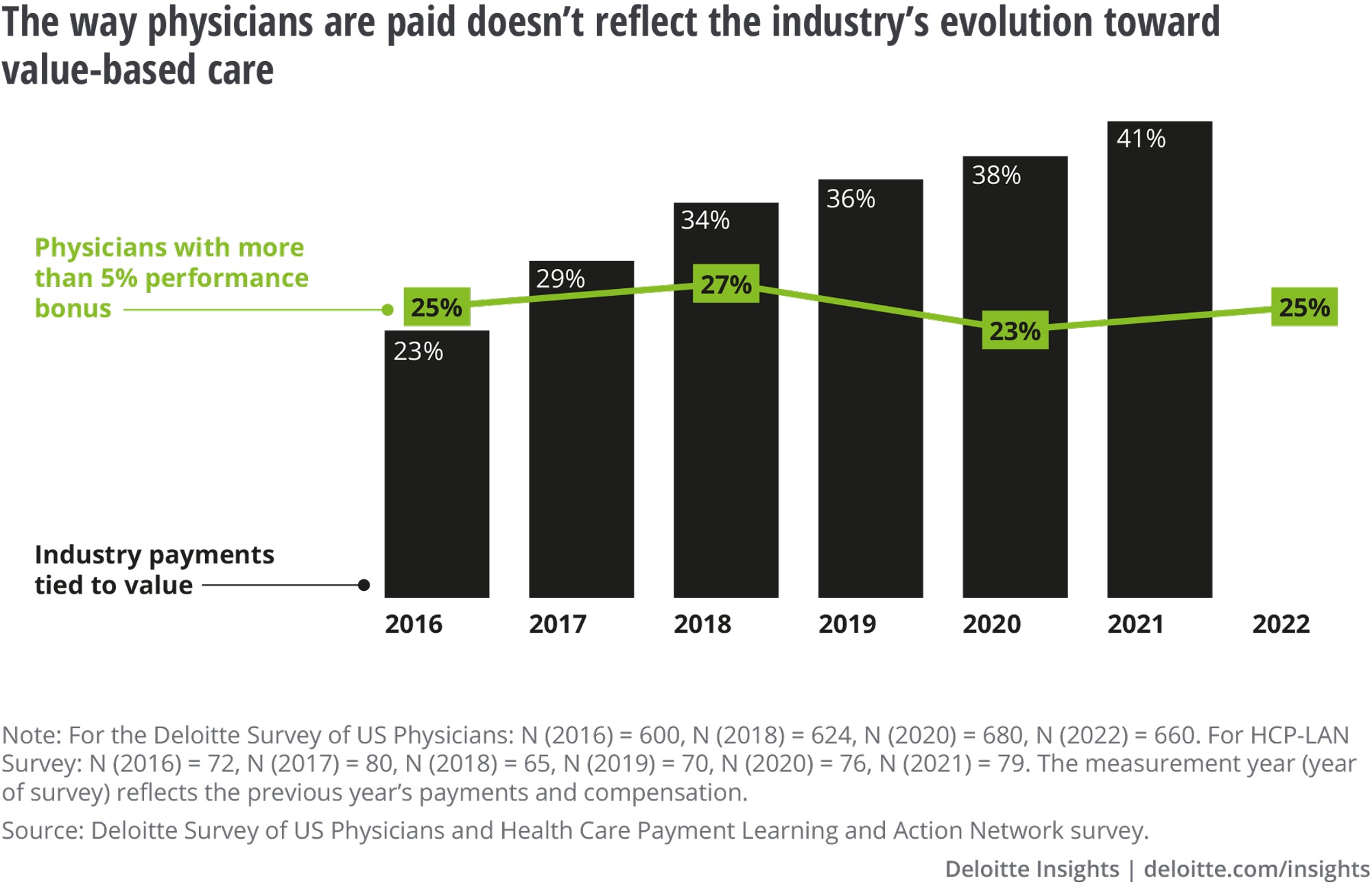
As value-based payments become the industry norm, the way physicians are compensated tends to be increasingly misaligned with how provider organizations are paid by public and private payers. The Health Care Payment Learning and Action Network (HCP-LAN) survey reveals that payments tied to value have increased from 23% in 2016 to 41% in 2021. Yet, the Deloitte 2022 Survey of US Physicians shows that during the same time period, the share of physician compensation has stayed the same with about one in four physicians receiving meaningful value-based performance bonuses.
Deloitte’s modeling to estimate the financial “tipping point” shows that when revenue from value-based payments reaches 40% of a provider organization’s overall revenue, it makes sense for that organization to fully transform to a value-based approach for all patients under its care.1 The HCP-LAN survey data suggests that, on average, the industry is close to this point. This means that for many provider organizations, a value-based care model has become more financially advantageous than the traditional volume-driven episodic model of care.
To correct this misalignment, provider organizations should rethink legacy physician compensation structures, so they are in sync with the organizations’ payment models that reward quality, outcomes, and equity. Additionally, they should provide physicians with the right capabilities:
- people to provide appropriate care and enable everybody to practice at the top of their license (e.g., comprehensive care teams)
- processes to ensure the right care is delivered in the right setting by the right people (e.g., care management programs)
- technology and data to seamlessly operationalize new care models (e.g., automated workflows and point-of-care decision support)
While the industry hovers at this tipping point, now is the time to ensure that physicians are equipped to successfully transition to value-based care—and that the incentives at an individual level correspond with the incentives at an organization level.
BY
Mark J. Bethke, FSA, MAAA
Dorrie Guest
Howard Drenth
Stephanie Beever
Madhushree Wagh
Project team: Natasha Elsner and Wendy Gerhardt led survey development and hypothesis generation. Hemnabh Varia oversaw the fielding, helped with the analysis plan and data interpretation. Our executive sponsors Ken Abrams, MD; Bill Fera, MD; Jay Bhatt, DO; and Shaun Rangappa, MD, provided guidance and reviews of multiple drafts.
The authors would also like to thank Grace Feldman, Danielle Moon, Meghna Sharma, Cassidy Estep, Lindsay Parra, Mark Snyder, Rebecca Knutsen, Prodyut Ranjan Borah, Laura DeSimio, Zion Bereket, Gargi Khandelwal and the many others who contributed to the success of this project.
Cover image by: Kevin Weier and Natalie Pfaff