
AI could turn government contact centers into an intelligent front door
As AI advances, contact centers could help people navigate government services, coordinate support across agencies, and identify recurring service problems
For many, government becomes real only when they need help, and a contact center is often where they turn to seek information, apply for assistance, or navigate an unfamiliar government service.
Artificial intelligence1 could transform many aspects of the government contact center experience, helping constituents resolve their issues while giving agencies insight into how to provide better service. A suite of intelligent technologies—including AI, generative AI, and agentic AI—could help contact centers become a more effective entry point for the public sector, improving service and helping agencies identify operational bottlenecks and potential fraud.
The AI journey isn’t just about technology. Agencies will also need to adapt risk controls, governance structures, and employee training to successfully integrate AI into their operations.
The larger transformation is not simply about how government answers questions, but how it understands constituents’ needs, coordinates services, and learns from those interactions to improve delivery.
The private sector is already adopting gen AI
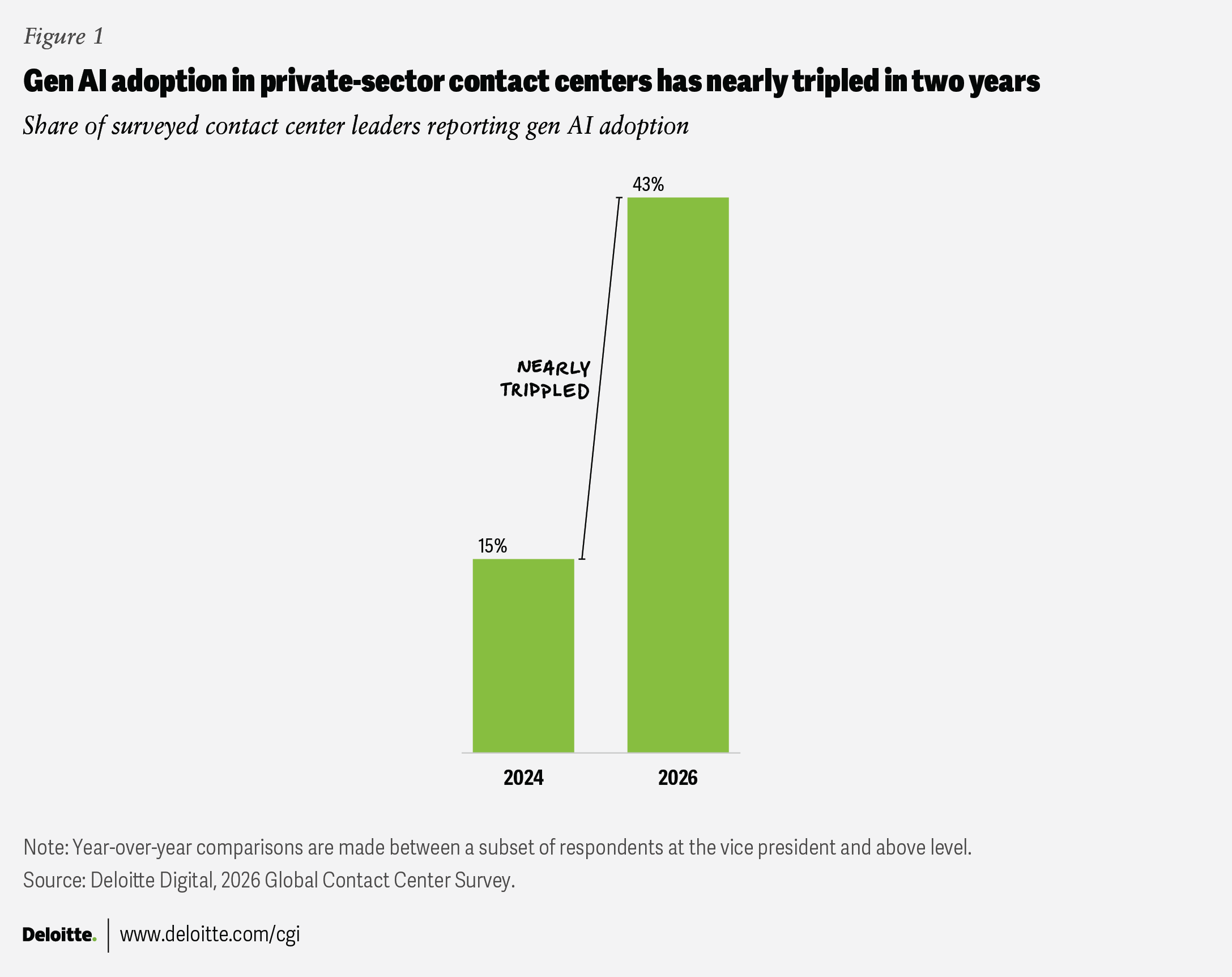
AI is taking on a broader role in private-sector contact centers, moving beyond routine automation to assisting representatives and resolving customer needs. Adoption is also accelerating: According to Deloitte Digital’s 2026 Global Contact Center Survey, gen AI adoption among respondents rose from 15% in 2024 to 43% in 2026 (figure 1).
Private-sector adoption may be moving faster than government adoption, in part because the private sector has greater access to capital for AI investment. These developments could offer a glimpse of how AI capabilities might evolve in government contact centers, although the pace and path of adoption may differ.
Government contact centers face a different AI journey
Government contact centers often handle highly sensitive personal information—such as health and financial information—while helping constituents access essential services. This makes accuracy, privacy, and security particularly important.
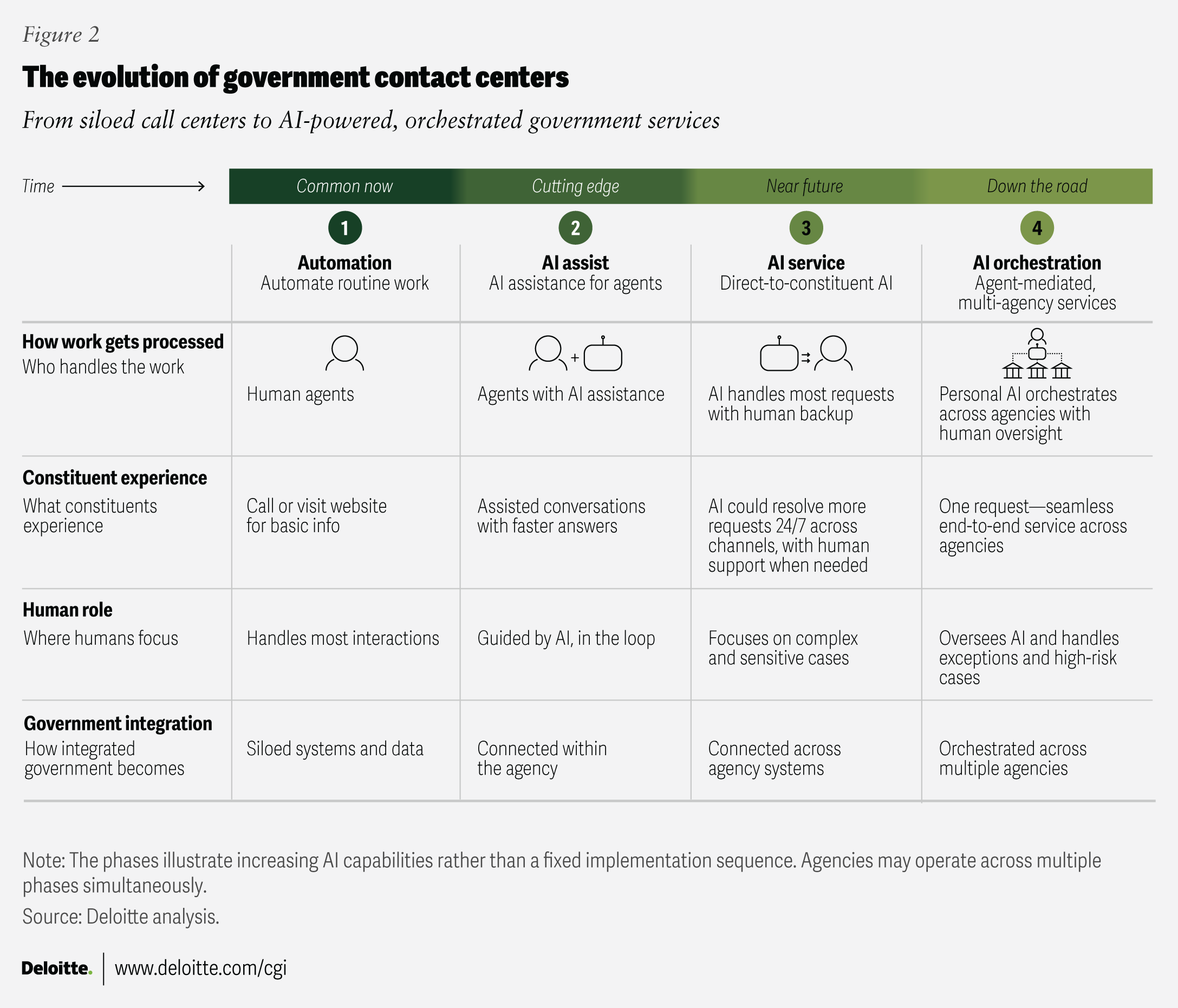
As AI use evolves, governments may need to adapt their controls, governance, operational processes, and employee training. That evolution is likely to unfold through a series of phases, from automating routine work in a way that supports frontline workers to helping constituents navigate more complex services (figure 2). These phases reflect increasing AI capabilities rather than a fixed implementation sequence. Agencies may operate across several phases simultaneously, depending on the service, technology environment, and risk involved.
Phase I: Automating routine work
The core technology in place today in many government agencies remains legacy telephony, including automatic call distribution, sample monitoring, call recording, and supervisor dashboards. There is often also some self-service, either through interactive voice response, a web-based application, or both. Websites may include static frequently asked questions or AI-based bots that can answer routine natural-language questions.
Tech platform: This is generally a hybrid of legacy telephony and web and mobile applications, with limited integration and sharing of experience data among the channels.
Representative role: Representatives are responsible for most nonroutine interactions.
What can government do at this stage? Government can often make relatively small process changes that significantly enhance productivity. For example, instead of having each representative begin by confirming the individual’s identity, it may be possible to automate initial authentication with a modest investment using existing technology.
Introducing a more intelligent interactive voice response and expanded self-service can reduce handle time and create a stronger foundation for more advanced AI capabilities over time.
Phase II: AI begins assisting representatives
This phase involves using AI to assist representatives and expanding self-service, such as by using scripted online bots. This phase may also entail greater integration among channels so that actions taken on the web or through text are available to contact center representatives. AI may also be used for initial call screening or to obtain basic information from the caller so that, when a representative answers, the caller’s information is already available, making the experience smoother for both the worker and the constituent.
Tech platform: This phase typically involves a more sophisticated contact center platform, such as a cloud-based contact center-as-a-service tool that can be configured for the government’s hosting environment. These platforms enable faster implementation and remote access for representatives, provide sophisticated management dashboards, and often include built-in AI capabilities, although these features may not be fully used because of risk concerns.
Representative role: What sets this phase apart is the degree to which the technology platform can provide customer service representatives with real-time AI assistance. With AI now supporting the process, the representative begins to shift from performing tasks to acting as a navigator, interpreting guidance from AI to determine the right path forward.
What can government do at this stage? In this phase, AI provides guidance to representatives. A human remains in the loop, and representatives make the final decision. In addition to assisting representatives, AI can also support training by providing targeted feedback to representatives and managers.
AI-powered analysis can capture real-time transcriptions and produce call summaries. In healthcare, AI-generated transcripts could be put into industry-standard SOAP (subjective, objective, assessment, and plan) and related formats, which are structured methods for documenting patient encounters. Sometimes known as AI medical scribes, these tools require human review but can save clinicians’ time.2
Phase III: AI begins serving constituents directly
In this phase, generative AI can directly provide constituents with answers, information, and assistance with transactions. As of 2026, few public-sector contact centers are approaching this phase.
These AI-based tools, sometimes known as digital or virtual agents, not only answer simple constituent questions but can also query government policy documents to address more complex ones, such as “Do I qualify for this program?” Because they can understand natural language, they can walk a caller through a conversation, in many cases all the way to issue resolution. These digital agents typically include options to connect users to a human representative, either at the constituent’s request or when the AI determines that a handoff is needed due to frustration, call complexity, or other factors. These tools also introduce risks and are still being fine-tuned.
These direct-to-constituent AI tools can provide additional support, such as checking the status of a constituent’s application by querying agency systems or guiding constituents through a process, such as determining whether they qualify for a benefit or applying for a permit. At this stage, AI begins to shift from answering questions to helping constituents navigate an entire service journey.
Tech platform: A cloud-based contact center platform is important. However, the main difference between Phase II and Phase III is not the platform itself; it is how fully the platform uses AI-based capabilities.
Representative role: Contact center representatives focus on the most complex interactions that AI cannot handle. These include escalated sensitive situations and complex cases requiring judgment, such as cases involving homelessness, domestic abuse, or multi-agency support. As AI resolves a growing share of routine interactions, representatives increasingly handle exceptions, exercise judgment, and oversee AI-supported constituent interactions.
What can government do? As AI begins interacting directly with constituents, agencies will need stronger governance and controls to manage potential risks. Guidelines alone may not be enough; agencies will also need mechanisms to monitor whether those guidelines are being followed. Government agencies should consider testing proof-of-concept pilot projects within limited sample groups, with the results analyzed before ramping up to the larger population.
To reduce long wait times and make unemployment support easier to access, the North Carolina Division of Employment Security introduced a gen AI virtual assistant that is available 24/7.3 Whether someone has a question about eligibility, documentation, or the claims process, the chatbot provides immediate guidance, can support multiple languages, and provides help without requiring a live representative.4 When more nuanced support is needed, users are directed to the appropriate channels.5 In its first month, it handled more than 2,700 inquiries that otherwise would have required human intervention, freeing staff to focus on more complex and sensitive cases.6
Phase IV: A future in which AI helps orchestrate services across agencies
Where Phase III makes individual interactions more intelligent, Phase IV could fundamentally change how services are organized and delivered across government. This shift is toward organizing services around constituents’ needs or life events rather than around individual government programs. A person who loses their job or wants to start a business may need to interact with multiple agencies. AI could help the individual coordinate interactions across agencies, reducing the need to deal with each system separately.
The final vision for this phase has not yet been achieved, though early examples are beginning to emerge.
In the future, government contact centers may start receiving requests from constituents’ personal AI agents rather than directly from constituents. These agents could understand a constituent’s intent, locate relevant government services, complete forms, submit supporting documents, schedule appointments, and interact with agencies on the constituent’s behalf. The contact center could become less of a destination for these specific constituents and more of an orchestration layer across people, agents, programs, and agencies.
Tech platform: Trusted digital identity would allow personal agents to log in to government systems on a constituent’s behalf if that is the constituent’s preference. Machine-readable government services would allow agents to discover and act on services based on constituent needs. This could include organizing service metadata around constituent life events rather than agency taxonomies, so an agent searching for “housing assistance” could find information about Section 8, emergency rental subsidies, and utility relief in a single query rather than hunting for three separate agency portals.
As AI takes on more responsibilities across agencies, accountability and auditability may become increasingly important.
Representative role: Contact center representatives would focus primarily on situations where agent-mediated services cannot resolve the need, particularly the most complex cases. At this stage, their role could shift toward orchestration and exception management.
What government needs to do: Right now, government can lay the groundwork for this next phase. This includes strengthening governance and data-sharing protocols.
Abu Dhabi’s TAMM platform offers an emerging example of this agentic model. The government is transitioning toward an architecture that connects more than 1,170 public- and private-sector services through a unified interface. A coordinated network of AI agents is designed to help residents navigate entire life-event journeys, rather than requiring them to interact separately with individual agencies. The initiative illustrates how contact centers and digital service platforms could evolve from answering individual requests to orchestrating outcomes across government.7
The contact center as an early warning system
With the help of AI, government contact centers could become a valuable source of insight into recurring service issues and provide an opportunity to improve workflows. AI could analyze large volumes of interactions and detect patterns that might otherwise go unnoticed, such as recurring confusion about program requirements, potentially suspicious activity, or patterns that could predict a looming surge in demand.
By identifying these patterns and flagging them to agency leaders, AI-enabled contact centers could help agencies address problems at the source. For example, agencies could use these insights to identify and clarify instructions that repeatedly confuse constituents. Instead of playing “pay and chase” with fraudulent claims, AI could suggest safeguards for risky claims that could help stop fraud before it happens. To realize this potential, agencies may need mechanisms for translating contact center insights into changes in policy, program administration, digital services, and operational processes.
As AI takes on more responsibility, governance should evolve
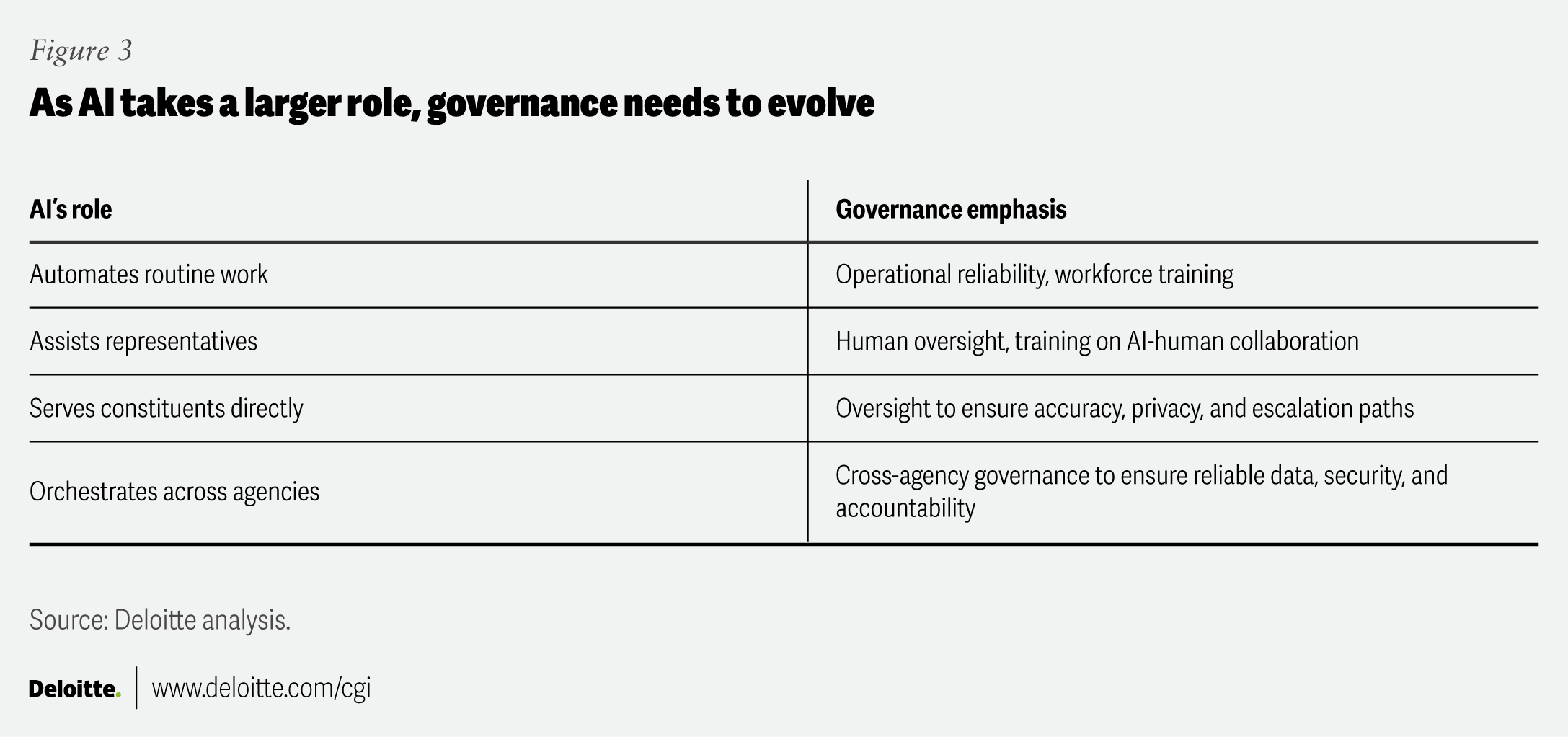
Not all AI risks in contact centers are the same. As AI plays a larger role in contact centers, the nature and potential consequences of those risks can change, requiring governance and controls to evolve as well.
In the early phases, the focus is on reliability and human oversight: In Phases I and II, risks could include service disruptions, inadequate employee training, and overreliance on AI-generated guidance. Agencies can address these risks through operational monitoring, training standards, supervisor review, clear escalation procedures, and checkpoints that keep humans involved in consequential decisions.
Direct AI interaction with constituents raises additional concerns: In Phase III, when AI begins providing information directly to constituents, accuracy, privacy, and appropriate escalation become more consequential. Agencies should develop safeguards and provide constituents with a reliable path to a human representative when needed.
Cross-agency orchestration introduces greater complexity and new risks: In Phase IV, drawing information from multiple agencies can increase privacy exposure. Moreover, incorrect information recorded in one agency, such as an inaccurate or outdated income figure, could affect decisions made by other agencies.
Interactions among AI agents could also introduce new security risks. Controls may therefore need to extend across agency boundaries, including data-sharing agreements, data segmentation, validation checkpoints, access controls, auditability, and continuous monitoring.
The appropriate controls will depend on how AI is being used and the consequences if something goes wrong. The goal is not to apply the same level of oversight to every use case, but to align governance with the role AI plays and the associated risks (figure 3).
Effective oversight also requires testing AI outputs, monitoring performance after deployment, and ensuring that consequential decisions remain reviewable and contestable.8
Turning the opportunity into action
Start with manageable use cases: Begin with lower-complexity tools, such as AI bots and agent assist, that can deliver early benefits. Also improve channel handoffs that force constituents to repeat information when moving from digital self-service or interactive voice response to a representative.
Build the foundation for scale: Modernize contact center platforms while improving the underlying knowledge bases, service workflows, and integration with customer relationship management and case-management systems. AI performance depends as much on the quality and accessibility of government information as on the sophistication of the models.
Walk before you run: Use AI-led self-service for simple requests and human oversight for moderately complex needs. Develop processes to escalate situations that merit human attention or oversight.
Understand your AI costs: AI introduces new types of costs. Governments will need to understand ongoing operating expenses, including model consumption, monitoring, integration, and governance, which can vary as consumption, pricing, and AI use change over time.
Match governance to risk: Match controls to each application’s maturity and risk.
Leverage AI for inclusive access: AI can support interactions in multiple languages. This can expand access for residents with limited or no English proficiency. India’s Centralised Public Grievance Redress and Monitoring System uses an AI-enabled multilingual voice chatbot to clarify, register, and route grievances, allowing people to lodge grievances in their own language.9
From answering questions to providing insights
The future of public-sector contact centers will not be defined by whether every call is answered by AI or by a person. Success will be defined by whether people can easily get the outcomes they seek and deserve.
The greatest opportunity may ultimately be not just to answer constituent questions faster, but to reduce the need for those questions in the first place. By drawing on insights from constituent interactions to identify what is working and what isn’t, AI-enabled contact centers could help governments improve services, support workforces, reduce unnecessary friction, and address problems before constituents need to call.
Continue the conversation
Meet the industry leaders
Shelly Metschan
John O'Leary
By
Shelly Metschan
Brian Haugabrook
Andy Beamon
John O'Leary
Sushumna Agarwal
Nicole Savia Luis
The authors would like to thank Marc Mancher and Andrew Lee for their thoughtful review, feedback, and insights at critical junctures throughout the study. The authors would also like to thank Anna Barnes, Chrissy Weaver, Amy Berggren, Molly Linabarger, and Casey Martner for their inputs on the draft.
Editorial (including production and copyediting): Kavita Majumdar, Shyamili M, Pubali Dey, and Anu Augustine
Design: Alexis Werbeck, Natalie Pfaff, and Manya Kuzemchenko
Cover image by: Manya Kuzemchenko; Adobe Stock
Knowledge services: Agni Wagh
Visit the Deloitte Center for Government Insights
Access more insights for the defense, security and justice, government health care, state and local government, transportation and infrastructure, human services, and higher education sectors.