
How much do bank customers trust gen AI?
Many banking customers use gen AI tools to research finances but hesitate to share personal data, trust recommendations, or let AI act on their behalf. What can that mean for banks?
Banking consumers are using more generative AI1 as a way to search, sort, and compare options, but Deloitte survey data suggests they remain selective about where they’ll allow AI to go next because they are worried about mistakes and privacy lapses.
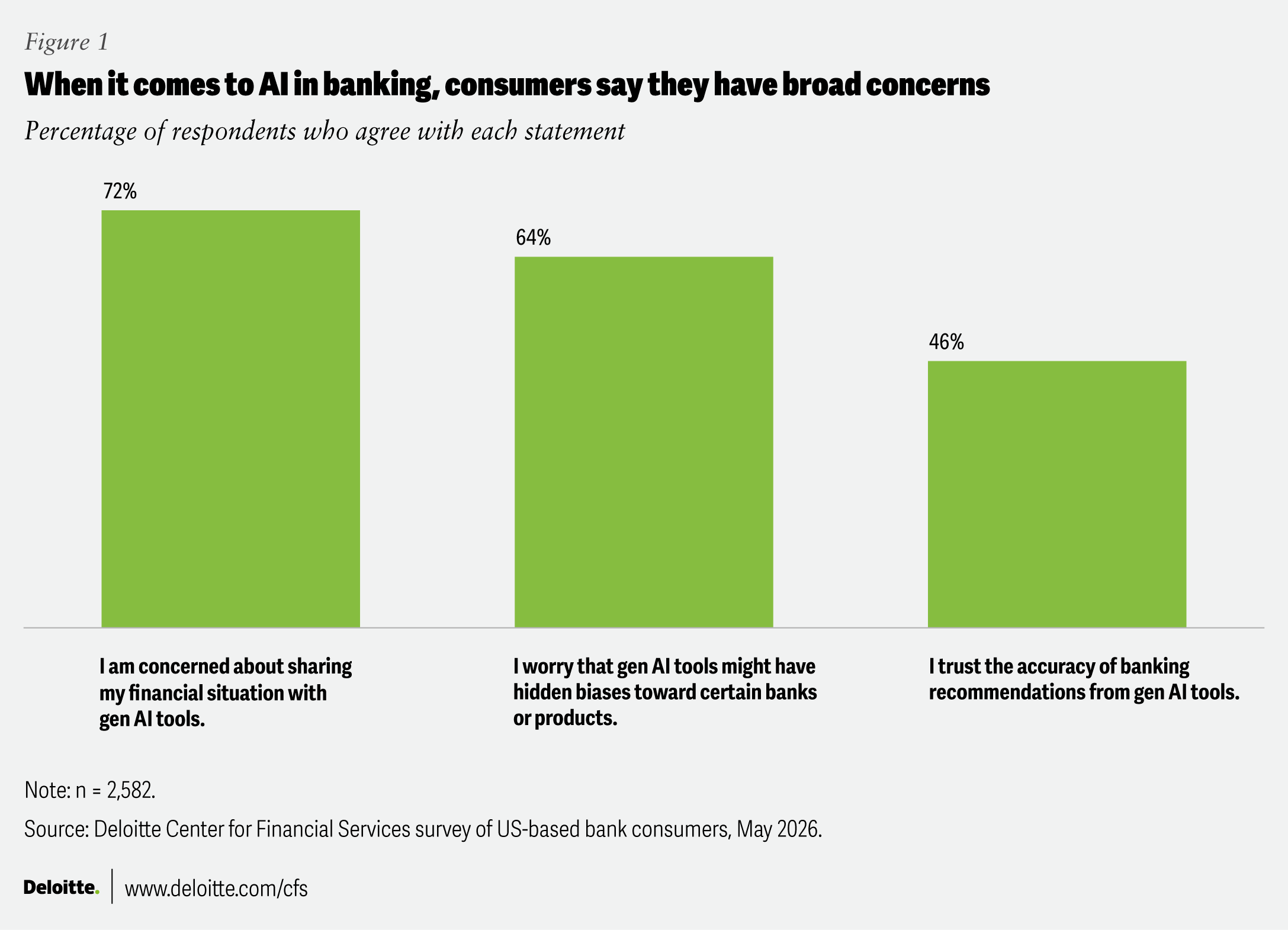
We surveyed almost 2,600 banking customers in the United States and found that 72% of consumers across different ages, genders, and income levels are concerned about sharing information about their financial situation with gen AI tools. Many (64%) also worry about hidden biases. Only 46% of respondents trust the accuracy of banking recommendations from the tools (figure 1).
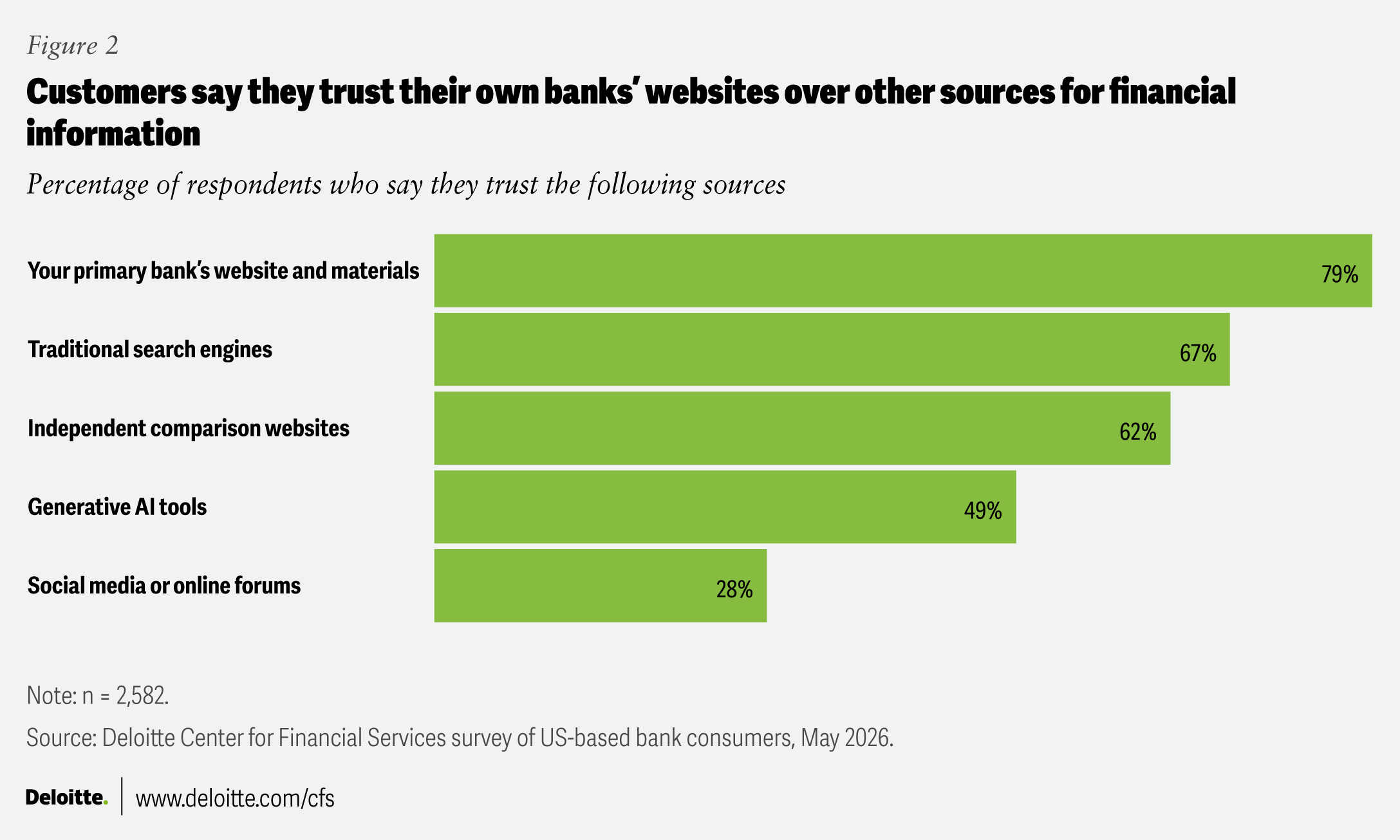
By contrast, 79% of bank customers who responded to the survey trust information from their banks’ own websites when researching banking products. That compares with consumers’ trust in traditional search engines (67%), gen AI tools (49%), and social media (28%) (figure 2). This difference between bank websites and gen AI tools reflects trust built by banks over years of regulations and customer experiences. Institutions should sustain this influence by ensuring their information and products are visible as gen AI tools become more popular gateways to financial research.
Our survey reveals a growing tension: Consumers may trust banks more than gen AI tools, yet they increasingly rely on gen AI. Also, as gen AI becomes more personalized and better at synthesizing information, banks’ trust advantage may diminish over time, particularly if consumers perceive gen AI tools as more neutral in their information or recommendations.
Banking customers want to stay in control
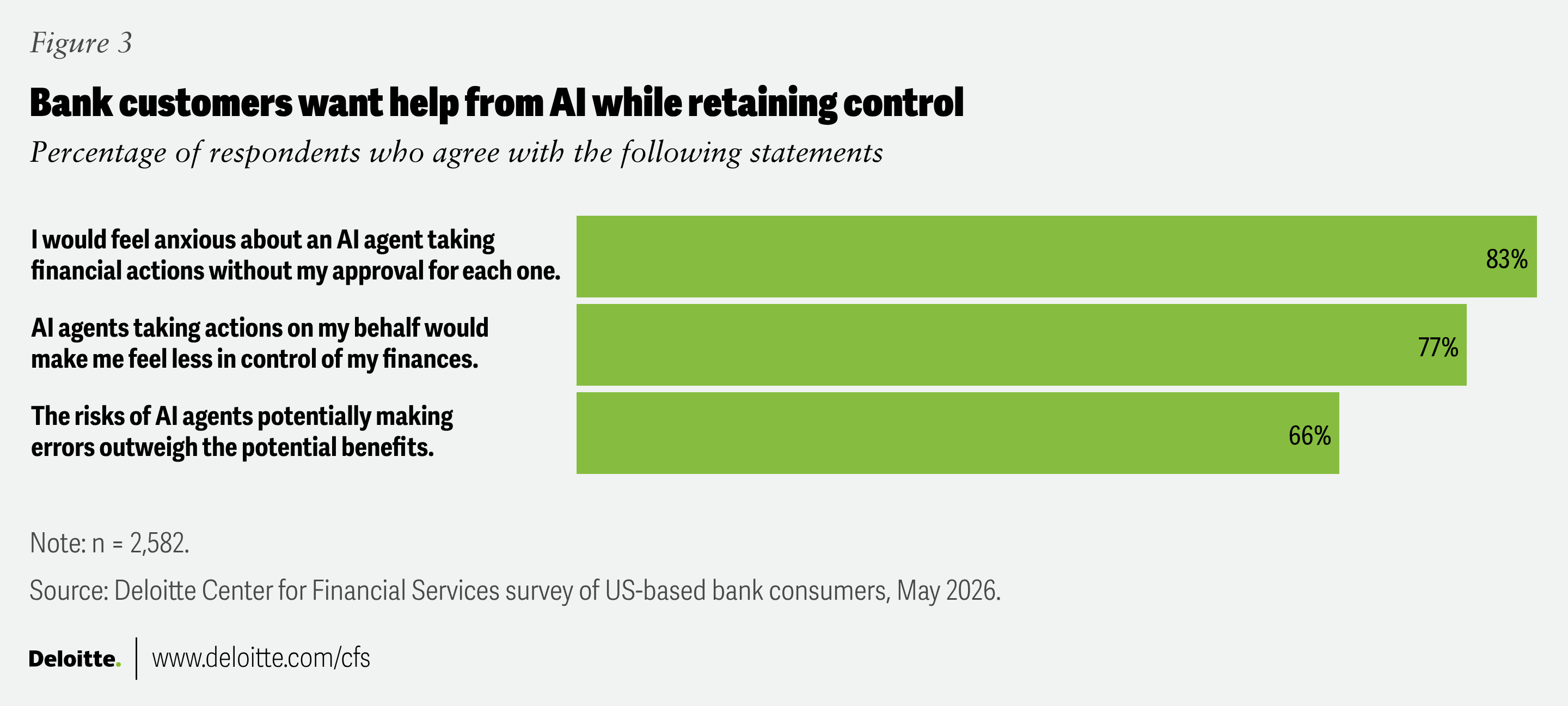
As banks roll out agentic AI tools, 83% of respondents say they would feel anxious about an AI agent taking action on their finances without their approval. And 66% say that the risk of AI agents potentially making errors would outweigh the benefits (figure 3). The concerns are widespread, with more than 40% of customers saying they are worried about costly errors, privacy, and no human oversight for AI agents.
Gen AI is still gaining traction in banking despite consumer concerns
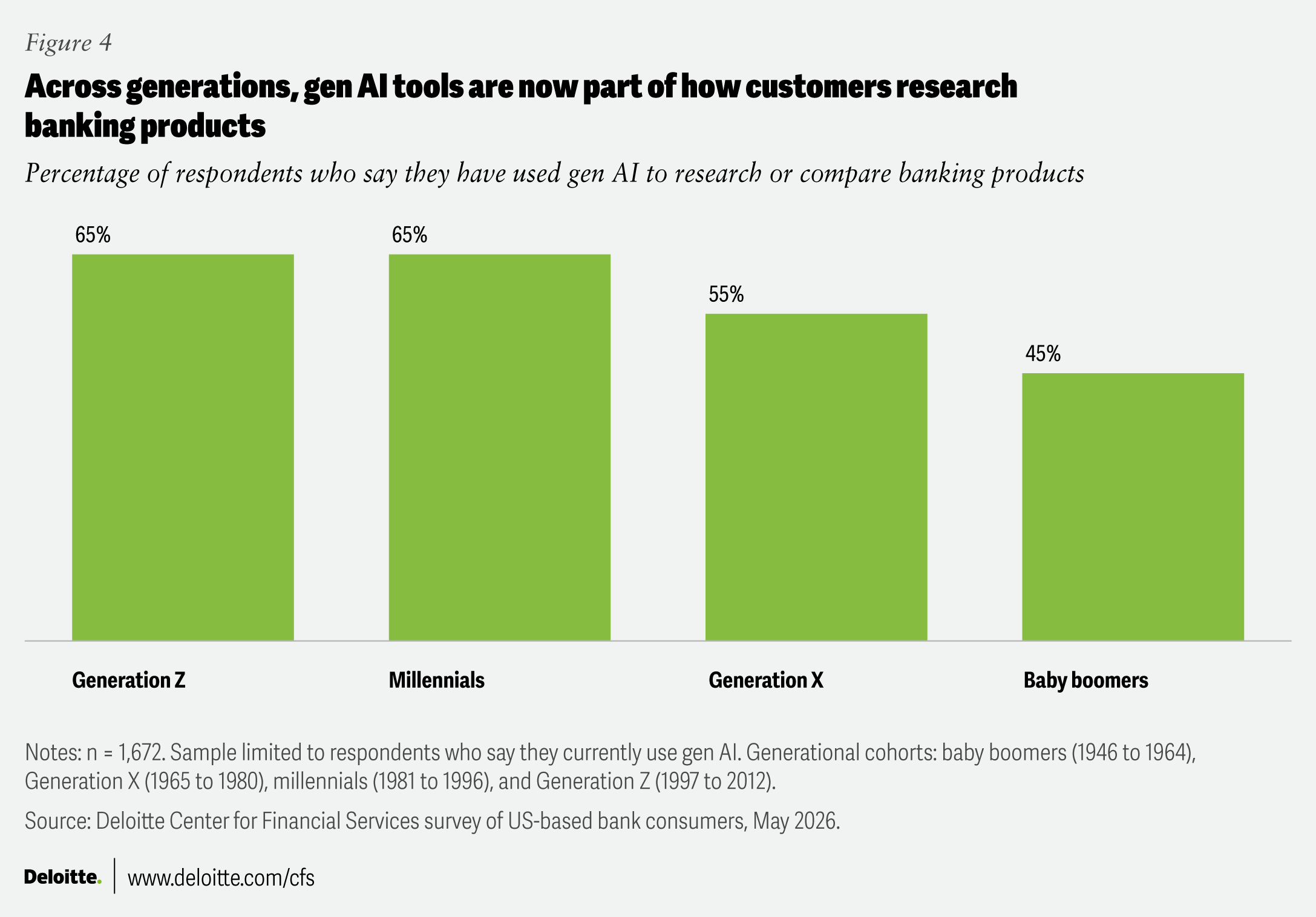
Despite their worries about the privacy, bias, security, and accuracy of gen AI tools, many banking customers still use them to save time and simplify product research. Among gen AI users surveyed by Deloitte, 58% have used these tools to research banking products, compared with 84% of respondents who have used search engines to do so. Only 45% of baby boomers2 have used gen AI for banking research, versus 65% of Gen Z respondents (figure 4). Skepticism is higher among older customers, with just 34% of boomers telling us they trust gen AI recommendations, compared with 55% of millennials.
Usage appears to be linked with trust. Of the roughly 1,700 respondents who say they have used gen AI tools, 60% told us they trusted the tools’ accuracy, compared with 19% of those who had said they had not used them.
Gen AI is changing how consumers gather information, compare alternatives, and buy products. It is becoming a more common starting point for how consumers get financial information, even though it hasn’t replaced search engines or bank websites.
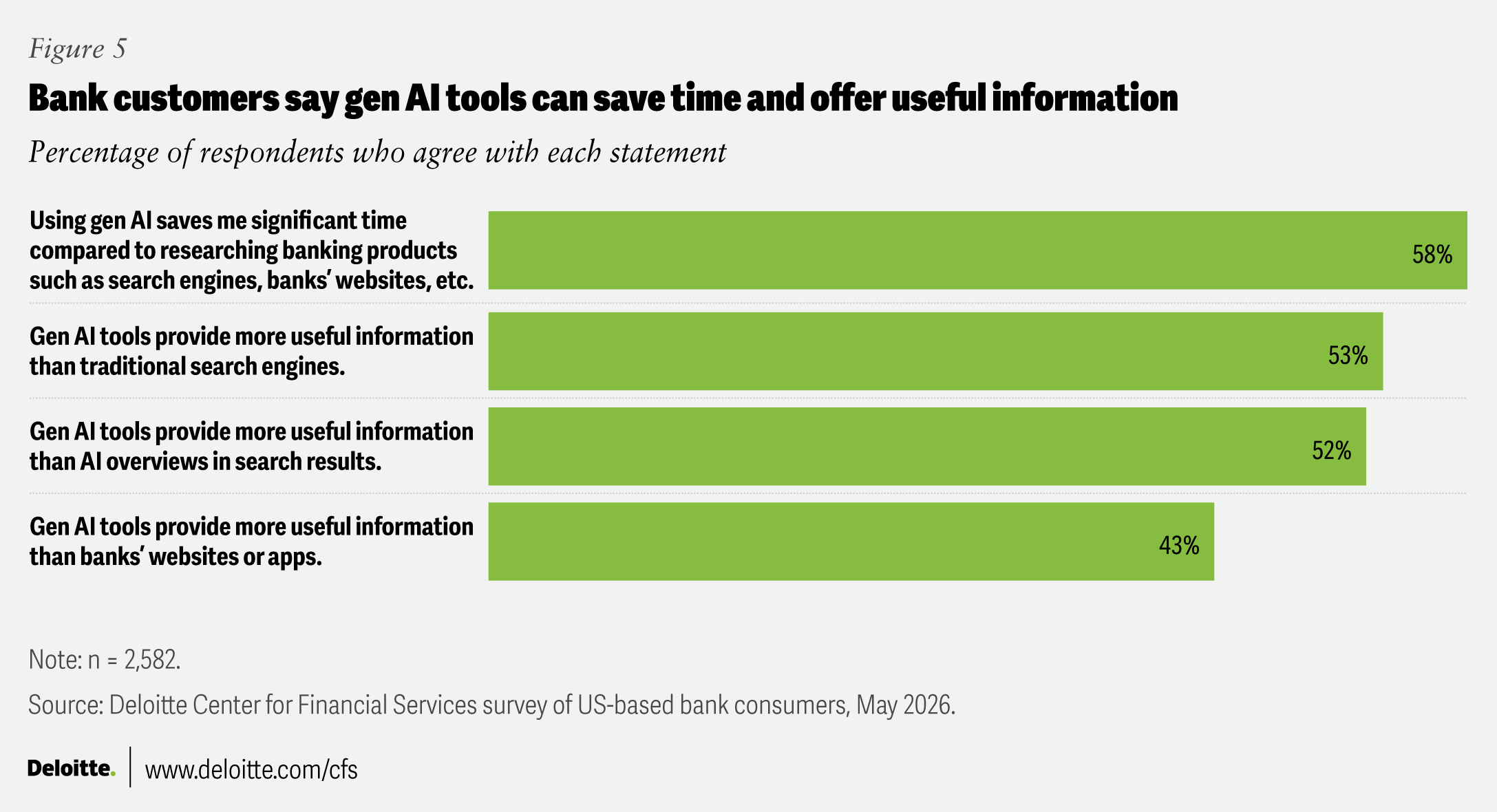
Respondents say the tools save them time compared with traditional sources like bank websites, comparison platforms, and third-party review sites. More than half of the customers polled say gen AI is more useful than search engines, and more than 40% say gen AI gives more useful information than bank websites or apps (figure 5).
How banks can retain trust as gen AI gains momentum
Our survey shows that customers still trust banks, but gen AI is shaping how they research, compare, and choose financial products. Here are practical steps banks can take to steer how third-party gen AI tools are used in financial decisions:
- Measure influence. Track the organization’s presence in AI-generated shortlists and the accuracy of AI descriptions. Measure customers’ trust and willingness to act on AI-assisted information.
- Redesign for AI searches. Make product descriptions, rates, fees, and disclosures structured and machine-readable so that AI tools can capture the organization’s bank offerings accurately. Tailor content to show customer questions and concerns on websites so the bank can stay visible in AI-mediated searches.
- Design customer-controlled AI. Prioritize tools that explain, compare, recommend, and prepare actions. Build in customer approvals before taking action.
- Enhance trust with product features. Show customers what data was used, what assumptions were made, and why a recommendation was given.
Continue the conversation
Meet the industry leaders
Val Srinivas
by
Baylee Simon
Jonathan Valenti
Nick Cowell
Alan Hart
Val Srinivas
Shivalik Srivastav
The authors would like to thank Annalyn Kurtz for editorial support on this article.
Editorial (including production and copyediting): Annalyn Kurtz, Sayanika Bordoloi, Stacy Wagner-Kinnear, and Cintia Cheong
Design: Molly Piersol
Cover image by: Tushar Barman and Adamya Manshiva
Knowledge services: Rishitha Bichapogu
Visit the Deloitte Center for Financial Services
Access more insights for the banking & capital markets, commercial real estate, insurance, and investment management sectors.