


Six M&A trends shaping dealmaking in 2026
Cautious optimism is driving a more selective approach to growth, deal execution and value creation.
Deloitte’s 2026 Heads of M&A survey finds Australian dealmakers remain ready to transact despite a more volatile outlook. Six trends reveal how they are targeting growth, managing risk and protecting value.
Key takeaways:
- Australian M&A leaders remain cautiously optimistic: 49% expect deal volumes to remain stable and 37% expect an increase over the next 12 months.
- Capability-led bolt-on acquisitions are the preferred path to growth, offering a targeted way to add strategic capabilities while limiting execution risk.
- Valuation gaps are demanding greater discipline, with buyers relying on scenario modelling, earnouts and a willingness to walk away.
- AI is reshaping deal execution faster than investment theses, while overstated synergies and uneven integration planning remain the greatest threats to value.
A lot can change in 12 months. Last year, falling interest rates and inflation were creating a more favourable environment for mergers and acquisitions (M&A). Now inflation has returned, the cash rate has risen and conflict in the Middle East has added fresh volatility to the geopolitical outlook.
Yet our annual Heads of M&A survey shows a market responding with caution rather than retreat. Confidence is concentrated in areas leaders can influence, and six trends are set to shape deals in the year ahead.
1. Decisions can be made under uncertainty
Economic and geopolitical risks have weakened sentiment. More than half of respondents expect overseas conflict to negatively affect their business, while only 53% are confident the economy will recover and grow, down from 65% last year. But this caution has not translated into retreat: 49% expect deal volumes to remain stable and 37% expect an increase.
The survey suggests that M&A decisions are increasingly being shaped by rigorous risk assessment, with dealmakers focusing on variables they can influence, including sector positioning, funding capacity and execution planning. The message is not that uncertainty has disappeared, but that it can be priced and managed when the strategic rationale is strong.
2. Capability led bolt-ons to accelerate growth
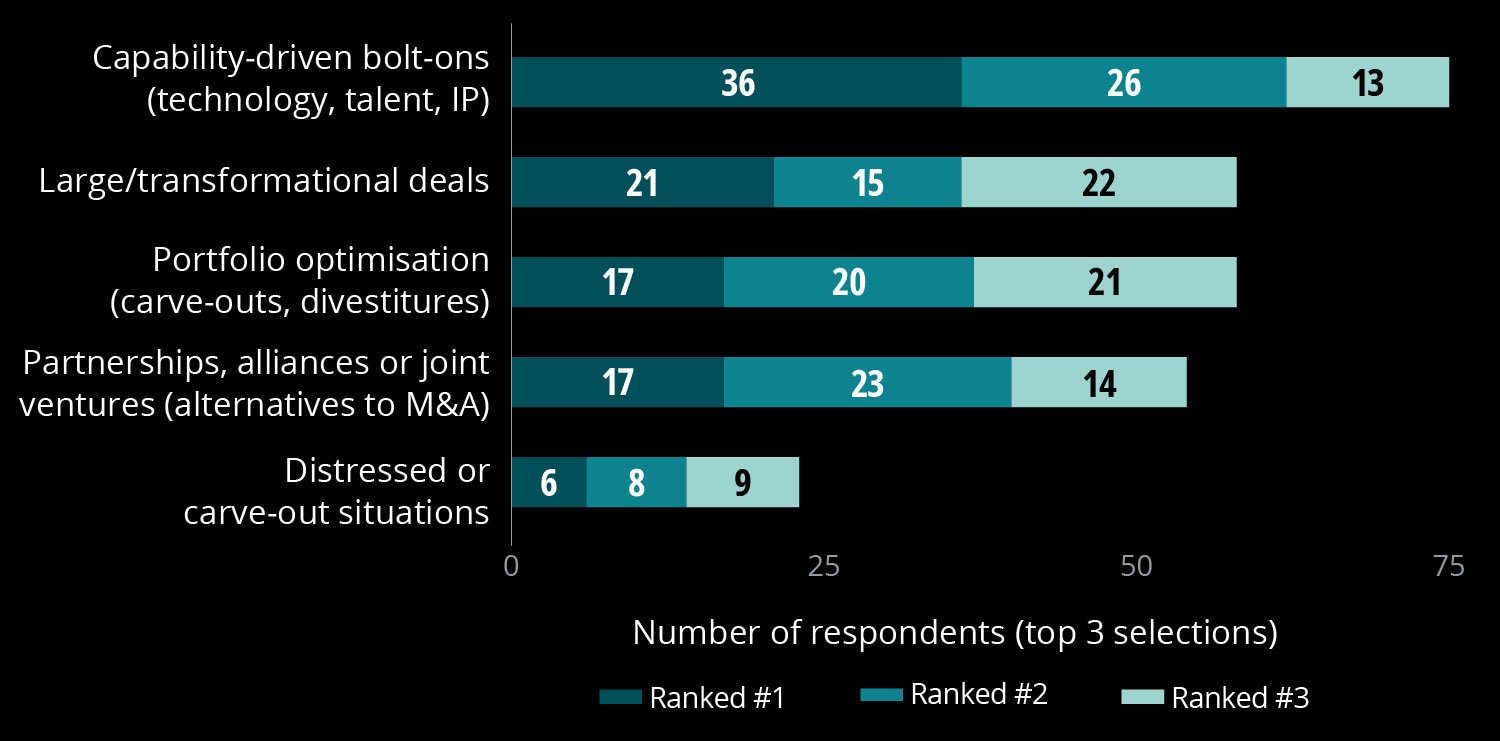
Capability-led bolt-ons are emerging as dealmakers’ preferred route to growth while reducing integration complexity, capital exposure and execution risk.
The approach reflects where confidence sits. Dealmakers are positive about their balance sheets, funding and sector opportunities, but less assured about the economy, regulation and valuations. Even so, risk tolerance and approval thresholds are broadly steady, while 49% expect deal volumes to hold and 37% anticipate an increase. Growth remains the objective for 62% of respondents.
Chart 12: Where organisations are most willing to transact over the next 12 months
The result is an active but selective market.
3. Valuation gaps demand greater discipline
The balance of negotiating power is shifting. Buyers have more time and choice, while many sellers remain anchored to prices set when conditions were less volatile. The bid-ask spread is now the clearest barrier to transactions: 52% identify it as the biggest obstacle to closing deals, while 44% say valuation volatility frequently delays or derails approval.
Capital remains available, but it is being deployed more selectively. Scenario modelling is central to that discipline: 55% require it for every approval and another 21% use it for larger or higher-risk transactions, testing what happens if growth falls short, costs rise or market conditions deteriorate.
Deal structures are absorbing more uncertainty. Earnouts and contingent consideration allow sellers to preserve a headline valuation while requiring performance to be delivered before the full price is paid. Joint ventures, minority stakes and staged acquisitions offer other ways to share risk.
The simplest tool remains walkaway discipline, used by 58% of respondents when the gap cannot be closed. In this market, completing a transaction matters less than securing the right asset at a price and on terms that protect value.
4. Portfolio reshaping strengthens the core
Growth remains the dominant objective, but portfolio reviews are becoming as important as acquisitions. Portfolio decisions are being used to reduce concentration, simplify the business and redirect capital and leadership attention towards the strongest opportunities.
Acquisitions still lead the agenda: 47% report a strong focus on buying businesses with minimal divestment activity. Another 20% are active on both sides, while 16% are primarily focused on portfolio rationalisation and divestments. The test for existing assets is whether they strengthen the group’s future strategy and whether common ownership remains the best way to create value.
Operational complexity is prompting action. While 54% consider their portfolios appropriately structured, 16% are actively carving out non-core or complex businesses and 12% are considering it. Geographic concentration is another priority, with 23% actively using transactions to manage market entry or exit and 35% considering it.
The strongest decisions will be based on forward strategic fit rather than recent performance. The best portfolio is a coherent one.
5. AI is reshaping execution, not yet the deal thesis
AI is changing how dealmakers work faster than it is changing what they buy. Most do not yet see it as a primary driver of acquisitions, distinguishing enthusiasm for the technology from confidence that it can create measurable enterprise value.
Buyers are looking beyond the AI label to commercial fundamentals. Some 58% would not acquire an immature or unprofitable AI or technology target without demonstrated profitability, while 23% would require significant risk mitigation. Only 4% include AI upside in the base case and 58% do not assess AI-driven revenue uplift.
AI is also creating a new diligence challenge. Buyers need to test whether a target’s products, pricing power, data and technology can withstand disruption. Yet close to half do not assess several key risks, and only 12–16% are very confident in their ability to judge whether a target can compete in an AI-disrupted market.
Tools such as Deloitte’s AI Due Diligence offering can help buyers understand how AI could change a target’s value. It starts with a quick assessment of how exposed the business is to disruption and how well it can respond, followed by deeper commercial and technical analysis where needed. This helps buyers work out whether the target’s AI claims stand up and what that means for the investment case.
Adoption within the deal process is accelerating, particularly in target screening and financial due diligence, but it falls away later in the lifecycle: 67% do not use AI to validate synergies and 71% do not use it for integration or separation planning. As access broadens, advantage will come from combining the tools with institutional knowledge and human judgement. AI can strengthen the evidence, but accountability remains with the dealmaker.
6. Value creation starts before signing
Signing completes the transaction, but it does not deliver the value. The hardest work begins when the buyer must turn the investment thesis into operating outcomes. Respondents identify overestimated synergies as the leading risk to value creation, closely followed by complex or poorly planned integration.
People and culture are the broadest pressure point, with 68% reporting tension between pre-deal assumptions and what can be delivered. Technology and systems follow at 62%. The business case therefore cannot be developed separately from the practical realities of bringing two organisations together.
Integration planning needs to begin during due diligence. Involving business and functional leaders early can test whether synergies are achievable, reveal dependencies and clarify the scope and pace of integration. Yet planning remains uneven: 30% flex their approach by transaction, 24% prioritise speed to close and only 11% invest heavily before close regardless of pace.
Business cases may need to be reset as new information emerges, but leaders should be transparent about what changed and how any value gap will be addressed. Protecting value requires the discipline of due diligence to continue through execution, with the business case, integration strategy and benefits plan aligned and accountable after signing.


