
Tech Trends 2026
As technology innovation and adoption accelerate, five trends reveal how successful organizations are moving from experimentation to impact
I spend most of my year in conversations with technology leaders, asking what’s working, what isn’t, and what keeps them up at night. Lately, those conversations have taken on a different quality.
The question used to be “What can we do with AI?” Now it’s “How do we move from experimentation to impact?” The focus has moved from endless pilots to real business value, and there’s a sense of urgency behind it all. Not because the technology is getting better—though it is—but because the pace of change itself has accelerated.
The numbers tell the story (figure 1). The telephone took 50 years to reach 50 million users. The internet took seven years. A leading generative AI tool reached about twice that many in two months.1 As of this writing, that tool has over 800 million weekly users—roughly 10% of the planet’s population.2
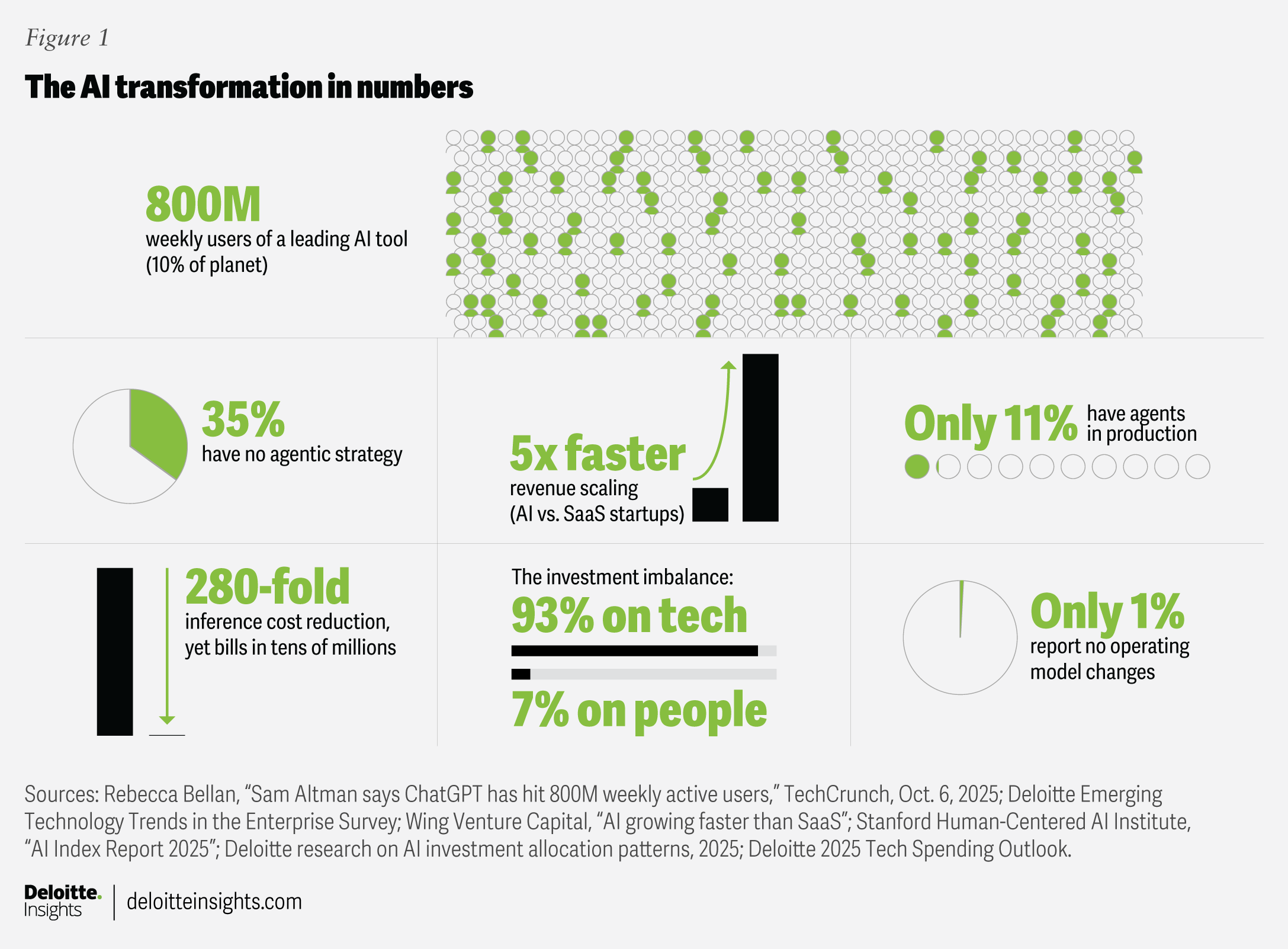
But rapid adoption is only the surface. Innovation is compounding; forces aren’t simply additive, but multiplicative. Think of it as a flywheel: Better technology enables more applications. More applications generate more data. More data attracts more investment. More investment builds better infrastructure. Better infrastructure reduces costs. Lower costs enable more experimentation. Each improvement simultaneously accelerates all the others.
It’s why AI startups scale from US$1 million to US$30 million in revenue five times faster than SaaS companies did.3 It’s why the knowledge half-life in AI has shrunk to months from years.4 And it’s why one chief information officer (CIO) told me, “The time it takes us to study a new technology now exceeds that technology’s relevance window.”
Every organization we studied is discovering the same truth: What got them here won’t get them there.
The infrastructure built for cloud-first strategies can’t handle AI economics. Processes designed for human workers don’t work for agents. Security models built for perimeter defense don’t protect against threats operating at machine speed. IT operating models built for service delivery don’t drive business transformation.
This isn’t only about enhancement. It’s about rebuilding.
For 17 years, Tech Trends has explored emerging technologies poised to reshape business in the next 18 to 24 months. Our research is based on trend sensing from conversations with Deloitte subject matter experts and external technology leaders, as well as Deloitte’s proprietary research on emerging technologies. This year, the data reveals five interconnected forces.
AI goes physical: Navigating the convergence of AI and robotics
Amazon deployed its millionth robot, and its DeepFleet AI coordinates the entire robot fleet, improving travel efficiency within warehouses by 10%.5 BMW’s factories have cars driving themselves through kilometer-long production routes.6 Intelligence isn’t confined to screens anymore; it’s embodied, autonomous, and solving real problems in the physical world.
The agentic reality check: Preparing for a silicon-based workforce
Only 11% of organizations have agents in production, despite 38% piloting them. The gap between pilot to production tells you everything. Forty-two percent are still developing their strategy, while 35% have no strategy at all.7 Gartner predicts that 40% of agentic projects will fail by 20278—not because the technology doesn’t work, but because organizations are automating broken processes instead of redesigning operations. HPE’s chief financial officer captured what works: “We wanted to select an end-to-end process where we could truly transform, not just solve for a single pain point.”9 Redesign, don’t automate. That’s the pattern separating success from failure.
The AI infrastructure reckoning: Optimizing compute strategy in the age of inference economics
Token costs have dropped 280-fold in two years;10 yet some enterprises are seeing monthly bills in the tens of millions. Usage exploded faster than costs declined. Organizations are discovering their existing infrastructure strategies aren't designed to scale AI to production-scale deployment. They're shifting from cloud-first to strategic hybrid: cloud for elasticity, on-premises for consistency, and edge for immediacy.
The great rebuild: Architecting an AI-native tech organization
AI is restructuring tech organizations, making them leaner, faster, and more strategic. Only 1% of IT leaders surveyed by Deloitte reported that no major operating model changes were underway.11 Leaders are shifting from incremental IT management to orchestrating human-agent teams, with CIOs becoming AI evangelists. Success requires bold reimagination: modular architectures, embedded governance, and perpetual evolution as core capabilities.
The AI dilemma: Securing and leveraging AI for cyber defense
The technology meant to give businesses an advantage is becoming the target used against them. AT&T’s chief information security officer captured the challenge: “What we’re experiencing today is no different than what we’ve experienced in the past. The only difference with AI is speed and impact.”12 Organizations must secure AI across four domains—data, models, applications, and infrastructure—but they also have the opportunity to use AI-powered defenses to fight threats operating at machine speed.
Throughout this year’s report, you’ll meet technology leaders successfully navigating this sea change. They don’t have all the answers, but there are noticeable patterns as they light the way forward.
- They lead with problems, not technology. Broadcom’s CIO: “Without focusing on a specific business problem and the value you want to derive, it could be easy to invest in AI and receive no return.”13
- Specifically, their biggest problems. UiPath CEO: “Rather than getting stuck in a cycle of perpetual proofs of concept, consider attacking your biggest problem and going for a big outcome.”14
- They prioritize velocity over perfection. Western Digital’s CIO: “We’d rather fail fast on small pilots than miss the wave entirely.”15
- They design with people, not just for them. Walmart involved store associates in building its scheduling app, which includes shift swapping, schedule visibility, and employee control. The result: Scheduling time dropped from 90 minutes to 30 minutes, and people actually used the app.16
- They treat change as continuous. Coca-Cola’s CIO described their journey as moving from “What can we do?” to “What should we do?”17 That shift—from capability-first to need-first—is what separates productive experimentation from pilot purgatory.
I’ve tracked technology evolution long enough to recognize the patterns. The internet changed everything. Mobile reshaped consumer behavior. Cloud computing was transformative.
But this moment is different.
It’s not just that AI is powerful. It’s that the S-curves are compressing. The distance between emerging and mainstream is collapsing.
Organizations built for sequential improvement can’t compete with those operating in continuous learning loops. The traditional playbook assumed you had time to get it right. That assumption no longer holds.
The organizations that succeed will probably not be those with the most sophisticated technology. They’ll be those with the courage to redesign rather than automate, the discipline to connect every investment to business outcomes, and the velocity to execute before the window closes.
Innovation compounds. The gap between laggards and leaders grows exponentially. How you respond determines which side of that gap you’re on.
But you don’t have to navigate this alone. We hope this year’s publication reminds you that everyone’s facing this rapid pace of change, and together, we can shape what comes next.
Kelly Raskovich
Executive editor, Tech Trends
BY
Kelly Raskovich
The author would like to thank executive sponsor Bill Briggs, as well as the Office of the CTO Tech Market Presence team, without whom this report would not be possible: Caroline Brown, Ed Burns, Preetha Devan, Bri Henley, Dana Kublin, Makarand Kukade, Haley Gove Lamb, Heidi Morrow, Sarah Mortier, Abria Perry, and Catarina Pires.
Additionally, the author would like to acknowledge and thank Katarina Alaupovic, Allison Cizowski, Deanna Gorecki, Ben Hebbe, Mikaeli Robinson, and Madelyn Scott; Amanpreet Arora and Nidhi John; as well as the Deloitte Insights team, the Marketing Excellence team, the NExT team, and the Knowledge Services team.
Cover image by: Jim Slatton; Getty Images, Adobe Stock