
Unlocking human potential
Proactive practices for individual elasticity
Introduction
One of the fundamental shifts that we now face is the shrinking of time spans, in large part due to exponential technological change coupled with the instantaneous propagation of ideas and information across a connected world. What used to take decades now takes years; what took years takes months; months, weeks; weeks, days; days, hours; hours, minutes. In the institutional environment, this shift is disrupting established businesses and business models, but it has also created a new set of businesses and business models better adapted to the faster (and accelerating) pace.
We, as individuals, are also experiencing this shift. For our parents, an education lasted a whole career. Now, it may last 5–10 years.1 With the accelerating pace of change, the relevance and validity of the ability to “know” a stable stock of knowledge is diminished while other abilities, such as creativity, empathy, and the ability to read context, become more important. Our children will truly have to take lifelong learning seriously, continuously upgrading their skills. They will likely transition to completely new fields of study and employment more than a few times in their careers. Like institutions, we too will need to develop new practices and capabilities that are adapted to the times.
Amid these pressures of a new, modern world, people have turned to some old, and very old, practices. Exemplified by phenomena such as the Wisdom 2.0 conference, there is a growing movement built around mindfulness, meditation, gratitude, and digital detox—all in reaction, as antidotes, to increased stress. The well-being sector is booming, experiencing new demand for old practices as well as developing new practices and distinctly new twists on old practices. Yoga has never been asked to do so much for so many. In fact, a recent study found that the number of people practicing yoga in the United States has increased by nearly 80 percent since 2012, with practitioners spending over $16 billion annually on instruction.2 Meanwhile, meditation-related spending reached just under $1 billion in 2015, a figure that doesn’t include mindfulness apps.3 The workplace wellness market is over $40 billion in the United States.4 In the desire to understand ourselves holistically and to thus manage our lives, health and wellness, well-being, mental health, professional development, career advancement, and even community service collide as the boundaries between these sectors and parts of our lives blur.
What we propose in Unlocking human potential is a set of proactive practices for all of us that can help shift the paradigm, as we face the unknown and unpredictable, from stress and survival to excitement and vitality. These practices include those, championed by (among others) the Wisdom 2.0 movement, that allow you to slow down and re-anchor yourself. We call these slowing-down practices “Roots.” But we also believe that Roots practices can have more value, not just when used proactively, but when used in concert with other practices—such as building a diverse social media network, traveling, and “unscheduling”—to speed up and explore new arenas for learning and growth. We call these speeding-up practices “Shoots.”
By connecting Roots practices with Shoots practices, individuals have the potential to not only gain focus, improve well-being, and become more productive (all potential outcomes of any one practice), but also to become more adaptable, more capable of learning across changing contexts, more empathetic, and more creative and flexible in creating new approaches and adapting old ones to sustain themselves over a career and a lifetime.
This isn’t a story about “checking out” or taking the path less traveled. It’s about checking in, with yourself and with others; leaning in and climbing out; jumping into the flow of ideas, people, and information to learn new strokes; and eddying out to regain equilibrium. It’s about learning to move with purpose and using flows, and “flow,”5 to successfully and sustainably live and work. We are very much interested in the path we’re all on. It’s about each of us finding ways to create a better path for ourselves, making sure the path is taking us where we want to go, and understanding the many options we have for traversing it.
While this report focuses on practices for individuals, institutions have an important role to play by providing environments that accelerate the adoption of these practices within the shifting contexts of the Big Shift. That, in turn, will endow institutions with a workforce that can bring creativity, curiosity, reflection, and resilience to the challenges of a changing and unknowable future business environment, leading to increased productivity and improved performance and output.
In the rest of this report, we build a framework around the “Roots and Shoots” concept and use it to explore a variety of practices relevant to our current and future work and life. This framework is designed to provide a new lens through which to view some of the robust research and tools that already exist, and to propose ways to use some of those tools and capacities in different ways or with a different focus. We will discuss how some existing practices fit into this framework and where there may be gaps, as well as possible mechanisms for connecting Roots to Shoots practices.
In developing this report, we saw three themes emerge:
- Roots and Shoots practices should be proactive, not reactive: The rationale for looking at these practices is not for their—for Roots in particular—well-documented value in mitigating stress and “busyness,” but for their greater value in unlocking and sustaining potential.
- Slowing down (Roots) and speeding up (Shoots) are complementary, not contradictory: With so many people already engaging in Roots practices, much unrealized potential can likely be gained by thoughtfully connecting Roots to new Shoots so that they reinforce and inform each other.
- Unlocking potential is a process of unlearning and learning: The interplay between Roots and Shoots and the focus of the practices themselves help us unlearn mental models and ways of operating that are no longer useful and learn skills and capabilities that are relevant to our future lives.
We don’t have all the answers. We hope, with this report, to start a conversation and to provide a framework for thinking about the options and how they support your individual and institutional goals. Ideally, Roots and Shoots practices are not just a reaction to stress, grabbed like lifelines as you careen by. Rather, they are proactive tools assembled with deliberation to better realize your full potential.
Individual elasticity for an unpredictable world
Balance, specifically work-life balance, often seems to be the goal, however elusive, when we try to develop new practices around our work and life. We are told that our lives, and our working lives, may be long—longer than for previous generations6—and we know that we have to sustain our bodies, minds, and relationships across this lifetime. To do this, we turn to balance. But is balance the only, or even the right, goal? In moments of unhappiness, we tend to notice great imbalances and think that balance is the answer. But for many of us, in thinking about our careers and aspirations and the ways we assess ourselves and find meaning, progress or impact might be as necessary for sustaining ourselves as balance.
If balance isn’t necessarily the goal, what is? The discourse around personal practices for times of exponential change tends to be divided between speeding up and slowing down, not so much at odds with each other as disconnected, each camp oblivious to the relevance of the other. On one side are practices for speeding up: doing more, getting more, becoming better, faster, stronger. In this camp, we identify passions, get into a flow state, and hack everything, Tim Ferriss style; the answers are out there, digital tools put them all within reach, and the only question is, what’s stopping you? In the other camp are practices for slowing down: mindfulness, meditation, digital detox. The answers are in there if you can shut out the distractions long enough to listen.
Both camps are responding to the increasing pressure that we all feel in current times. The goal of the first is the need to achieve, to stay relevant and competitive in a faster world where safety nets and social contracts are in short supply. The goal of the second is to mitigate and recover from the actual pressures of an always-on, fast-moving, competitive world. Seemingly irreconcilable, each goal points to different practices.
As we’ve written elsewhere,7 this situation is complicated by the fact that the useful life of specific skills is decreasing, and it is hard to predict exactly which skills an organization will need next. Any work that can be standardized and made routine is a likely candidate for automation, and rapidly improving AI (artificial or augmented intelligence) will encroach even on some work that requires “judgment.” What will remain is the subject of another report, but we believe there will still be many ways for humans to augment machines and machines to augment humans. Curiosity, empathy, and creativity, as well as resourcefulness, flexibility, and persistence, will be critical capabilities for the demands of the future. The ability to learn (new skills, new contexts, and new applications), the flexibility to apply skills and tools in new ways, and the creativity to create new knowledge will be paramount.
If we take as our goal sustainable, long-term performance, the practices for slowing down and speeding up can be seen as complementary rather than contradictory. Slowing-down practices have been shown to improve creativity, persistence, and empathy.8 Speeding-up practices fuel curiosity, uncover new resources, and expose us to new ideas and contexts that may prove relevant to our own domain or pursuits. Both are critical to the ability to engage in the type of learning that we believe will be increasingly important in the workforce: that which creates new knowledge (insights, techniques, approaches), in contrast to assimilating existing stocks of knowledge.
Taken together, speeding up and slowing down form what we think of as “individual elasticity”: flexibility and responsiveness in a system designed to be flexible and responsive. Individual elasticity borrows from the concept of “resilience” developed by Joshua Cooper Ramo, which is defined as being able to become stronger, not just survive or bounce back, as a result of stresses to the system.9 This strong, flexible, responsive system—our individual elasticity—comes of cultivating both the ability to slow down and the ability to speed up. Echoes of this concept are found in Chinese yin-yang philosophy, which describes how “opposite or contrary forces are actually complementary, interconnected, and interdependent in the natural world, and how they give rise to each other as they interrelate to one another.”10 In addition, individual elasticity depends upon developing the ability to cycle between slowing down and speeding up over periods of weeks and months—and also over the course of a day or an hour—through a set of practices that fit the cadence and rhythm that an individual needs.
Focusing on speeding up without the space or capacity to slow down and reflect can lead to burnout, or to pursuing a topic or staying on a career path beyond its viable life. Similarly, practices to slow down and become grounded can be useful and healing, but without focus, direction, and experimentation, they could lead to stagnation. We nourish our minds, spirit, and bodies through growth and exploration as well as through rest. When both sides are understood to be complementary and pursued deliberately to reinforce each other, the effect on unlocking potential is greater.
While different life and career stages may dictate a greater need for some practices over others at any given time, it is imperative for individuals to have the ability to slow down and speed up, and to develop an array of speeding-up and slowing-down practices to draw on over the course of a lifetime.
The Roots and Shoots framework
Think of a tree. It is rooted to the ground. Through a system of strong roots anchored into soil and rock, the tree gets nutrients, water, and stability—all essential for the tree’s health and growth. A strong tree also has branches, shoots of new growth that spread upward and outward into the sky. Through these shoots, the tree collects sunlight for photosynthesis, also essential for the tree’s health and growth.
Roots and shoots are both vital—not just necessary, but interdependent, forming a cycle. We thought that this was a useful way to think about the simultaneous need in our lives to cycle between slowing down (Roots) and speeding up (Shoots) if we want health and growth.
Growth is a key differentiator in this framework. So many practices are focused on health, often defined as recovery from or resistance to stress in all the ways it manifests in our bodies, work, and relationships. There’s no doubt that health alone, or the absence of harm, is a compelling goal for its own sake. Yet many of us, whether or not we acknowledge it, want something more than health and the absence of pain. Most of us once wanted to be something or do something. Most of us still do. That is the heart of our framework, the trunk of our tree: The fundamental reason to engage in Roots and Shoots practices is to unlock our potential.
It is our contention that learning and unlearning—which, together, lie at the heart of growth—occur through the interplay of Roots and Shoots. Learning and unlearning occur on two levels. First, we have to learn and adopt new practices as well as—equally important but perhaps more difficult—unlearn and stop executing old practices that are not serving us. Second, to pursue growth, we must acknowledge that the point of engaging in new practices is to learn new skills and approaches that are most relevant to the moment at hand and that will serve us in the dynamic future. The goal is to be exposed to new ideas and new ways of looking at the world, to develop new skills and techniques, and to discover new applications of skills and tools we already have.
In our framework, we begin by identifying key elements of Roots and Shoots. These elements describe “how” growth and learning happen in the Roots and Shoots cycle. What does it mean to be in the Roots, in the slowing-down space? What does it mean to be in the Shoots, in the speeding-up space? These elements, which we will describe in greater detail later, include Rest, Reconnect, and Reflect and Reframe for Roots, and Act, Adjust and Align, and Accelerate and Amplify for Shoots.
Within the broad context of the elements, certain types of activities are necessary to feed and sustain the learning cycle. This is where practices come in. Practices are discrete, tangible activities that we can build into our daily lives to help develop the capability for speeding up and slowing down in the service of our values and aspirations. Our framework identifies several “meta-practices” (such as “shape serendipity”) to define the objectives that will nourish and sustain the cycle. These meta-practices help further differentiate deliberate practices from the everyday activities that consume us—the outward busyness and escapism and the inward anxiety and retrospection, which don’t serve us well in navigating the changing world.
While well-developed practices already exist within some meta-practices, in others, the meta-practice defines an objective that isn’t yet supported by effective, accessible practices. Some practices also align to multiple meta-practices; meditation, for example, serves to “replenish and re-energize” as well as to create space to “explore core values.” Our intent with the framework is less to create an authoritative, mutually exclusive mapping of all practices than to offer a way to think about the role of the practices we have and identify what is missing.
By adopting Roots and Shoots practices and going through cycles of learning and unlearning, an individual can discover purpose and passion. Sometimes, the goals we set give us purpose; ideally, our sense of purpose gives shape to our goals. And if we don’t yet have goals or purpose, as human beings, we have an innate curiosity, a need for novelty and learning that must continually be fed to maintain health and sustain vitality. In the process of feeding our curiosity and deepening our understanding in specific areas of interest, we discover new avenues of inquiry and connections to other domains that pique our interest or in which we have unique capabilities. Through this branching, circling back, and aggregation of skills and knowledge flows, we may discover our sense of purpose and cultivate our passion.
How learning happens
The illiterate of the 21st century will not be the man who cannot read and write, but the man who has not learned how to learn.
The Roots and Shoots framework helps highlight where our practices are out of balance and where we may need to invest. The larger goal, however, is to focus our attention and energy on developing a productive dynamic between Roots and Shoots such that we perform better and hew more truly to our purpose, no matter how the environment changes. If we think of practices such as meditation as tools that can be deployed toward multiple ends, it’s worth first examining the objective—achieving growth and sustained performance improvement—to consider how unlearning and learning occur in the interplay between Roots and Shoots. Having established how this dynamic should work, we can then use the lens of unlearning and learning to consider specific practices.
The type of learning we are most interested in is integrated learning, where an individual not only gains skills or knowledge about the specific context but also generates insights and applies his or her new skills and insights to other areas. Learning that focuses only on context-specific techniques or mastering existing stocks of knowledge may be useful, but are prone to fall short in helping us navigate the changing world;11 integrated learning, in contrast, accumulates and is constantly evolving. The former type of learning is like collecting fruit just to eat versus planting the fruit’s seeds to grow more trees. Both have the potential to provide sustenance for a time, but integrated learning is like bringing fertilizer and seeds together to grow an orchard that can sustain us over time and at higher levels of performance.
The graphic below identifies six elements in the Roots and Shoots that are conducive to integrated learning. Importantly, these six elements need not be explored in any particular order; there is no set pathway for learning and growth. Rather, an individual can take the opportunity to begin consciously cycling between Shoots and Roots and make a deliberate effort to connect the elements.
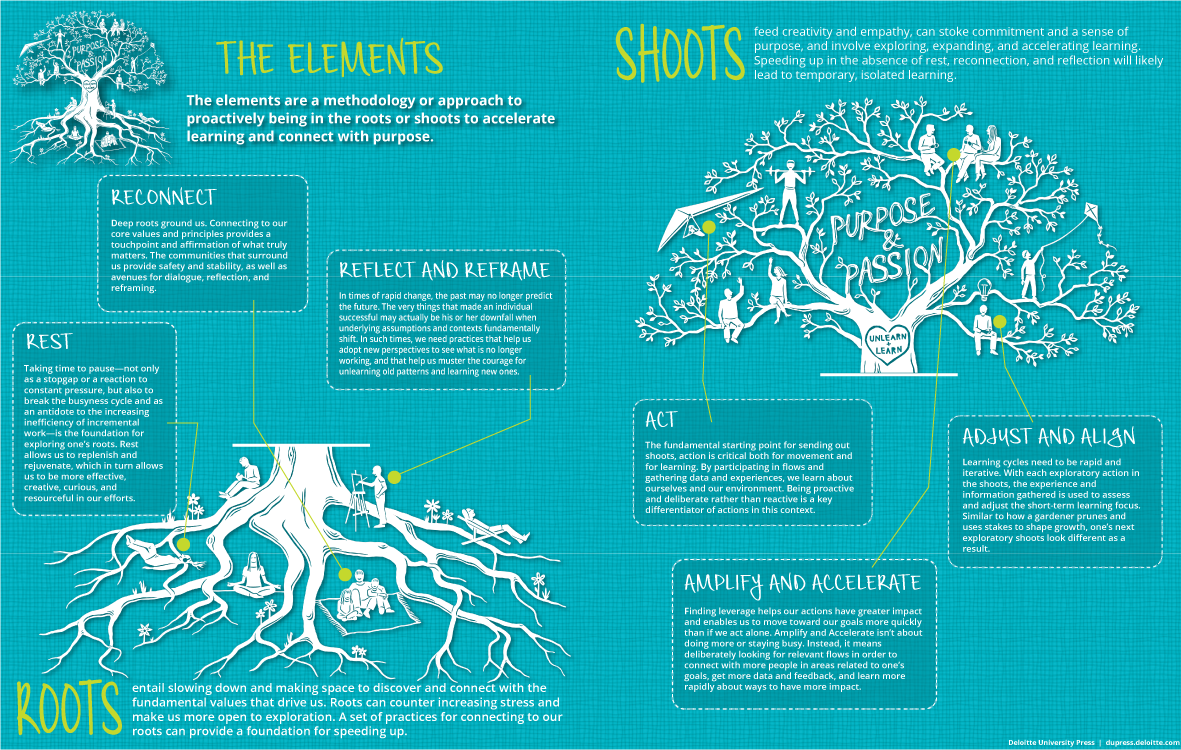
In the Roots we slow down and make space to discover and connect to the fundamental values that drive us. While these types of practices have proven effective to counter increasing stress, practices to proactively connect to one’s Roots also provide stability and guidance, increasing our capacity for empathy, creativity, and openness and serving as a foundation for speeding up. The elements in Roots are Rest, Reconnect, and Reflect and Reframe.
The counterpoint to slowing down, in the Shoots we accelerate, exploring, experimenting, and expanding our horizons. Shoots feed creativity and empathy and can stoke commitment and a sense of purpose. Speeding up in the absence of Rest, Reconnection, and Reflection and Reframing will likely lead to more busyness and sporadic, isolated learning rather than integrated learning. The elements in Shoots are Act, Adjust and Align, and Amplify and Accelerate.
Conceptually, the cycle starts in the Roots with Rest. In Rest, we gather the energy needed to learn and pay attention to new information. To Rest is to step away from busyness and the trap of believing that relief from the “too much on our plates” problem is “just a little more” work. As digital devices and global workforces allow work to follow us home and into weekends and vacations, true Rest becomes more important, both within the day—think nap pods in next-gen firms—and across longer periods of time. By improving our relationships with ourselves and others, Rest creates the space to be creative and open to experiences.12
Rest is often a prerequisite for Act. To Act is to take a step in a specific direction with the goal of either gathering information (about ourselves or about our environment), or putting new information (learning) into practice. In our framing, Act refers to proactive and deliberate action to move beyond thinking to doing, in contrast to the time- and energy-wasting reaction to external stressors. One pitfall of technologies that allow us to passively absorb endless content, no matter how informative, is that we may fail to ever take the actions that are necessary for learning and growth.
To Reflect and Reframe is to interpret the data and experience that we obtain from Acting and to reformulate assumptions to incorporate new information into our world view. One aspect of what we believe will be a more rapidly changing business environment is that underlying assumptions and contexts can and will shift. Failing to incorporate new assumptions and contexts into our thinking may keep us stuck in unproductive (or even doomed) approaches. Reflection brings awareness and helps us interpret new data, while reframing helps to assimilate new information, keeping us from reverting to old ways and old assumptions.
Reflection and Reframing suggest ways we might Adjust our exploratory actions to be more useful for learning and relevant to our goals. They can also highlight where we need to Align our actions with our core values. Adjusting and Aligning is another way we stay out of the busyness trap, ensuring that our new Shoots, our explorations and actions, are furthering our goals, creating productive new avenues for additional, relevant learning, and steering clear of conflict with our core values.
Reconnecting helps us formulate goals and values, guiding what we choose to learn about. Reconnection can offer us stability, another condition that feels increasingly scarce. Our peers are more transient, we switch jobs more often, and we have more visibility into upheaval and change around the world—but we can gain stability by Reconnecting with a set of values, a core community, or a place. Connecting to what really matters acts as an internal guide or lens for how to direct our actions, and is a powerful counterweight to the increasing isolation of our fast, digital world. For some people, Reconnecting might be the starting point: to reaffirm or discover what values they hold, and to create the communities that can aid them in the work of Reflection and Reframing. However, in our busy lives, especially if we have become particularly disconnected from the self, Reconnecting may seem impossible without the space provided by Rest and the insight generated by Action and Reflection.
Taking moments to Rest and Reconnect helps create the mind-set to Amplify and Accelerate. To Amplify and Accelerate is to increase one’s rate of learning and impact by getting involved in activities and knowledge flows that are already underway and related to one’s goals. Participating with others who are engaged in related efforts helps us gain more data and feedback more rapidly. For example, if your goal is to help the low-income population gain self-sufficiency, you might gain momentum and discover alternate paths and possibilities by acting as a mentor or by getting involved in communities of others working in education, homelessness, or personal technology. Having something larger to participate in, getting more feedback, and seeing bigger, faster results can be powerfully motivating and help sustain one’s efforts past challenges and setbacks. As we see our learning accelerate, we may become more committed and passionate. This is also where the concept of flow is particularly relevant, as individuals who can achieve flow can accelerate their learning much faster.
Practices to unlock potential
Many existing practices align with the Roots and Shoots framework and have value independent of it. As described in the previous section, however, we believe that such practices have more power to propel us to realize our potential when assembled into a cohesive set that incorporates Roots and Shoots and views these practices through the lens of learning and unlearning. To that end, in the graphic below, we’ve identified six primary objectives, defined as meta-practices, and listed a few examples of practices for illustration.
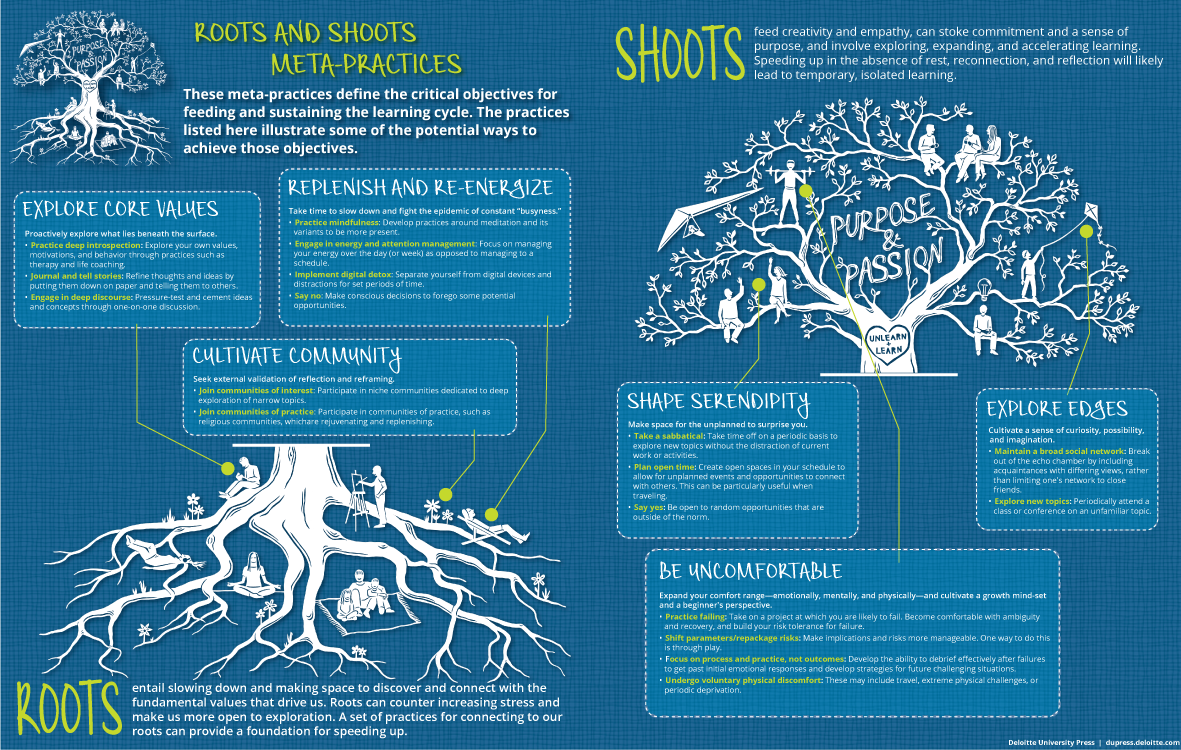
While the elements described in the preceding section can be thought of as a general approach to moving between different types of practices to generate learning and growth, the meta-practices describe specific objectives that a set of practices should achieve to facilitate the continuous process of unlocking our potential. As such, the six meta-practices do not correspond directly to the elements.
The practices listed are by no means comprehensive. One thing that is clear, however, is that some areas are associated with far more accessible and mature practices than others—particularly in the Shoots, where well-defined practices are sparse. That said, this is an ecosystem in flux, and many more practices and tools for achieving these objectives are emerging. For example, a growing number of books, talks, and seminars are devoted to various life hacks, some of which might be applicable to speeding up. Virtual communities have sprung up, allowing practices to be shared and refined more readily. In addition, technological tools (see the sidebar “Life in the emerging ‘transtech’ world”) are attacking many barriers to accessing and adopting both Roots and Shoots practices.
There is no one right set of practices. The idea is for individuals to assemble their own set of practices that collectively support learning and unlearning in a way that is relevant and feasible for each person. The relevant practices may change over time and depend on a variety of factors. Ideally, each person will be able to adopt practices both large and small, those that shape our years and those that shape our minutes, in order to continuously build the capacity for learning and growth.
The meta-practices that support learning and growth in the Roots and Shoots cycle include:
- Replenish and re-energize: One of the more common outcomes of today’s always-connected, never-done-with-work lifestyle is burnout, or perhaps more commonly, the less visible and more insidious experience of constant fatigue. Consciously choosing to step out of the busyness is the first step. We can force a break, for example, by scheduling periodic breaks on our calendars, using a personal tracker to remind us to take micro-breaks every hour, maintaining separate phones and computers for work and personal use, or, more dramatically, by taking sabbaticals. Having forced a break, specific additional practices can help ensure that we are getting replenished and re-energized by our breaks—mentally, physically, and emotionally.
- Explore your core values: Another downside of being constantly busy is that it is difficult to take time for introspection. Over time, we become disconnected from even knowing what we value, which can lead to a crisis of identity and hopelessness or despair when difficulties inevitably arise in our daily lives. Too often, it takes a traumatic experience—the death of a loved one, an unexpected illness, getting fired—to force us to step back and examine our core values and aspirations. As a result, by the time we look inward, our day-to-day life might be far out of line with our core values, and we may hide from that awareness when it feels threatening or unmanageable. Proactive, ongoing practices aimed at exploring one’s core values can help make introspection safe and productive.
- Cultivate community: In parallel to introspection and internal validation is a need for external validation of one’s Reflection and Reframing. Given that, the process of cultivating community, done right, is one that requires us to make ourselves vulnerable, to expose our goals and core values, and our thoughts about them, to the light of day. External validation is most effective with a small close-knit community: one that understands you and your context as much as it does the issue at hand, a community that will push and prod your perspectives and conclusions but one that will also support you in taking action upon them.
- Explore edges: In the corporate world, most disruptive innovations come from “edges”—the unlikely candidate, the random adjacency that the market leaders aren’t paying attention to. For individuals, too, edges—such as the unlikely connection, the random skill that you’ve ignored in adulthood—can be fertile ground for growth. This is an underdeveloped area, and new practices are needed to help us find relevant edges without being so prescribed that we miss the interesting adjacencies. At the same time, we also need practices that expose us to more edges and help us understand and make sense of what we find in the edges we choose to explore. Online social networks offer one way to access more edges, but doing so effectively involves using social media in a counterintuitive way, paying less attention to close friends and family who are similar to us and cultivating looser connections with a broader network of people whose beliefs and behaviors are less similar. This practice can expose us to more nuggets of information, ideas, and perspectives than we would encounter among close friends.
- Be uncomfortable: Being out of your comfort zone is one indication that you have an opportunity to learn something new. Being comfortable, in contrast, occurs when you are on automatic pilot, where the brain is using neural shortcuts to deal with what is expected as efficiently as possible. When uncomfortable, your brain and all of your senses are paying attention. They are trying to map the new experience or new information and make sense of it. Learning something new is usually inherently uncomfortable at the onset.
- Shape serendipity: One of the more uncomfortable tasks for many of us in today’s rigidly scheduled world is to have unscheduled time. Given how busy we are, and how busy we feel we “should” be, having any unscripted free time seems blasphemous. This calendar-filling tendency only does one thing: ensures that there will be no surprises. At best, you address what is on your plate. There is little opportunity for anything new—a thought, an idea, an experience—to enter your world. One practice to counteract this is to actively schedule free time, especially when traveling, but also in your regular schedule. The idea is to leave space, not just as a means of taking a breather, but with the intent to say “yes” to an invitation or request, even if it seems random and the payoff isn’t immediately clear. Leave space so that you can accept the unexpected but intriguing request and approach it with an open mind, seeking first to learn, then to build on—rather than critique—the ideas presented.
Finally, connecting Roots practices to Shoots practices in a meaningful way isn’t easy. It requires being able to occasionally step back and objectively look at our actions and insights to identify patterns and to apply the insights gained from one practice to guide the direction of another.
Why is this hard?
Adopting new practices is hard. New practices ultimately involve forming new habits and, often, breaking old ones. So all of the research on behavior change applies. It requires time and effort, which, in the midst of our connected busyness, can be in short supply.
As anyone who has tried to take up meditation or who has attended a Meetup on an entirely unfamiliar topic knows, quieting the mind and being open to learning from new experiences isn’t always comfortable. Other obstacles include being unaware of what practices are available or of how to use them; not believing in the benefits enough to commit to developing a practice; perceived lack of social acceptance for practices that seem “woo-woo” or not professional; and the lack of a supportive community to deepen one’s pursuit of the practice. Instruction and a guide can help. Immersive experiences such as retreats or even in-person events can help give practices a chance to stick.
Recognizing the growing interest among corporate and business professionals in individual practices and performance, organizations such as 1440 Multiversity (for the number of minutes in a day) are experimenting with immersive campuses that combine professional development topics with more traditional wellness retreat practices such as guided meditation. At the same time, traditional corporate training programs are increasingly being supplemented with a greater array of well-being support. Perhaps these moves reflect a growing recognition of the interrelationship between talent development and individual well-being in both the employee experience and overall workforce planning.
Meaningfully connecting Roots and Shoots is hard, but it also is not. It truly is a case of small moves, smartly made, setting big things in motion. There are numerous “micro-practices” that can be deployed immediately, and more are being developed all the time, thanks to the hacker mentality developing around speeding up and slowing down. For example, one simple tip from the co-founder of Digital Detox is to buy a basic “dumb” alarm clock in lieu of using a smartphone as an alarm to wake up in the morning. This small move helps create a barrier to getting sucked into the world of work and distraction first thing in the morning (and last thing at night). Another simple practice is to pick a time during the morning commute to do a brief breathing meditation every day; our commutes already are part of our routines and have the added benefit of being a time when we have already pried ourselves away from home and family and are not yet visible to co-workers. Five to ten minutes of deep breathing can help clear the mind and awaken the body for workers who don’t believe they have time for meditation.
One barrier to adopting new practices, access—either because there are no locally available instructors or because the cost is prohibitive—is being addressed in interesting ways through the power of technology. The digital environment, in some ways the villain in our busy lives, can also be our ally. Fitness trackers put a trainer and personal motivator on our wrists, Headspace puts a meditation leader in our ear, BetterUp brings an executive coach to our desks and phones. In fact, our phones can provide much of the support and guidance we need, whenever and wherever, for a nominal fee. And we are only at the beginning of that technology-enabled revolution. The emergence of transformative technologies as a sector (see the sidebar “Life in the emerging ‘transtech’ world”36) is suggestive of how technology might help us better understand ourselves and address our unique needs. Nichol Bradford, co-founder of the TransTech Alliance and a leading advocate of this emerging sector, believes that the transtech market will continue to grow as a result of societal preoccupation with health care costs—although the health care sector (and scientific research) is currently hidden within a multitude of other markets, such as the $446 billion fitness and mind-body market, the $432 billion preventative health market, and the $150 billion weight loss market.37
The prospect of navigating your own ship through a technology-enabled future may seem exciting and scary in equal proportion. In the graphics below, we provide some examples of small moves that can allow you to get started on developing new habits around Roots and Shoots. These are not all digitally enabled practices; a good portion of them are traditional, involving activities such as putting pen to paper and exploring the physical world. The list is also not meant to be exhaustive; rather, it aims to trigger some ideas for getting off the ground. Most of these are personal practices that we, the authors, have tried (with varying levels of success) to kick-start our own Roots and Shoots development.


One important element in getting these practices to stick, in our experience, is a shift in mind-set. A friend of one of the authors, a human resource executive at a social network company, once stated that many of us tend to frame life by anchoring around work. What if we flipped that around? Instead of “taking time off work,” could we “take time into life,” whether for taking a vacation, exploring a new idea, learning a new skill, or caring for a sick child or parent? This shift in anchoring can make a world of a difference in recognizing the value of developing new practices—moving us from a short-term, work-focused mind-set to a long-term, life-focused one.
While we provide some guidance on how to get started on developing new habits and practices, we would be the first to acknowledge that some of the barriers that stall that growth are real. Kids’ schedules have to be managed, political battles at work exist, people get sick, and bills need to get paid. All of these require time, energy, and mindshare. Here again, the longer-term, life-focused mind-set can come into play, helping us build momentum and providing motivation for overcoming short-term setbacks. A commitment to get started with one simple practice that requires little time, energy, or mindshare is a good place to begin. We believe that even one small practice can trigger a positive cycle of change, which, over time, will lead to increasing benefits and greater impact.
From practices to purpose
The practices described in this report can help us perform better in a world of constant change. They may serve to create more interesting long-term opportunities while preserving engaging short-term activities.
However, what will truly amplify the long-term value of practices is direction. Purpose. A North Star. For a few, this purpose may be apparent from the outset, and their actions are aligned with that purpose. But for most, purpose may only be discovered through the process of deploying these practices, through the simultaneous exploration of edges and core values. Working through these cycles of speeding up and slowing down allows one to develop insights—about a shifting world and about oneself—that over time consolidate into one’s purpose.
When we, at the Center for the Edge, have written about passion and purpose in the past, one consistent response from readers has been that they find the perspectives compelling, but lament that they haven’t found their own passion. The framework presented here is our attempt to provide avenues to discover one’s purpose and passion by actively engaging in one’s own Roots and Shoots.
Don’t wait for your purpose to reveal itself to get started, or have that as the goal. Start with the practices and aim to make them habits. The journey may well reveal your purpose.
BY
Duleesha Kulasooriya
Maggie Wooll
The authors would like to thank our colleagues Jodi Gray and John Day for their efforts in shaping and researching this report. In addition, we are grateful for the input and support of our colleagues: John Hagel, John Seely Brown, Lucy Pan, Junko Kaji, Sonya Vasilieff, Jen Fisher, Josh Bersin, Blythe Aronowitz, and Andrew de Maar.
This paper emerged from and was inspired by conversations with edge dwellers who generously shared their experiences over the years:
- Arup: Chris Luebkeman
- BetterUp: Alexi Robichaux, Eddie Medina, Damian Vaughn
- Digital Detox: Levi Felix, Ilana Lipsett, Adam Smiley Poswolsky
- Embassy Network: Jessy Kate Schingler
- Facebook: Brynn Harrington
- Flow Genome Project: Steven Kotler
- Galvanize: Ryan Nadeau
- Spire: Neema Moraveji
- Swissnex: Emina Reissinger
- Vitra: Raphael Gielgen
- Willow Group: Nichol Bradford
- Wisdom Labs: Parneet Pal, Cory Smith, Rich Fernandez