
Gen Zs and millennials are redefining career progression on their own terms
They may be more selective about commitment, but a Deloitte survey of over 22,500 Gen Zs and millennials shows they aren’t slowing down. They’re accelerating where it counts.
Gen Zs and millennials are sometimes described as the “maybe-later” generations—delaying major milestones like buying homes, starting families, or stepping into leadership. In the workplace, that hesitation can be read as a lack of ambition: a generation opting out of traditional paths, unwilling to take on responsibility, or reluctant to lead.
There’s data to support that perception. More than half of Gen Zs (55%) and millennials (52%) in Deloitte Global’s 2026 Gen Z and Millennial Survey say they have delayed major life decisions because of their financial situation. And only a small percentage say achieving a leadership position is their primary career goal.
But beneath the data, the research reveals a deeper story about how these generations are choosing to sequence their ambitions—investing first in stability, well-being, and skills before committing to paths that feel uncertain. While uncertainty has made them more selective about some decisions, the research shows that it has accelerated others. They’re actively reshaping their careers through continuous learning, rapid adoption of AI, and a growing focus on adaptability as a core career capability.
The result is a fundamental tension: Gen Zs (born between 1995 and 2007) and millennials (born between 1983 and 1994) might be more deliberate about committing to traditional milestones and linear career paths, but they’re accelerating how they build skills, adopt technology, and push organizations to evolve.
Deloitte Global’s 2026 Gen Z and Millennial Survey, drawing on responses from more than 22,500 individuals across 44 countries, highlights this tension. The Gen Z and millennial coming-of-age story isn’t about delay, but discernment. They’re recalibrating priorities, moving more deliberately where the stakes are high and accelerating where the opportunity is theirs to control—moving forward thoughtfully, selectively, and on their own terms.
What does this mean for the organizations that employ them? As Gen Zs and millennials continue to navigate the reality of continued uncertainty, what they need and expect from work will likely continue to evolve. Meeting that reality will require organizations to evolve alongside their Gen Z and millennial workers—redesigning work, leadership, and career paths that can adapt in real time.
Where Gen Zs and millennials are being more selective
The tension between speed and caution becomes more visible when we examine how Gen Zs and millennials are making decisions about commitment, risk, and progress.
They’re making deliberate choices in a costly reality
Financial pressure continues to shape how Gen Zs and millennials make decisions about work, stability, and the future. For the fifth consecutive year, cost of living remains their top concern, cited by 38% of surveyed Gen Zs and 42% of millennials, far exceeding worries about crime, unemployment, the environment, or geopolitics.
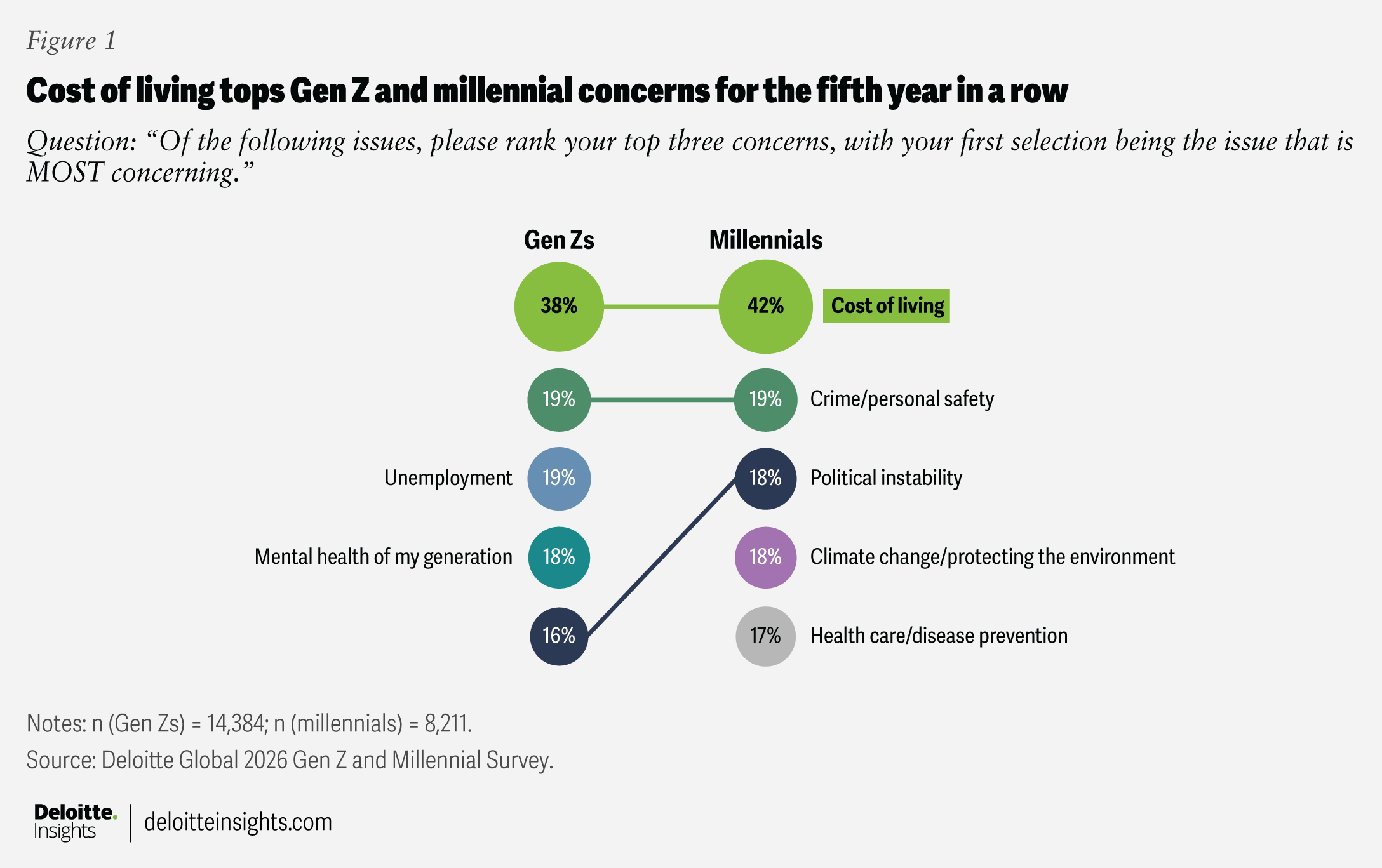
For many, this pressure is shaping not just how they live, but what they feel able to commit to. More than half of our survey respondents say they have delayed major life decisions—buying a home, starting a family, or furthering education—because of their financial situation. Housing affordability, in particular, is directly influencing where they can work and how they plan their careers. A majority (69% of Gen Zs and 64% of millennials) say that the availability or affordability of housing has a direct impact on their career decisions and where they can work.
As one millennial respondent explained, “Employers are not paying even close to the cost of living. When I see jobs advertised online in my city, the salaries don’t match what it costs to live here. People can’t live off these salaries. And I'm not talking about being able to afford luxury items. I’m talking about simply room and board, groceries, and other everyday items.”
The result is a shift in how they’re managing risk. Gen Zs and millennials aren’t necessarily stepping back from progress but recalibrating when and how to take on major commitments. In a world where margins feel thinner and external conditions remain volatile, delaying a decision is less about hesitation and more about avoiding a bad bet.
For organizations, this shifts the talent equation. Commitment increasingly depends on whether work feels stable enough to build a life around. Competitive pay still matters, but it’s no longer sufficient on its own. Reducing friction in everyday life—through flexibility in where and how work gets done, clearer and more predictable career paths, and benefits that directly address financial strain—can make a meaningful difference.
Support such as housing or relocation assistance, student debt benefits, and greater flexibility in how rewards are structured can expand workers’ options and reduce unnecessary tradeoffs. Just as important is acknowledging financial pressure openly and normalizing conversations about it, rather than leaving workers to navigate them alone. As financial strain continues to shape everyday decisions, organizations that respond in tangible ways will likely be better positioned to earn long-term engagement, retention, and performance.
They’re rethinking the cost of leadership
At first glance, the data can make it seem like Gen Zs and millennials are pulling back when it comes to leadership. Consistent with last year’s findings, only 6% of surveyed Gen Zs and millennials say achieving a leadership position is their primary career goal, and many favor steady progress over rapid promotion. Among those who are not prioritizing leadership roles, the most cited barriers are perceptions of stress and burnout, excessive responsibility, and concerns about work/life balance—trade-offs that make the role feel less appealing in its current form.
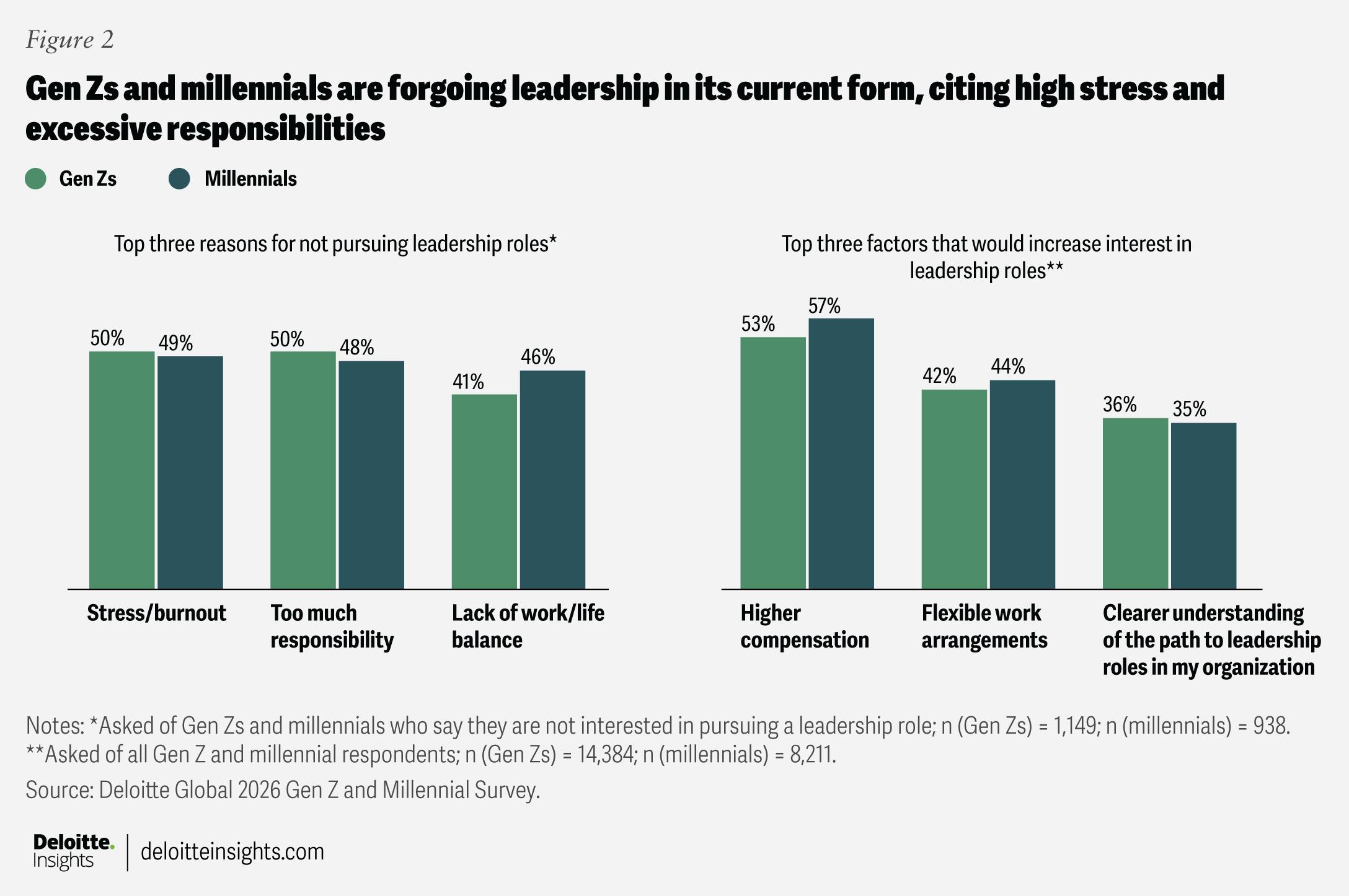
But the broader picture tells a different story. Over the course of their careers, a strong majority still express interest in pursuing leadership roles, with 76% and 67% of surveyed Gen Zs and millennials, respectively, saying they are interested in executive leadership roles, and 80% of Gen Zs and 73% of millennials saying they are interested in pursuing supervisory or management roles at some point.
As Becky Frankiewicz, president and chief strategy officer of ManpowerGroup, explains, “It’s not that Gen Zs and millennials are opting out of leadership or management completely. Many still aspire to be leaders, but they’re not willing to do it at the expense of other priorities. They want it to fit with the rest of their life.”
They are not opting out of leadership, but they are questioning whether the way it is structured today is worth the cost. For many, ambition is no longer defined by how quickly they can climb, but by whether that climb is sustainable, aligned with their values, and compatible with the rest of their lives. They are prioritizing long-term fit over short-term advancement and redefining what progress looks like.
This shift reflects a recalibration, not a retreat. Gen Zs and millennials still want to lead, influence, and make an impact, but they are less willing to do so at the expense of well-being or sense of purpose. In fact, many believe they can drive change without formal titles: Sixty-nine percent of surveyed Gen Zs and millennials believe they have the power to drive change within their organization, suggesting that even when individuals postpone leadership roles or major career moves, they still see themselves as contributors who can shape outcomes from where they are.
For organizations, it’s important to understand that the matter is not a lack of ambition, but a mismatch between traditional leadership models and evolving expectations. When leadership is framed as a trade-off—more responsibility for less balance—interest will continue to be delayed.
Reframing leadership as sustainable work likely means organizations will need to be more intentional about how careers are guided and what is recognized as high performance. Workers who build breadth, adaptability, and impact across roles may be just as valuable as those who move quickly up the hierarchy. Leadership roles might need to evolve as well, so they are more clearly defined and focused on enabling others rather than absorbing endless demands.
Done well, this kind of reframing can make leadership more attractive while strengthening adaptability and long-term performance across the organization.
Where Gen Zs and millennials are accelerating
While they may be making more selective decisions in some areas, that doesn’t mean that Gen Zs and millennials are moving more slowly overall. They’re just choosing strategically where to move faster. Our research shows that these generations are far less hesitant about growth opportunities, especially when it comes to building capability and adopting new tools and technology.
They’re quicker to build new capabilities
Gen Zs and millennials are redefining what progress looks like. Titles and promotions still matter, but they are no longer the primary signal of growth. Instead, progress is measured by the accumulation of skills, the ability to navigate change, and the flexibility to move across roles and opportunities.
When asked about their ideal career path, most respondents favored steady, sustainable growth over rapid promotion, and many said they are willing to move laterally—or even step back—to gain the experience they want to build. Roughly 20% of both generations in our survey said they would be willing to move laterally or accept a more junior title to gain experience they believe will support long-term success.
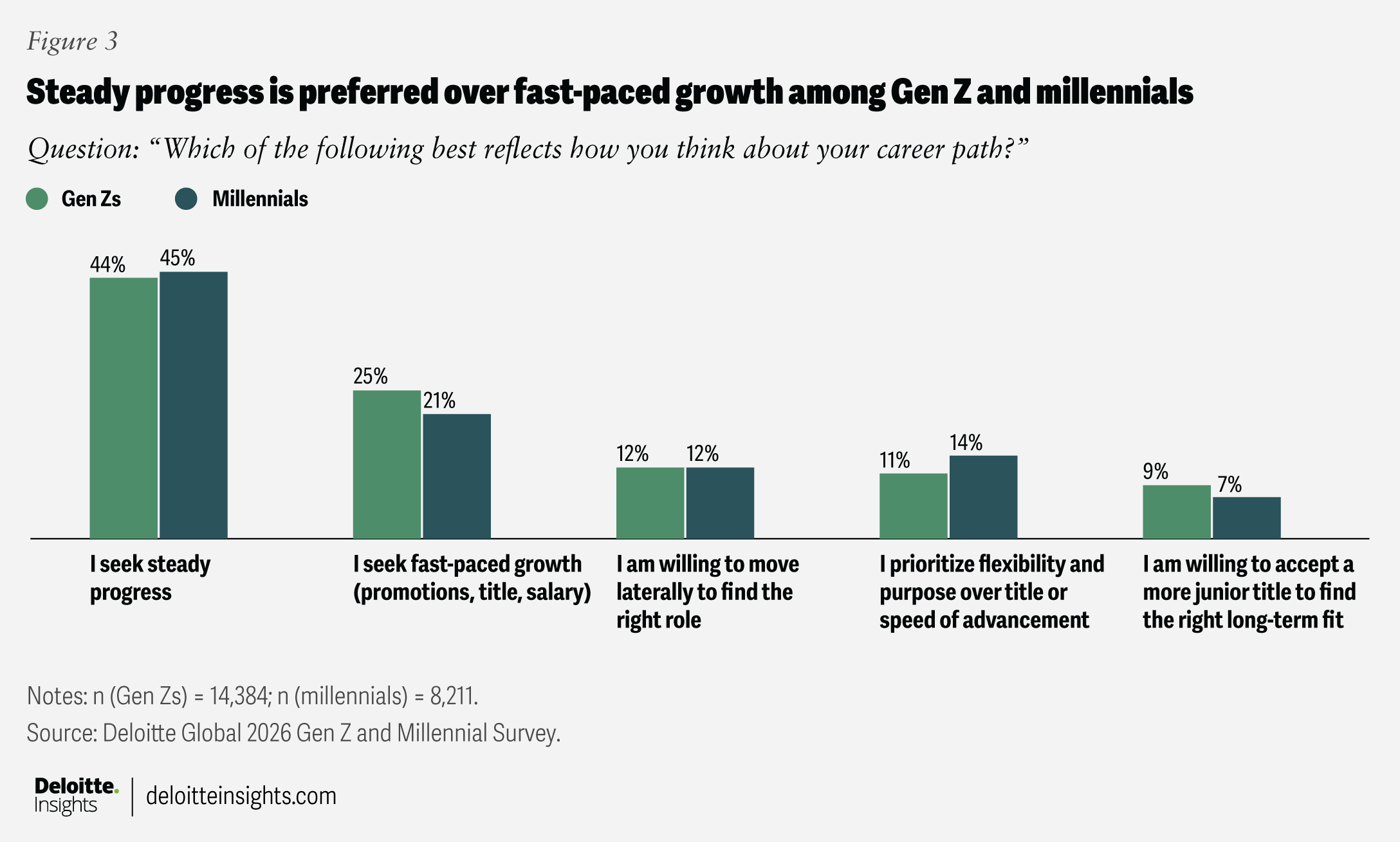
At the same time, they are actively investing in their own development. In a world where learning is continuous rather than episodic, these generations are prioritizing skills like adaptability, communication, creativity, and increasingly, AI fluency. Adaptability itself has become a core career capability—one that enables them to remain relevant and resilient amid constant change.
That investment often extends beyond the boundaries of a single role. Nearly 30% of surveyed Gen Zs and roughly 25% of millennials have a part‑ or full‑time side job. While financial need is a primary driver, more than a third of those with a side job say that work helps them develop important skills and relationships, further reinforcing a shift toward capability over title.
“I just like to be constantly learning and growing,” said one respondent. “I don’t necessarily have to be climbing the ladder up to CEO or anything, but I do want to be learning new skills and adding on to my tool set.”
Organizations will likely need to rethink how they define progress for these generations. Many organizations still signal progress through hierarchy and title, while their Gen Z and millennial workforce is optimizing for capability and long-term trajectory. Leaders can strengthen adaptability by making learning continuous, visible, and embedded in everyday work rather than relying on episodic training or one‑off upskilling initiatives. This helps create regular opportunities for people to build and apply new skills, especially those that combine human judgment with technical fluency.
When learning is treated as an expected and supported part of the job instead of something added on to already full workloads, adaptability becomes a shared organizational capability rather than an individual burden. In that environment, workers are better equipped to evolve in real time, and organizations are better positioned to keep pace with the speed of change.
They’re moving faster on AI than their organizations
The adoption of AI has moved from emerging to mainstream with remarkable speed. Roughly three-quarters of surveyed Gen Zs and millennials now report using AI in their day-to-day work—a sharp increase from just a year ago. For many, AI is improving output, freeing up time, and enhancing how they work.
But its role extends well beyond productivity. Many respondents also report using AI to identify learning and development opportunities (79% of both generations), seek career advice (72% of Gen Zs and 69% of millennials), and cope with work‑related stress (67% of Gen Zs and 65% of millennials). This is effectively turning AI into a kind of always-on career coach that supports growth, decision-making, and resilience.
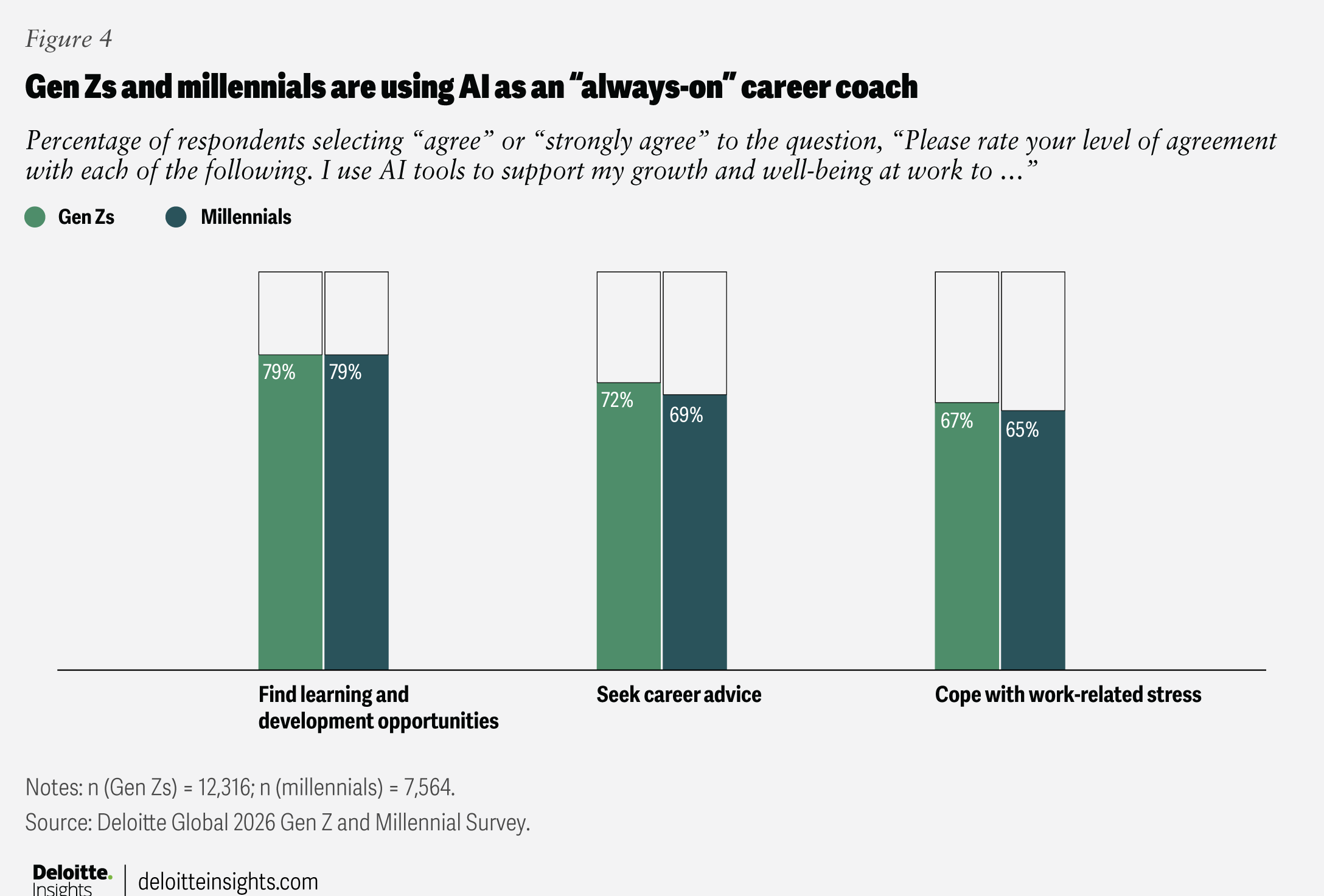
This is where the acceleration becomes visible. While uncertainty may be slowing major commitments, AI is enabling these generations to move faster in how they learn, experiment, and evolve. They are not waiting for formal training or organizational direction but are integrating AI into how they build capability every day.
At the same time, many feel their organizations are not keeping pace. Roughly one-third of respondents say their employer is not prepared for the changes AI will bring, and many point to gaps in training, tools, and integration. Confidence in leadership’s AI adoption is lagging as well: While most Gen Zs (68%) and millennials (66%) in our survey say they feel capable using AI tools themselves, fewer (60% of Gen Zs and millennials) express the same confidence in their senior leaders.
The gap between individual adaptation and organizational readiness is widening. Change is happening—but it is happening from the bottom up, often despite existing systems rather than because of them. Adaptability, then, has become a form of career capital and one of the most valuable assets these generations possess.
For organizations to close the gap, they will likely need to go beyond treating AI as a tool rollout and instead consider how it can be used for work redesign and change management. That means intentionally redesigning roles and workflows so humans and AI can work together, and equipping leaders to better keep pace with the speed of change.
The challenge is meeting Gen Zs and millennials where they are
The takeaway from this year’s report is that Gen Zs and millennials are moving in response to their environment. They’re optimizing for resilience, adaptability, and long-term viability in a world where stability can’t be assumed.
The challenge is not to push these generations to move faster along traditional paths, but to recognize where they are already moving quickly and meet them there. That likely means rethinking how leadership is structured, how work is designed, how skills are built, and how technology is integrated into everyday workflows.
The real risk isn’t that Gen Z and millennial workers might fall behind—but that organizations might not keep pace.
Methodology
Deloitte Global’s 2026 Gen Z and Millennial Survey reflects the responses of 14,384 Gen Zs and 8,211 millennials (22,595 respondents in total) from 44 countries across North America, Latin America, Western Europe, Eastern Europe, the Middle East, Africa, and the Asia Pacific. The survey was conducted using an online, self-completion-style interview. Fieldwork was completed between Nov. 24, 2025, and Jan. 15, 2026.
The report represents a broad range of respondents, from those in executive positions at large organizations to those who are participating in the gig economy, doing unpaid work, or are unemployed. Respondents also include students who have completed or are pursuing a degree; those who have completed or plan to complete vocational studies; and those who are in secondary school and may or may not pursue higher education.
The report includes quotes from survey respondents who answered open-ended questions, as well as from participants in one-on-one, ethnography-style, qualitative interviews conducted separately from the online survey. In addition, the report draws on insights from in-depth interviews with business leaders on workforce trends and intergenerational dynamics. The qualitative interviews were conducted between Dec. 18, 2025 and March 13, 2026. Qualitative insights from Gen Z and millennial respondents are attributed by pseudonym and generation to protect participant privacy. Business leader insights are attributed to named individuals and their organizations, with permission.
As defined in the study, millennial respondents were born between January 1983 and December 1994. While Gen Zs are typically defined as being born between January 1995 and December 2010, this study included only those born between January 1995 and December 2007 to exclude individuals younger than 18. That means each year the definition of Gen Zs in this survey shifts a year to include all adult Gen Zs.
Continue the conversation
Meet the industry leaders
Elizabeth Faber
BY
Elizabeth Faber
Editorial (including production and copyediting): Corrie Commisso, Hannah Bachman, Preetha Devan, and Pubali Dey
Design: Molly Piersol
Audience development: Kelly Cherry
Cover image by: Sonya Vasilieff; Adobe Stock
Knowledge services: Rohan Singh