
Building consumer trust
Protecting personal data in the consumer product industry

Executive summary: A new perspective on data privacy
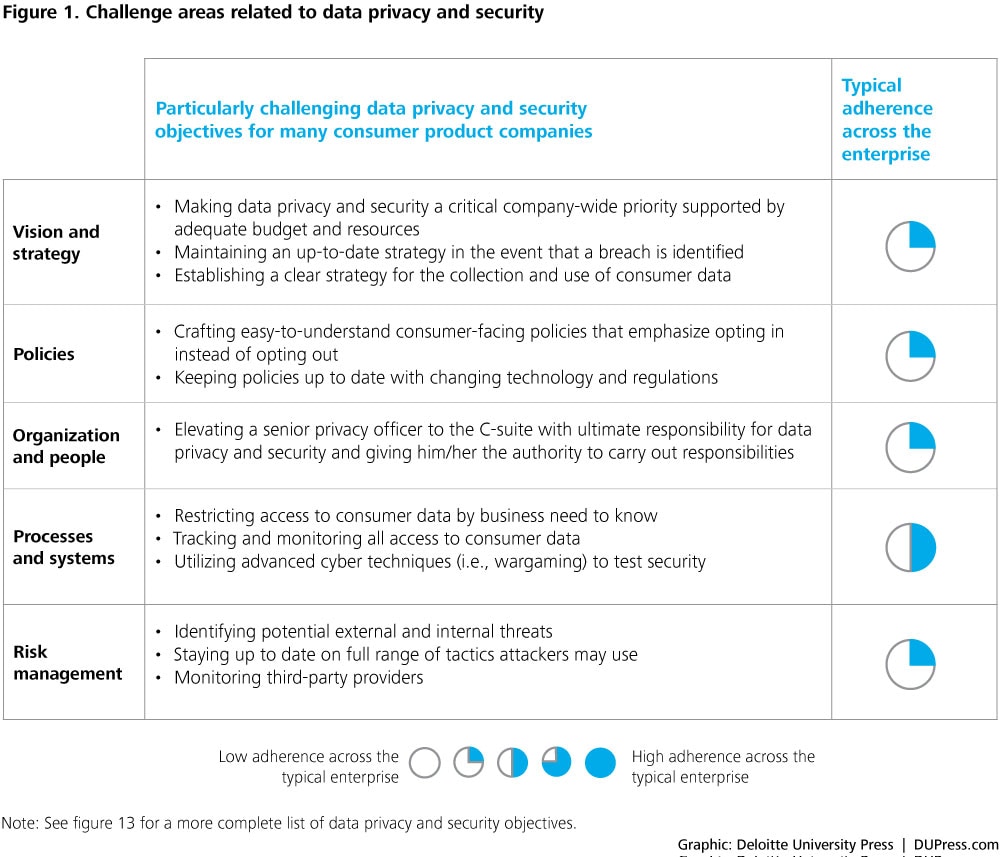
Data privacy and security1 is about much more than keeping hackers at bay. It is also about assuring consumers that the trust they place in a consumer product brand is warranted. The results of a recent survey of consumers and executives show that consumers have a keen sense of awareness of the risks surrounding data security and privacy, and that many consumer product executives are likely overestimating the extent to which they are meeting consumer expectations related to data privacy and security.2 On the other hand, many consumer product executives may be underestimating the opportunity for competitive advantage associated with meeting consumer expectations regarding data privacy and security. Furthermore, many consumer product companies do not seem positioned to gain consumer trust based on their current data privacy and security strategies, policies, and systems (figure 1). The field appears wide open for consumer product companies to differentiate themselves through a reputation for strong data privacy and security practices. Consumer product executives should consider viewing data privacy and security not just as a risk management issue, but as a potential source of competitive advantage that may be a central component of brand-building and corporate reputation.
A breach of trust
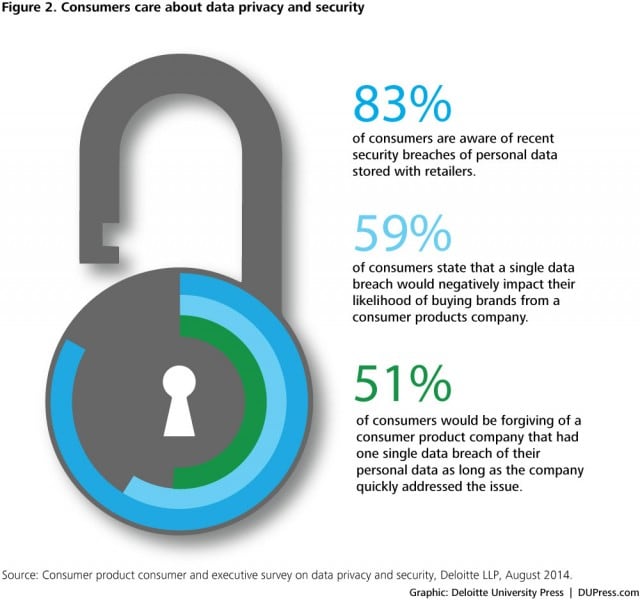
Nearly everyone who works in the consumer products industry knows that negative brand experiences can quickly negate years of brand-building, a hard-gained positive reputation, and—perhaps most importantly—the trust a consumer places in a brand.3 Consider the impact on consumer trust, then, when a company announces that it has experienced a data breach. In this age of big data and digital marketing, in which consumer product companies and retailers are building detailed profiles of individual consumers based on a plethora of data sources, even a single data breach can substantially damage consumer trust. Indeed, 59 percent of consumers state that the knowledge of a data breach at a company would negatively impact their likelihood of buying from that company. Only 51 percent of consumers, moreover, say they would be “forgiving” of a consumer product company that experienced a breach as long as the company quickly addressed the issue.
Recent data breaches in various industries have heightened consumers’ awareness of data security and privacy.
The risk is real—and growing. It is no secret that consumer product companies have been accumulating consumer information with the intent of using big data analytics to improve marketing effectiveness, particularly digital marketing effectiveness. As consumer product companies invest more in targeted digital marketing, the drive to collect consumer information and compile individual consumer profiles is intensifying.4 The more data a company collects—and the more sensitive that data—the greater the data’s attractiveness to malevolent hackers, and the greater the risk associated with data breaches.
Nor are consumers unaware of that risk. Recent data breaches in various industries have heightened consumers’ awareness of data security and privacy: 83 percent of the consumers we surveyed were extremely or moderately aware of recent retail breaches. And 83 percent of these same consumers consider security breaches of personal data stored with consumer product companies to be a serious or moderate problem.
Regulators, too, are increasingly aware of the risks to consumer privacy with big data. Edith Ramirez, Federal Trade Commission (FTC) chairwoman, has stated: “Addressing the privacy challenges of big data is first and foremost the responsibility of those collecting and using consumer information. The time has come for businesses to move their data collection and use practices out of the shadows and into the sunlight.”5
Data privacy and security as a competitive advantage
But there is also an upside. There is a clear connection between consumers’ perceptions of data privacy and security practices and commercial success. Half of the consumers we surveyed “definitely consider” the privacy and security of their personal information when choosing an online retailer, and 80 percent say they are more likely to purchase from consumer product companies that they believe protect their personal information (figure 3). Furthermore, 70 percent of consumers would be more likely to buy from a consumer product company that was verified by a third party as having the highest standards of data privacy and security. In short, strong data privacy and security practices are not just about risk mitigation, but also a potential source of competitive advantage.
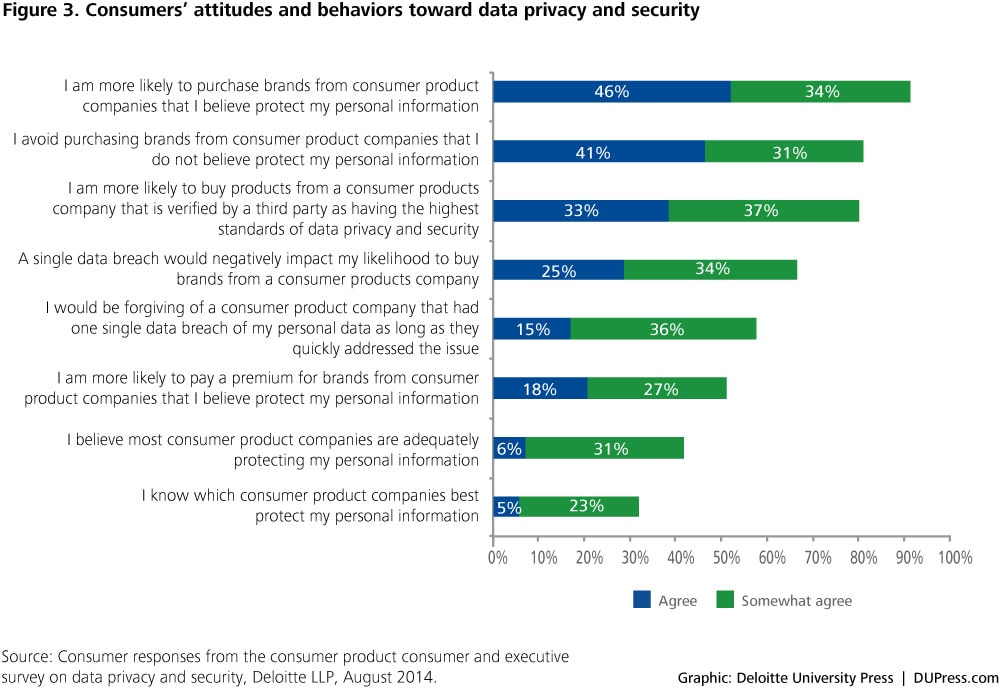
Our survey suggests that the field is wide open for consumer product companies to build a reputation for strong data privacy and security practices. Today, few consumers (37 percent) believe that most consumer product companies are adequately protecting their personal information. Even fewer consumers (28 percent) think that they know which consumer product companies best protect their personal information. These findings suggest that consumer product companies have yet to establish a name for themselves as trusted stewards of consumer data—and that a company in the industry that can do so can set itself apart from the competition.
Overestimating consumer comfort
Unfortunately, convincing consumers to trust consumer products companies with their personal information may be something of an uphill battle. Our research revealed a certain degree of consumer skepticism, even cynicism, about corporate motives and practices around the collection and use of personal data. In the words of one consumer we interviewed: “It would be hard for me to feel reassured that big companies are protecting my interests as it relates to the privacy and security of my personal information. I’m more inclined to think that companies are so concerned with wringing as much potential as they can from a consumer that they don’t really care about how consumers feel.”
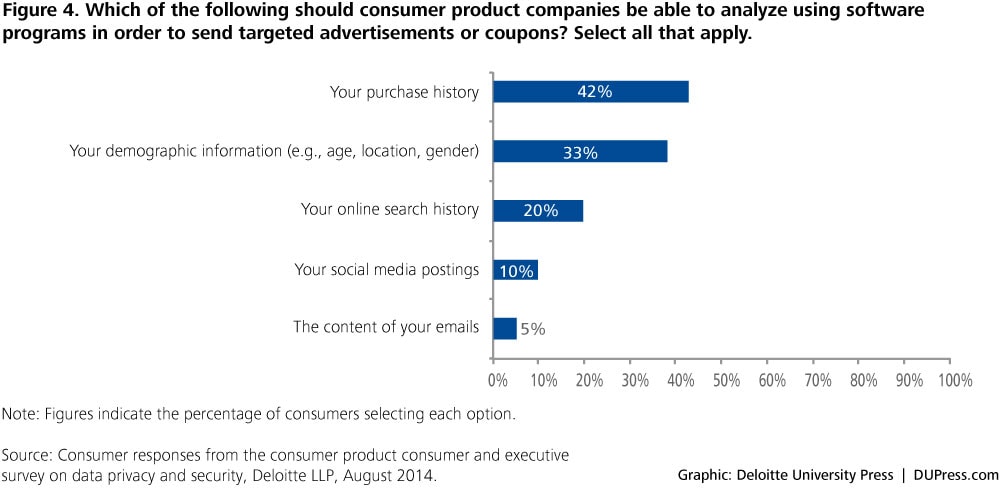
In general, consumers are hesitant to knowingly allow consumer products companies to use their personal information for targeted marketing. While nearly half (42 percent) are willing to allow their purchase history to be analyzed, the vast majority do not believe that their demographics, social media postings, online search history, or emails should be analyzed by software programs (figure 4)—all of which are common practice today in digital advertising placement.
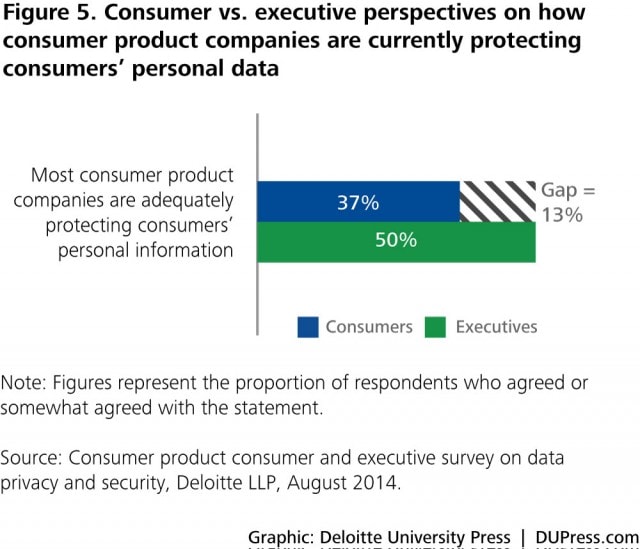
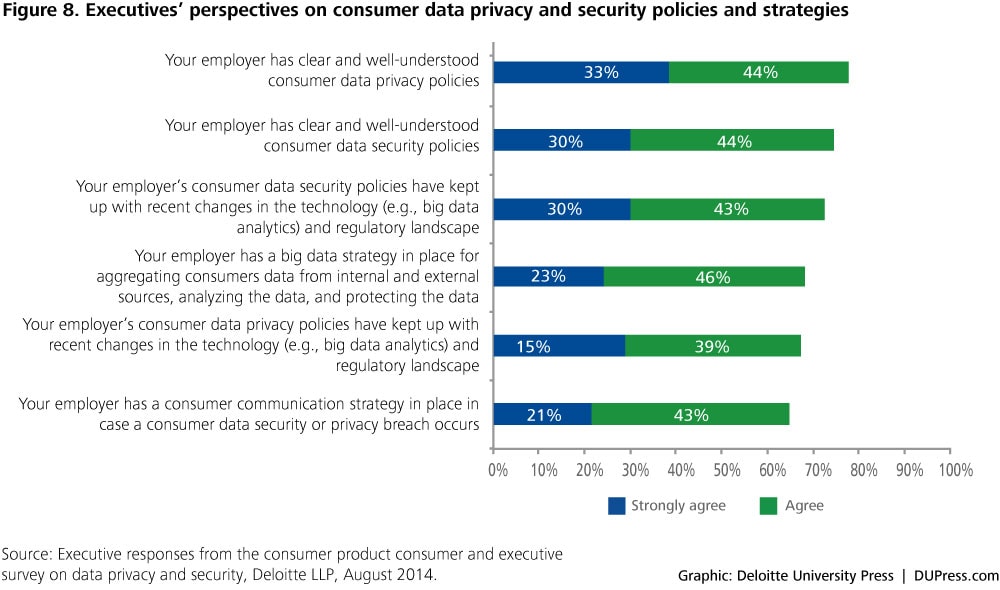
Furthermore, our results suggest that many consumer product executives may not be fully aware of how much ground needs to be gained in the quest for consumer trust around data privacy and security. Fifty percent of the executives we surveyed thought that many consumer product companies are “adequately” protecting consumer information; only 37 percent of the consumers we surveyed thought the same (figure 5). Many executives also seem to be more complacent about their companies’ data privacy and security policies than consumers’ opinions warrant. While 77 percent of the executives in our study believed that their employer had clear and well-understood consumer data privacy policies, many of the consumers we surveyed sought easier-to-understand policies (“Write the policies in clear and readable English,” said one consumer, “and in print large enough to read”). And of the consumers we surveyed who said that they either “carefully read” or “skim” privacy policies, nearly two in five reported deciding not to purchase from an online retailer as a result of its privacy protection policies.
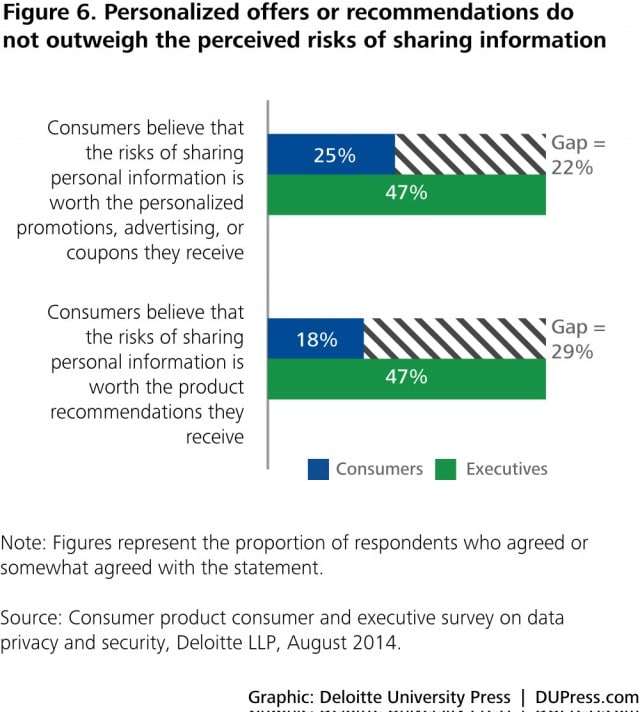
Interestingly, our research hints that consumer product executives may be overestimating, not just consumers’ comfort with sharing their personal data, but also the extent to which they feel they receive fair value in exchange (figure 6). Specifically, while 47 percent of the executives we surveyed felt that consumers believe that the risks of sharing personal information are worth the personalized promotions, advertising, or coupons they receive, only 25 percent of the surveyed consumers agreed. Similarly, 47 percent of the surveyed executives thought that consumers believe that the risks of sharing personal information are worth the product recommendations they receive; only 18 percent of the surveyed consumers thought the same.
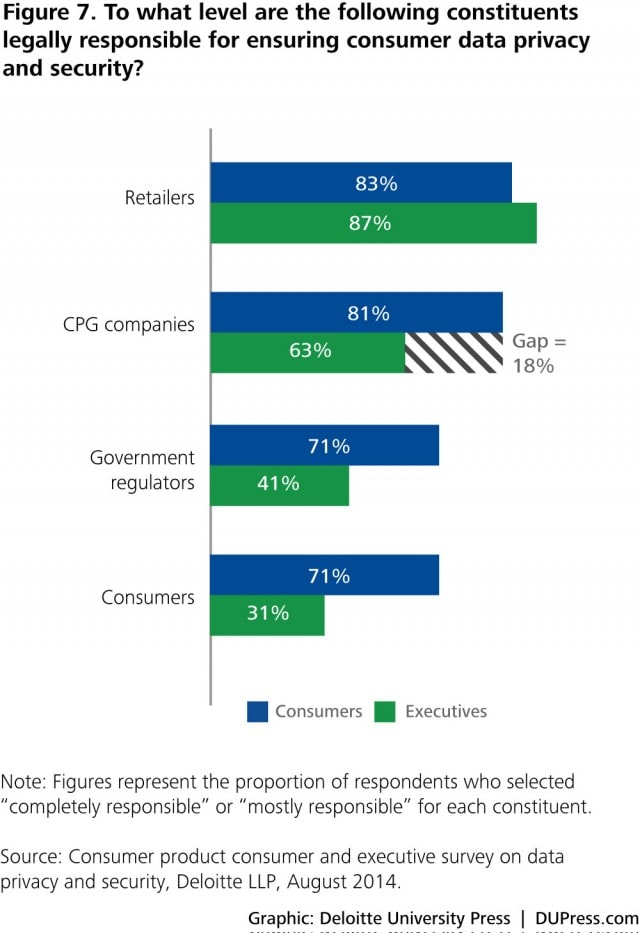
Consumers are also more likely than executives to hold consumer product companies responsible for data privacy and security (figure 7). When asked who they thought should be responsible for ensuring consumer data privacy and security, 81 percent of consumers said that they believed that consumer product companies were mostly or completely responsible, compared with only 63 percent of executives who felt that consumer product companies were mostly or completely responsible.
All this being said, the tendency to overestimate consumer comfort with consumer product companies’ data privacy and security practices does not mean that executives are blind to the risks. Reputational damage to brand, loss of current consumers, loss of potential new consumers, and lawsuits from consumers topped the list of risks executives cited with regard to data privacy and security.8 Moreover, many of the executives in our study were less than completely confident in their own companies’ data privacy and security practices. Only 41 percent of the surveyed executives stated that consumer data privacy was “absolutely critical” at their employer; only 37 percent stated that consumer data security was “absolutely critical.”9 Fewer than one-third of the executives surveyed “strongly agreed” that their company’s privacy and security policies had kept up with recent technology and regulatory changes or that their company had a consumer communication strategy in place if a breach occurred (figure 8).
Underestimating the competitive opportunity
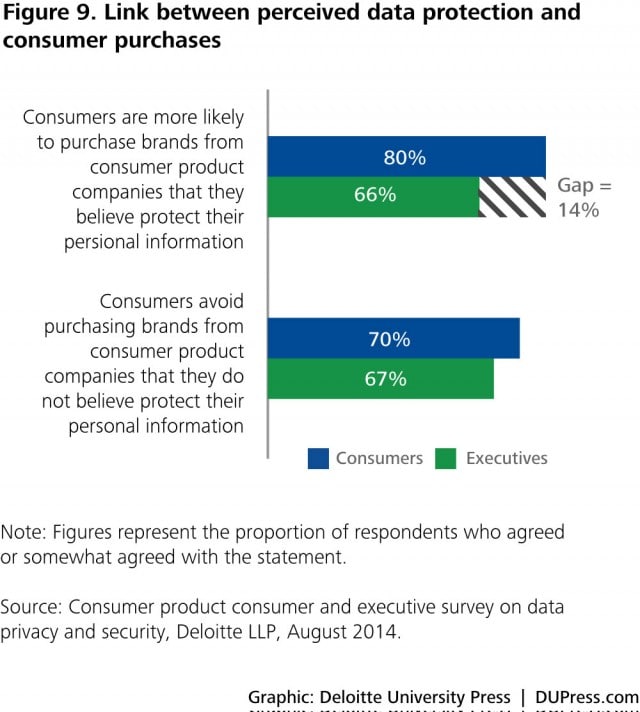
The good news is that consumer product companies could stand to gain a great deal from strengthening their privacy and security practices—and communicating these strong practices to consumers. In particular, the link between purchase decisions and perceived data security is stronger than many executives believe. Sixty-six percent of the executives in our survey thought that consumers are more likely to purchase brands from consumer product companies that are perceived to be protecting their personal information—but the actual proportion of consumers who agreed with this statement was much higher, at 80 percent. Similarly, the proportion of consumers who agreed that they would avoid purchasing brands from consumer product companies that are not perceived to be protecting personal information was somewhat higher than the proportion of executives who agreed with this statement (figure 9).
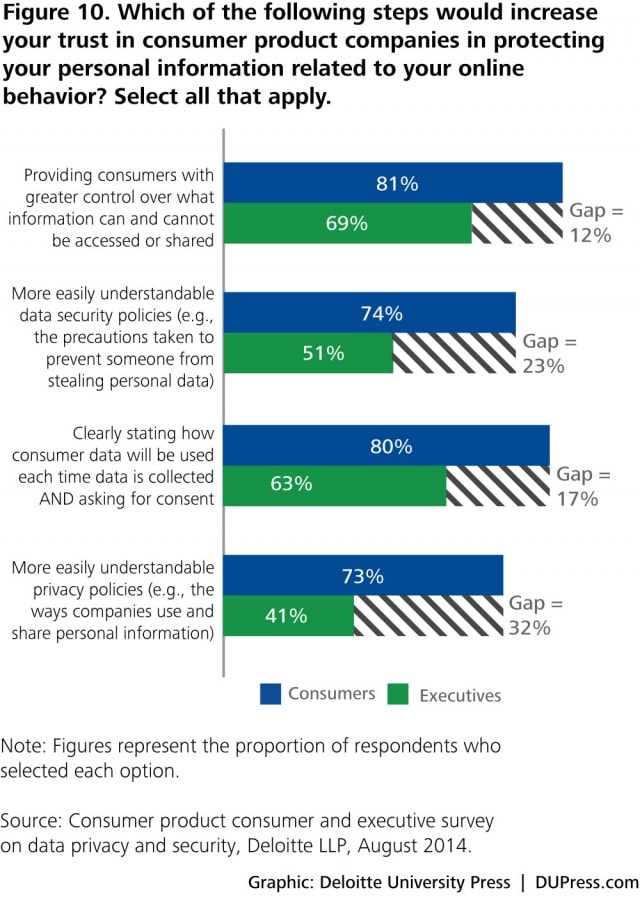
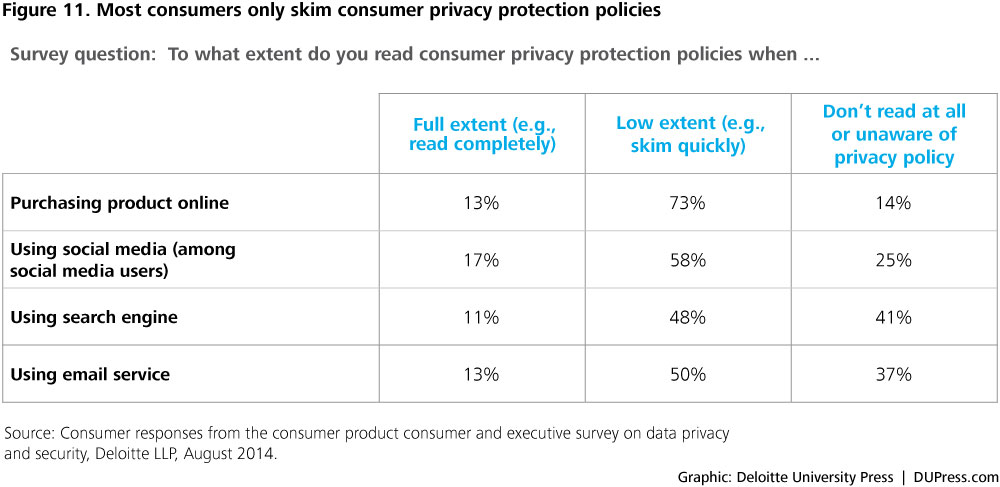
Consumers also appear more amenable to being influenced by clarity and transparency around corporate data privacy and security practices, as well as by the ability to control how their data is used, than executives may suppose. For each of four possible actions we described in our survey, a higher proportion of consumers than executives indicated that the action would help “increase trust” in a company’s data privacy and security practices (figure 10). Especially worth noting is the importance consumers place on a company’s privacy policy—even though many admit to only “skimming” privacy policies when purchasing product online as opposed to “carefully reading” them (figure 11). Seventy-three percent of our surveyed consumers agreed that easy-to-understand privacy policies would increase their trust in consumer products companies with regard to the protection of their personal information.
Five considerations for stronger data privacy and security practices
Because gaining consumer trust around data privacy and security can translate into competitive advantage, consumer product companies should consider treating data privacy and security not just as a risk management issue, but as a central component of brand-building and corporate reputation. To strengthen both the reality and the perception of corporate data privacy and security practices, we suggest that consumer product companies consider objectives in five areas (figure 13).
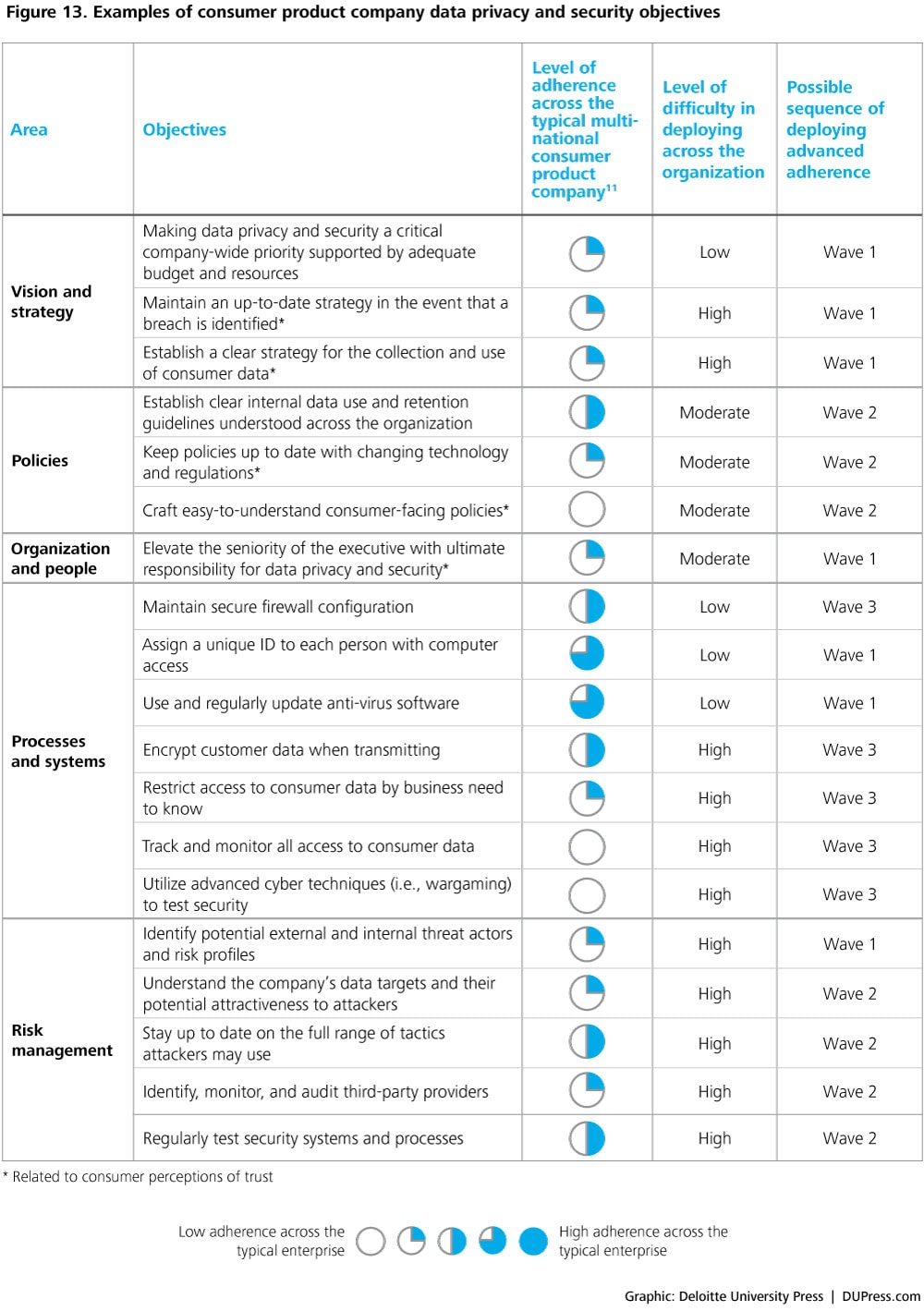
see endnote 11
1. Take on the consumer mindset in setting the vision and strategy for what data is collected, how data is analyzed and used, and how breaches are handled.
“Provide clear and frequent updates on what personal information is held and how and when the information is provided to others.”—Consumer survey respondent
“Be as clear and transparent as possible with consumers, and then follow through with strict data policies.” —Executive survey respondent
Taking the consumer mindset is an important part of building a brand for strong data privacy and security practices. By “taking the consumer mindset,” we mean developing a vision and strategy for using and protecting consumer data with an acute awareness of how consumers might interpret the company’s activities. Leaders should consider understanding what consumers appreciate and what they might object to in the use of their personal data, and examine both their goals and their tactics with the consumer perspective in mind. Questions to ask may include:
- How do we aim to improve the consumer experience, from awareness and consideration to initial product trial and repeat purchase?
- What data do we have or need to collect to improve the consumer experience at each of these steps?
- In what situations (e.g., for what types of data or what types of analyses) should we seek consumer consent or allow them to opt in, as opposed to defaulting to collecting/using their data?
- How do we avoid collecting or storing “excess” consumer data that we do not use or do not need? If we have excess data that could be harmful to consumers if breached, what do we do about it?
- Which of our attempts to improve the consumer experience could be viewed as “creepy” or intrusive instead of helpful?
- How transparent, timely, coordinated, and comprehensive are we if or when there is a breach?
Many consumers may share the perspective of one consumer we surveyed, who implored consumer product companies to “ask for my consent and allow me to decide which information I want to share.” While transitioning to a world of “opting in” rather than “opting out” may reduce digital marketing ROI in the short term, it can pay off in the long term in the form of greater trust and greater consumer openness to sharing data. “Consumers are more willing to share personal information if they know the rules, and raise their hand to opt in,” according to one mobile consumer tool developer we interviewed.12
To better understand the consumer perspective on these and similar matters, it can be useful to segment consumers based on their awareness of and level of concern with data privacy and security issues. A prudent approach could be to develop a vision and strategy based on the views of the consumer segment that is most aware of and concerned with data privacy and security. A company that meets the needs of these discerning consumers will likely exceed the needs of the others.
2. Develop privacy policies as if they were a marketing tool rather than only a legal disclosure.
“Companies should have simplified privacy policies. Now you have to practically have a law degree to understand them.” —Consumer survey respondent
A privacy policy’s goal should not only strive to inform consumers of the precautions a company has in place around data protection and use, but also—and just as importantly—aim to increase the willingness of consumers to share their personal data. Leaders should view their company’s privacy policy as a strategic communication that, by making a commitment to consumers to safeguard their personal information, maintains and even builds trust. However, few companies appear to see their privacy policy as anything more than a legal safeguard. A privacy policy over a dozen pages long, written in arcane legal language, and presented in a tiny font size does not likely inspire a great deal of trust, particularly when it is difficult for consumers to find.
According to our research, two of the most important ways that consumer product companies can increase trust in their data privacy and security practices are by clearly stating how consumers’ personal data will be used and by giving consumers more control over the use of their data. A privacy policy should therefore lead with easy-to-understand language that addresses these fundamental issues. Points to cover include:
- What personal data does the company collect?
- How does the company use the data?
- How does the company protect the data?
- How do consumers opt in and opt out of the collection or use of their data?
- How do consumers benefit from the collection and analysis of their data?
One tactic for shortening and simplifying the privacy policy is to present key information in plain English on the main privacy policy page, then provide links to more comprehensive details for those consumers interested in the fine print. Recall that many consumers skim, rather than carefully read, privacy policies—making it essential for companies to get the main messages across quickly and simply.
To back up the promises made by the privacy policy, companies should consider developing clear internal data use and retention guidelines across the organization that directly link to the consumer privacy policy. These guidelines could drive behavior both within the company’s own organization and at its partners. And, given the ever-changing technological and regulatory landscape, it is important to regularly revisit policies to keep them up to date.
3. Elevate the seniority of the executive with ultimate responsibility for data privacy and security.
“Responsibility [for data privacy and security] doesn’t roll up to one place at many consumer product companies due to their size and complexity. A corporate privacy officer’s role should be to set overall company policy and ensure that the policy is adequately deployed in the organization. However, to do this, the privacy officer has to have the budgetary authority and the managerial control to enforce company policy.” —Consumer products information technology executive interviewee
It is our view that large consumer product companies looking to reassure consumers of the precautions in place around data privacy and security—as well as ensure compliance with data privacy and security laws across a multinational enterprise—should consider having a senior privacy officer (e.g., chief privacy officer) who reports directly to the CEO. As one executive interviewee pointed out, a privacy officer’s responsibilities require a certain amount of authority and budget to carry out. A privacy officer considered a peer to the chief marketing officer, chief information officer, and general counsel is more likely to be able to effectively carry out those responsibilities, which may include weighing the trade-offs between business needs (e.g., targeted promotional campaigns based on personal data) and technology precautions; advocating on behalf of the consumer; and providing the consumer perspective to help determine what level of risk and exposure is acceptable to the company. Optics are also important: A company that puts its top privacy officer in the C-suite sends a message to the marketplace that it takes protecting consumer data seriously.
For many consumer product companies, having a privacy officer in the C-suite rather than within the information technology department would likely be a change. Only 41 percent of the executives we surveyed worked at a company where the leader ultimately responsible for consumer data privacy reported directly to the CEO. Even fewer executives (34 percent) worked at companies where the leader of consumer data security reported directly to the CEO.
4. Deploy supporting processes and systems consistently across the enterprise to reduce exposure and mitigate threats.
“Stay current on threats and continuously upgrade technology.” —Executive survey respondent
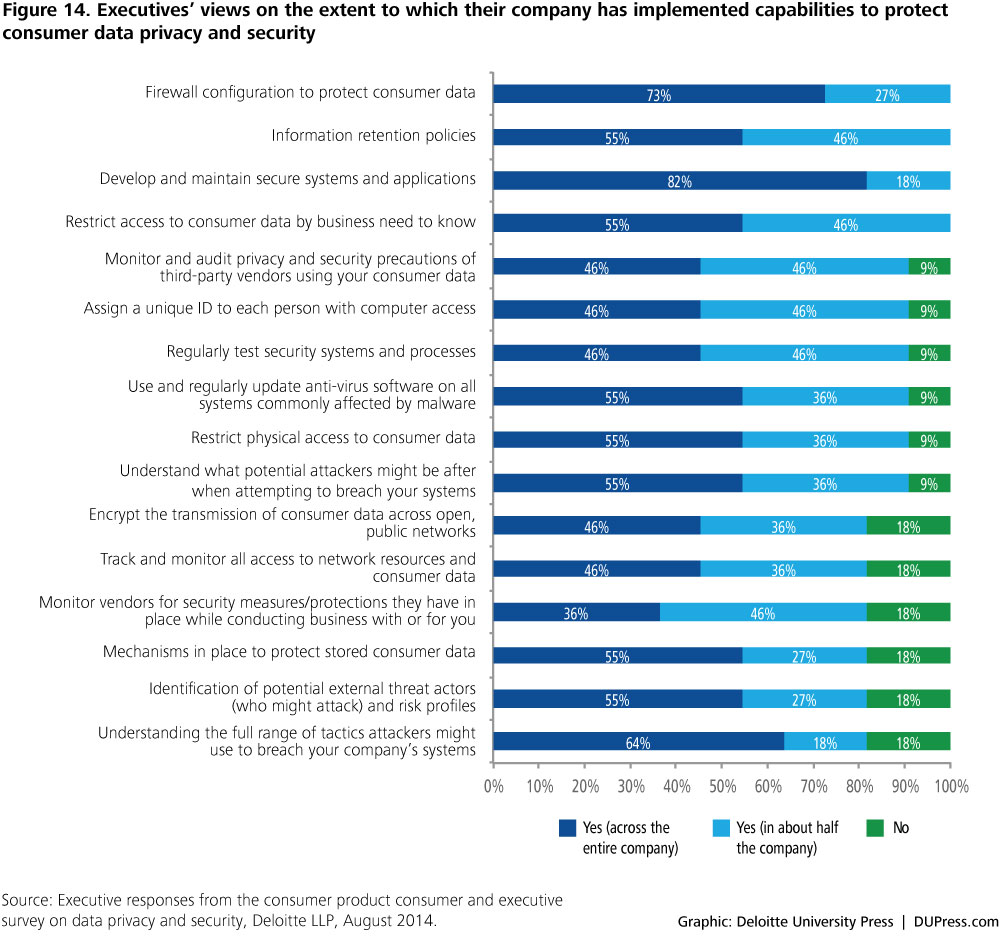
If personal data is compromised or misused, consumers are unlikely to care which department's or division’s fault it is. Consequently, all parts of the enterprise must have processes and systems in place to safeguard data privacy and security and to mitigate threats. Unfortunately, deploying processes and systems across a complex organization is often challenging, as many disparate data repositories often exist. When asked about the extent to which their companies had deployed a variety of process and system capabilities for protecting consumer information, the percentage of executives who reported that their organization had deployed a capability “across the entire company” ranged from a high of 82 percent (for developing and maintaining secure applications) to a low of just 36 percent (for monitoring vendors’ security practices) (figure 14). These results suggest that many consumer product companies do not have many basic data privacy and security tactics in place across the entire enterprise.
Our executive interviews revealed a number of approaches to achieving organization-wide consistency in data privacy and security practices. One consumer product information technology executive emphasized the importance of reducing exposure to simplify the deployment of processes and systems. This executive’s company systematically inventories areas of exposure and then examines whether these areas could be removed as exposures—for instance, by shortening the data retention period or by not collecting certain data elements. This approach reduces the extent to which processes and systems to safeguard data are required in the first place, thereby easing the challenge of deploying them across the organization.
Top-down governance can also be useful in achieving consistent deployment, as demonstrated by one multinational, multi-product-line consumer product company that maintains a privacy council that supports the senior privacy officer. Through the council, accountability for privacy is consistently deployed across the organization to key business units responsible for the communication of privacy standards to employees. The council also oversees compliance with global privacy standards, and sees that consistent privacy policies are instituted and maintained across all data types and countries.
5. Expand risk management around data privacy and security to guard against not just external malicious breaches, but also inadvertent internal breaches and third-party partner breaches.
“Consumer product companies should not assume that adequate privacy and security precautions are in place with digital marketing vendors. They should be verifying with third-party audits.” —Consumer product information technology executive
Malicious hackers aren’t the only source of data security risk. A company’s own employees often have opportunities to compromise data security, either inadvertently or intentionally. Further, for many targeted marketing campaigns, much of the actual work is done by third parties—vendors and contractors with whom a company must share consumers’ personal data. It is therefore imperative to consider expanding risk management to install safeguards against both third-party partner breaches and internal security lapses, as well as against external threats. Steps to consider include:
- Identify potential external and internal threat actors and risk profiles. This allows companies to step into the shoes of potential security threat actors to better characterize the precautions required.
- Understand the company’s data targets and their relative attractiveness to attackers. Creating a tiered policy that prioritizes the level and number of privacy and security controls in place can be a good starting point.
- Stay up to date on the full range of tactics attackers may use. Expect attackers to be creative and breaches to occur, and plan to have multiple layers of protection to render some breaches “harmless.”
- Identify, monitor, and audit third-party providers. Don’t assume vendors are complying with the data privacy and security stipulations in work agreements. Confirm that they are complying, and identify and address weaknesses in their systems and processes.
- Regularly test security systems and processes. As consumer product companies continue to link previously separate data sources to create a single view of the consumer, they may inadvertently create privacy and security lapses. Regular testing increases the probability of companies identifying issues before attackers do.
- Simulate cyber attack scenarios to evaluate incident response preparedness and identify response deficiencies. Cyber wargaming can allow companies to develop a shared perception of cyber security threats. Consumer product companies that understand key dependencies and inventory sources of consumer information prior to a cybersecurity incident are better positioned to respond. They should stress test the communication of strategic and technical information between executive management and IT team.
As one consumer we surveyed said, “I’m not sure that there is anything that companies can do [about hackers]. Hackers will always be finding new ways to access information.” However, it is possible that, while consumers may perceive external threats as more or less inevitable, internal threats and third-party breaches may be seen as more avoidable—and therefore less forgivable. If this is the case, then it becomes especially important for consumer product companies to consider safeguarding data privacy and security in areas over which they have some measure of control.
A matter of trust
When it comes to consumer privacy, begin and end with the mantra of “build consumer trust.” It is easy to understand consumers’ hesitation about having their often private preferences—for products, brands, and media—and their social media activities aggregated and analyzed to uncover the essence of their shopping behaviors. Cultivating positive consumer perceptions of data privacy and security practices can help offset this unease, and thus become a potential source of competitive advantage. Rather than forego the unequivocal value of gathering and using personal consumer data to drive targeted digital marketing, consumer product companies can seize the opportunity to build brand trust by meeting—and even exceeding—consumer expectations related to data privacy and security.
Appendix: A deeper look at the consumer perspective
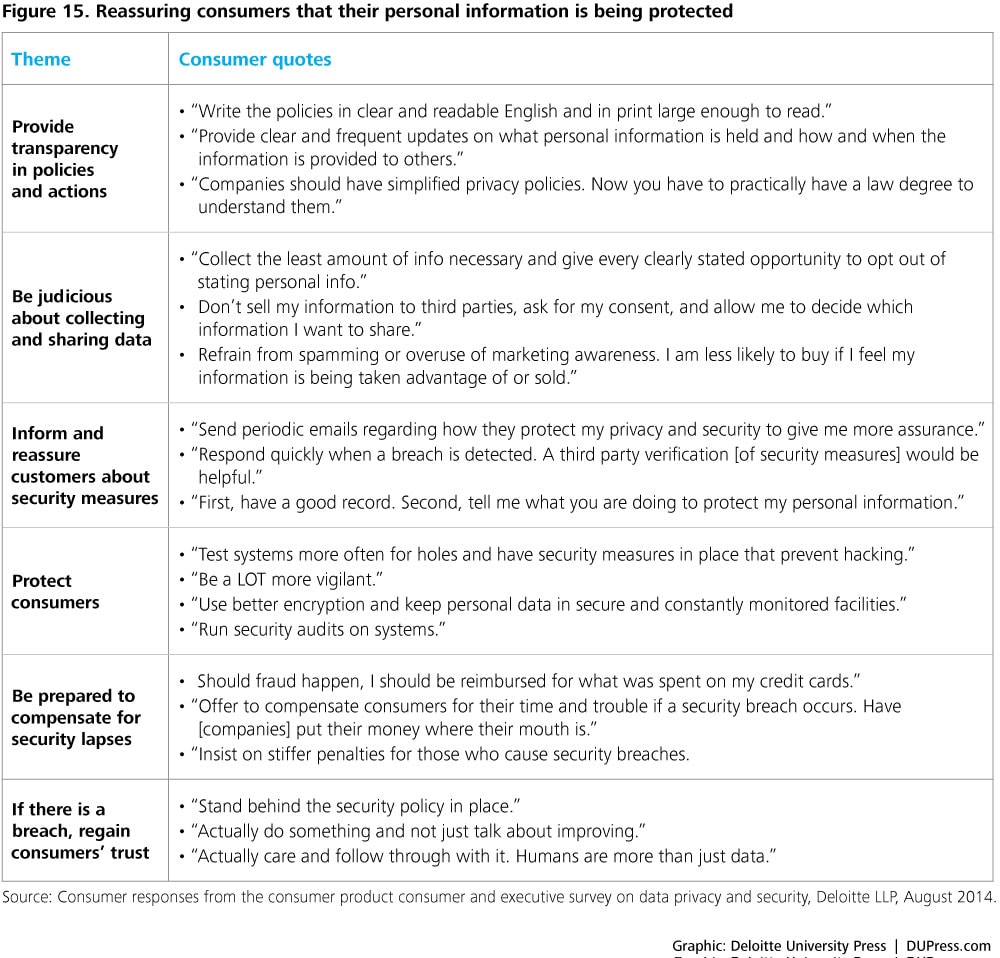
What can retailers and consumer product companies do to reassure consumers that they are protecting the privacy and security of their personal information? When we asked consumers in our survey this question, the answers appear to cluster around six themes (figure 15):
- Provide transparency in policies and actions
- Be judicious about collecting and sharing data
- Inform and reassure customers about security measures
- Protect consumers
- Be prepared to compensate for security lapses
- If there is a breach, regain consumers’ trust
BY
Pat Conroy
Anupam Narula
The authors would like to thank Julie Finn (Deloitte Services LP), Junko Kaji (Deloitte Services LP), Robert Libbey (Deloitte Services LP), and Anup Raju (Deloitte Support Services India Pvt. Ltd) for their significant contributions to the research and writing. We would also like to acknowledge the contributions of Sushant Gaonkar, Shweta Joshi, Vaibhav Khobragade, and Neelakantan Subramanian (all of Deloitte Support Services India Pvt. Ltd).