
What directors’ career histories may reveal about the capabilities of Fortune 100 company boards
If a board is only as strong as the sum of its parts, how much do we really know about those parts?
As businesses face volatility and market shifts, many corporate boards are having to make critical decisions amid heightened uncertainty to help top management deliver growth while strengthening resilience. Against this backdrop, improving board composition could be a key strategy for enterprises seeking to build long-term strength. This potential is underscored by a recent Deloitte Global survey of 739 board directors and C-suite executives, in which 38% of respondents identified it as a leading driver of long-term resilience, second only to open communication between the board and the CEO (66%).
Having broader functional experience in the boardroom could help enterprises adapt more effectively to shifting market conditions. To assess that potential, we examined how directors’ career backgrounds may influence the capabilities of Fortune 100 boards, drawing on the last six leadership roles held by each director (see “About the data”).1 The objective is practical: to provide a baseline for board refreshment discussions and help focus director education efforts.
Boards and their stakeholders rarely view composition through a single lens. Different approaches serve different purposes. Proxy-statement disclosures, including skills matrices, can help communicate the oversight capabilities the board brings to the company’s priorities.2 Internal views, such as maintaining a record of director backgrounds, can add more detail to support refreshment discussions. By focusing on functional leadership roles, this analysis considers the depth and breadth of experience directors have built over time.3
Fortune 100 board experience: What’s prevalent (and what’s not)
Mapping directors’ career titles to current Fortune 100 board composition reveals three primary patterns. Some backgrounds are common, while others appear less frequently, even as demand for them grows. A small set remains rare across boards.
Directors with top C-suite experience are ubiquitous. Every Fortune 100 company CEO sits on the board, and more than half (53) also serve as board chair. Beyond the company’s CEO, every Fortune 100 board includes at least one director with CEO experience. The premium that boards place on former chief executives could grow further, given ongoing geopolitical volatility and what it can mean for the enterprise.4 Consistent with this emphasis on top management experience, directors who were finance and operations executives appear on 96 and 89 boards, respectively.
About two-thirds of Fortune 100 boards (67) include at least one director with a senior marketing background. A comparable number (65) include directors who previously worked as nonprofit executives, served as military officers, or held senior roles as government officials at the local, state, or federal level. Reflecting the growing importance of human capital oversight and workforce-related risk on board agendas, over half (56) of Fortune 100 boards include at least one former senior human resources leader (figure 1).5
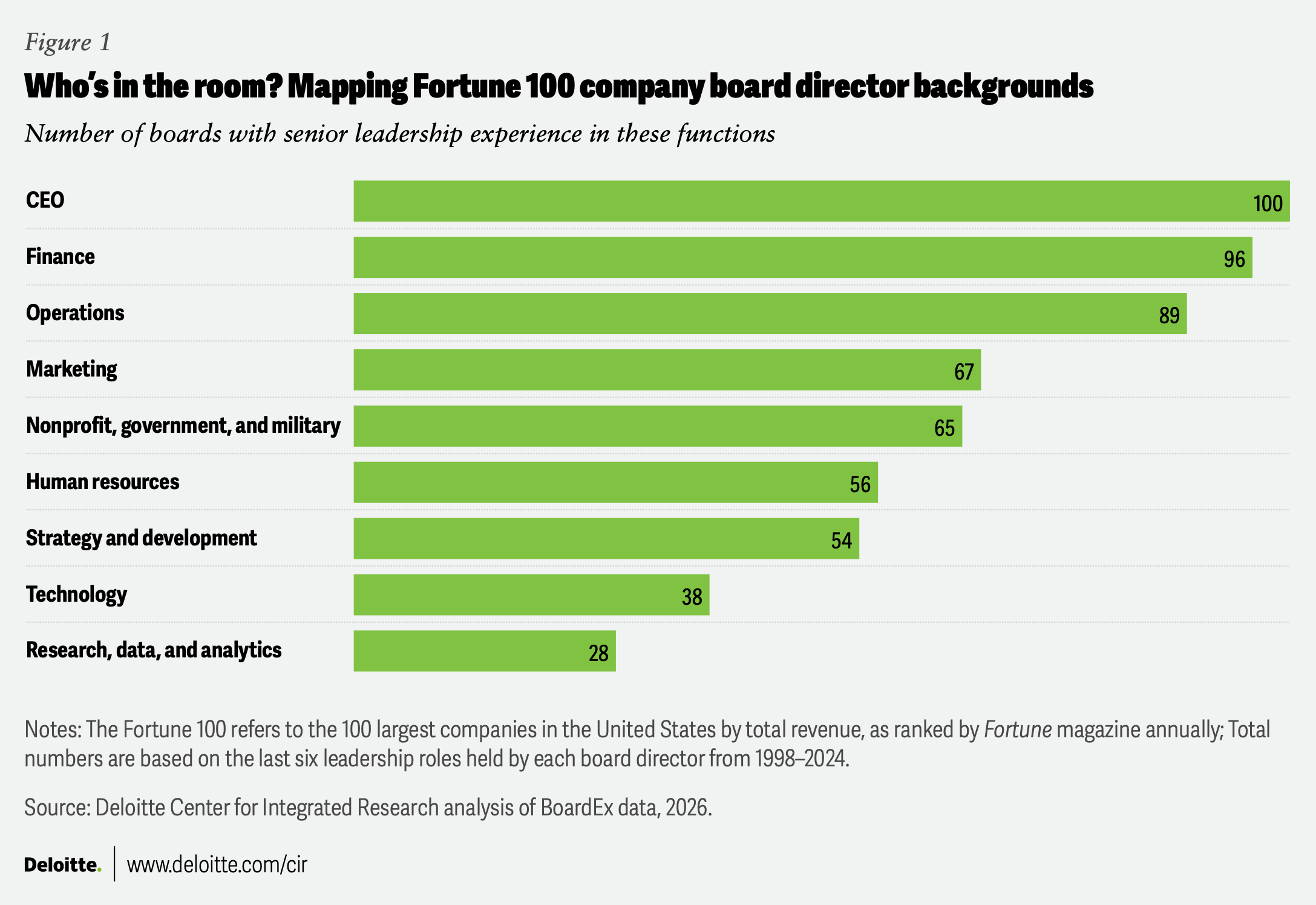
Digital and technology experience is a recruitment priority, but not yet a norm in composition. Technology has become an essential factor in how companies compete, function, and address risk. As a result, many boards are placing greater emphasis on technology expertise when searching for directors. A recent Spencer Stuart survey of nominating and governance committee chairs found that technology experience (51%) was a top recruitment priority, second only to CEO and chief operating officer backgrounds (60%).6
That stated preference is partly reflected in board composition: All Fortune 100 boards have at least one director with CEO experience, and 89 include directors with COO backgrounds. But while interest in former technology executives appears to be growing, directors with that background serve on just 38 Fortune 100 boards.
Potential capability gaps emerge for newer C-suite functions. The limited presence of technology leaders reflects a broader reality in Fortune 100 board composition: The pool of directors with technology expertise is relatively small. For example, while 38 Fortune 100 boards have at least one executive with technology experience, just under 6% of all current directors have held a senior technology leadership role (that is, 66 current or former technology executives are directors at Fortune 100 companies).
Research and analytics leadership is similarly uncommon. The 41 individuals who have held such roles—3% of all current directors—serve on 28 Fortune 100 boards. Put another way, 72 boards lack a director with current or recent executive-level experience in research or analytics. The relative newness of C-suite-level roles in technology, research, and analytics could limit the pool of candidates with tenure in these functions.
Strengthening capabilities with two levers: Refreshment and upskilling
Understanding the collective experiences board members possess can provide a baseline for refreshment discussions and help focus director education efforts on the competencies most closely tied to strategic priorities. Board leaders who seek to add capabilities can use these complementary approaches:
Developing refreshment strategies that align board capabilities with future priorities. Leaders can try to evaluate their board’s specific skills and qualifications, including board members’ functional career experience, in the context of the company’s unique needs. Such assessments, performed periodically, may be able to pinpoint both strengths and potential gaps, independent of how often new members are appointed.
Building emerging capabilities between refreshment cycles through training and education. Adding new directors whenever a competency gap arises may not always be feasible or desirable. In such cases, boards may be able to strengthen their ability to navigate evolving market conditions by equipping directors through structured learning opportunities, external expert perspectives, and peer-to-peer knowledge-sharing.
Thoughtful refreshment and targeted upskilling, grouped together, can help boards keep pace with a dynamic risk and opportunity landscape and stay focused on achieving growth and resilience. Intentionally aligning directors’ career histories, skills, and qualifications with the company’s evolving strategy may, in turn, support more effective stewardship of long-term value creation.
Watch the data come to life.
by
Christine Davine
Jamie McCall
Timothy Murphy
Elizabeth M. Molacek, PhD
Caroline Davis Schoenecker
The authors would like to thank Karen Edelman and Narasimham Mulakaluri for their valuable contributions and support throughout the creation of this article.
Editorial: Karen Edelman, Hannah Bachman, Anu Augustine
Design: Steffanie Lorig, Molly Piersol, Harry Wedel
Cover image by: Steffanie Lorig
Knowledge services: Rishitha Bichapogu
Visit the Deloitte Center for Integrated Research
Access more insights on some of the most complex issues facing businesses today.