
Beyond natural disasters: Building resilience across the value chain
In an interconnected economy, risks arising from extreme weather and other climate changes are systemic, multitiered, and embedded deep in value chains
In a global economy, the impacts of physical climate risk—whether extreme weather or longer-term shifts in climatic conditions—often rarely stay where they start. A company may not own the asset that fails, or buy directly from the supplier under stress, yet it can still feel the impact through delays, shortages, price pressure, or reduced service levels. A coffee supply chain offers a simple illustration: Weather, transport, processing, energy, and trade all influence whether the product reaches the shelf on time and at the expected cost.1
That is why many leading companies are expanding their risk assessment beyond direct physical exposure and tier-1 suppliers. The challenge is not in recognizing the interconnection but in understanding its potential implications. A critical question is whether existing analysis extends far enough to identify the dependencies and points of failure that create material risk. The 2021 storm-related outage at a Texas semiconductor plant demonstrates how disruptions ripple through interconnected supply chains. The temporary shutdown reduced semiconductor output, limiting chip availability for automotive and electronics manufacturers.2 As those companies struggled to secure components, production schedules got delayed; inventory shortages increased; and downstream suppliers, distributors, and retailers worldwide experienced delivery disruptions and rising costs—for instance, one company estimated a US$100 million disruption as a result of the outage.3
As weather-related disruptions intensify, the organizations that assess risk across multiple supply chain layers will likely be better positioned to adapt, sustain business continuity, and pursue growth with confidence. Even under ambitious mitigation scenarios, impacts are expected to increase in the decades ahead, making earlier adaptation increasingly valuable.4
This article provides a framework organized around five areas that leaders can use to help assess, strengthen, and adapt their approach to operational resilience.
- Risk assessment and mapping: Understand where risks impact the business and how they cascade across the full value chain.
- Operational and supply chain adjustments: Build flexibility, durability, and redundancy into the operating model.
- Financial and strategic planning: Bring climate scenarios and impacts into corporate strategy, capital allocation, and business planning.
- Collaboration and governance: Make resilience an effort that spans the full value chain, with engagement and coordinated action across internal functions, suppliers, logistics providers, and other critical partners.
- Social, regulatory, and market adaptation: Plan for shifting regulations, workforce conditions, and customer behavior.
Risk runs deeper than tier 1
Many climate risk assessments can provide a detailed view at both facility and direct-supplier levels. However, these assessments often stop before they capture the difficult-to-model second- and third-order dependencies that impact cost, capacity, delivery, and demand. Risks can propagate through suppliers, infrastructure, labor availability, commodity markets, and the communities that support operations.
The systemic effects can take many forms: crop losses that raise input costs; heat that reduces labor productivity; infrastructure disruptions that delay shipments; or shifting climatic conditions that contribute to inflation, migration, and broader economic instability. Because these effects affect markets, institutions, and physical assets, they are rarely confined to one geography or sector.5
Thirty-three percent of over 2,000 global executives surveyed by Deloitte Global in 2025 said natural disasters and severe weather were affecting their business, yet supply chain risk assessment and operational reconfiguration remained among the less common sustainability actions.6 Other research suggests that only about one-fifth of companies have a climate adaptation action plan,7 and that only about half assess the risk exposure of their suppliers.8 Organizations that stop short of this deeper analysis may be overestimating their operational resilience and ignoring critical risks to their business.
Using input-output analysis to evaluate systemic value chain exposure
To understand how physical risks extend beyond immediate suppliers, companies can benefit from tools that trace dependencies across multiple tiers. Input-output analysis paired with climate risk modeling provides one such approach (see “How does an input-output analysis assess risk?”). It reveals where industries depend directly on vulnerable sectors and where those dependencies extend deeper into the economy, distinguishing immediate risk exposure and system-wide risk across the value chain.9
While the approach is intentionally simplified in figure 1,10 it demonstrates how exposure broadens beyond tier 1. Input-output analysis does not replace supplier-level diligence; rather, it helps prioritize where further investigation is most needed.
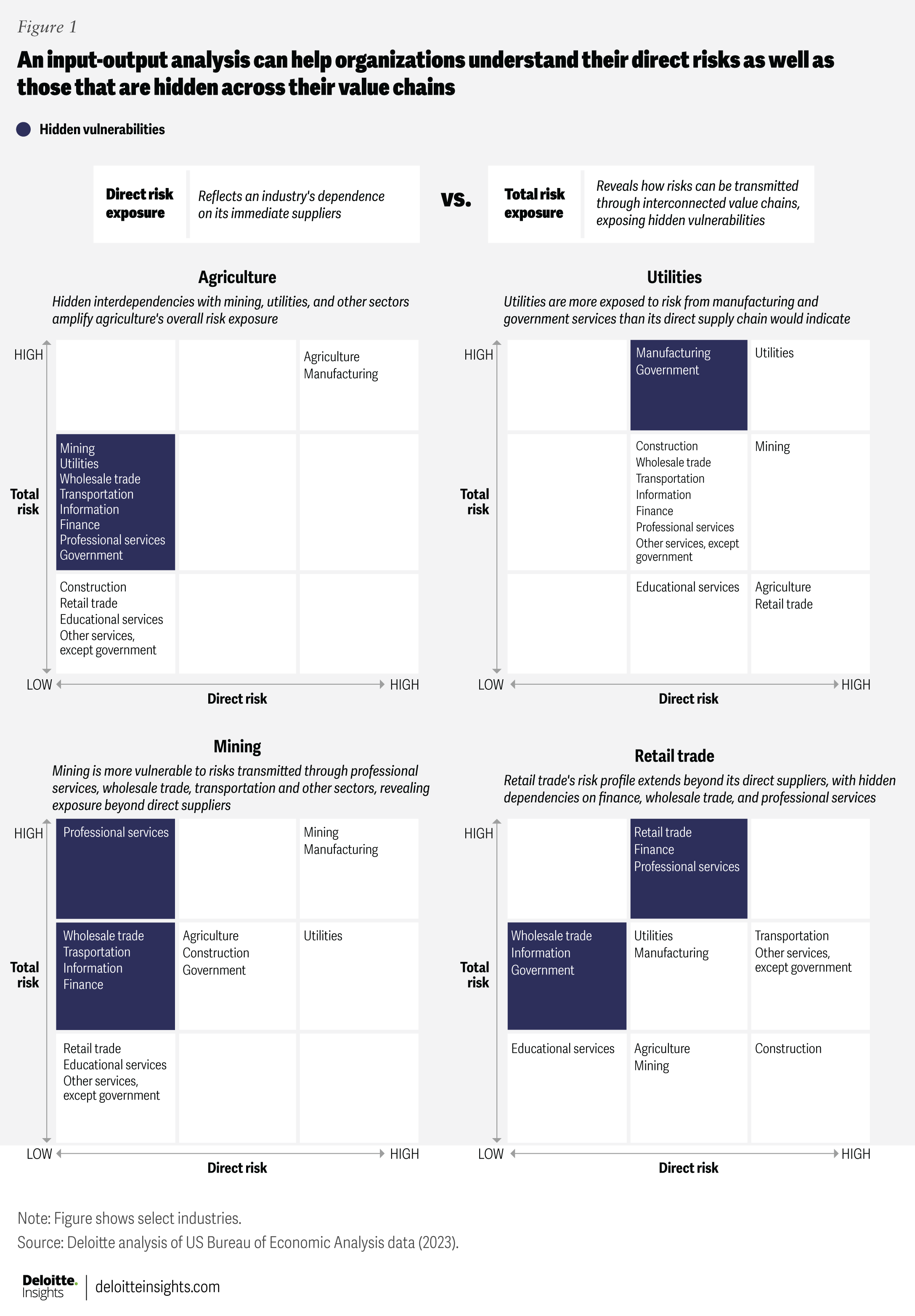
The results vary by industry, with some sectors more exposed at the direct supplier level and others carrying greater risk deeper in the value chain. Retail, for example, appears more exposed once deeper dependencies are included, while much of manufacturing’s risk is visible in its direct supply chain.
Without that systemic perspective, companies risk misallocating time, resources, and capital, overemphasizing some value chain risks while missing others. Greater visibility into these deeper dependencies allows businesses to prioritize the right supplier engagement, contingency planning, and capital allocation in advance of disruptions.
Reframing resilience: From enterprise to ecosystem
The stable conditions that once allowed companies to treat climate disruption as episodic are becoming less reliable in some locations. For business leaders, that raises the cost of narrow, asset-only risk management. Resilience now includes understanding how environmental stressors can move through their value chains, infrastructure, labor markets, and customer behavior.11
Companies do not need to wholly reinvent their operating model, but they should consider treating resilience as a strategic, enterprise priority—not a narrow risk exercise. Leaders should consider connecting a multitier risk assessment with supply chain design, capital allocation, supplier engagement, workforce planning, and governance.
The five-part framework below is intended as a practical starting point. Used together, these levers may help companies identify embedded vulnerabilities, take action, and build competitive advantage. AI and other digital tools can support many of these activities, including scenario analysis, supplier mapping, and operational monitoring.
1. Risk assessment and mapping
Understand where climate risks enter the business and how they may move across the full value chain.
- Multitier visibility: Look beyond tier-1 suppliers; use input-output analysis, supplier data, and scenario planning to target deeper investigation of tier-2 to tier-4 dependencies.
- Geographic hot spots: Identify exposure in water-stressed regions, coastal zones, wildfire corridors, and other at-risk locations.
- Single points of failure: Surface dependencies on scarce materials, concentrated suppliers, or infrastructure bottlenecks.
- Cascading disruption mapping: Test how shocks in one region or sector could affect production, pricing, inventory, and customer delivery.
2. Operational and supply chain adjustments
Build flexibility, durability, and redundancy into the operating model.
- Diversification: Evaluate multisourcing, nearshoring, alternative materials, and substitute components.
- Buffers: Design inventory, capacity, and recovery plans around the cost of risk-related downtime.
- Resilient logistics: Prepare backup transport routes, warehouse hardening, and alternative distribution options.
- Supplier partnerships: Work with high-risk suppliers on adaptation plans, not just compliance.
3. Financial and strategic planning
Bring climate scenarios and impacts into corporate strategy, capital allocation, and business planning.
- Stress-testing: Model impacts on revenue, costs, working capital, and service levels under different climate scenarios.
- Investment prioritization: Direct resilience spending toward the suppliers, assets, and processes that matter most to continuity of operations and growth of the business.
- Innovation: Develop substitutes for climate-sensitive inputs and redesign products or processes where exposure is concentrated.
- Nature-based solutions: Where relevant, use ecosystems and natural infrastructure to reduce risk and provide co-benefits.
4. Collaboration and governance
Integrate resilience across the value chain through joint planning, investment, and execution.
- Coalitions: Coordinate with shared suppliers, customers, logistics providers, and infrastructure partners.
- Policy engagement: Support public-sector resilience measures that strengthen the systems on which your business depends.
- Governance: Give the board and executive team clear oversight of resilience priorities, metrics, and trade-offs.
- Transparency: Disclose systemic risks and the actions being taken to mitigate them.
5. Social, regulatory, and market adaptation
Plan for shifting regulations, workforce conditions, and customer behavior.
- Regulation: Track disclosure requirements, pricing mechanisms, and adaptation mandates across key markets.
- Workforce resilience: Plan for impacts on labor availability, productivity, and worker safety.
- Human capital: Recognize that pressure on education, public health, and communities can affect the future talent pipeline.
- Demand shifts: Consider how changing environmental conditions could alter customer needs, locations, and purchasing patterns.
Resilience should be viewed not only as a way to reduce disruption, but as a source of strategic advantage. Companies with deeper visibility across the value chain can act earlier, adapt faster, and compete more effectively as climate risks intensify.
by
Laura Bryce
Derek M. Pankratz
Nirmal Kujur
The authors would like to thank Joel Sonkin, David Novak, and Aditi Vashishtha who contributed with their time and insights, further strengthening this work.
Editorial (including production and copyediting): Elizabeth Ryan, Rithu Thomas, Shyamili M, and Pubali Dey
Design: Molly Piersol and Rahul Bodiga
Cover image by: Rahul Bodiga
Knowledge services: Vanapalli Viswa Teja
Visit the Deloitte Center for Integrated Research
Access more insights on some of the most complex issues facing businesses today.