
How conflicts are impacting global supply chains
The October 2026 Economic Insider analyzes the strains on global supply chains and shipping due to geopolitical challenges and their subsequent impact on inflation, interest rates, and international trade
Worries around global supply chains are back in the news—this time, it’s not an unknown virus but the conflict in the Middle East that has added to concerns about the global economy. In April, the Federal Reserve Bank of New York’s global supply chain pressure index rose to its highest level in four years, believed to have been driven by disruption to shipping routes through the Strait of Hormuz.1 A truce among the parties helped calm the waters in between, but it appears to be short-lived. Hence, shipping through the strait, which had accounted for about 20% of global oil and gas exports in 2025,2 has faced renewed disruption.
The impact is being felt on global supply chains through four key channels: First, diminishing supplies of crude oil from Gulf countries have potentially pushed up prices. Second, exports of natural gas, which power households and factories, have faced disruption. Refined products such as diesel and aviation fuel, too, have seen notable price increases, with the conflict in Ukraine also adding pressure. Third, global food production could face challenges as lower levels of fertilizer exports from the Gulf may affect crop yields, especially in Asia. Finally, the growing number of attacks on merchant vessels in Middle Eastern waters3 may be adding a new layer of risk and uncertainty to international trade.
A crude (oil) jolt to the world
According to the International Energy Agency (IEA), more than 10 million barrels per day (mbpd) of Gulf oil production remained offline in August as disruptions to maritime traffic in the Strait of Hormuz constrained producers’ ability to export crude oil.4 Rerouted flows through alternative pipelines and escorted tanker transits have kept some crude moving.
Even so, total crude-oil exports from the Gulf were about 45% lower in August than before the conflict. Attacks on Saudi Arabia’s East-West Pipeline in September and threats to Red Sea shipping routes may continue to place pressure on the Gulf’s oil supplies.5 Producers that are not part of the OPEC+6 group have increased output, but that may not be enough to offset the loss in crude supply. The IEA now projects global oil supply will fall by 5.7 mbpd this year.
Crude inventories have likely provided some relief: The IEA estimates that 507 million barrels of global inventories have been drawn down since the conflict started, with China accounting for a large share of the most recent decline.7 Such support may, however, become less available if the conflict persists and inventories continue to dwindle. As of Sept. 18, 2026, in the United States, crude stocks in the Strategic Petroleum Reserve had fallen by 46% since the conflict began, leaving them at their lowest level since October 1982.8
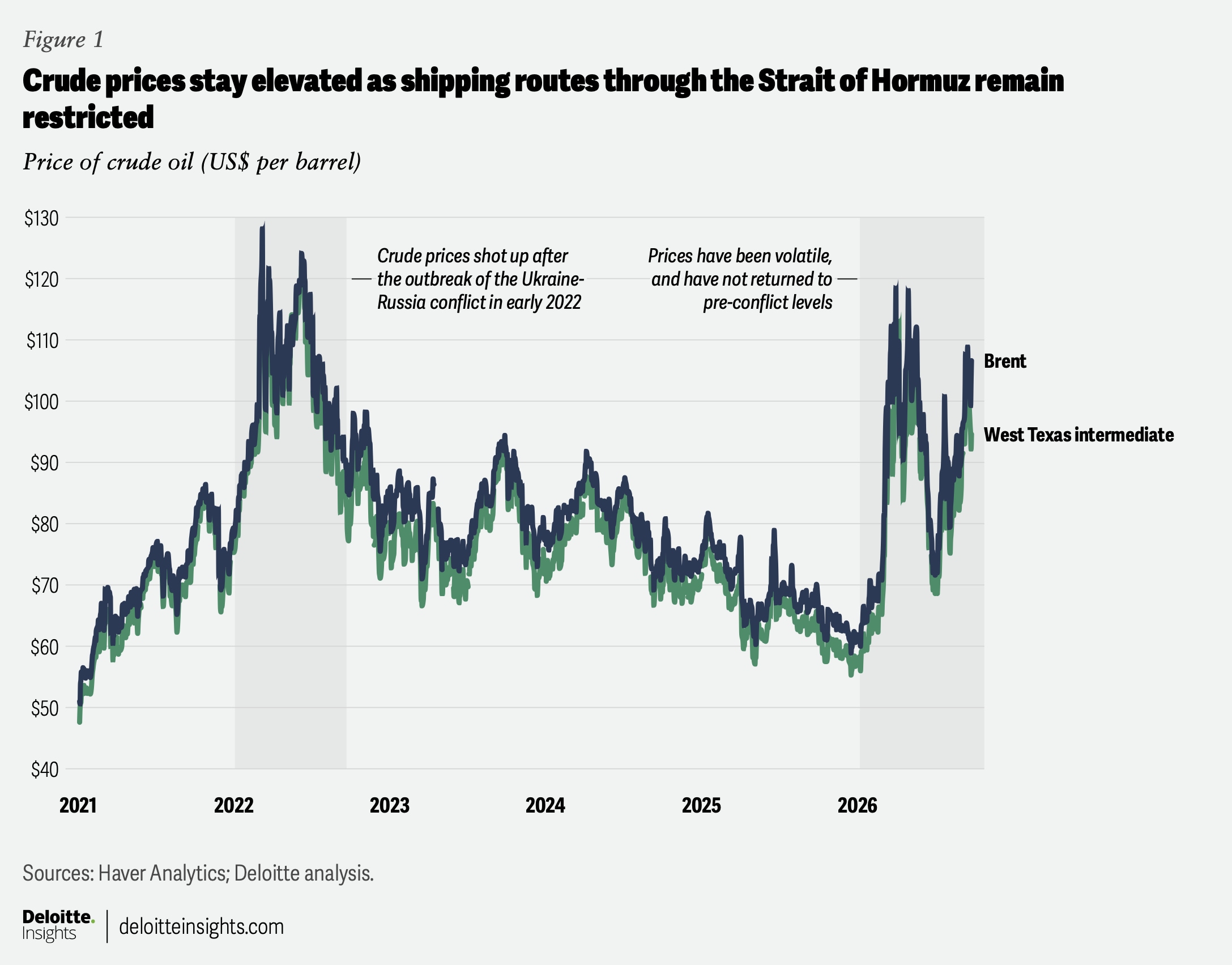
The net result of this has been an increase in crude prices this year. Brent crude was trading above US$105 per barrel on Sept. 24, 2026—about 50% above its pre-conflict level and nearly 75% higher than at the end of 2025 (figure 1). Prices have been volatile, as frequent flare-ups in hostilities and intermittent negotiations keep traders on their toes. Higher prices have dampened some demand for crude oil: The IEA forecasts global oil demand could decline by 2.5 mbpd in 2026 before recovering next year.
The impact on refined products and natural gas supply chains
In August, exports of refined products and liquefied petroleum gas from the Gulf were nearly 60% below their February levels.9 Ukrainian attacks on Russian refineries are also believed to have contributed to the problem. Russia has been a major producer of refined oil products and second only to the United States and China.10 But, with damage to its refineries, diesel output in Russia was 30% lower than in 2025, while gasoline production was down 20%. The IEA expects the throughput from Russian refineries to be more than 25% lower in 2026 compared with the previous year. Russia has, in turn, banned gasoline exports and restricted jet-fuel exports to protect domestic supplies.
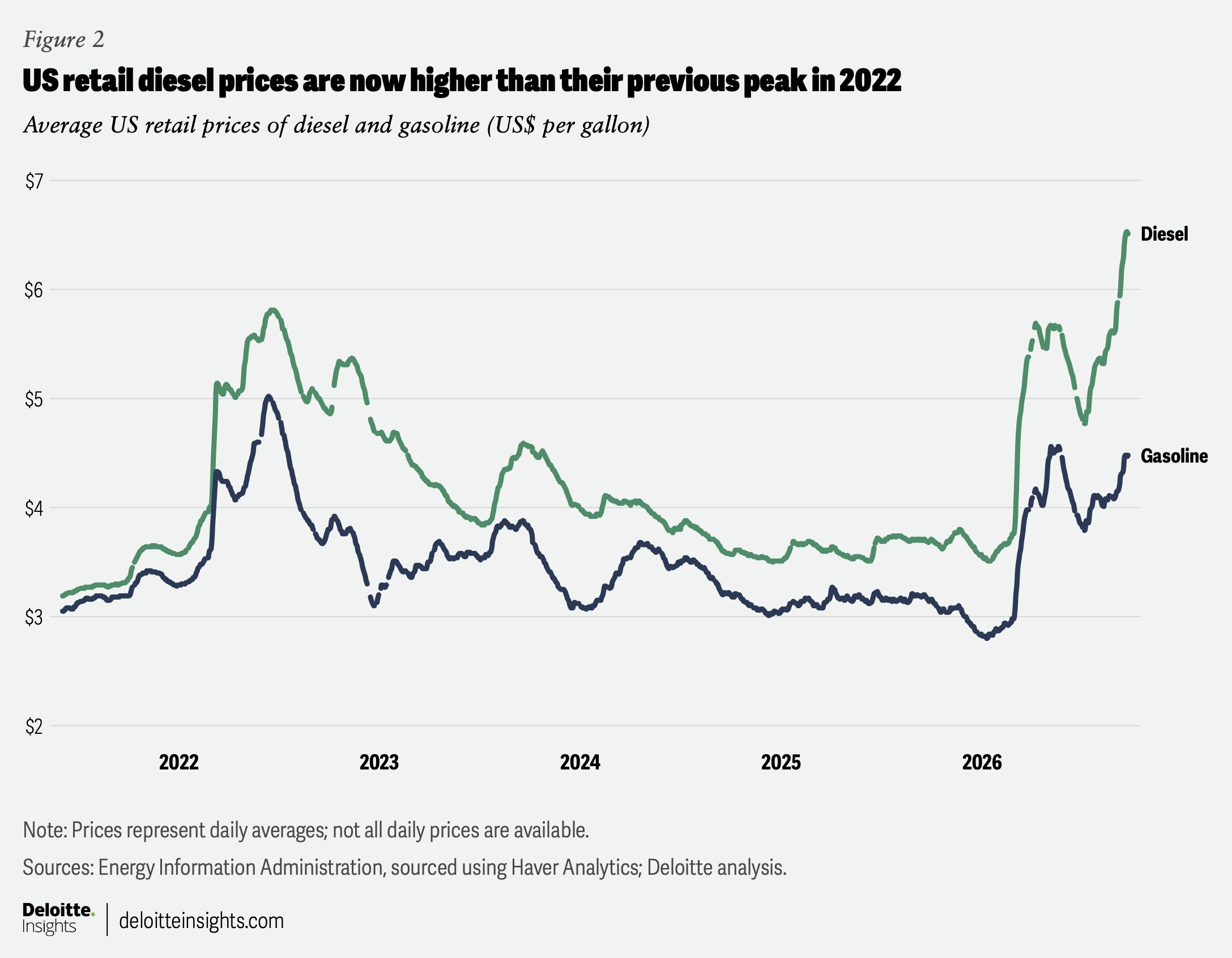
Consequently, combined diesel and gas oil11 exports from the Middle East and Russia were down by 75% in August compared with a year ago.12 Refiners in other nations have raised output in response to higher margins, but not enough to close the global supply gap. Unlike crude, refined products cannot be replaced quickly as refineries need spare capacity and the right crude slate. Hence, prices have risen (figure 2). As of Sept. 22, 2026, US retail diesel prices were up 74% since the start of the conflict, while gasoline prices had risen 50%.13
Natural gas markets show a broadly similar pattern. Before the conflict, the Strait of Hormuz carried nearly one-fifth of global liquified natural gas (LNG) supplies.14 But between March and June, LNG loadings for Qatar and the United Arab Emirates were 35 billion cubic meters lower than a year earlier, while damage to LNG facilities at Qatar’s Ras Laffan complex has likely added to the strain.
Increased supply from North America and Africa has partially bridged the supply gap. Nevertheless, natural gas prices have risen significantly, especially in Europe and Asia. On Sept. 23, 2026, Dutch TTF gas futures were trading 125% higher than just before the start of the Middle East conflict.15 Prices may remain elevated as nations prepare for winter. For example, demand from the European Union may increase given that current inventories are lower than a year ago.16
Food, too, is not off the hook
Global food supply also faces multiple challenges, particularly from reduced fertilizer output. According to the Food and Agriculture Organization (FAO) of the United Nations, up to 30% of internationally traded fertilizers usually pass through the Strait of Hormuz.17 Disruptions to shipping in the strait, therefore, appear to have reduced exports from the region.18
Nitrogenous fertilizer shipments from Saudi Arabia were 63% lower in the first half of 2026 than a year earlier, while exports from Qatar and the United Arab Emirates fell by 37% and 29%, respectively, according to estimates by the International Food Policy Research Institute.19 Saudi Arabia is also a major exporter of phosphate fertilizers, with the institute estimating a 22% drop year over year in the six months through June 2026.20 The closure of the strait has also disrupted shipments of sulfur, a key ingredient in manufacturing phosphate fertilizers.21
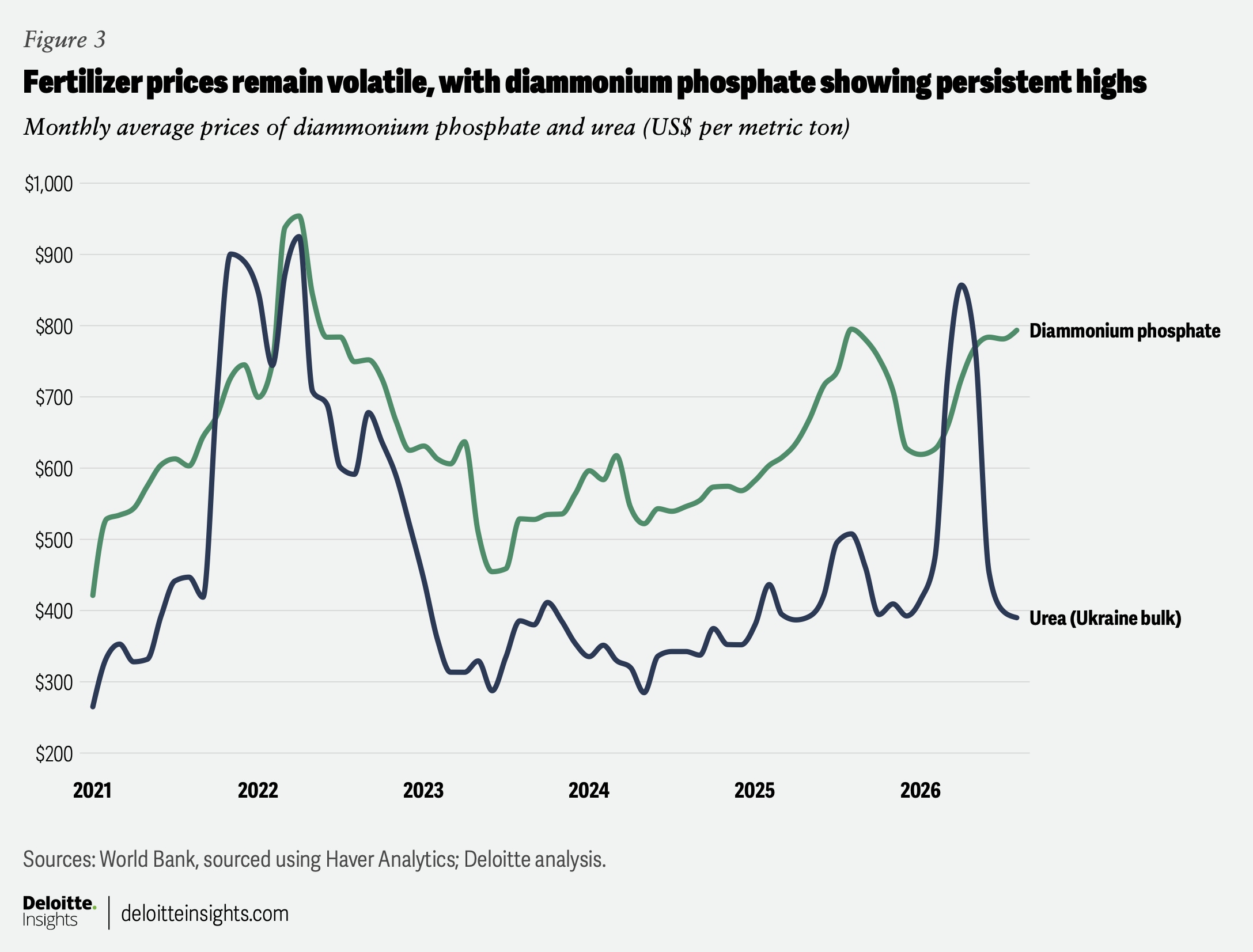
The immediate impact of fertilizer supply disruption has been on prices. According to the World Bank, urea prices surged by 81.5% between February and April.22 Prices, however, have eased since then and returned to almost pre-conflict levels due to three reasons: First, stranded Gulf shipments made their way out in June when hostilities ceased for a while. Second, producers like the United States and China ramped up exports.23 Finally, surging prices early in the conflict led to a drop in global demand.24 The same, however, cannot be said of phosphate fertilizers like diammonium phosphate, as sulfur supplies remain tight and keep prices elevated (figure 3).25
If fertilizer supplies do not normalize, farmers may reduce dependence or shift crops, potentially affecting yields next year. These shocks may also reduce the resilience of the global food system at a time when climate-related risks (such as those from El Niño–related effects) are rising. There have also been disruptions in the Black Sea region, with strikes on storage and port infrastructure around Odesa constraining Ukraine’s ability to move its harvest to global markets.26 Together with higher energy and freight costs, these factors suggest that the global food supply chain could remain under pressure. Food prices have, therefore, edged up. The FAO food-price index rose by 6.4% between February and August. The corresponding increase in the same period last year was just 2.7%.27
Shipping is becoming a more challenging business
In addition to energy flows, the Gulf is also a major trade hub for merchandise trade. Disruptions in the Strait of Hormuz, therefore, have affected not only global energy supply chains but also broader merchandise shipping—an important enabler of international trade. Renewed risks in the Red Sea and the Bab el-Mandeb Strait, following hostilities in Yemen, have added to these pressures. According to the UK Maritime Trade Operations and the Joint Maritime Information Center, there have been 116 confirmed vessel incidents in the Middle East maritime region between March 1 and Sept. 20, 2026.28 These incidents highlight the broader risks to seaborne trade despite US-facilitated transits and a strong naval presence.
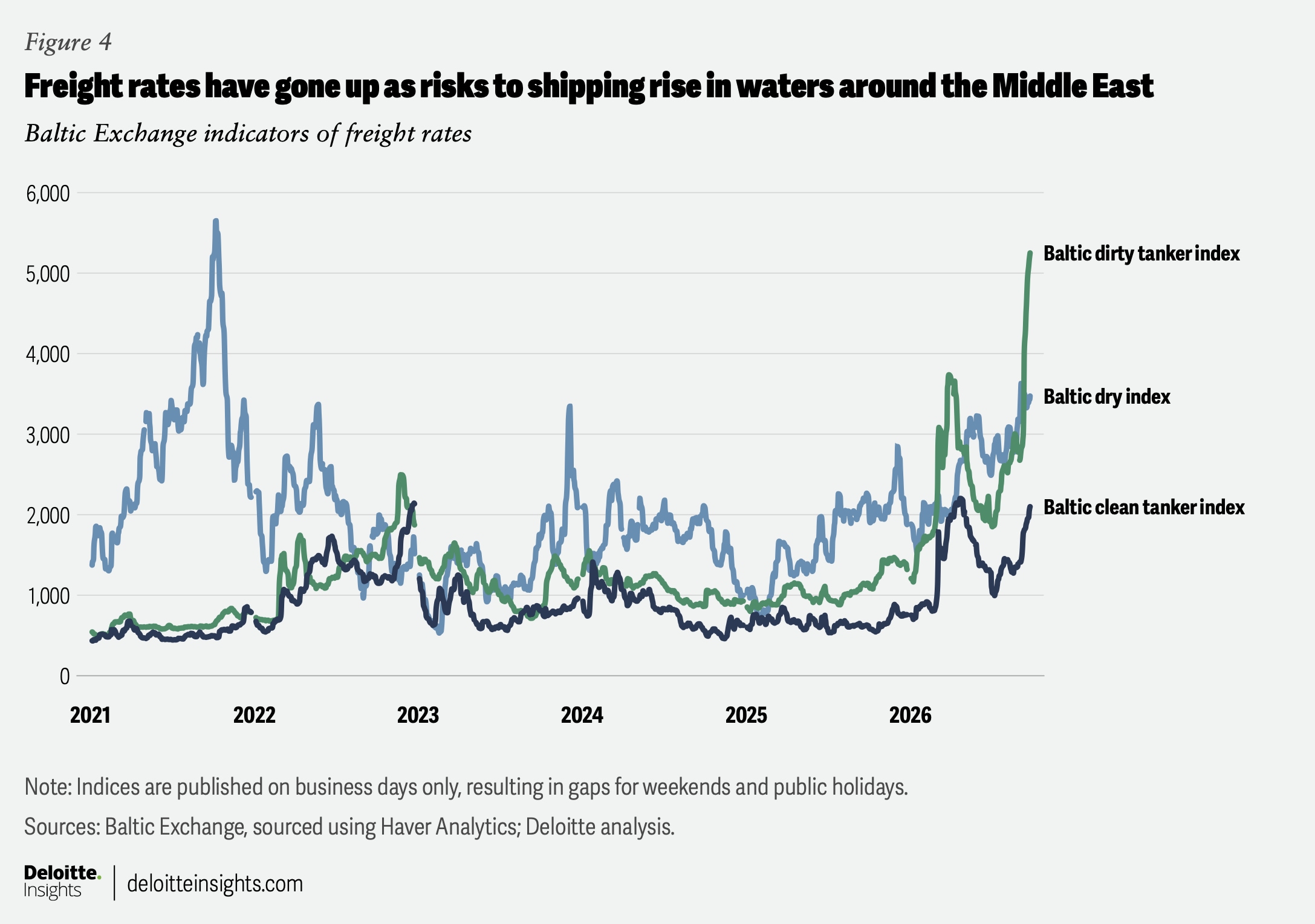
Due to such incidents, risks to vessel crews and port workers have likely gone up as well. According to the International Maritime Organization, there have been 24 confirmed seafarer fatalities in 120 confirmed incidents (as of Oct. 22, 2026) in and around the Strait of Hormuz and the wider Middle East.29 The organization’s incident-level reports also indicate that at least 53 seafarers were injured.30 These numbers help explain why shipping companies, insurers, and cargo owners continue to treat the region as a high-risk one. War-risk insurance costs have consequently risen, adding to higher freight costs. The Baltic dirty tanker index, for example, which tracks freight rates for crude tankers, is now more than four times its level a year earlier. Other freight indices also show a similar upward trend (figure 4).31
The disruption has also encouraged greater use of ship-to-ship transfers, especially in waters off the coast of Oman.32 A large crude oil–carrying tanker may transit the Strait of Hormuz with its automatic identification system transponder switched off, using a US-facilitated route. Once in Omani waters, it may transfer its cargo to another vessel, which then carries it to an importing country. While this has helped some crude from the Gulf find its way to global markets, the process is costly and may increase operational risks, including collision, vessel damage, environmental harm, and reduced regulatory oversight, which have been the hallmarks of credible maritime trade.33
Brace for impact: Inflation and borrowing costs rise in the United States
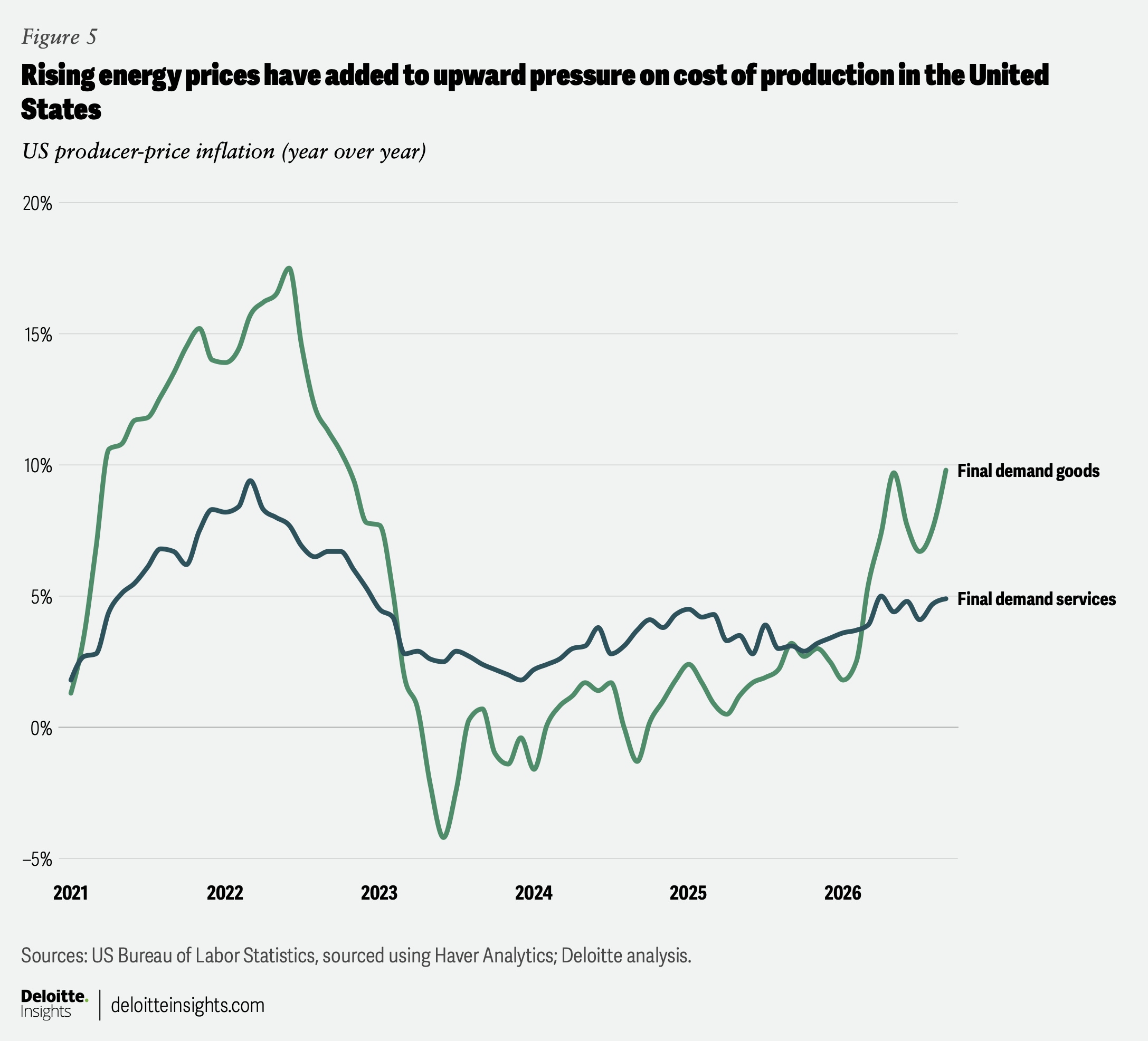
With conflicts not only hitting energy and food supply chains but wider international trade as well, it’s only natural that their impact is being felt by consumers, businesses, and governments the world over. In the United States, energy-driven inflation has added to existing price pressures. Inflation for energy goods and services was negative in January and February of this year but rose to 23.7% in May; the figure was 16.8% in August.34 Businesses in the country that were already facing tariff-related cost pressures are seeing production costs rise further (figure 5).35 It is likely that they are passing on some of these costs to consumers: Durable goods inflation in August was nearly double of what it was a year ago.
As price pressures rose, the Federal Reserve responded by tightening monetary policy. On Sept. 16, 2026, the Fed raised the federal funds rate by 25 basis points—the first rate hike since 2023.36 In its median projections, the Federal Open Market Committee indicated the possibility of another hike this year.37 This marks a reversal from March, when the committee’s median quarterly projections had indicated a rate cut of 25 basis points later this year, followed by a similar cut in 2027.38 However, it’s not just the Federal Reserve that has moved toward tighter monetary policy in response to rising inflation risks. The European Central Bank has raised rates twice this year by a total of 50 basis points, and so has the Bank of Japan, pushing the country’s policy rate to its highest level in 31 years.39
Rising inflation and inflation expectations have likely led bond markets to reassess monetary policy stances and the fiscal health of governments. Consequently, government bond yields have risen. In the United States, the 10-year Treasury yield rose to a 19-year high on Sept. 24, 2026, while the 30-year yield is now the highest in 22 years.40 This could potentially raise borrowing costs for businesses and households. Interest rates for auto loans, credit card debt, and mortgages are often influenced by the 10-year Treasury yield. As Treasury yields rise, so too have consumer borrowing costs: The 30-year fixed mortgage rate, for example, was at 7.1% on Sept. 23, 2026—the highest in nearly 18 months.41
Rising government bond yields can also increase interest costs for the government. Net interest payments are now the third-largest spending item for the US federal government.42 With debt and deficit levels already high, rising borrowing costs could also limit the US government’s ability to respond to any future economic crisis. It is an issue that other governments across the developed world may also face if current geopolitical conflicts persist.
By
Dr. Ira Kalish
Akrur Barua
Editorial (including production and copyediting): Arpan Saha, Preetha Devan, and Cintia Cheong
Design: Harry Wedel
Cover image by: Harry Wedel
Knowledge services: Agni Wagh
Visit the Deloitte Global Economics Research Center
Access more insights for the consumer spending, housing, business investment, globalization & international trade, fiscal & monetary policy, sustainability, equity, & climate, labor markets and prices & inflation sectors.