
European CFOs are more pessimistic in 2026 than at any point since the 2022 energy crisis
A new Deloitte survey shows that CFOs are prioritizing cost discipline, resilience, and scenario planning as geopolitical risk, margin pressure, and economic uncertainty intensify
Deloitte’s spring 2026 European CFO Survey reveals that chief financial officer pessimism has nearly doubled among respondents since autumn 2025. The survey was conducted in March and April 2026 and captures the views of more than 1,100 CFOs across 12 European countries on the macroeconomic, geopolitical, and operational forces shaping their decisions over the next 12 months (see methodology). It found that the percentage of CFOs who felt less optimistic about the financial prospects of their company than they did three months earlier jumped from 25% to 48% (figure 1). That’s the highest level since 2022, when energy supply shocks and supply chain disruptions stemming from the Russia-Ukraine conflict, among other factors, sent CFO confidence plummeting.
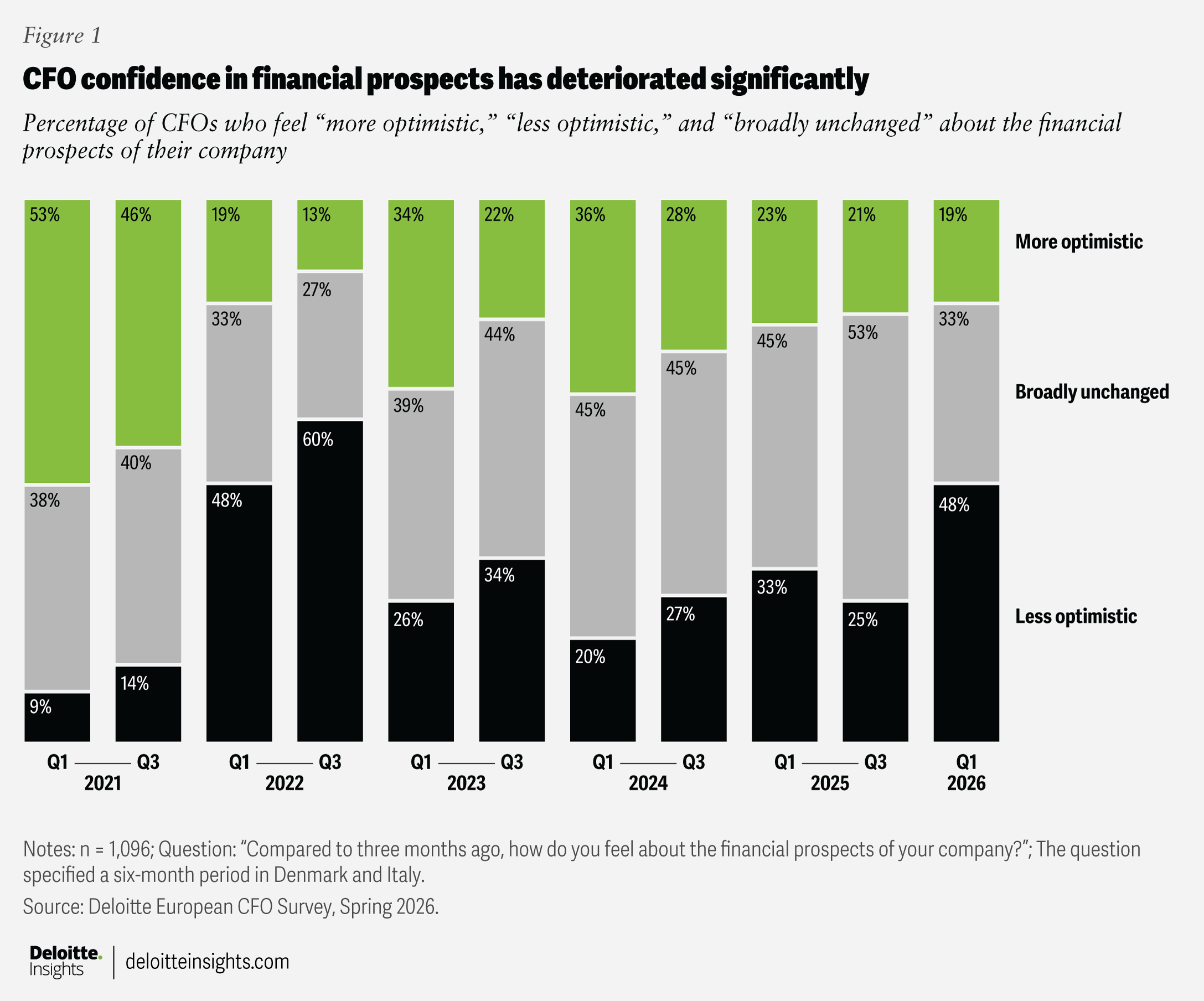
The current shift toward pessimism reflects broader macroeconomic pressures. The European Commission’s Spring 2026 Forecast projected slowing euro area growth and growing inflation due to renewed energy-price volatility.1 Accordingly, 76% of CFOs in the Deloitte survey rate external financial and economic uncertainty as high or very high—a 15-percentage-point jump from autumn 2025, returning to levels last seen during the peaks of 2022.
Macroeconomic headwinds are hitting European industries unevenly, with essential services and regulated sectors remaining more optimistic than their discretionary, consumer-facing peers. The life sciences and healthcare sector leads, with 25% of CFOs reporting optimism and only 35% indicating pessimism. A stable demand profile, strong innovation pipelines, and lower sensitivity to short-term consumer cycles drives this resilience. Meanwhile, just 20% of consumer industry CFOs feel optimistic, while 48% feel pessimistic, reflecting expectations of continued margin pressure and softening discretionary demand.
Geopolitical risk, higher energy costs, and margin pressure drive pessimism
CFO pessimism is being driven by a trio of connected concerns: heightened geopolitical risk, elevated energy and input costs, and mounting pressure on profit margins.
Geopolitical risk now ranks as the leading concern across all surveyed countries (figure 2). Economic growth risk remains a secondary concern, with CFOs tying it to geopolitical spillovers.
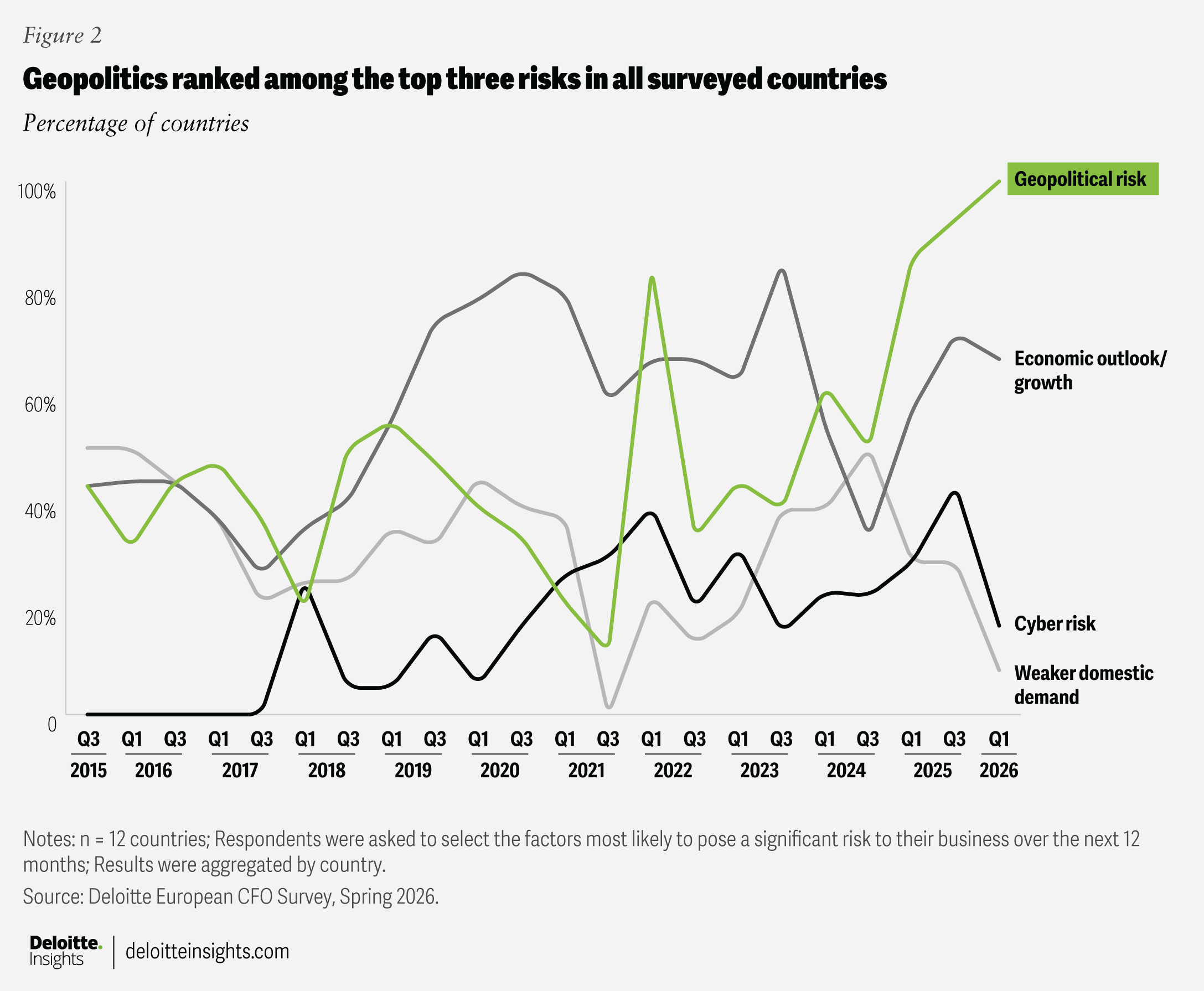
The top three geopolitical concerns for CFOs are energy shocks, Middle East conflict escalation, and critical material disruption—closely correlated risks signaling that CFOs expect compound, systemic shocks rather than isolated events. This outlook is shaped by recent experience. According to the Deloitte survey, over the two years through March 2026, 42% of European companies reported that energy costs negatively affected profitability and investment decisions.
When it comes to Middle East developments, 48% of CFOs expect negative effects on the margins and investment decisions in European companies over the next year, and 15% anticipate indirect effects through a macroeconomic slowdown, supply chain disruption, or more stringent regulations. Only 21% feel adequately prepared through prior hedging and diversification.
Mounting margin pressure, which is closely tied to the above external risks, is further contributing to CFO pessimism. While more than half of CFOs expect revenue growth over the next 12 months, 36% foresee margin declines, up 7 percentage points from autumn 2025, with roughly the same proportion (35%) expecting margin gains. Even among CFOs forecasting revenue growth, 42% expect flat or declining margins. Across Europe, companies are growing top-line sales but struggling to convert that growth into stronger bottom-line performance.
CFOs are building business resilience through planning and cost discipline
Broadly speaking, CFOs are deploying two primary strategies to combat pessimism and reduce risk: analysis and planning, and efficiency and cost reduction.
Despite accommodative monetary conditions, capital deployment remains cautious. Only 26% of Europe’s CFOs plan to increase their capital expenditures over the next 12 months, while 45% expect no change. Notably, 85% believe now is not the time to take on greater balance sheet risk.
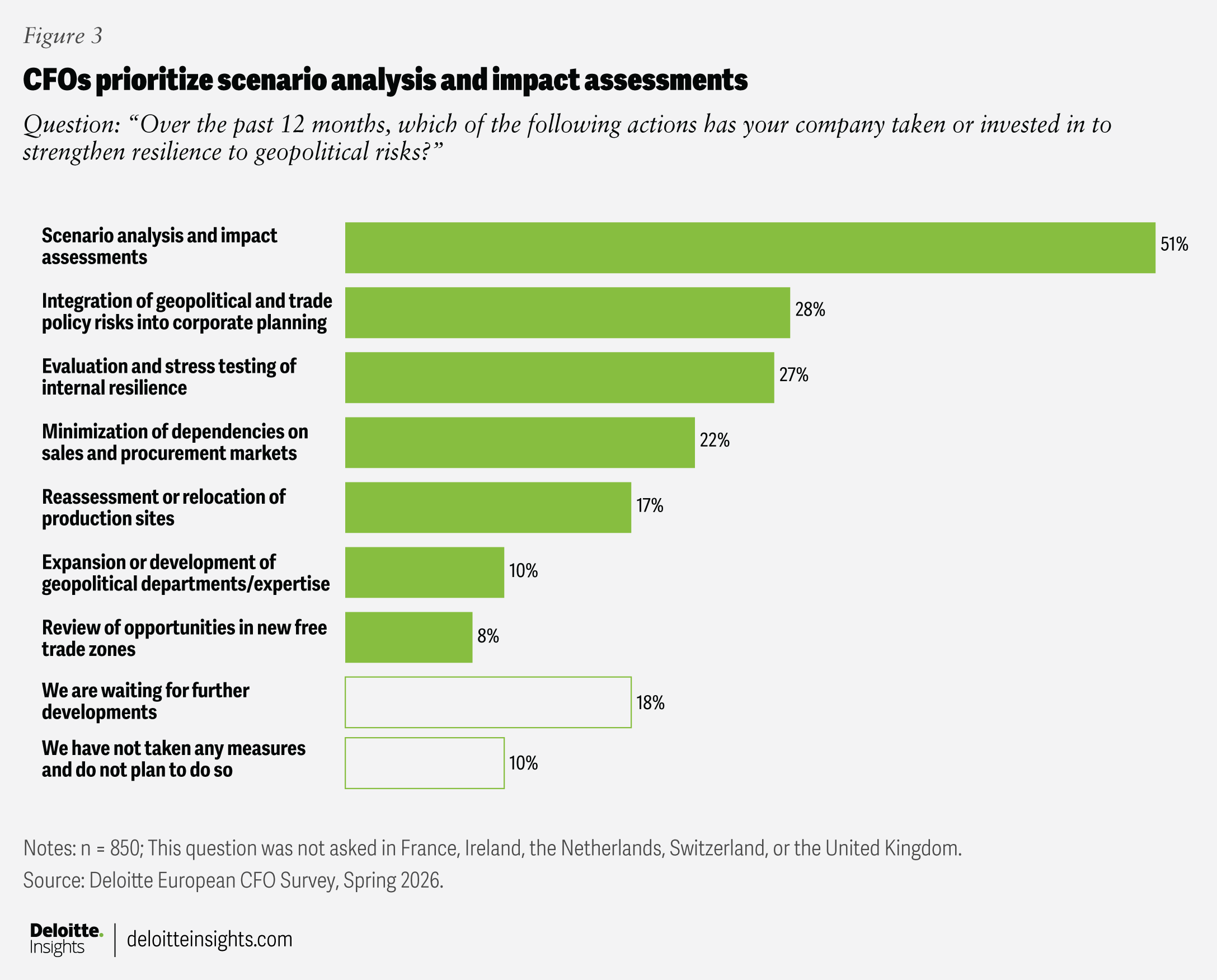
The most common risk-mitigation measures are scenario analysis and impact assessments, with 51% of CFOs reporting that they deployed these measures over the 12 months through March 2026 (figure 3). Meanwhile, capital-intensive shifts remain rare, with only 17% reassessing or relocating production sites.
Across all industries, there is unprecedented consensus on cost reduction, which ranks among the top three priorities across all surveyed countries for the first time in the survey’s history. Yet CFOs are not abandoning growth—they’re redirecting it. Organic growth expectations have fallen to 45%, their lowest level outside the pandemic period and well below the spring 2024 peak of 83%. However, expansion in existing markets has risen to 45%, the highest level since spring 2022, which suggests companies prefer deepening market positioning over entering new ones.
This defensive approach mirrors the responses to the 2020 pandemic and the 2022 energy crisis, in contrast to the more balanced cost-and-growth dynamic of 2024. What’s distinctive is the breadth: Geographic consensus across all surveyed markets signals a deeper recalibration toward leaner, more resilient operating models.
For many companies, reduced hiring is a core component of cost reduction. Only 23% of firms expect to increase their headcount over the next 12 months, while 36% anticipate decreases and 41% expect no change. This reflects a shift toward labor cost discipline and productivity enhancements over headcount expansion and mirrors broader EU labor-market slowdown signals.
Hiring outlooks vary sharply by industry. The life sciences and healthcare sector stands out as relatively resilient, with 37% of CFOs expecting headcount increases, the highest among all industries. Consumer companies are taking a more cautious approach, with 50% of CFOs expecting headcount freezes. Financial services companies are the most aggressive on overall cost reduction: Nearly a third (31%) expect to decrease headcount, consistent with ongoing cost and efficiency programs.
The survey reveals a decisive shift toward more cautious positioning across all surveyed markets. However, this shift reflects sustained external volatility, not a permanent posture change. CFOs are recalibrating their operating models to absorb shocks while remaining ready to pivot toward growth as conditions clarify.
Three imperatives for CFOs
From the survey data, three imperatives emerge for CFOs:
- Redesign for resilience, not just cost-cutting. Companies that fundamentally redesign their operating models through automation, digital transformation, and supply chain diversification are more likely to be well positioned to improve margins. Those that rely on static cost reduction alone, on the other hand, will face constraints when conditions shift.
- Grow where you already win. High-performing companies are likely to be highly selective, focusing on opportunities in existing markets while avoiding new market entry or aggressive expansion until margins begin to recover.
- Invest now to rebuild margins later. While 85% of CFOs are cautious about risk, strategic investment in productivity, technology, and capability building during this period can position companies to boost margins when conditions improve. The performance gap between those preparing now and those taking a purely defensive posture will probably widen significantly.
Companies executing these imperatives should emerge with competitive advantages that extend well beyond 2026.
Continue the conversation
Meet the industry leaders
By
Richard Muschamp
Ram Krishna Sahu
Douglas Gunn
The authors would like to thank all participating executives for their support in completing the survey. Additionally, the authors would like to thank Roxana Corduneanu, Kristi Egerth, and David Anderson for their contributions to this article.
Editorial (including production and copyediting): Aditi Rao, Aparna Prusty, Shyamili M, and Anu Augustine
Design: Sanaa Saifi and Molly Piersol
Cover image by: Sanaa Saifi
Knowledge services: Agni Wagh