
Scaling up XaaS
Transforming your business to market, sell, and transact as-a-service offerings
Introduction
Is your company shifting its offering portfolio toward anything-as-a-service (XaaS)? If yes, are you prepared to transform your business capabilities to market, sell, deliver, support, and manage these types of offerings at scale? Once you have undergone the process of defining your strategic guardrails, business model, capabilities, and operating model requirements—no small accomplishment—it is time to fuel the transformation engine and put in place the people, processes, and technologies to scale with XaaS in the market (see figure 1).
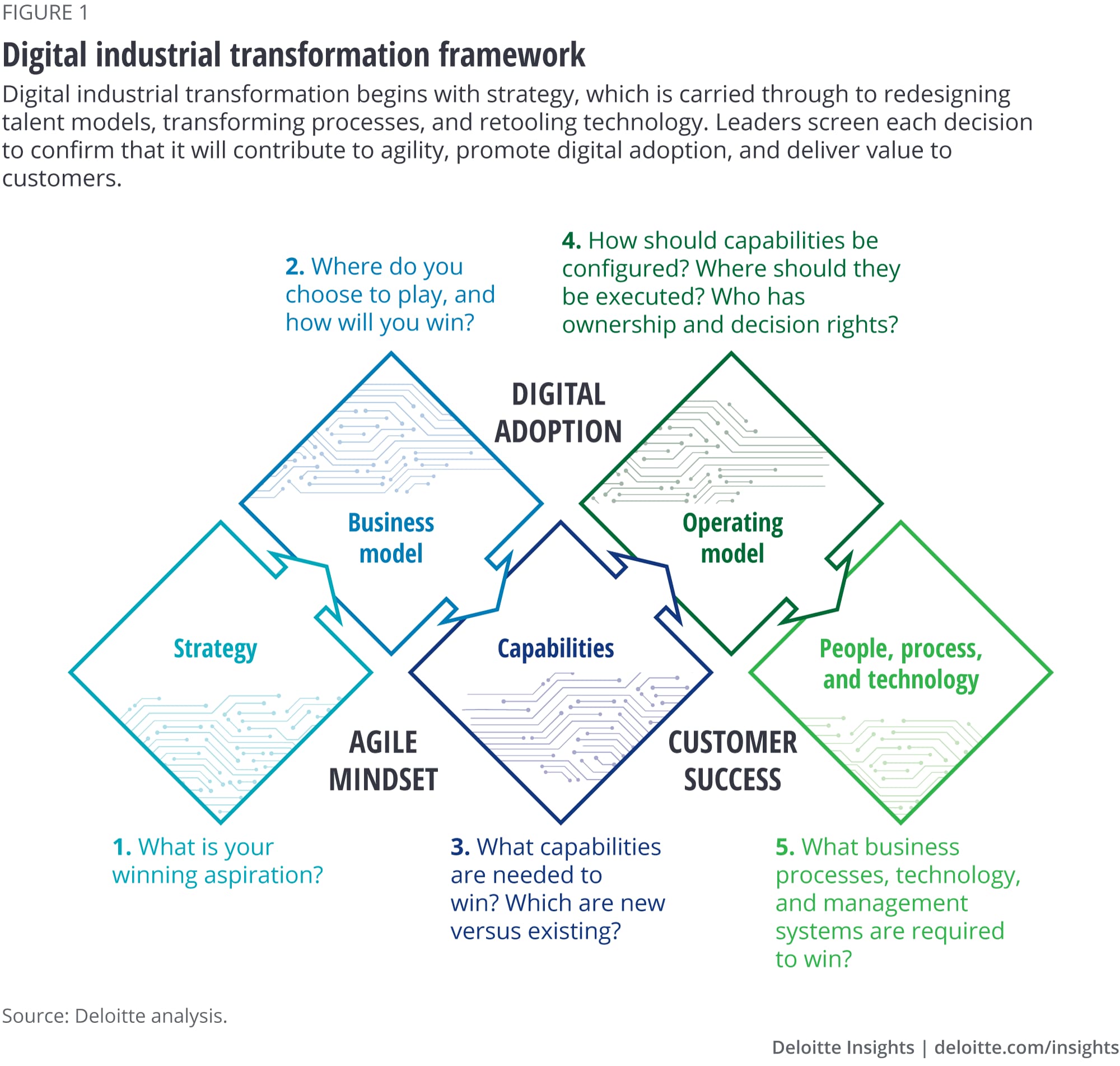
Getting the execution right is critical for an XaaS transformation. A transformation strategy, as explained in our previous article on how to set a digital transformation north star,1 becomes meaningless if the organization fails to carry it out with intention, urgency, and commitment. Many companies struggle with decisive execution given the unique complexities of XaaS transformations that proliferate in this phase of the digital industrial transformation journey. These complexities make companies less than optimally prepared to overcome operational inertia. In a recent study, only 20.7 percent of manufacturing executives rated their companies as “highly prepared” to address the emerging business models that the Fourth Industrial Revolution demands.2
Inside XaaS transformation
What is driving this complexity—and the common sentiment of feeling unprepared? Based on our experience working directly with industrial technology companies in transformation settings, there are five main characteristics of XaaS transformations that must be addressed for successful execution.
- Diverse solution components: XaaS solutions combine hardware, software, and services—traditionally sold separately—into a single customer offering. Industrial companies may think of this as marrying digital information to the physical act of manufacturing. As we discuss in this series’ first article,3 value is migrating away from the physical and more toward the data and insights generated from a combination of the physical, software, and services.
- Intricate dependencies: In our first article, we also explain how standing up a digital industrial operation involves fundamental shifts across all aspects of a business. The businesswide nature of these transformations highlights the dependencies that exist across the transactional value chain, making timelines and dependency management critical for execution success.
- External ecosystems: Suppliers and channel partners play an increasingly important role in defining what processes and automation are necessary. In our recent article on digital transformation as a path to growth,4 we discuss how HPE built a robust partner ecosystem as part of its digital transformation in order to round out its own capabilities. These new partner ecosystems introduce ways of working and transactional complexities that all players must learn to navigate.
- Significance of customer value: Leaders should look to redefine customer relationships to place customers at the center of innovation. In our article on setting a transformation north star,5 we talk further about how to address the daunting task of setting a transformation vision and specifically about how evolving customer expectations may be at the heart of a company’s imperative to change.
- New synergies: By establishing partnerships between product development and back-office functions, organizations can enable new synergies to accelerate XaaS offers’ time-to-market for diverse customer segments. Our article on architecting an operating model6 provides insight into designing operating models that break down functional silos to enable these types of synergies across the business.
Getting started
By definition, transformation efforts are a process rather than a discrete project seeking one-time incremental improvements. They represent an iterative and dynamic execution journey focused on continuous improvement and feedback loops.
Many companies look to improve and streamline their current processes before moving to introduce large-scale innovation. A recent Deloitte study7 found that the desire to improve current processes is a more significant driver of digital transformations than the desire to innovate (see figure 2). The momentum gained from starting with improve can be a powerful lead-in to innovate down the road.
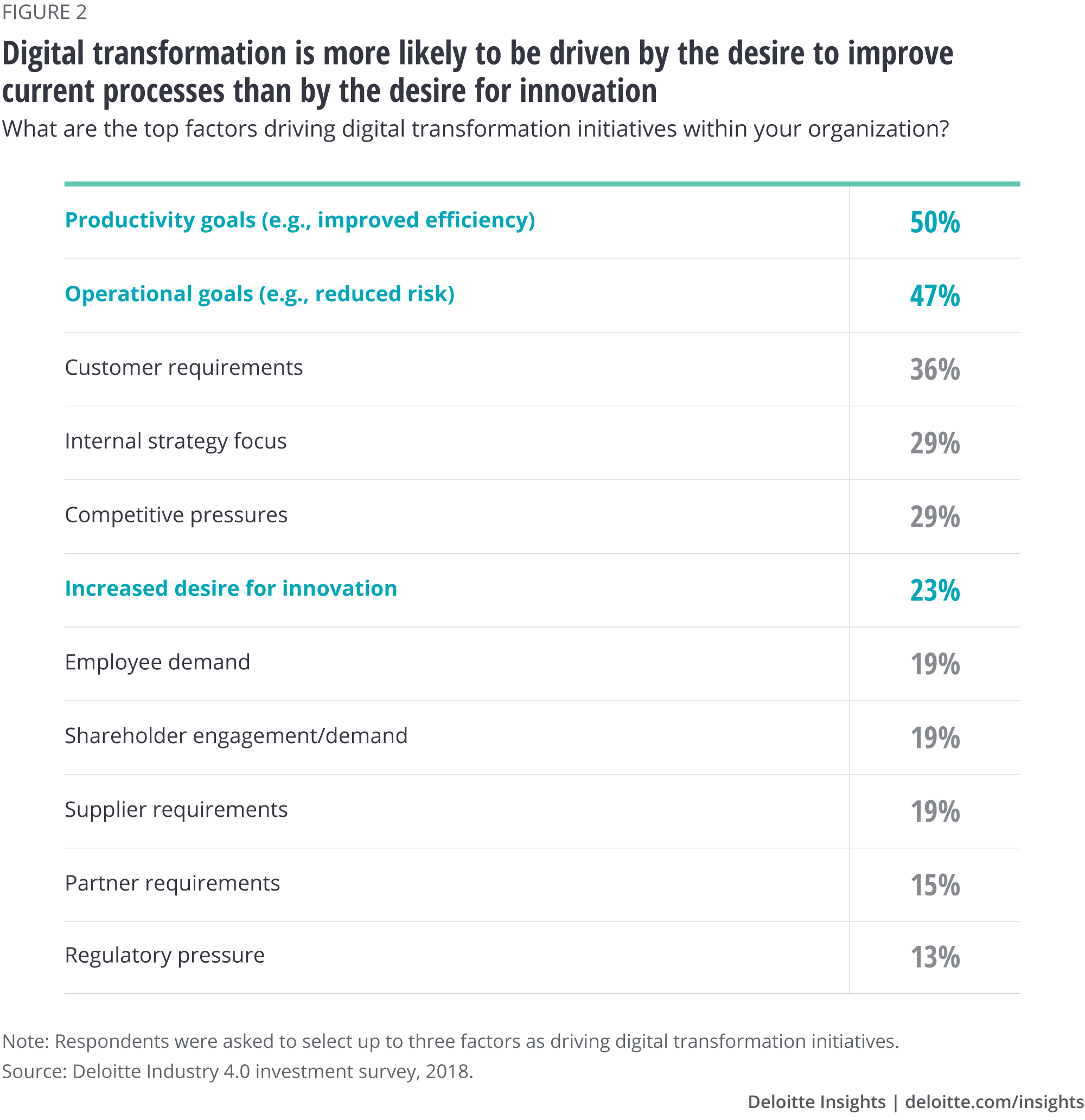
Figure 3 offers a visual depiction of the journey that we propose companies go through to successfully execute XaaS transformations. The concept of crawl, walk, run, fly illustrates how companies gain momentum during the journey via iterative design testing.
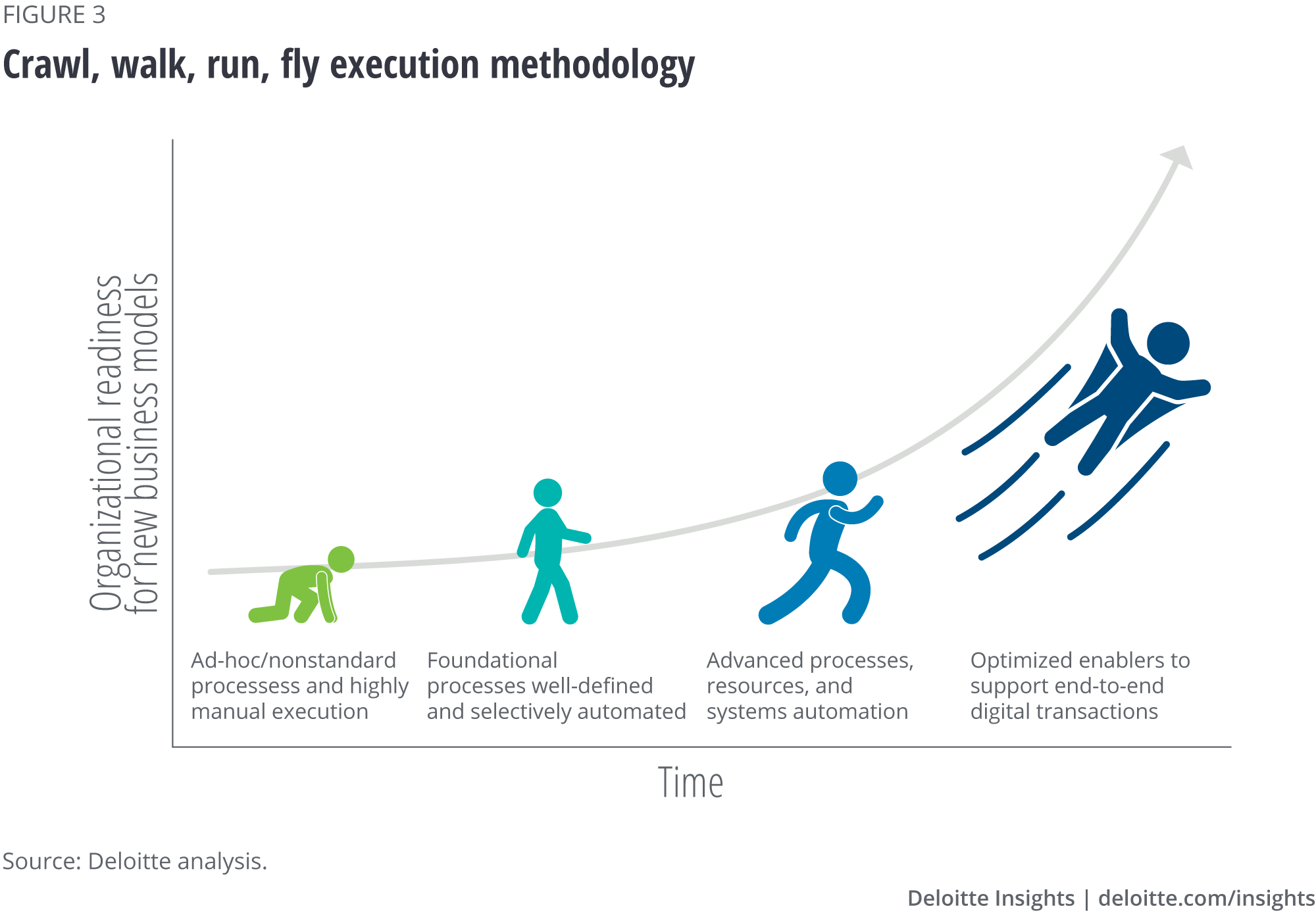
The benefits of steadily progressing along this digital maturity curve are multifold:
- It enables an organization to quickly deploy the minimum viable operational capabilities necessary to begin transacting new XaaS offers.
- It enables an organization to act in an agile manner—to iterate and adjust based on learnings.
- It allows an organization to implement a strong business process and policy foundation (for an extended transformation effort) before making large technology architecture decisions.
- It minimizes throwaway work and helps manage operational spending effectively during a digital transformation journey.
Based on our work in this field, we estimate that most organizations take three to five years to move from the crawl to the fly phase and complete their transformation to an XaaS business. This timeline depends upon factors such as the complexity of XaaS offerings, company size, appetite for change, and XaaS revenue growth projections. For example, Adobe’s transformation to cloud-based subscription models took approximately five years. The company’s legacy business model relied on offering customers’ physical products on a perpetual license, but it struggled to either attract incremental customers or compel existing customers to upgrade. In 2012, leaders made their transformation efforts official by announcing the release of the subscription-based Creative Cloud.8 By 2017, Adobe had transitioned to a software-as-a-service (SaaS) business model, with around 95 percent of all Creative Cloud revenue coming from subscriptions.
The maturity phases
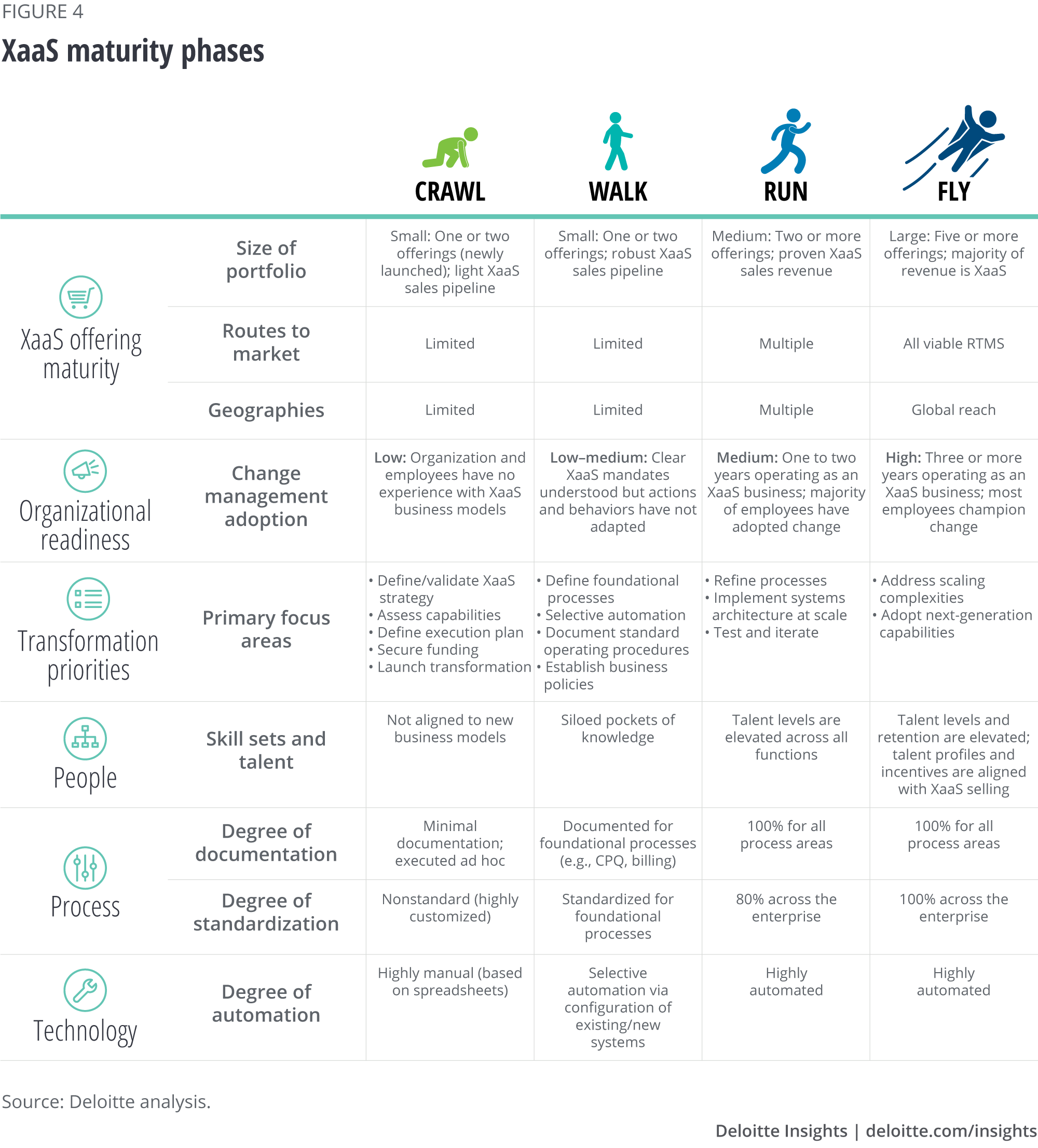
Each phase of this journey presents unique challenges and opportunities. Figure 4 summarizes the four maturity phases and companies’ typical behavior in each phase across the dimensions of XaaS offering maturity, organizational readiness, transformation priorities, people, process, and technology.
Crawl phase: Assess operational gaps to transact XaaS offerings
When a company’s transformation journey is in the crawl phase, funding and budgeting conversations are prevalent, since leaders are focused on proving the ROI and market adoption of the new XaaS offerings. Characteristics of companies operating in the crawl phase:
XaaS offering maturity. XaaS offerings have just been launched (low sales revenue); portfolio is small (one or two offerings) with limited routes-to-market/geographies.
Organizational readiness. Change management adoption is low, characteristic of companies early in the transformation journey. An organizational mindset shift is necessary for employees to understand and embrace XaaS offerings and their impact on how business is transacted.
People. Existing skill sets and talent may not be aligned to new business models.
Process. Processes for transacting XaaS are neither documented nor standardized (instead highly customized on a deal-by-deal basis).
Technology. Highly manual execution based on spreadsheets.
Transformation priorities
- Validate the transformation strategy. Align the executive team on the strategic objectives for the XaaS transformation—for instance, revenue and profit aspirations, business model archetype enablement, and external branding.
- Conduct a capability gap analysis. At this stage, it is important for companies to identify their capability maturity gaps. For example, many companies need to modify their invoicing capability to accommodate XaaS invoices, which are recurring and based on usage data rather than fixed prices, similar to how utilities such as electric companies invoice customers on their monthly usage. Organizations that are new to selling in this business model often find themselves processing XaaS invoices manually due to a shortage of automated processes and tools. Usage-based invoicing requires metering and rating tools that can track usage and translate it into invoices based on relevant metrics and rates. Maturing this capability and closing the gap will require new tools, automated processes, and training talent to use both.
- Create an execution roadmap. Create a clear map of what the organization needs to do (informed by the capability gap analysis) to create an informed and targeted path for innovation. Focus more on go-to-market capabilities, such as pricing, marketing, and sales in the first few quarters to establish a XaaS brand in the marketplace.
- Secure funding. Develop an investment case for total cost of the entire transformation, factoring in both labor and licensing costs (for any new tools). Leverage that case to secure transformation funding from leadership.
- Launch the transformation program. Activate a transformation management office with dedicated resources to execute a road map through the crawl, walk, run, and fly phases.
Walk phase: Build a strong business process and policy foundation focused on standardization and simplification
Companies operating in the walk phase have ignited their transformation journey and are beginning to make investments in process improvement. Characteristics of these companies:
XaaS offering maturity. Active pipeline for new business models in limited markets.
Organizational readiness. Low to medium. Companies have clear XaaS transformation mandates and revenue targets that are well understood, but day-to-day actions and behaviors remain unchanged.
People. Select employees involved in transformation efforts to develop siloed knowledge of the new business model. The rest of the organization still needs to be brought along on the journey; significant talent upskilling is needed.
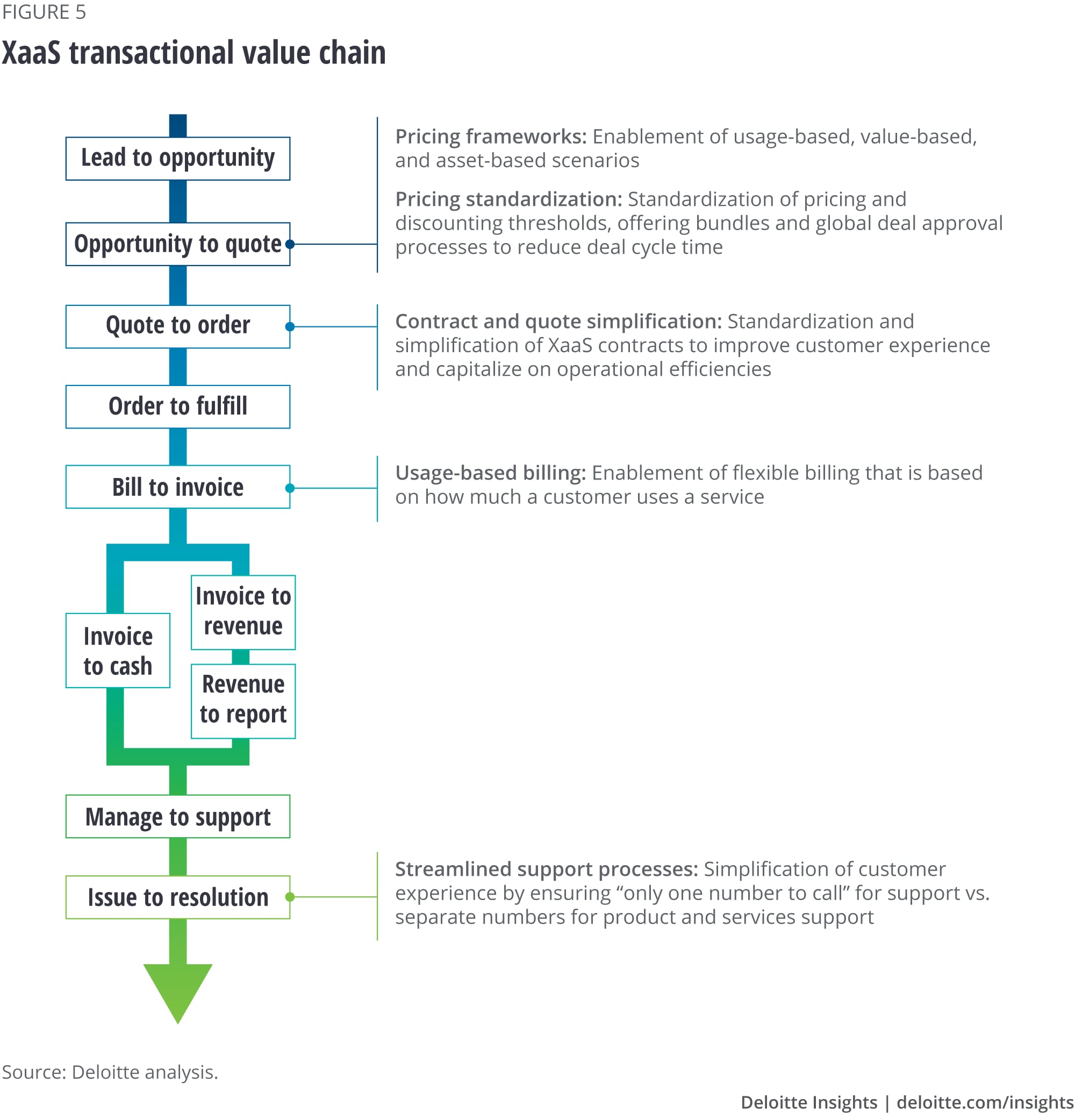
Process. Foundational processes are documented, standardized, and optimized for XaaS business models. Figure 5 shows priority areas across the XaaS transactional value chain.
Technology. Selective automation via configuration of existing systems. Priority areas for automation include offering configuration, pricing, quoting, billing, invoicing, and revenue recognition.
Transformation priorities
- Develop foundational processes. Document new processes that are simplified and standardized across the organization to enable XaaS transactions.
- Make automation decisions. Decide what will be automated in this phase; design standardized and simplified process flows to reflect selectively automated capabilities.
- Document standard operating procedures. Leverage the newly defined processes to document SOPs to establish handoffs across functions and process phases.
- Establish business policies. Make clear policy decisions about how to do business with XaaS for areas such as billing (How will we capture and bill on usage?) and sales (Which sales roles will be selling these offerings, and how will they be compensated?).
Run phase: Invest in automation to achieve long-term results
Companies operating in the run phase of their journey are operating as mature digital organizations with advanced/automated capabilities for transacting XaaS. Characteristics of companies operating in the run phase:
XaaS offering maturity. Healthy XaaS business revenue from two or more XaaS offerings across multiple routes-to-market/geographies.
Organizational readiness. Typically, one to two years operating as a digital XaaS business. The organization has shifted mindset to embrace and understand new business models, with most employees adopting the change in their day-to-day routines.
People. Majority of the business is trained on the new business model; talent levels are elevated across all enterprise functions.
Process. Processes have been documented, simplified, refined, and automated across all process areas, applied consistently to XaaS deals.
Technology. Full systems automation is enabled via an interconnected digital business architecture. There is little to no manual touch involved in end-to-end (E2E) XaaS transactions.
Transformation priorities
- Refine processes. Update processes to add the advanced capabilities necessary to enable complex XaaS offerings and reflect new automation for XaaS transactions.
- Implement a systems architecture. Adopt a digital business architecture through E2E systems automation.
- Test and iterate. Continue to test and refine new capabilities based on customer and employee feedback.
Fly phase: Continuously refine the digital model
Companies operating in the fly phase are making bold investments to drive disruption. Characteristics of such companies:
XaaS offering maturity. Global reach, with a large and sophisticated XaaS portfolio that is available for all viable ready-to-market products.
Organizational readiness. More than three years operating as a digital business. All employees embrace the XaaS business model and champion the change that the business model shift has driven.
People. Talent levels and retention of high-potential employees are elevated across the enterprise. Talent profiles and incentives are aligned with XaaS selling.
Process. Processes are highly advanced, and 100 percent documented and standardized across the enterprise.
Technology. A sophisticated systems architecture is enabled to transact digital offerings.
Transformation priorities
- Address scaling complexities. Tackle the complexities that come with scaling and maturing XaaS business, such as driving consistency across capabilities.
- Adopt next-generation capabilities. Optimize enablers such as artificial intelligence and machine learning to infuse analytics in offerings and E2E operations. Leverage blockchain to drive transactional integrity.
Lessons learned from XaaS transformation execution
Reflecting on experiences and case studies, there are core lessons that are important to keep in mind for executing an XaaS transformation:
- Eliminate organizational silos. In particular, business and IT need to be able to jointly address and manage critical dependencies. According to a recent study, one-third of leaders ranked organizational silos among their top three challenges in setting Industry 4.0 strategy.10 One of our clients found success in eliminating functional silos by hosting monthly “delivery acceleration” sessions to bring together cross-functional stakeholders for rapid decision-making.
- Leverage the walk phase for foundational investments. This is the phase that allows organizations to build a strong process foundation based on simplification and standardization. It gives leaders time to test these processes and make the right system decisions going forward. It also enables organizations to embrace the shift to new business models and build the muscles required to run and fly with XaaS.
- Have defined decision-making processes. Only 29 percent of executives see their organizations as having clearly defined decision-making processes.11 XaaS transformations require rapid decision-making, and it is critical to have clear ownership, accountability, and processes defined to enable swift and firm decisions that will move the transformation forward.
- Make change and communication a pillar of the transformation. An effective communication capability can enable an organization to adopt changes quickly by ensuring that stakeholders embrace the responsibilities of their role, have clear expectations in terms of impact to their day jobs, and feel strongly supported by their leadership.
- Keep the end goal in mind. Don’t lose sight of what fly means to an organization, so that it is clear what the organization is trying to accomplish at each phase of the journey.
- Enforce top-down leadership commitment. It is critical for leaders to be engaged in the transformation and involved in key decision-making. Ensure that leaders have clear roles in the transformation and are committed to catalyzing the transformation through change management, communication, and decision-making.
- Put the right people with the right skills in the right roles. Ensure that your key stakeholders have the right skills, mindset, and influence to drive rapid organizational change and proactively anticipate dependencies, risks, and issues.
- Take your customers, employees, partners, and suppliers along on this journey. Ensure that these stakeholders have a voice and play a key role in the transformation. Your XaaS business cannot thrive without their commitment to your organization. Cisco CEO Chuck Robbins recently articulated the importance of pulling partners into the XaaS journey: "As we make this transition to more SaaS and software subscription offers, I’ve told [our teams] I don’t know how you are going to do it, but you’re going to do it with our partners.”12
Conclusion
Launching a successful XaaS transformation begins with having a clear understanding of capabilities, gaps/breakpoints, and aptitude for change. This understanding will determine the path of the execution journey—and how quickly and adeptly an organization navigates the crawl, walk, run, fly curve to XaaS digital maturity.
In the next article, we will talk more about the specific challenges and complexities faced when transforming the quote-to-cash process for XaaS models.
BY
Jagjeet Gill
Deepak Sharma
Anne Kwan
The authors would like to thank Molly Campbell for her research and dedication to bringing this article to life. The authors would like to recognize Maximilian Schroeck , Jon Kawamura , Cristina Stefanita , and Divy Jain of Deloitte Consulting LLP for their contributions to the Digital Transformation practice.
Cover art: Sonya Vasilieff