
Rethinking market access
Delivering on the promise of therapeutic innovation
Originally published on March 9, 2022, updated on April 20, 2025.
Executive summary
The average cost of bringing a pharmaceutical asset to market has reached US$2 billion, yet 34% of all new launches in the United States fail to meet expectations. Market access strategy and execution—life sciences companies’ ability to demonstrate clinical and economic evidence, negotiate with health care access stakeholders,1 and enable affordable and timely product fulfillment for appropriate patients—is one of the primary contributors to product launch success and failure.2 Additionally, the introduction of the Inflation Reduction Act presents new considerations to successful launches, further emphasizing the importance of ensuring access.3
Without effective market access, patients lose trust in the ability of the entire health care system to ensure access to therapies. Furthermore, market access challenges can undermine the trust of other important stakeholders: providers who prescribe and administer treatments, private and public payers that pay for them, and researchers and investors who contribute to innovation.
While successful market access strategy and execution are universally important, our research suggests that more nuanced approaches are necessary. We found that market access activities behind successful launches often vary based on product type. Therefore, we introduce a therapeutic archetype framework that can help life sciences companies improve the success of their product launches and deliver on the brand ambition. We propose five archetypes that take into account product, patient, disease area, market characteristics, and product technology, and the evolution of drug pipelines from broad patient populations to more targeted indications and personalized therapies. The archetypes are:
- Vaccines
- General medicine (such as cardiovascular, diabetes, or respiratory)
- High-volume specialty (such as multiple sclerosis, immunology, hepatitis C)
- Oncology
- Rare disease, including cell and gene therapies
Our research suggests that launch preparation should begin much earlier in the development process by incorporating market access perspectives, engaging a wider set of industry stakeholders, and involving deeper cross-functional collaboration. We report our research findings within the context of the strategic choices that organizations should make.
- What is the winning ambition? A disciplined approach to market access should begin with formulating the objectives for the brand and how these objectives will support the overarching commercial goals. This includes a robust understanding of the access landscape and cross-functional alignment on clear and specific access goals.
- Where to play? Manufacturers should consider factors such as the treatment context, how stakeholders make decisions about using the product, who the priority stakeholders are, which access options are most appropriate and viable, and the trade-offs that come with them.
- How to win? Winning in a competitive market requires thinking through how to define and communicate the brand’s value to stakeholders, and determine approaches to pricing, contracting, reimbursement, affordability, and fulfillment.
- How to execute? Organizations should define, prioritize, and execute cross-functional actions while continuously monitoring results and adjusting to market conditions. This may require conscious trade-offs and adjustments to the execution plan.
As launches become more complex, companies should consider these strategic questions and specific launch and market access requirements. Operationalizing these requirements through archetype-based launch planning can help them execute new launches successfully.
Introduction
The ever-increasing costs of drug development, intense competition, payer controls, and complex distribution logistics have made it challenging for pharma companies to get the launch strategy right. Deloitte’s study that analyzed drug launches in the United States shows that success at launch significantly impacts the product’s revenue trajectory in later years, yet 34% of drugs launched between 2012 and 2021 missed their launch forecasts. More than half (57%) of drug launch failures were attributed to limited market access, followed by inadequate understanding of market and customer needs (47%) and poor product differentiation (41%).4
As we look to the future, we expect market access will continue to loom large over the entire product life cycle. Complex benefit designs, increasingly sophisticated utilization management practices, and payers’ rising market power due to industry consolidation have put market access at the center of launch success. These dynamics raise the stakes for launch teams, necessitating intentional and careful planning around potential access challenges early in the development process and throughout the product life cycle.
The Inflation Reduction Act (IRA) has introduced a new set of considerations for product launches. Among the various IRA provisions affecting biopharma companies, the Drug Price Negotiation provision stands to increase the importance of a successful launch for manufacturers moving forward. This provision shortens the window for value realization by allowing direct negotiation with the Centers for Medicare and Medicaid Services during the exclusivity period. Consequently, some manufacturers may be incentivized to bring follow-on indications to market sooner to capture value, some may choose not to pursue indication expansion, and others may reconsider their approaches to indication sequencing.5 Regardless, new entrants should quickly gain market traction to maximize the benefits of these shorter value realization windows for both the initial launch indication and subsequent follow-on indications. Therefore, a successful launch now requires even more intentional and careful planning around potential access challenges from the early stages of development through the entire product life cycle.
In the absence of effective market access, new therapies, even after launch, remain an unfulfilled promise, undermining patient and caregiver trust in the ability of the health care system to ensure access to treatment. Additionally, market access challenges can erode the trust of other key stakeholders: providers who prescribe and administer treatments, private and public payers that pay for them, and researchers and investors who contribute to innovation. Biopharma manufacturers ought to rethink market access and their relationships with stakeholders to ensure market adoption of new treatments.
In this article, we explore critical launch considerations across different types of biopharmaceuticals and share ideas on how to refine future launch approaches based on the unique characteristics and needs for each therapy. We propose that processes based on therapeutic archetypes (see sidebar “Therapeutic archetypes can optimize launch decision-making”) can improve the effectiveness of launch planning and execution.
Research findings
End-to-end market access strategy
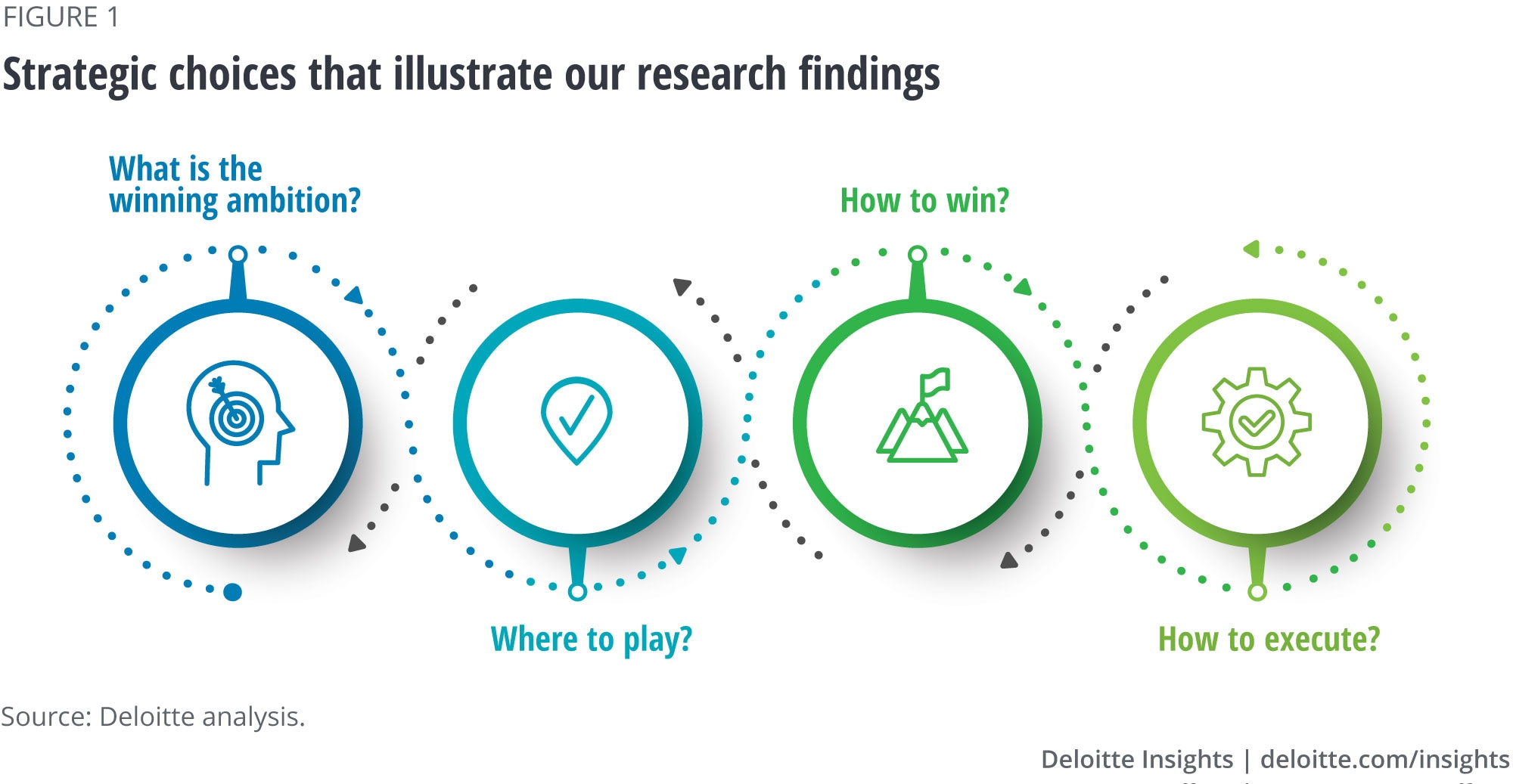
In Deloitte’s experience, a successful market access strategy considers a set of strategic choices, optimizes process coordination across functions and affiliates, brings clarity around roles and responsibilities, and employs digital technologies toward efficient and effective operational execution. Our market access excellence (MAx) methodology recognizes that organizations make decisions based on incomplete information and that strategic choices come with trade-offs, upstream requirements, downstream implications, and knock-on effects. We use the following strategic choices to illustrate our research findings (figure 1):
- What is the winning ambition?
- Where to play?
- How to win?
- How to execute?
What is the winning ambition?
A disciplined approach to market access begins with formulating the objectives for the brand and how these objectives will support the overarching commercial goals. Organizations should consider trade-offs—such as time to access, market share, volume, discounts and rebates, cost of patient affordability programs, fulfillment solutions, and required commercial capabilities—recognizing that goals and costs will be adjusted as the investigational asset progresses through clinical development.
An important input into this exercise is landscape assessment that informs “where to play” and covers the following areas:
- The disease, patient population, and patients’ unmet needs
- Detailed understanding of the patient and access journey
- Current and future ecosystem dynamics:
- Customers: How health care professionals and other customers think of the disease and treatment; their pain points
- Competition: Current and future therapies that represent direct and indirect competition
- Context: Policy, economic, societal, and technological
- Priority access stakeholders—such as health plans, pharmacy benefit managers (PBMs), integrated delivery systems, and value assessment bodies—and how each defines value
- Anticipated approaches to utilization management and benefit designs
Our research suggests that even at a very early stage, incorporating commercial insights into the clinical development program can prove exceedingly valuable, as it can help shape future evidence development, trial design, and formulation strategy. In many instances, the window of opportunity can be quite narrow, as one of our respondents explains:
Adaptive trial designs move very quickly from phase 1 to phase 2/3. So, if the phase 1 team is designing a phase 2 study, you have to bring the market access professional before the protocol is closed for the phase 2 design. And if it’s a phase 2 adaptive 2 to 3, then there's only one opportunity [for commercial] to provide input; so getting the study right becomes really critical
Respondents gave examples of the types of insights from commercial that can inform goals for the brand:
- Many therapies will see indication expansion throughout the product life cycle. These indications may span multiple archetype categories, meet different needs, and target populations of varying sizes, raising critical questions on sequencing, prioritization, and future access.
- Future competitive dynamics could affect how well-protected a certain new MOA or product is going to be, once commercialized.
- Certain design elements of clinical trials could invite utilization management restrictions down the line, or access could be influenced by product formulation and mode of administration.
- Sometimes the system of care cannot support a therapy, even one clinically superior to current alternatives. For instance, a treatment regimen for working-age patients that requires frequent in-office infusions and leaves them unable to drive will probably see low uptake.
Where to play?
In deciding where to play, manufacturers should consider factors such as treatment context, priority stakeholders, how stakeholders make decisions about using the product, the most appropriate and viable access options, and the trade-offs that come with them. Doing this homework helps them avoid mistakes associated with the second most common reason for launch underperformance: inadequate understanding of market and customer needs.7
We heard that the approach to landscape assessment may differ by therapeutic archetype. For instance, for rare disease therapies that target small populations, landscape assessment must get increasingly granular to address uncertainty: e.g., do prescribers, provider organizations, and public and private payers understand and agree on the burden of disease; what do they think about current treatment options; where do current treatments for this disease fall in their budget; and where will the new therapy fit within the system of care? Understanding what they do and do not know and how stakeholders make decisions about treatment choices can inform manufacturers’ medical education, communication, and regulatory strategy. Communication platforms may include medical and scientific engagement with population health decision-makers, such as burden of disease education and preapproval information exchange; communication with health care professionals through conferences or continuing medical education programs; and engagement with value assessment or guideline organizations, such as ICER or NCCN.
Respondents stressed the importance of presenting a compelling story about the burden of illness and unmet needs. They also emphasized the importance of generating evidence that addresses those needs through carefully developed endpoints in randomized controlled trials or targeted evidence development using real-world data. This sets the foundation for evidence-backed value discussions with stakeholders down the line.
Value of generating evidence [in rare] is more impactful than for other archetypes. Everything is magnified in terms of evidence. In rare, literature is limited, evidence is developed by the manufacturer developing the drug. How many patients are out there—that translates into budget impact. Unmet need is heavily influenced by the literature developed by the manufacturer. Ideally, many months before launch, in phase 2 you should invest in understanding the literature. No one knows anything about the disease—understand pain points from clinical or economic perspective, illustrate the burden of disease. In phase 3, you should design endpoints to address those pain points.
Examples of decisions about where to play include indication, target population and subpopulation, line of treatment, distribution channel, and priority accounts.
How to win?
Companies should think through the choices in front of them as they define and communicate the brand’s value to different stakeholders and determine their approaches to pricing, contracting, reimbursement, access, fulfillment, and patient affordability. In addition to bringing market access insights earlier into clinical development, respondents spoke about classic market access activities, such as segmentation, targeted stakeholder engagement, product positioning, and price/value assessment. Doing this right could help avert the third most common reason for missing launch expectations—poor product differentiation.8
You want people to tell you if your baby is ugly or not before you bring it to market and then find out it’s ugly and you have invested a billion dollars bringing it to market.
Respondents discussed the value of early stakeholder engagement, particularly payers—in many cases 18–24 months before launch. Most have experience with preapproval information exchange9 that conveys the details of the molecule, MOA, clinical trials, and existing competition.
You will get a feeling for payers’ enthusiasm. You will know whether they are intrigued by the science of the product or they are like “this is just an old blah-blah.” You get a feel for their pain points, and if there is something they don’t really understand, or they are asking a lot of questions on. You know that those are the areas where you need to tighten up the story or you are going to need strong objection-handlers.
Manufacturers should help payers and prescribers understand the new therapy’s most appropriate uses, its potential for off-label use, how it compares to other options, and its key benefits. Early discussions enable manufacturers to develop a better understanding of customer needs and to explore elements that help identify the right patients and inform utilization management criteria like diagnostic testing, and the type of clinical documentation payers will find useful.
As they build upon the evidence and publication strategy, manufacturers can refine and tailor value messaging to address individual customers’ questions and pain points.
Help payers understand how it will help, especially if it substitutes for an existing product. “My new product will fit into the treatment paradigm where you currently have this, and you are already paying X. What you are going to get is greater efficacy, better response across patients treated, and more durable, safe treatment.” Building a narrative that shows you understand what payers do today, what that investment buys, and how you can come in is important.
Establishing a pricing and contracting strategy for new therapies requires extensive market understanding. Tools range from pricing and value assessments to budget impact, cost-effectiveness, actuarial modeling, stakeholder driver and barrier impact/sensitivity analysis; to price-volume optimization, often performed throughout late-stage development and up until approval and launch. There is growing use of advanced analytic models, which consider a range of variables and take advantage of increased data availability. Examples of critical questions addressed here include: setting WAC/list price, unit pricing, price guidelines over time, and segment-specific contracting guidelines, and estimating effects of fulfillment and affordability solutions on access and volume.
General medicine is the scariest [of all the archetypes]. You most likely have a number of competitors, including generics. The most important thing is your pricing—price it as competitively as possible. The price differential vis-à-vis generic or other brands needs to be justified by the efficacy or safety differential that you bring to the market. Are people going to pay a nickel for that difference, a dime, or a dollar?
Value and price assessment methodologies vary by therapeutic archetype due to differences in maturity and competitive intensity. Life sciences companies should also keep an eye on how stakeholder economics change over time due to consolidation, new payment models, or policy changes, as well as the implications of state drug price transparency requirements. This calculus becomes even more complicated for products with multiple indications, as indication-specific pricing remains challenging to execute.
Regardless of therapeutic archetype, manufacturers should develop an overall integrated evidence development plan early and ensure that real-world data collection can begin on day one after the launch. As the understanding of market needs crystallizes, stakeholder segmentation and mapping can provide insights for the real-world evidence (RWE) strategy. This could be an opportunity to incorporate elements into the phase 3 trial design that will support and create continuity of evidence-generation through patient adherence tools and electronic patient-reported outcomes, which could be achieved through digital companions10 or other digital health tools.
There may be an interest on the part of a health plan to measure adherence and incorporate certain digital devices that promote adherence. These are useful data points to ensure that if the health plan is covering a medication, the patient is doing his or her part to remain as adherent as possible.
Negotiations and contracting should take into account customers’ economic drivers, such as patients' out-of-pocket costs under typical benefit designs, rebate revenue for plans and PBMs, and practice and pharmacy economics, which can vary substantially by therapeutic archetype. Respondents also recommend being realistic about addressing the following questions:
- How do our customers define value and how should we define value?
- How do our customers measure value and how should we measure value?
- How should we allocate and capture value?
How to execute?
Based on our experience and research insights, we conclude that life sciences companies should ensure that market access is effectively integrated into early and ongoing pipeline and launch activities. This may call for a different allocation of launch resources, systematic application of best-in-class market access execution activities, continuous market monitoring, agile strategic and tactical adjustment, and willingness to make conscious trade-offs in pursuit of sustainable, profitable market access.11
Consider the stage when you’re doing disease opportunity assessment for phase 1 assets. Many companies are not involving market access professionals at that stage. The most sophisticated ones tend to think of market access around phase 2. The less sophisticated ones bring some market access individuals at phase 3, closer to phase 3 readout. And in either case that’s too late.
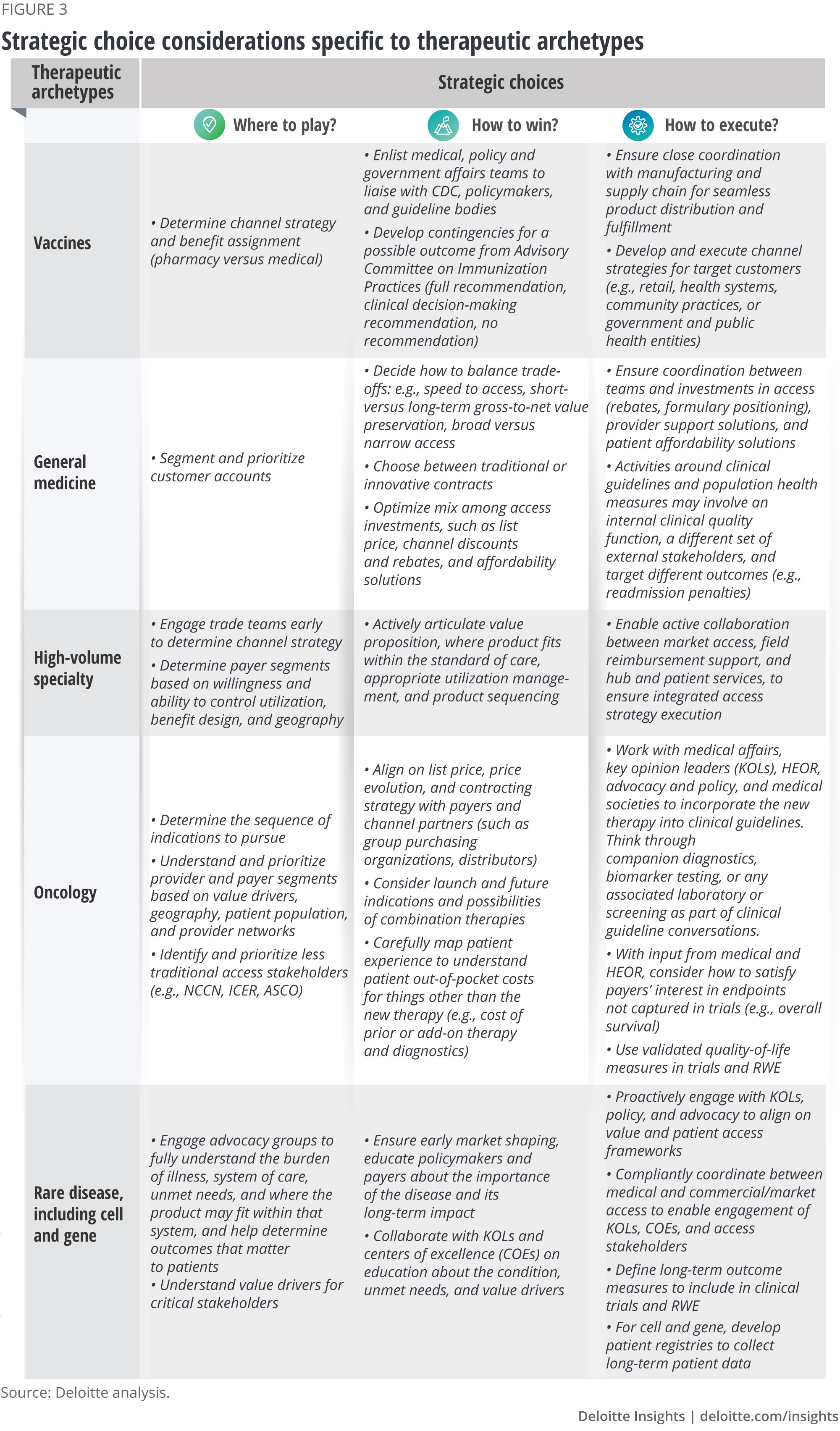
Archetype-specific launch playbooks can be a way to codify, standardize, and operationalize leading practices; outline activities, timing, and interdependencies; clarify the roles and responsibilities; and improve cross-functional collaboration. Doing so can help anticipate nuances that a one-size-fits-all approach cannot. For instance, involvement of government affairs, advocacy, or policy groups may be more necessary in rare disease than in other product archetypes. We list some archetype-specific considerations in figure 3.
Conclusions
This research reinforces the fact that market access strategy and execution is the primary driver behind launch success. While the discipline of market access continues to evolve, we propose a set of principles12 that should underlie market access strategy.
- Follow a rigorous and disciplined approach to develop, evaluate, and evolve effective market access strategies. Ensure adequate resources and cross-functional execution across market access, brand, medical, HEOR, sales, and finance.
- Start with what matters most to access stakeholders and work backwards to demonstrate and communicate the value. This calls for incorporating market access perspective into early clinical development and consistently throughout the product life cycle.
- Develop an overarching value and evidence strategy, identifying outcomes that matter to each type of stakeholder, and apply considerations specific to therapeutic archetypes.
- Ensure alignment and cross-functional coordination with overall brand strategy.
- Build in flexibility to adapt to changes affecting customers, competition, and context (policy, economic, societal, technological), and make conscious trade-offs in pursuit of sustainable, profitable market access.
BY
Brian Corvino
Natasha Elsner
John Jaeger
Madhushree Wagh
Project team:
Sonal Shah developed the project concept, provided project oversight, and helped organize the findings for the paper. Wendell Miranda contributed to conceptualizing the therapeutic archetype concept, helped with instrument development, and conducted primary and secondary research.
The authors would also like to thank Linda DaSilva, Richard Maria, Mathias Cousin, Jeff Ford, Alex Blair, Thomas Yang, Candy Lurken, Tom Fezza, Joe Coppola, Andy Davis, Jeff Morgan, Paul Silver, Clay Willis, Lynn Sherry, Ramani Moses, Laura DeSimio, Zion Bereket and the many others who contributed to the success of this project. This study would not have been possible without our research participants who graciously agreed to be interviewed. They were generous with their time and insights.
Cover image by: Kevin Weier