
Is the hospital of the future here today?
Transforming the hospital business model
Executive summary
The COVID-19 pandemic has turned the health care industry upside down and accelerated many of the ideas for the future that some thought would take decades to take hold. Hospitals quickly deferred or cancelled elective procedures, discharged non-COVID-19 patients, used data and technology to analyze and forecast demand, implemented virtual health solutions, and moved some of their workforce to remote work. The use of virtual health technology for screening, monitoring, and e-visits as well as consumer preference to stay away from the hospital during the pandemic offer a glimpse into how the hospital of the future might operate.
In mid-January 2020, the Deloitte Center for Health Solutions crowdsourced health care experts and futurists for their vision on the hospital of the future. We also interviewed several physicians and hospital operations and technology executives in mid-April to confirm our initial research and to consider how we should be thinking differently in the aftermath of the pandemic.
When asked what the hospital would look like in 2040, the crowdsourced experts said:
- While there will still be a need for some hospitals, most of the care delivery will shift away from the hospital setting, driven by technological advances in clinical care, value-based payments, and scientific discovery (personalized medicine, genomics, DNA sequencing, for instance).
- Hospitals will transform their business models toward narrower physical offerings, focused on high-acuity, complex cases, and with increased virtual offerings.
- Technology and data will be pervasive and transform care delivery models.
- Smart spaces and digitally enabled hospitality will be a necessity, given consumer demands.
The experts said that hospitals were up against the wall due to COVID-19, and while several hospitals were challenged by this unprecedented crisis, a few have already started to act like the hospital of the future, particularly with regard to virtual health and use of technology.
The question is: Will these changes persist, or will hospitals go back to how they’ve always done business? The speed to decision and execution in this recovery phase is critical. Hospitals cannot go back to their old business models. It most likely is not viable given where health care is heading. As the industry begins to recover from the pandemic, hospital executives should consider how they can maintain their momentum toward operating as a hospital of the future and position their organizations to thrive.
Introduction
COVID-19 forced organizations to transform their operations overnight, and in the process debunked many widely held conventional beliefs.
- Hospitals deferred or canceled elective procedures and some consumers tried noninvasive interventions (e.g., physical therapy for back pain instead of surgery).
- Adoption of virtual-visit and remote-monitoring technology increased rapidly due to cancellation of in-person visits by hospitals and doctors and consumers’ safety concerns.
So far, both physicians and consumers have welcomed these changes. Consumers in particular preferred to stay away from the hospital.
Even as the pandemic curve appears to be flattening in many areas, the impact on the market is likely to last. Many hospitals are now looking toward recovery of their business, staff, and operations. Executives contemplating steps toward recovery should also take into consideration how their business can thrive in the future. To that end, we suggest they adopt the hospital of the future as outlined in this article.
Three main themes emerged on how hospitals will transform by 2040
The experts agreed that there were many reasons for hospitals to transform their business models, including the quest to reduce costs, better engage consumers, leverage technology, enhance clinician experience, and compete with new entrants. The COVID-19 crisis has shown that care can be delivered and monitored in virtual settings, that consumers prefer to stay away from the hospital, and technology and interoperable data are critical.
Theme 1. Hospitals will have transformed business models
According to the experts, hospitals will pick a path and become one of the following:
- Specialty care operators/focused factories for complex procedures: In 2040, the overall market will have significantly fewer hospital beds with most hospitals becoming focused factories catering to procedures for critical care, complex, and specialized populations. We envision that the hospitals will focus on trauma/critical care, pandemic/epidemic, and complex specialties as listed below.
- Trauma/critical care: Emergencies, transplants, trauma services, and ICU/NICU
- Pandemic/epidemic: Infectious disease and quarantine/isolation services
- Specialized procedures: Complex patients (cancer, cardiac surgery, orthopedics, neurological surgery, etc.) who require specialized treatment or multiple specialists
- Health hubs: The hospital building would become a health hub and part of a larger system that offers outpatient, ambulatory, retail, virtual, and home services. In 2040, the hospital building itself might offer:
- Ambulatory surgery, urgent care, and diagnostic services
- Drivers of health (social determinants of health) services that improve food security, housing, employment, utility access, and other needs that impact health
- Holistic care services and treatments that would focus on mental, social, emotional, spiritual, and financial health of the community. Hospitals will have a relaxing setting
- Hospital at home or virtual hospital: Care, including monitoring, could be delivered outside the building in either a hospital at home or virtual hospital setting (see sidebar, “Virtual care delivery in action”). During the COVID-19 pandemic several hospitals quickly adopted virtual capabilities. Some have done this to monitor and treat both traditional outpatients through e-visits and certain inpatients such as those with congestive heart failure and chronic obstructive pulmonary disorder through hospital-at-home models.
Our experts noted how growth in adoption of virtual care delivery in the months of the COVID-19 pandemic has been greater than any that occurred over the last decade. An estimate in the Lancet is that there has been a ten-fold increase in the number of virtual patient consultations since the pandemic began.1
Theme 2. Care delivery models will be disrupted by ubiquitous data and technology
The crowdsourced experts said that hospitals will be both “high-tech and high-touch,” with connected interoperable data and systems, streamlined operations, and efficient clinical care delivery. Technology will be used for monitoring, prediction, and care delivery.
They also identified artificial intelligence (AI) and machine learning as the emerging technologies most likely to transform the industry in the next 10 years.
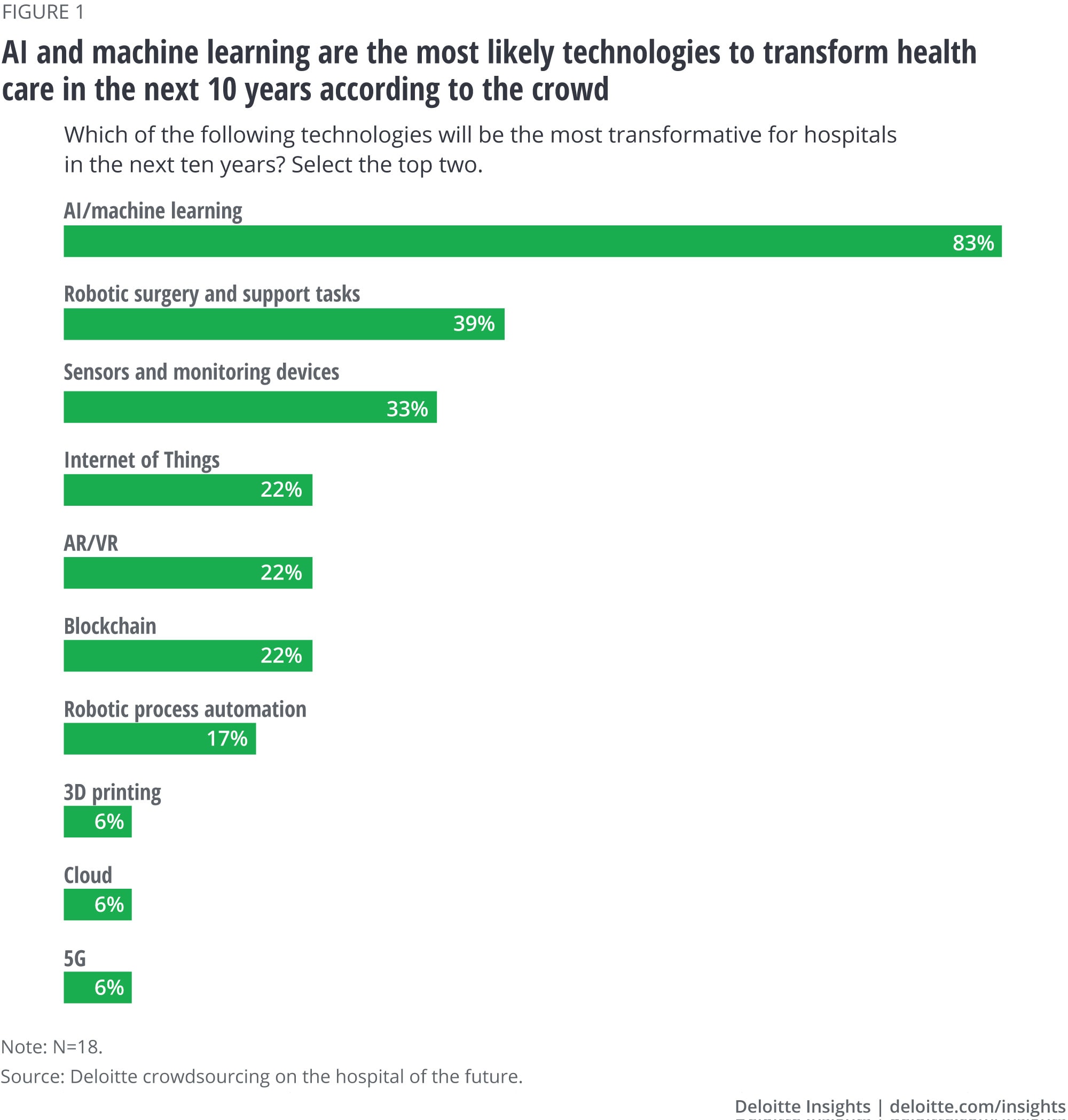
Envisioning the technology hospitals would use in 2040, many agreed that some of today’s technologies will be more mature in the future. Radically interoperable data, AI, machine learning, and other cognitive technologies will drive the hospital’s clinical care delivery, operations, and experience. In our recent survey of technology executives on interoperability, they said that it would benefit cost of care (44%), consumer experience (38%), and care coordination and outcomes (36%).
Examples of how technology and data could be leveraged in the future include:
Digital twins: A digital twin refers to a digital replica of potential and actual physical assets, processes, people, places, systems, and devices. In health care, the experts envisioned using digital twins to help streamline the admission process and update clinicians on patient status and medical history. Before a patient arrives at the hospital, appropriate staff will already have reviewed and analyzed the patient’s data, which could include electronic health record (EHR), information from medical devices, vital signs from wearables, and scans from diagnostics procedures such as MRI.
Digital command centers/Traffic control towers: Future hospitals could use digital command centers to predict and determine their service (operations, logistics) and clinical/procedural needs, in addition to improving the patient experience. Using predictive analytics, the command center could analyze hospital (clinical and operational) and community health data to forecast business, experience, and clinical needs.
For example:
- Clinical needs: Digital real-time monitors could track a patient’s health in the hospital, and the command center could use AI and predictive analytics to help with diagnosis and treatment plans.
- Supply chain, operations, and other logistics: Technologies can predict staffing, supply chain, operations, and logistics needs to ensure efficient use of resources.
- Patient experience: Another possibility is the patient-facing virtual assistant powered by natural language processing (NLP) and AI in the command center/control tower. The device is equipped in each room and takes verbal requests from the patient, uses NLP to process the requests, and then uses AI to assign them to the most appropriate person (or robot) based upon efficiencies.
- Pandemic or epidemic disease: Monitoring and tracking of biometrics and test results could identify a potential infectious disease on the rise before it spreads more broadly.
Robotics and digital reality: Some nurse and clinician tasks will likely be conducted by robots. Robots could deliver and administer medication, take and document vital signs without waking the patient, and conduct minor procedures such as putting in IVs and drawing blood. Clinicians will oversee the work from the command center/control tower. While robotic surgeries have gained popularity in recent times, the adoption is currently limited to specific, mostly noncritical procedures. This will change—robot-assisted surgeries for several major procedures will become commonplace.
In addition, digital reality—AR/VR—will be mandatory and pervasive for procedures, data visualization, pain/dependence management, behavioral/mental health, and even medical training. For instance, it could be used to train surgeons on complex procedures. Also, AR/VR glasses can enable physicians to view patient data as they simultaneously interact with the patient.
Theme 3. Smart spaces and digitally enabled hospitality will be essential
Whatever path hospitals choose, the experts, both those crowdsourced and those interviewed, were unanimous in envisioning smart spaces and the integration of digital technologies into every aspect of hospital space, transforming not only the physical structure but also providing a hotel-like personalized experience. Modular spaces will be part of hospital design so that services can be scaled up or down based on surges in demand.
Not only do the experts expect the physical space to transform, but they also predict hospitals will be able to integrate virtual with physical offerings. Virtual offerings will be a seamless part of the experience for the patient—data will always be available, clinicians will always be accessible, and treatment will always be delivered—whether in their own home or in a hospital. Miniaturized, self-contained, and mobile equipment will support the ability to be modular or deliver care in the home. The hospital of the future will bring the technology to the patient instead of bringing patients to the technology.
Examples of how smart space and digitally enabled hospitality will help transform the physical offerings of the hospital of the future include:
Wayfinding and push notifications: The hospital’s app could become active as soon as patients make an appointment. Even before they enter the hospital, the app could advise them on best parking areas, provide them with forms or paperwork that can be filled out ahead of time online, and offer “what to expect” material. Once the patient enters the hospital, the app can analyze the patient’s records and provide turn-by-turn directions to guide them to the correct department. Visiting physicians and nurses can also use the same wayfinding system to navigate through various departments. In addition, patients will receive push notifications in their preferred language about physician availability, appointment times and updates, and other information related to their visit. When a patient is ready to be discharged, the platform/app could enable discharge planning, education, and postdischarge engagement to reduce readmissions and a speedy recovery.
Seamless diagnosis and treatment experience: Miniaturized, self-contained, and mobile equipment will support the hospital’s ability to be modular. These tools can assist the patient across the care experience, starting before they enter the hospital and after they are discharged. For example, diagnosis can begin at home using tools such as virtual triage and symptom checker. The virtual triage tool combines the patient’s responses with the results from the symptom checker tool to generate diagnosis and provide suggestions that direct the patient on how or where to seek care—hospital, outpatient facility, virtual visit, or otherwise. The COVID-19 pandemic has demonstrated how these tools can help streamline the care process. Going forward, these tools also have broader applicability for various health scenarios in different health care settings.
If the patient requires care at a hospital, smart wearables will begin monitoring their vitals, such as heart rate and blood pressure, as they proceed to their allotted exam room. The physician can then access those results in advance of seeing the patient and save time for both the physician and the patient and streamlines the visit experience. In addition, instead of having a physical chatbot, each patient will have access to a personal robot-shaped health-bot which will appear in the form of a hologram and accompany the patient throughout the process to answer any queries. After the patient’s diagnosis is complete, cognitive computers will organize logistics and ensure zero waiting time for the patient by notifying the pharmacy to prepare a prescription.
As diagnostic equipment becomes digital, smaller, and more portable, it will limit patient movement—often cumbersome—enhancing their experience and improving efficiency. Smart equipment will predict and prioritize demand for diagnostic testing and scans, and it will be delivered to the patient seamlessly without the patient having to wait. In other words, the hospital will bring the technology to the patient instead of bringing patients to the technology.
Smart and personalized rooms: The architectural space of the patient’s room will cater to individual patients’ preferred ambience and feel more like a private guest suite instead of a hospital room. The design of the future will consider all five senses to put a patient at her happiest and most comfortable self, which will ultimately promote healing. Patient experience platforms will empower patients to have an integrated, voice-enabled personal space. For example, the décor can be made more appealing by hiding devices behind walls or other design elements. The patient can control the room environment and place noncritical requests through voice activation. For instance, she can change the room temperature or lighting and access services such as aromatherapy and music or ambient sounds by speaking to a machine. This can reduce waiting time for the patient and reduce burden on staff, freeing them up to attend to other critical activities.
Revamped waiting areas and green spaces: Waiting areas for visitors and families will be digitally designed to provide timely updates. Large-screen TVs, projectors, and tablet/mobile device stations will not only be used for entertainment but also educate the visitors about the patient’s health issues and treatment progress. Furthermore, these areas will be modular and designed as cross-functional spaces, which can be used interchangeably as waiting areas, patient rooms, or surgery centers, thus maximizing functionality and minimizing footprint. Additionally, relatives and family members will be able to make use of on-site amenities and outdoor walkways and green spaces while they wait for the patient.
Designing the hospital of the future today
Regulatory levers and rapid, agile decisions have enabled hospitals to quickly transform and respond to the COVID-19 pandemic. Executives who are now entering the recovery phase of the pandemic can take steps toward how they will ensure that their organizations will thrive. One of the most important steps will be to sustain changes made to operate as a hospital of the future. Consumers have shown that they are open to virtual visits, don’t want to be in hospitals, and are comfortable having their procedures outside hospital walls. The speed to execute on this momentum can be critical. To do this, executives should consider how they can continue to:
- Build upon the acceleration of innovation today
- Plan for the future
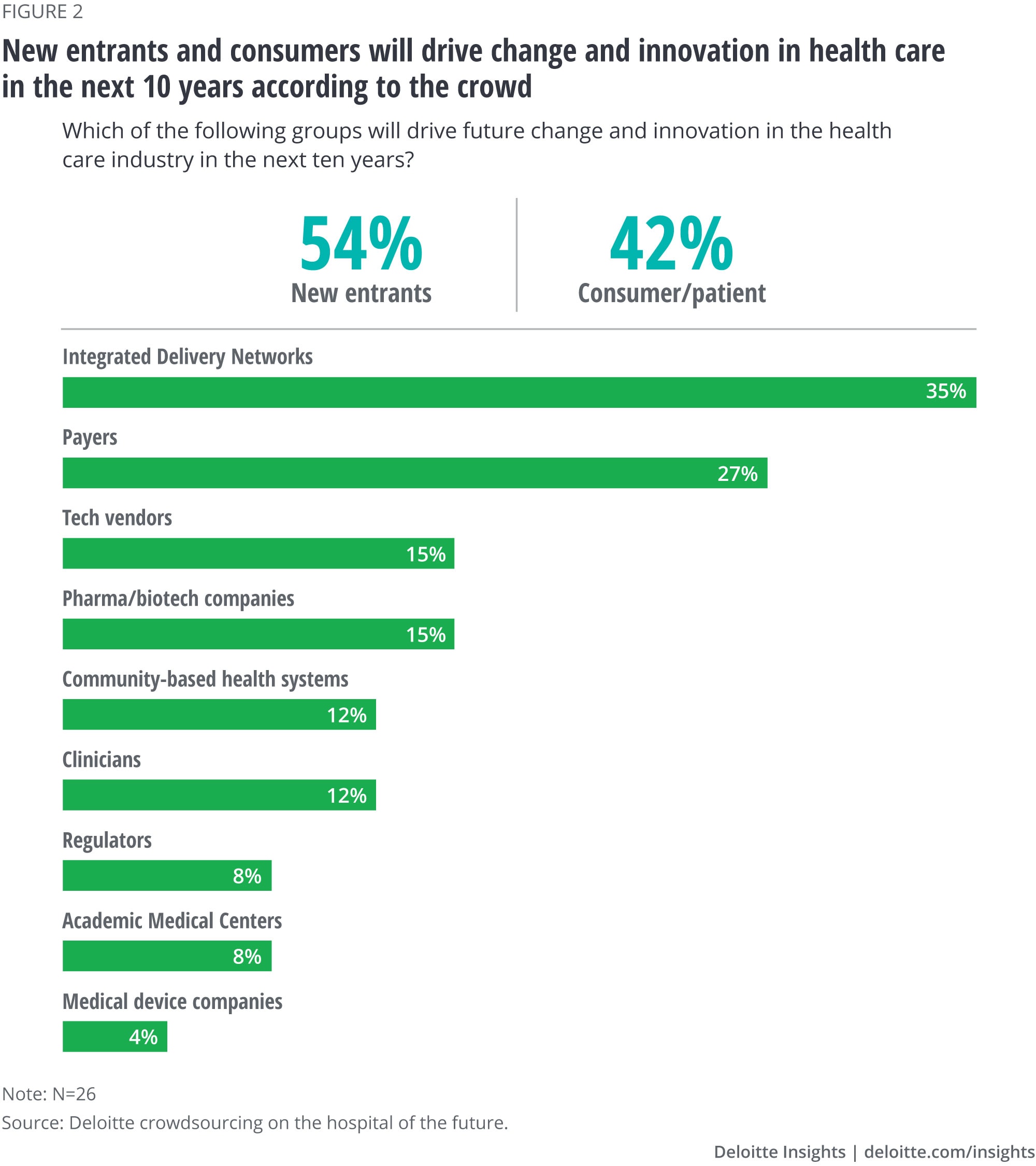
This can be a challenging time for hospital executives. Facing an industry that has been disrupted by a pandemic, incumbents may face even greater challenges ahead, such as meeting pent-up demand, catering to higher levels of uncompensated care, addressing social determinants, educating nervous consumers, and competition from new entrants. New entrants—not the typical health care providers of today—and consumers are expected to drive change and innovation in health care in the next 10 years (figure 2). This was in response to a question asked before the pandemic, and the disrupted industry may be even more ripe for consumers and disrupters to demand and bring about change.
Build upon the acceleration of innovation today
Hospitals had to shift their investments and priorities rapidly to respond to the pandemic. To sustain innovation, they now should continue to invest in the following:
- Data and interoperability capabilities
- Virtual health and digital solutions
- Offerings to enable the shift of patients out of the hospital
- Improving consumer experience and meeting their expectations
Plan for the future: Strategy, capital, and workforce
Today’s executives should ask themselves the following questions to help determine which business model they will use to position their organizations to thrive in the future:
- What is your market position today? What do you want it to be?
- What are your competitors up to and who are your competitors of the future?
- How are you going to win (or survive) in your market?
- How can you meet consumer expectations, and how are the expectations of your consumers evolving?
After strategic decisions have been made, an important step is rethinking the organization’s capital investment strategy and making a plan to move forward. Instead of investing in beds, hospitals should focus capital investments on digital and technology capabilities, particularly virtual offerings.
Organizations should consider what parts of their COVID-19 response should remain as part of their new normal. Organizations need to consider:
- What investments are needed in new capabilities and technology
- How virtual health capabilities should be extended and strengthened
- How to rethink workforce, skills, collaboration models, and enablement. How to enable the types of collaboration required with the virtual and remote workforce
- Which partnerships and alliances are needed to execute on organizational goals
- How to revamp the supply chain to address the change in model and site of care
If anything, the devasting pandemic has taught everyone that hospitals can transform. The hospital of the future may be nearer than we think.
BY
Dr. Kulleni Gebreyes
Jason Wainstein
Wendy Gerhardt
Leslie Korenda
Hemnabh Varia contributed significantly to the planning, question development, research, analysis, and writing. Maulesh Shukla provided invaluable contributions to the research, analysis, and editing.
This study would not have been possible without our research participants who graciously agreed to participating in the crowdsourcing exercise and interviews. They were generous with their time and insights.
The authors would also like to thank Steve Burrill, David Betts, Stephanie Allen, Robbie Robertson, Michael Main, Chris Park, Bill Murray, Arod Balissa, Gaurav Mehta, Kyle Sutter, Sarah Thomas, Ramani Moses, Laura DeSimio, Claire Cruse and the many others who contributed to the success of this project.
Cover image by: Taylor Callery